Building a Ship That is Comfortable for Both Passengers and Crew, According to a Cruise Ship Professional
【About This Part】
In this first part of a three-part interview, we asked about the behind-the-scenes of supporting a sea voyage—including the scale of the luxury cruise ship Asuka II, how guests spend their time, the freedom of enjoying ports of call, the unique charm of an Alaska cruise, the maritime communication environment, and the procurement system for food and water. (This interview was conducted in August 2026.)
◆Scale of Asuka II and the Profile of Its Guests
Sugihara:
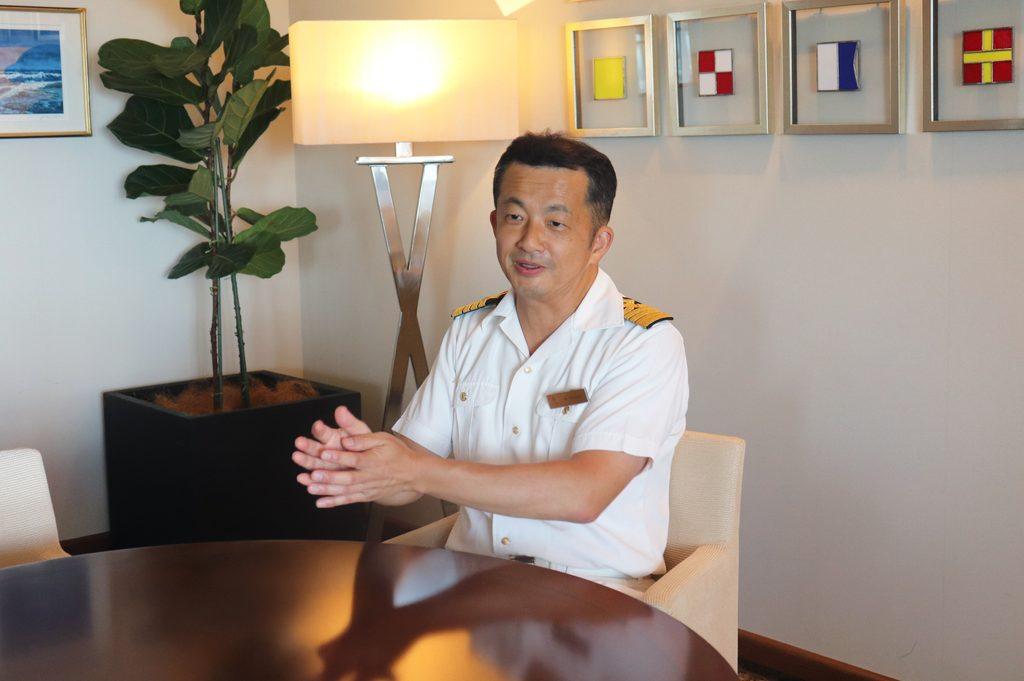
Thank you for your time today. We are speaking with Captain Taguchi, who serves as the 14th ship captain of Asuka Cruise. First, could you tell us about the size of the cruise ship Asuka II?
Taguchi:
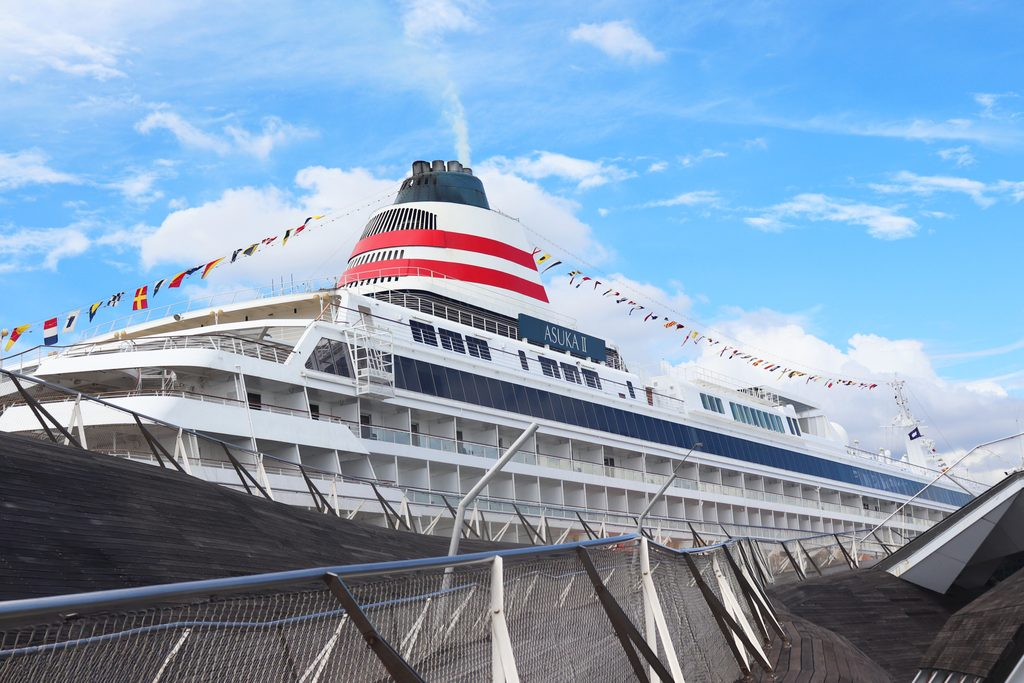
Certainly. We now have a sister ship called Asuka III, which has become our largest ship, but until the spring of last year, Asuka II was the largest passenger ship registered in Japan. Its total length is 241 meters, and its gross tonnage is 50,444 tons. In terms of decks, we often tell people it is a 12-story ship, counting the areas accessible to guests. We have a crew of 490, and we can accommodate a maximum of 872 guests.
Sugihara:
The number of crew members is surprisingly large relative to the number of guests.
Taguchi:
It sure is. We place great importance on the ratio of crew members to each guest, and we maintain this staff size as a system to provide meticulous, attentive service.
Sugihara:
That must be another reason it’s known as a luxury cruise ship. What kind of guests typically sail on Asuka II?
Taguchi:
While the size of the ship is as I just mentioned, the cruises we offer are incredibly varied. The cruise departing today is a 3-day, 2-night trip, something people can easily take during the Obon holiday. On the other hand, the Alaska-Hawaii cruise we ran from April to June of this year took 46 days.
The age demographic of our guests shifts depending on the length of the cruise. For a short cruise like a 3-day, 2-night trip, we often see young couples with children utilizing their company Obon holidays. But for a 46-day voyage, the number of people who can take that much time off is naturally limited, so the majority are retirees. The average age of our guests is around 70, and on our last cruise, I believe our oldest guest was over 90. That shows just how healthy they are
In general, people in society imagine retiring around 60 to 65 years old. However, since the average age on a long cruise is 70, a 65-year-old still feels like part of the younger demographic.
Sugihara:
So, the working generation can enjoy the shorter tours, and with those memories in hand, they can look forward to longer cruises after retirement. That’s a wonderful way to enjoy the experience.
◆Enjoying Ports of Call the Way One Wants to
Sugihara:
I personally have never been on a cruise, but while traveling around Japan, I saw a cruise ship from Hong Kong, not the original Asuka, docking somewhere around Matsuyama or Nagasaki. Right after docking, the cruise guests immediately scattered to various locations in groups. It felt very relaxed, not rushed at all. I felt that scattering out to places you can only reach by ship is a unique way to enjoy it.
Taguchi:
That is generally how it works. For cruises with ports of call, we sometimes offer excursion-style tours on sightseeing buses to visit local attractions, and for those who prefer to just look around the port area without joining a tour, we offer shuttle buses. There are also guests who simply relax on the ship the whole time we are docked. Everyone enjoys it at their own pace. For those who come primarily to stay on Asuka II, just gazing at the town from the port is perfectly fine.
We do prepare shore excursion tours that cover the main highlights, but whether or not to choose them is entirely up to the customer. For older guests, even if they have booked a tour, they might cancel if it rains, thinking it would be terrible to fall and get hurt. Yet, just relaxing on the ship is a fully satisfying way to spend the day for them.
Sugihara:
Some customers probably prefer not to receive a strong recommendation, right? Like someone saying they just want to eat fried rice at a luxury Chinese restaurant, and that being perfectly acceptable.
Taguchi:
Exactly. I believe the best establishments pleasantly embrace and cater to whatever way the customer wants to enjoy themselves. Many people associate cruises with delicious meals, dancing, and watching movies. However, for repeat guests, their ways of enjoying the trip vary wildly—some come just to see crew members who have been working here for 10 or 20 years, some spend their time gazing at the ocean, and others board specifically to pass under a bridge they have fond memories of.
We cannot unilaterally recommend everything, and the guests might not want us to either. Our stance is to provide the options, and let the customer choose.
◆Alaska Cruises: Breathtaking Views Only Accessible by Ship
Sugihara:
By the way, on long cruises spanning over a month, are there places that are difficult to reach by plane or land, but are accessible specifically because you are on board the Asuka?
Taguchi:
The fact that certain places can only be reached by a cruise ship is one of the reasons the Alaska cruise is so popular. Alaska has many glaciers, and the areas near them form U-shaped valleys with deep waters, allowing even large ships to get quite close. Since you can’t get there by car, cruising through the fjords and seeing the glaciers is an experience unique to ships.
During the summer, Alaska is a highly popular route with ships from foreign cruise companies coming and going constantly. If you are lucky, you might even encounter shifting ice or the moment an ice wall collapses. It’s too dangerous to go there by car or on foot, but you can go by ship. That is another part of the appeal.
Cruises on Asuka II and Asuka III provide an environment and cuisine tailored to Japanese people, so I believe that is a unique service specifically designed for Japanese guests on the Asuka Cruise.
◆Wi-Fi Connectivity at Sea: The Changes Brought by Starlink
Sugihara:
Since we have group companies in the telecommunications industry, I have to ask: is there Wi-Fi on the ship?
Taguchi:
This is a recent development, mostly post-COVID, but our ship has started introducing Starlink, the low-Earth orbit satellite communications network spearheaded by Elon Musk’s SpaceX.
Even large vessels sailing through the middle of the Pacific Ocean are starting to pick it up. We purchase high-capacity lines and provide the service to guests, albeit with some restrictions, such as time limits. If you ask whether it’s usable, yes, it is. However, if you are asking if it’s on the exact same level as land-based internet where you can stream Netflix endlessly, it’s not quite there yet. But for things like exchanging LINE stickers, there is no problem at all.
Back when I was just a navigating officer on an around-the-world cruise, we had absolutely no communication environment like that. If we saw a moving landscape, we could only share it among the guests right there. Now, you can instantly share beautiful scenery on social media with family and friends on land while you enjoy it.
Sugihara:
Was this driven by increasing demands from the passengers?
Taguchi:
Rather than an increase in demand, it was more of a consensus that there’s no reason not to adopt it. Within the general sentiment that it would be convenient to have, various ships have started introducing it. As the bandwidth grows, we also hope that guests with flexible schedules can work while on board, enjoying a “work-ation”.
While it might be difficult to watch long videos on Netflix, a web conference that’s mostly conversation with a few slides is perfectly fine. In fact, during our around-the-world cruise the year before last, we had a guest who was participating in web meetings based in Japan while aboard our ship.
◆Food and Water Procurement and the Behind-the-Scenes Work That Supports It
Sugihara:
You mentioned cruises that last for months. How do you replenish the buffet-style meals, beverages, and water during that time? Do you have equipment to turn seawater into fresh water? Please explain your procurement system.
Taguchi:
Oil and food naturally deplete as they are used, so we don’t go a month and a half without restocking at all. If fuel gets low, we do bunkering at a port of call to refuel, and similarly, we procure additional food at ports along the way.
As for water, we use a technology called reverse osmosis to turn seawater into fresh water. It’s a Japanese technology where seawater is pushed through under intense pressure to produce fresh water. In the past, there was also a method where we used the heat from exhaust gas to boil water, lowered the atmospheric pressure to drop the boiling point and create steam, and then cooled it to make fresh water. However, reverse osmosis is the mainstream method now. We also sometimes replenish our water supply when we arrive at a port.
Sugihara:
So you don’t totally rely on getting water at ports.
Taguchi:
That’s right. We operate by continuously making it and taking it in. We basically use nearly 500 tons of water a day. That includes water for bathing, laundry, dishwashing, and everything else, consumed by about 1,300 people in total—our 490 crew members and 872 guests.
Sugihara:
Does food procurement involve sourcing whatever is locally available in each country you visit?
Taguchi:
Yes. We have specialized crew members for that. Staff with experience in the galley investigate in advance to determine what kind of ingredients can be procured and where. For instance, they researched this extensively for the recent Alaska-Hawaii cruise. Sometimes seasonal or fresh items aren’t available locally, so there are fluctuations, but we execute our plans after thorough research on what we can roughly expect to procure.
Sugihara:
Is all of that also part of the captain’s duties, as well?
Taguchi:
I receive reports, of course, but as long as things are running smoothly, I don’t usually intervene. On a long cruise, we have a policy of never serving the exact same menu twice, and the galley staff does an excellent job of making adjustments, like using one certain ingredient from one port or changing the menu if something is no longer available.
Sugihara:
I think it’s the same in corporate management. The departments doing the high-visibility work might seem like they are running everything, but the service cannot exist without the behind-the-scenes work. They are doing incredibly important jobs.
Taguchi:
Exactly. If even a single piece is missing, the whole operation falls apart.
Sugihara:
And you are managing all of that together within a giant framework for months at a time.
Interview conducted by D-POPS GROUP’s advisor Genta Sugihara.
【NYK Cruises Co., Ltd.】
President and CEO: Yuji Nishijima
Location: The Landmark Tower Yokohama, 2-2-1 Minatomirai, Nishi-ku, Yokohama
Established: January 1989
Website: https://voyage.asukacruise.co.jp/en/
Next, in the second part of the interview, we discuss:
・The brand power and domestic/international recognition of Asuka Cruise
・The reality and daily duties of working as a captain
・Captain Taguchi’s career path from working on a cargo ship to managing a cruise liner
・Dealing with crises like sudden illness and approaching typhoons
・And other topics.
Be sure to check out Part 2 here:
https://d-pops-group.co.jp/en/column/asukacruise-part2/