How to Cultivate the Soil for a Restaurant with Endless Lines of Customers, According to a Ramen Artisan
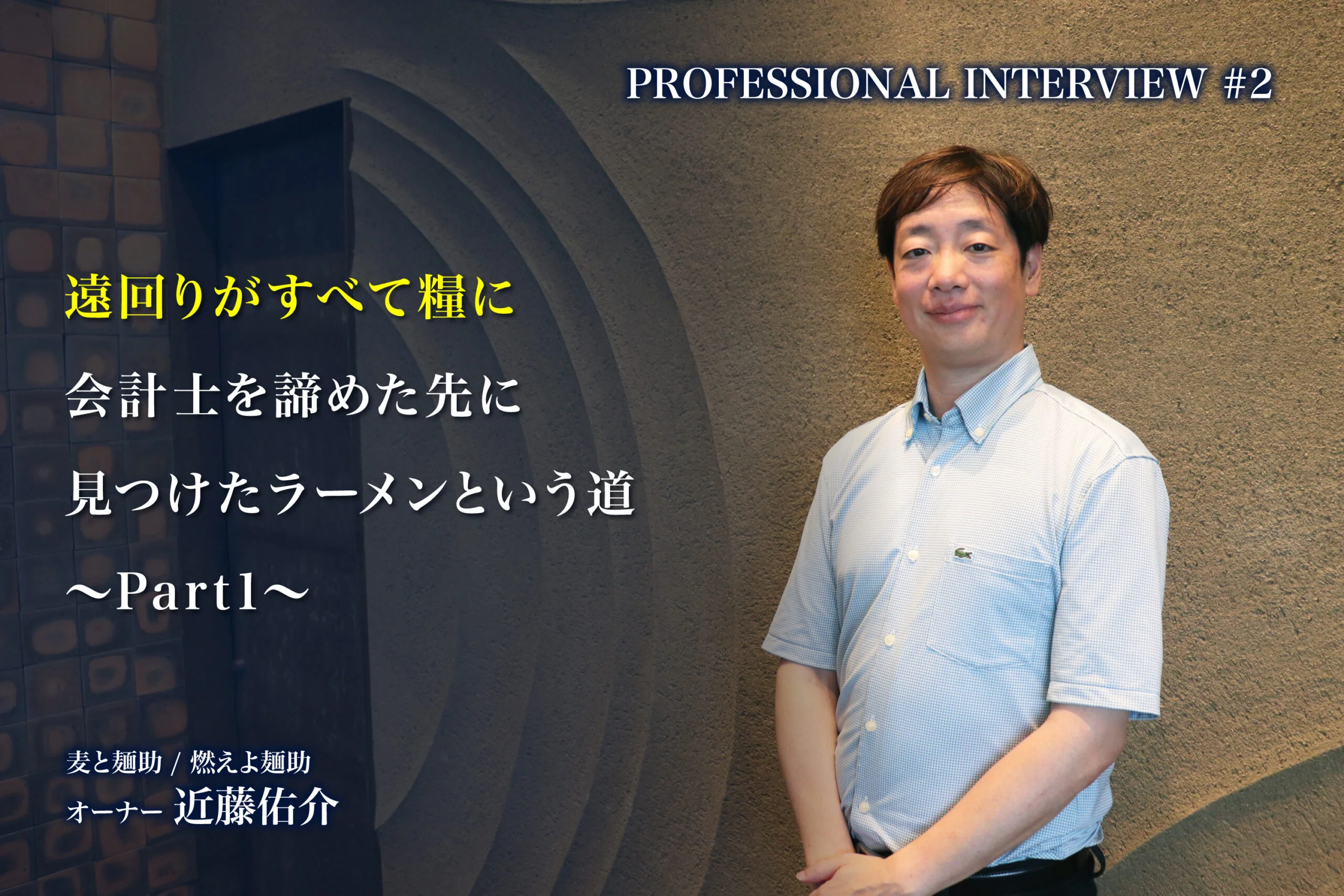
In Part 1, the first of a three-part interview, we asked Yusuke Kondo about his honest feelings on his popular Nakatsu, Osaka restaurant “Mugi to Mensuke” being selected for a Michelin Guide Bib Gourmand for the seventh consecutive year. We also hear about the winding path he took before starting a ramen shop, the dedication poured into their signature guinea fowl soup, and the trial-and-error process behind perfecting its flavor. (This interview was conducted in July 2026.)
◆Seven Consecutive Years in the Michelin Guide: Honest Joy and Expanding Overseas Support
Sugihara:
Today, we are speaking with Mr. Yusuke Kondo, the owner and head chef of Mugi to Mensuke, a ramen restaurant that has been featured as a Michelin Guide Bib Gourmand for seven consecutive years, from 2020 to 2026. First of all, congratulations on Mugi to Mensuke—your incredibly popular restaurant in Nakatsu, Osaka—being selected again for a Bib Gourmand in the 2026 Michelin Guide this spring. Seven years in a row is quite an achievement. Could you share your honest thoughts on this?
Kondo:
Honestly, my first reaction was relief. I view the Michelin rating as a kind of bonus reward for the customers who visit us. My strongest feeling is one of gratitude—I’m just glad for the people who support us and those who wait in line for hours.
Sugihara:
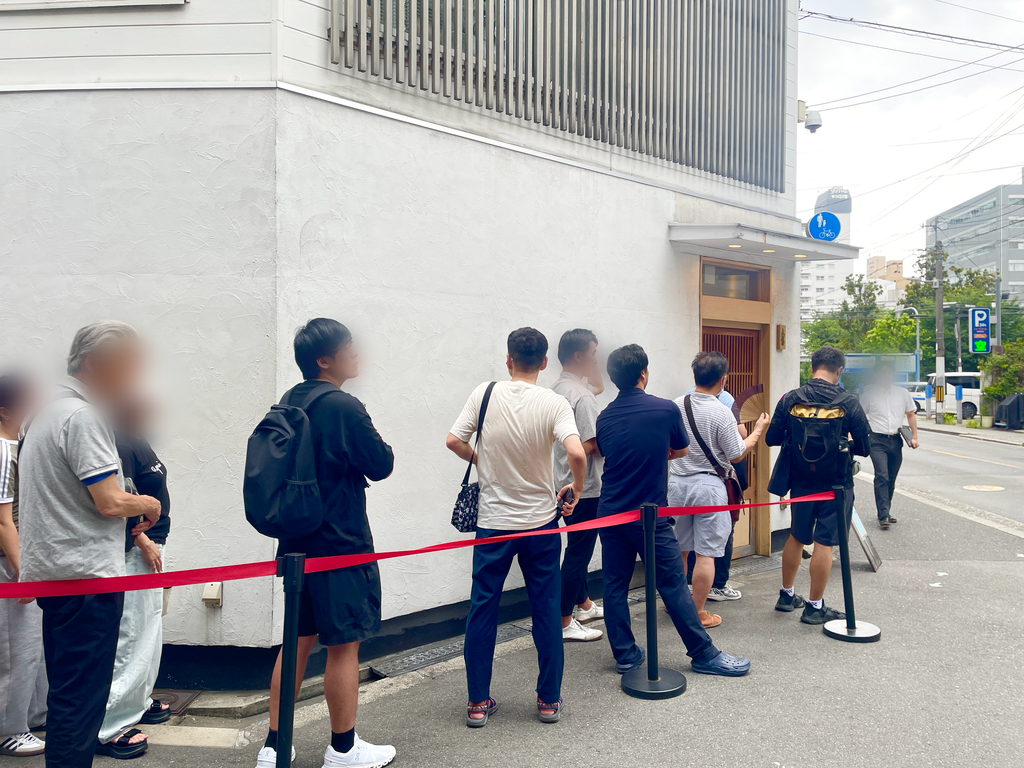
The lines outside Mugi to Mensuke are truly remarkable.
Kondo:
Sometimes I think it’s almost too much. There are certainly seasonal factors, but we are truly grateful. The reality is that people are waiting far longer than I ever imagined.
Sugihara:
What’s surprising is that while waiting in line to eat is a given for Japanese people, looking at the crowd, it seems about a third are international customers from places like Taiwan and Hong Kong.
Kondo:
That is also something I’m very thankful for. Foreign customers have told me, “This restaurant is the most famous one in Korea.” Just the other day, a Thai YouTuber featured us without my knowing, and that caused a sudden surge in customers from Thailand. It feels like the word is spreading entirely on its own, outside of my awareness.
Sugihara:
There are people who set their sights on visiting Michelin-starred locations as if they were World Heritage sites. That is wonderful in its own right, but as a Japanese person, I sometimes wonder if they truly understand the nuances of ramen. It might just be that influencers are broadcasting, “This is delicious.”
Kondo:
With Tokyo’s soy sauce ramen culture, a strong, prominent soy sauce aroma is considered delicious, but for foreign customers, that intense saltiness can sometimes be a bit unapproachable. On the other hand, I think Kansai’s dashi-based soy sauce is easier for people around the world to appreciate. We make it so the sharp edge of the salt isn’t too overpowering, and I feel that makes it more accessible to international palates.
To speak on a more fundamental level, humans are biologically wired to find high-calorie foods—those rich in fats and sugars—delicious. As an extreme example, between a 10-calorie cheese and a 500-calorie cheese, people will naturally prefer the latter.
When you think about it that way, taste preferences might not vary so drastically at their core, even with different cultural roots. Of course, ingredients that are unusual to certain groups of people, like cilantro, can be hard to accept. But fundamentally, if you take the good taste of high-quality ingredients and add fat without masking anything, I believe a wide range of people will find it delicious.
◆A Career Full of Detours that Started with the Search for a Vocation
Sugihara:
Let’s move on to the next question. Mugi to Mensuke is a Michelin regular, and its sister restaurant, “Moeyo Mensuke”, has been selected as a Tabelog Top 100 restaurant for nine consecutive years. You’ve even been called a maestro of the ramen world. When and how did you decide to start a ramen shop?
Kondo:
My life hasn’t exactly been smooth sailing. If anything, it’s been a life of many detours. After graduating from university, I initially aimed to become a certified public accountant.
I studied from morning till night, dedicating about two years to it, but I couldn’t stop failing my exams. My original reason for aiming to be an accountant wasn’t necessarily a burning passion for the work, but rather a desire to learn a practical, stable vocation. Still, some part inside of me believed that if I worked hard, I could do it. When it became clear I wasn’t going to pass my courses, I realized I was in trouble. Right around that time, a friend of the same age who had been working at a hotel Italian restaurant for six or seven years said he wanted to go independent. He invited me, saying, “You studied accounting and bookkeeping before, so you can do the finances.” I couldn’t really do it, but he just asked me to help with that specific part, which is how I set foot in the food and beverage industry.
I didn’t enter the industry as a chef, but I found it surprisingly interesting. Specifically, what I thought was most interesting was the hospitality industry’s service of providing food that customers say tastes good. Of course, in the beginning, I faced frustrating moments like customers saying I looked arrogant just standing there. But from those experiences, a desire to pursue the restaurant business began to sprout.
However, about a year and a half later, the chef had a child. Since his parents ran a temple in Fukui, he told me he was moving back to take over for them. The chef offered to let me directly take ownership of the restaurant, but honestly, I was more worried about what it would cost to close up the shop, and I struggled to decide what to do. In the end, I tried to keep the restaurant going using simple, pre-prepared meals, but the customers left, and I painfully realized it wasn’t going to work.
After that, I happened to find a job at a Japanese restaurant, and I met a company CEO who told me at the time, “If you can do accounting, just do accounting,” so I spent about three years living the life of a corporate officeworker, handling the books for that restaurant. When I turned 30, I thought that if I kept going like this, I would regret it at 40. I asked myself, “What do I actually like?” and the answers that came up were futsal and ramen.
I figured if I opened a ramen shop, I might be able to make it work, but the truth is, I had never once made ramen myself. Even at the Italian restaurant, I hardly had the chance to do any cooking, but the little I had helped out with there had been a genuinely fun experience for me. So, at 30, I decided, “Alright, I’m going to do it!” and quit my job.
I imagine it was a nightmare for my parents. Just when they thought I had finally started working a normal job, I quit and announced I was going to make ramen. My mother was the type to say I should do whatever I want, but my father’s reaction was, “After we put you through university? Are you serious?!” Even so, I basically forced my way through, having already arranged my move before even telling them, and began my journey toward independence.
Once I decided to make ramen, I took a single resume to the shop that was considered the best in Osaka at the time and asked them to let me work there. Even while calling me a “weird guy”, they accepted me, and I trained there for four years. I’m still incredibly grateful to them today.
During my final year there, the number of customers supporting me grew, and it became almost like a pre-opening phase for my own business. As a result, I was able to carry that momentum straight into establishing my restaurant.
During the last two years of my training, I was entrusted with management-style duties at the headquarters, experiencing work from a business perspective in a supervisory role and figuring out how to increase sales. I had only immersed myself in accounting studies to become an accountant, but my understanding of bookkeeping and accounting principles helped me tremendously. I truly feel that every single thing has connected to where I am now.
Sugihara:
So at that place, you weren’t just learning about making ramen, but also about business management.
Kondo:
At the time, I wasn’t intentionally trying to learn those things, but looking back, it is absolutely paying off now.
Sugihara:
Many entrepreneurs who start businesses after working as corporate employees say that the dots of their experiences as an employee eventually connected to form their present success. In your case as well, President Kondo, while you were just doing your best, everything ended up connecting.
Kondo:
That is exactly right. I was giving it my all. Those two years at the headquarters were particularly grueling—so tough that I would never want to go back. I was working from before 8 AM until just before midnight every day. Honestly, there were days I didn’t think I had any talent, but as I pushed through with the determination to finish what I started, I eventually reached the point where I could go independent.
◆Pushing the Limits of Ramen: The Differentiation Strategy of Guinea Fowl Broth
Sugihara:
Now, let’s shift to talking about the ramen itself. I’m sure many of our readers are ramen lovers. I’ve heard that the defining feature of your signature ramen at Mugi to Mensuke is the broth made from guinea fowl, an ingredient familiar in French cuisine. I have had it myself, and it was a rare ramen where I could drink every last drop of the soup. Is guinea fowl a crucial element in crafting your flavor?
Kondo:
Yes, it is a crucial ingredient. We use different ingredients for each restaurant—duck for “Moeyo Mensuke” in Fukushima, and guinea fowl for Mugi to Mensuke. From the very beginning, I was highly conscious of differentiation. If someone simply told me, “I made delicious ramen using lots of premium ingredients,” I honestly wouldn’t be very drawn to it as a customer.
I constantly thought about what ingredient sat right on the very edge of the framework of ramen. You can’t cross the line entirely—for instance, if you used something like crocodile meat, probably no one would want to eat it. Our strategy was to differentiate by featuring a single ingredient that exists as an extension of the Japanese culinary sense of taste. That was also one of the reasons we used duck at the Fukushima shop. In an era where ramen was generally categorized simply as soy sauce, miso, or tonkotsu, I believe we established ourselves as a ramen shop focused on the core ingredients themselves, like duck, shijimi clams, and scallops.
Sugihara:
So, I guess another key point is not to reveal too much information at a single restaurant.
Kondo:
At the time, there weren’t many ramen shops featuring a specific core ingredient like that. Another reason is simply that I get bored easily. Once we made duck ramen a hit in Fukushima, we could have continued on that same path, but I knew I would get tired of it. So I started researching what kind of ingredients could serve as the main dish in French cuisine, and that led me to guinea fowl—an ingredient I honestly didn’t know much about. We tasted it, found it delicious, and decided to just go for it based on that momentum.
Sugihara:
Was the initial idea that it should be used for the soup, rather than as a meat topping or chashu pork?
Kondo:
Some people would say it’s a waste to use it for soup, but doing so completely changes the final product. The lightness of the fat and the depth of the richness differ slightly from standard chicken, and I believed that by pushing it to the limit in a soup, it would become something completely different from any other shop.
I think we are still probably the only ones using whole guinea fowl, meat and all, entirely for the soup. That’s because the costs simply don’t make sense normally. Furthermore, it’s an ingredient with proper historical roots. Apparently, pheasant meat was eaten as a luxury dish by the nobility from around the Heian period. There is even a theory that the style of soup called “Kamo Namba” originated from Toyotomi Hideyoshi’s fondness for duck. So, I think Japanese people actually have a surprisingly deep connection with ingredients like duck and pheasant.
◆No Need for Perfection: Improvement Born from On-Site Reactions
Sugihara:
Regarding this ultimate ramen, did you start serving it only after it was completely perfected, or did it gradually get closer to its current taste through daily service to customers?
Kondo:
Definitely the latter. We start serving something once it’s delicious enough, and because I’m the type to adjust the flavor while observing customer reactions, I choose what works best by looking at their faces on the floor, thinking, “Maybe this way is better.” I’ve lost count of how many times I’ve tweaked the recipe, as in way more than 100 or 500 times.
It’s easiest to understand if you think about the amount of salt, for instance. In fact, even if you just change the type of salt but keep the exact same weight in grams, the mellowness changes due to the difference in mineral content. Japanese customers are particularly sensitive to these delicate differences, so we engage in daily trial and error to make it even more delicious.
Sugihara:
Do you judge this by looking at their expressions rather than asking them directly?
Kondo:
Of course, sometimes we ask directly, and other times we observe them while they eat. Ultimately, a bowl of ramen isn’t great just because it tastes good; it has value because customers ask for it. I believe the fundamental principle is that the more times customers ask for it, the larger its demand has grown.
Sugihara:
That’s really similar to companies in the startup phase. They release a product while still on the ground running, they get feedback, and they iterate on it. They go through countless trials and errors until they get on track and deeply penetrate the target audience. It seems ramen shops operate exactly the same way.
Kondo:
I believe this applies to all businesses, not just ramen shops. Whether you're a hairstylist, an app development company, or a ramen shop, the core is the same: the key is how you can shape things to generate demand.
There’s actually an interesting piece of data: when a chef from a famous restaurant goes independent, their food is undeniably delicious, so you might assume their success rate is around 90%. However, in reality, about 40% fail within a few years. I think this is a clear example showing that if you don’t focus on the business aspects beyond just the flavor, you won’t succeed even if the taste is perfect. Keeping what customers want at the core while continuously adapting the other parts to fit the environment is how you ultimately survive. Pushing through solely with what you want to do is a style that simply doesn’t last.
Of course, chefs still need the backing of knowledge and technical skill to speak authoritatively, but the foundation is always making what the customers want—making the very thing your specific customers are eager to eat.
~To be continued in Part 2~
Interview conducted by D-POPS GROUP’s advisor Genta Sugihara.
【Mugi to Mensuke】
Owner: Yusuke Kondo
Location: 3-4-12 Toyosaki, Kita-ku, Osaka-shi, Osaka
Established: May 19, 2018 (sister restaurant “Moeyo Mensuke” established in Fukushima, Osaka, in April 2016)
Sister Restaurants: Moeyo Mensuke (Fukushima, Osaka), Naniwa Menjiro locations (Namba, Osaka, and Umeda, Osaka)
Next, in the second part of the interview, we discuss:
・The attitude of learning from top-tier chefs
・The realities of management and costs unique to restaurants with long lines
・Strategies for multi-restaurant management and brand building
・The pop-up store at Azabudai Hills along with his encounter with the rare Takasaka chicken
・And other topics
Be sure to check it out here:
https://d-pops-group.co.jp/en/column/mugitomensuke-part2/