



At D-POPS GROUP, our corporate mission is to multiply the number of growth companies (so-called “unicorn companies”) that will revolutionize society, and our core value is to grow and learn together through sincerity, humility, and gratitude.
Genta Sugihara, who serves as an advisor to our company, set a goal for himself: “Conquer all of Japan’s 100 Famous Mountains while wearing our company’s iconic unicorn T-shirt.” Balancing his work commitments, he travels to mountains across the country on weekends, having summited 46 peaks as of writing this article. In this series, we reflect on the successes, failures, judgments, and lessons from his journey, drawing parallels to venture management and organizational leadership.
In Part 1, we discussed the importance of defining your target peak and making the necessary preparations to reach it.
In this second installment, we will explore how to move a challenge forward from the three key perspectives of planning, execution, and forming a team.
4. Detailed Planning: Devotion to the Business Starting from the Planning Stage
There are multiple routes to reach the summit of any single mountain. Whether you choose a short but steep trail or a long route with a gentle incline, you formulate your summit strategy by taking your own skills and physical stamina into account.
Japan’s 100 Famous Mountains are scattered all across the country—from Mt. Rishiri in Hokkaido at the northernmost tip to Mt. Miyanoura on Yakushima Island in the south. Because of this, the approach to each trailhead varies greatly. Will you combine public transportation, such as flights and trains, with a rental car? Or will you drive your own car along the expressway? These decisions must be made after weighing time, cost, and physical exhaustion.
Planning also includes calculating the travel time to the trailhead, estimating course times from ascent to descent, and determining the appropriate amount of water and trail snacks suited to the season and temperature of the day.
Furthermore, will you stay at an inn near the trailhead or spend the night in a mountain hut? When and what will you eat for breakfast and lunch? If you are climbing multiple mountains in succession, how will you reach the next mountain? Will you rest your body and recover your strength at a hot spring somewhere?
You must take every detail into account and build a meticulous plan. While this planning process is enjoyable, it holds the key to a successful summit, so it must be approached with utmost seriousness.
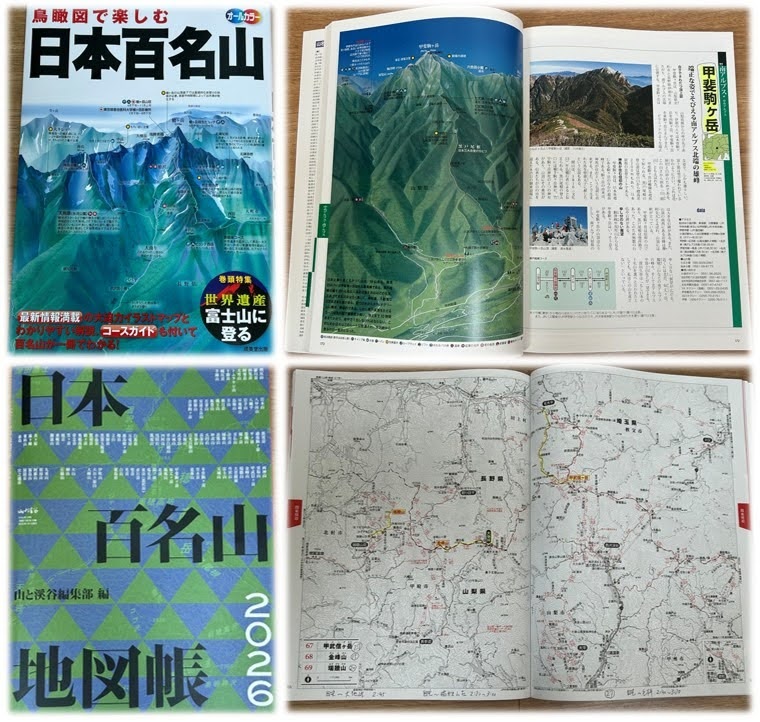
(Pictured: I plan out my approach using maps and guidebooks, and then create detailed climbing plans using a hiking app)
Looking back, I believe startup management is exactly the same. The first thing a business leader must do is thoroughly research the target market, formulate an entry strategy, and build a comprehensive business plan.
Then, you have to develop product strategies, pricing strategies, sales channel strategies, and marketing strategies, identifying precisely where within these areas you will build your competitive advantage. Then, to put these strategies into motion, you outline recruitment plans for the necessary talent and fundraising plans, drilling them down to an actionable level.
The more concrete this plan is—and the more of the founder’s soul is poured into it—the closer the business will get to achieving its envisioned goal.
Whether in mountaineering or management, the challenge truly begins right at the planning stage.
5. Once You Start Climbing, Focus on Every Single Step: A Momentary Lapse in Judgment Can Mean Life or Death
Once you actually begin your ascent, you must focus entirely on taking steady, deliberate steps forward. On many mountains, the summit remains completely hidden from view until you get close. In the meantime, you must walk along long trails enclosed by dense forest, traverse difficult rocky stretches and paths with chains to help you climb, and cross streams many times.
While keeping the big picture of your route to the summit in mind, you must pay close attention to tree roots, rocks, and mud underfoot, taking meticulous care not to slip, trip, sprain an ankle, or fall.
It is no different in startup management.
Even while holding up a grand vision, it is necessary to accumulate effort every day, working on plain and simple tasks. It is common for a startup founder to spend an entire day making sales calls, conducting recruitment interviews in between, and then writing code late into the night.
Again, focusing solely on sales while neglecting cash flow management; pouring all your energy into hiring while putting organizational structure on the back burner; becoming so obsessed with developing new features that you stop listening to existing customers…
These are all clear signs that you’re not paying attention to the ground beneath your feet. Over time, these small oversights will start to add up, and eventually turn into major crises.
Just after writing my previous article, I myself experienced this firsthand while climbing Mt. Gassan in Yamagata Prefecture. About 30 minutes into ascending a slope covered in unstable, slushy snow that hadn’t completely melted, I came upon a steep downhill section. There, I took a step without proper caution, lost my footing, and slid down the slope, hitting a rock at the bottom with full impact.
Fortunately, the rock I hit was flat, so I escaped with only a sprained ankle. Had the rock been shaped differently, I easily could have suffered a compound fracture. I was forced to abandon the climb, and I managed to get back down the mountain and receive medical treatment, but if that slip had sent me toward the bottom of a ravine…I shudder to think what could have happened.
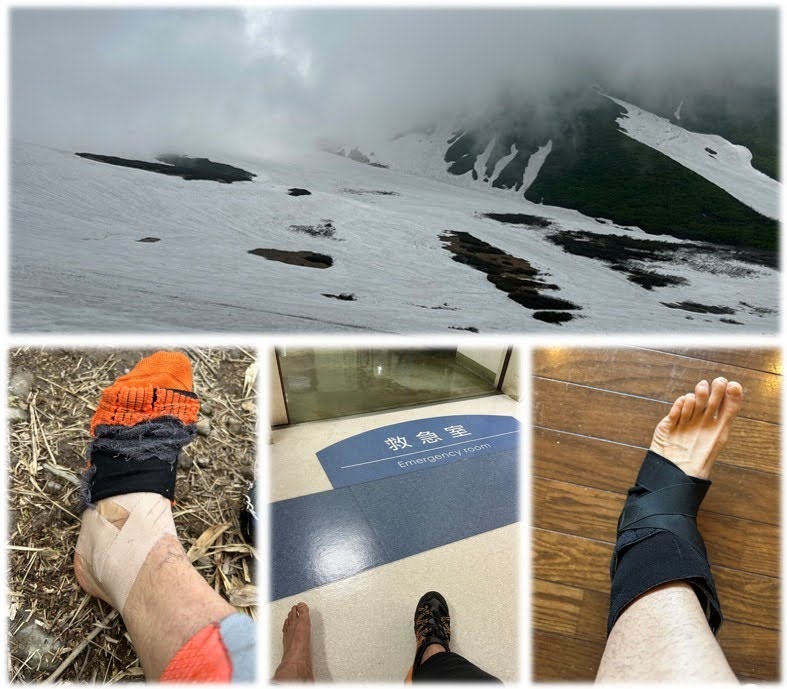
(Pictured: I slipped on a steep, snow-covered slope and landed on a rock, spraining my left ankle.)
In both startup management and mountain climbing, failures rarely stem from a lack of grand vision; more often, they are caused by small lapses in vigilance on a daily basis. A moment of carelessness, a lack of confirmation, cutting corners, or disregarding unglamorous tasks—the accumulation of these minor oversights is what leads to dangerous accidents or falls on a mountain, or the bankruptcy of a company.
The higher and more rugged the peak you aim for, the more crucial it becomes to focus entirely on every single step you take.
6. Climb with Team Members Aiming for the Same Peak: Shared Trust and Values Make an Organization Strong
In mountaineering, when you climb as a group, you verify each member’s experience level and physical stamina beforehand. Those who lack confidence must take measures such as building up endurance or gaining experience on lower mountains. In some cases, you may even have to decide whether someone can participate at all.
If there is too great a gap in stamina and experience among group members, slower hikers may end up overexerting themselves or find themselves unable to negotiate dangerous sections.
Furthermore, if group members don’t know each other well, problems can easily arise during critical moments like if the group gets lost, encounters hazardous terrain, faces bad weather, or has to deal with an injury. Opinions may clash, or judgment could become split.
When climbing higher and steeper mountains, if the commitment and desire to reach the summit vary among team members, their resilience in the face of hardship will vary just as much.
It is advisable that each member should share the same sense of caution and appreciate the weight of taking steady, deliberate steps, as discussed in the previous section.
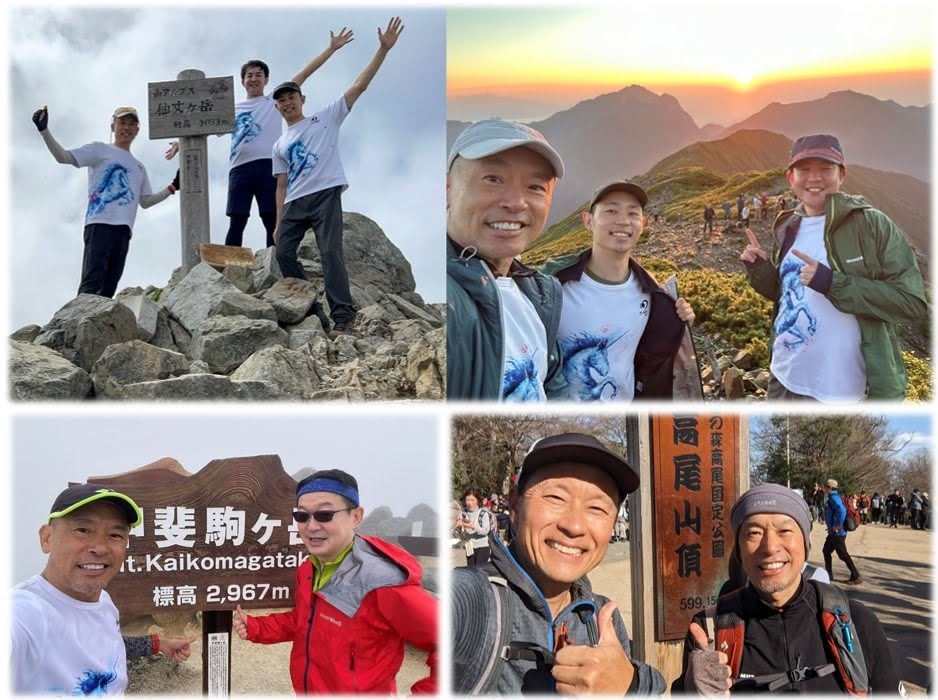
(Top: tackling Mt. Senjōgatake with colleagues from my company; bottom: climbing with close, trusted friends)
This applies directly to startup management as well.
It is advisable for co-founders and employees who join early on (in other words, companions riding the same boat) to hold the same ambitions, bring similarly deep experience in their respective fields, and share a relationship of mutual trust.
In business promotion and product development, your approach will differ depending on whether you prioritize speed or quality. In financial strategy, your plans will change based on whether you choose to take on debt and run deep deficits to aim for massive growth, or aim for short-term profitability through debt-free operation.
The “personality” of a company is a reflection of the founding members’ own personalities. If core members hold vastly different mindsets, friction will eventually spark, causing people to leave one after another.
In other words, what is crucial in managing a startup—especially in its early stages—is not only a match in skill level, but also a match in values and decision-making criteria. These initial members form the core that gradually shapes the company culture.
In my own career, I have navigated through numerous growing and transforming companies: DDI (now KDDI) in its early startup days, AOL during the dawn of the internet, Google around the time of its IPO, and currently D-POPS GROUP in its second founding phase. My criterion for joining each company was always whether the founder’s vision and company culture aligned with my own thinking, and whether I felt I wanted to work alongside the people I met during interviews.
Conversely, there were many companies whose offers I declined because I felt their company culture wasn’t a good fit. I knew that under extreme pressure, I wouldn’t be able to give it my all.
In both mountaineering and business management, there is a limit to the peaks you can reach alone. Aiming for the same summit with companions you can trust is what enables you to challenge yourself to climb higher and steeper mountains.
This concludes Part 2 of “Startup Management Lessons Inspired by Japan’s 100 Famous Mountains”.
I myself am still only halfway toward my goal of conquering all of Japan’s 100 Famous Mountains.
From here on, I will gradually take on steeper and more rugged peaks. I want to continue being as candid as possible about the hesitations, mistakes, decisions, and lessons I encounter along the way.
The next installment’s topic will be “Strategy, Tactics, and Execution”, in which we will dive deeper into the differences between these three concepts by comparing how they apply to the 100 Famous Mountains challenge and startup management.
D-POPS GROUP Advisor Genta Sugihara

September 2025: Mt. Nikko-Shirane (#15), Mt. Kumotori (#16);
October 2025: Mt. Hakkoda (#17), Mt. Iwaki (#18), Mt. Kaimon (#19), Mt. Kirishima (#20), Mt. Odaigahara (#21)

October 2025: Mt. Hakkyo (#22), Mt. Utsukushigahara (#23), Mt. Tateshina (#24), Mt. Kirigamine (#25);
November 2025: Mt. Daisen (#26), Mt. Tanigawa (#27);
March 2026: Mt. Tsurugi (#28)