


“Is my child being bullied at school?”
The parents and guardians of children everywhere share this same anxiety, and the parental control app Kodomamo seeks to resolve it using the power of AI.
Today, this innovative service is gaining significant presence in mobile phone shops across Japan. This success is the result of a strategic partnership built on the strengths of three companies: the provider of the app itself, Adora Inc.; the company with extensive know-how in mobile phone shop operations, D-POPS Corp. (website in Japanese only); and the partner with a robust network across mobile phone shops nationwide, Advancer.inc (website in Japanese only).
This article outlines how these three partners in our Venture Ecosystem tackled the challenge of distributing the Kodomamo app across Japan and led the project to a successful resolution.
[The Challenge] Increasing Awareness of Kodomamo
① What is Kodomamo?
Kodomamo*, provided by Adora, is an original parental control application designed to safeguard children. Specifically, when installed on both the child’s and parent’s smartphones, it can detect when a child is involved in dangerous online chats, enforce screen time limits to prevent overuse, and help prevent use of a smartphone while walking.
*The name is a portmanteau of the Japanese words ‘kodomo’ (children) and ‘mamoru’ (to protect).

The above graphic shows off some of Kodomamo’s key app features and accolades.
However, when the service was first launched, it faced a major obstacle: the wall of awareness: how to get the people who need Kodomamo to know it exists.
② Points of Contact Between Kodomamo and Customers
Kodomamo’s customer touchpoints were primarily limited to online channels and within the app itself. While efforts were made to direct users to the official website through social media and web advertisements, it was difficult to reach potential customers through passive advertising alone. Furthermore, the in-app chat function served only to support existing users and could not act as a contact point for new customers.
While countless parents were worrying about their children being bullied, there was a stark lack of opportunity for them to learn about the potential solution of Kodomamo. Without overcoming this situation, the service could not truly contribute to society.
[The Hypothesis] Reach Customers through Mobile Phone Shops
To solve the challenges mentioned above, we hypothesized that a network of mobile phone shops throughout Japan could be the best way to connect Kodomamo with its customers. The realization of this hypothesis would not have been possible without support from D-POPS (with its expertise in managing mobile phone shops) and Advancer (with its strong network across shops nationwide).
There are many benefits to introducing Kodomamo through mobile phone shops:
① Direct Customer Contact
Staff can propose Kodomamo directly to parents who visit the store, especially when their children are getting their first smartphone.
② Support from Specialized Staff
Just as carrier payment plans can be complicated, there is significant demand for support in selecting and setting up the most suitable app from a large selection. Knowledgeable staff can also assist both parents and children in getting the application installed and functioning on their devices.
③ Continuous Service
Customers gain the peace of mind that they can ask questions at a physical store if any issues arise after they begin using the service.
The concept of maximizing the value of a “face-to-face” experience in a physical store to solve problems that cannot be solved online perfectly embodies D-POPS GROUP’s core business model of Real Business × Technology × Group Synergy.
[The Strategy] A Three-Pillar Approach for Expansion in Japan
To turn our hypothesis into reality, we constructed a strategy based on three key pillars:
① Sales Channel Expansion
Even among the approximately 7,000 mobile carrier shops around Japan, the major telecommunication company NTT docomo boasts an overwhelming number of “docomo Shops”, so we set our sights on working with them. To do this, we had to go through their proprietary product application system, an approval process necessary for retailers to handle their own unique products and services. Part of our strategy involved submitting our application through D-POPS, which manages a number of docomo Shops. After it was approved, Advancer leveraged their network of dispatched personnel to pitch our services at docomo Shops nationwide.
② System Integration
Initially, Kodomamo only supported in-app purchases, which was unsuitable for sales in mobile phone shops. The in-app purchase model made it impossible to accurately track sales performance at each individual shop and provided insufficient incentives to those businesses due to high payment processing fees. To resolve this, we sought system integration that aligned with the shop owners’ business models, creating a mechanism that could visualize sales results and provide appropriate incentives.
③ Sales Scheme Construction
Through consultation with D-POPS’ top sales members, who have extensive know-how of sales in mobile phone shops, we established the most effective sales scheme. Specifically, this involved combining the proposal with the mandatory guidance provided to customers under 18 regarding filtering services. This scheme allows Kodomamo to be naturally proposed as an option precisely at the moment parents are considering safety measures for their children’s smartphones.
This multifaceted strategy, driven by the close cooperation of these three companies, transformed a mere concept into a plan ready to be executed across Japan.
[The Execution] Growth Trajectory Accelerated by the Venture Ecosystem
Here is a timeline of the execution based on the challenges, hypothesis, and strategies we explained so far.
July 2024: D-POPS GROUP invested in Adora (Press Release on Investment in Adora Inc.)
August 2024: The project was launched by a team from Adora, D-POPS, and Advancer.
October 1, 2024: Sales were initiated at Smartphone Consultation Desk TOP1, D-POPS’ chain of mobile phone shops. At this beginning stage, they accumulated sales know-how, and promotional materials were produced by fellow group company graphD.
Late October 2024: The proprietary product application for docomo Shops managed by D-POPS was approved. Armed with this approval and their newly-acquired sales experience, campaigns began at docomo Shops nationwide. Kodomamo received favorable reactions at many shops as “a socially meaningful and profitable product that is easy to sell together with a smartphone”.
February 2025: The proprietary product application for Rakuten Mobile Shops managed by D-POPS was approved. This secured a new sales channel for future store expansion.
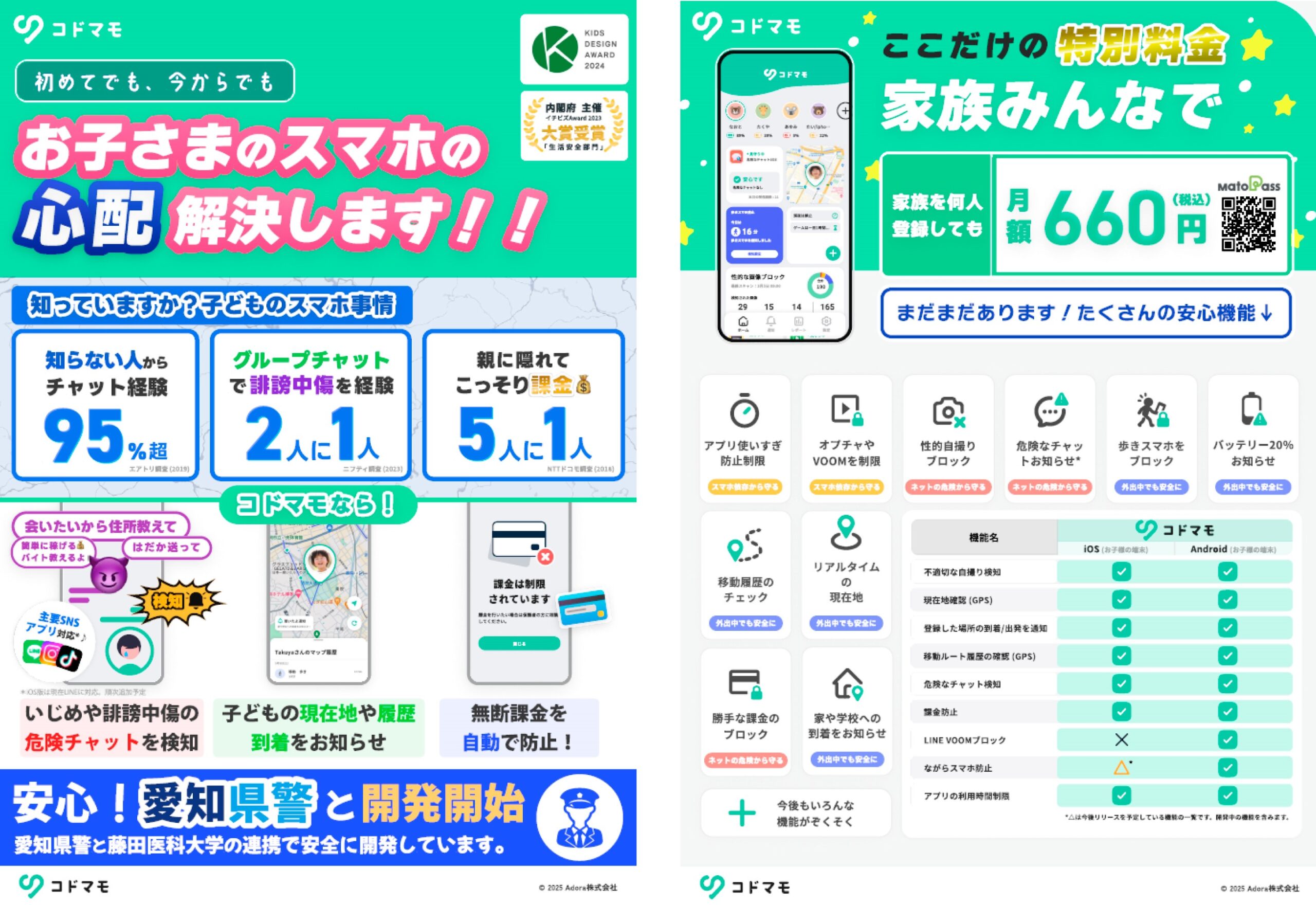
The above graphic advertizes Kodomamo’s relevance for minors who use smartphones, its collaboration with the Aichi Prefectural Police, and a pricing guide with a list of available features.
In this way, D-POPS GROUP’s Venture Ecosystem became a powerful engine accelerating Adora’s growth.
[Results and Next Challenge] Rapid Expansion and Future Issues
The sales channel expansion targeting docomo Shops, which began in earnest in November 2024, achieved adoption in approximately 300 stores in less than a year. The breakneck speed at which it spread is a significant achievement brought about by the collaboration of the three companies.
However, the next challenge is now clear: improving the rate of acquisitions per shop. While the number of shops adopting Kodomamo has increased, there is some variation in the number of acquisitions at each location. To address this, Advancer, which has offices all over Japan, established a new support team composed of members with mobile phone shop sales experience. They are working to raise the overall performance by providing tailored support to shops struggling with acquisition rates.
Additionally, D-POPS and Advancer are jointly supporting Adora in securing adoption with their partners, such as MVNOs (Mobile Virtual Network Operators) and device manufacturers.
[Conclusion] Potential for Unlimited Growth through the Venture Ecosystem
This article summarizes the case where three partners in our Venture Ecosystem collaborated to successfully tackle the difficult objective of boosting Kodomamo awareness—a task that would have been impossible for a single small company—and achieved substantial results.
These efforts go beyond the simple provision of funds. Pooling the expertise and resources of various companies within the group in this way shows a strong case for the successful model of supporting the growth of a startup company. D-POPS GROUP will continue to leverage the unlimited potential of the Venture Ecosystem to create new value to benefit society.
Written by:
Shoichi Sakamaki (D-POPS Corp.)
Shuhei Hosoda and Nizo Ohashi (Advancer.inc)