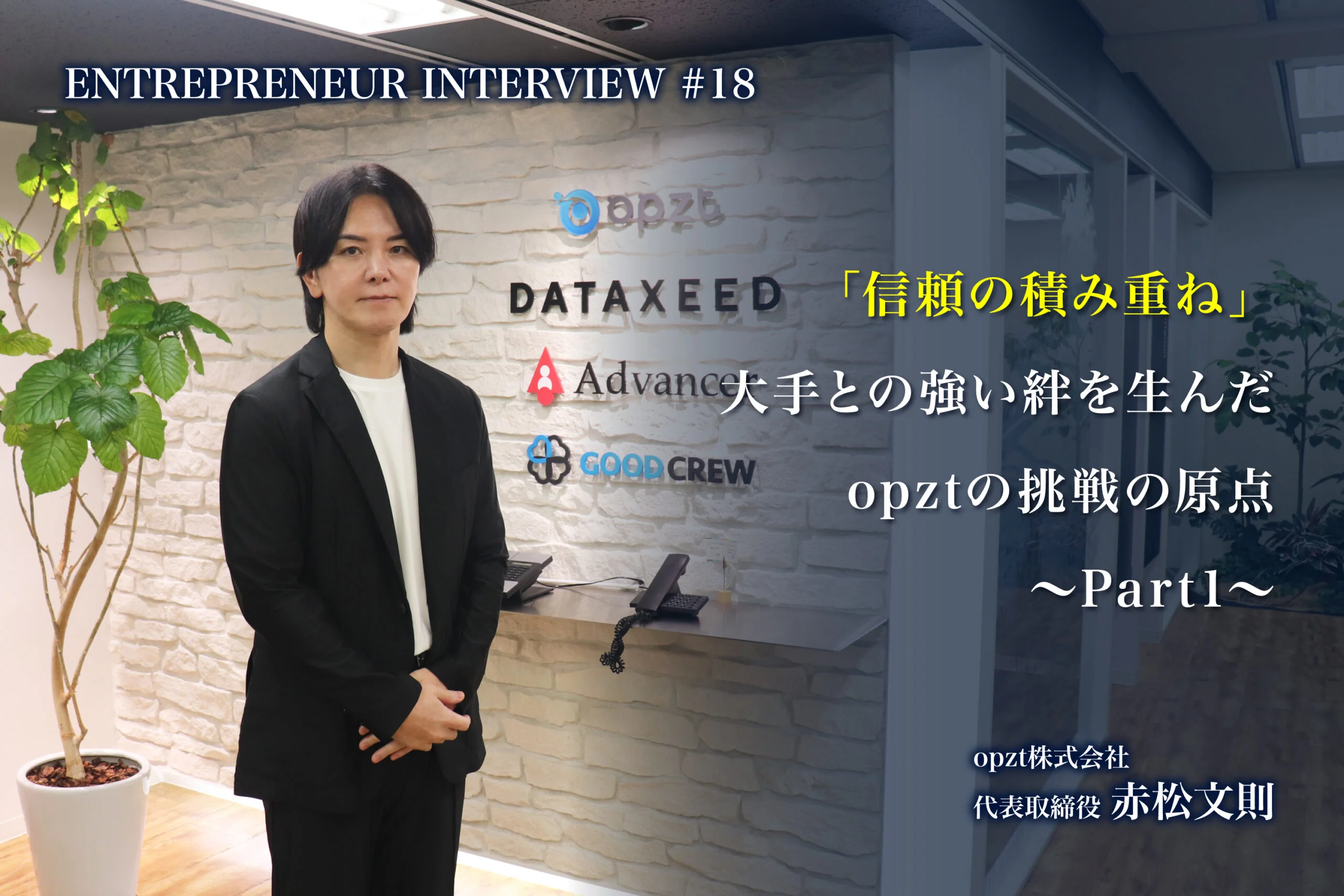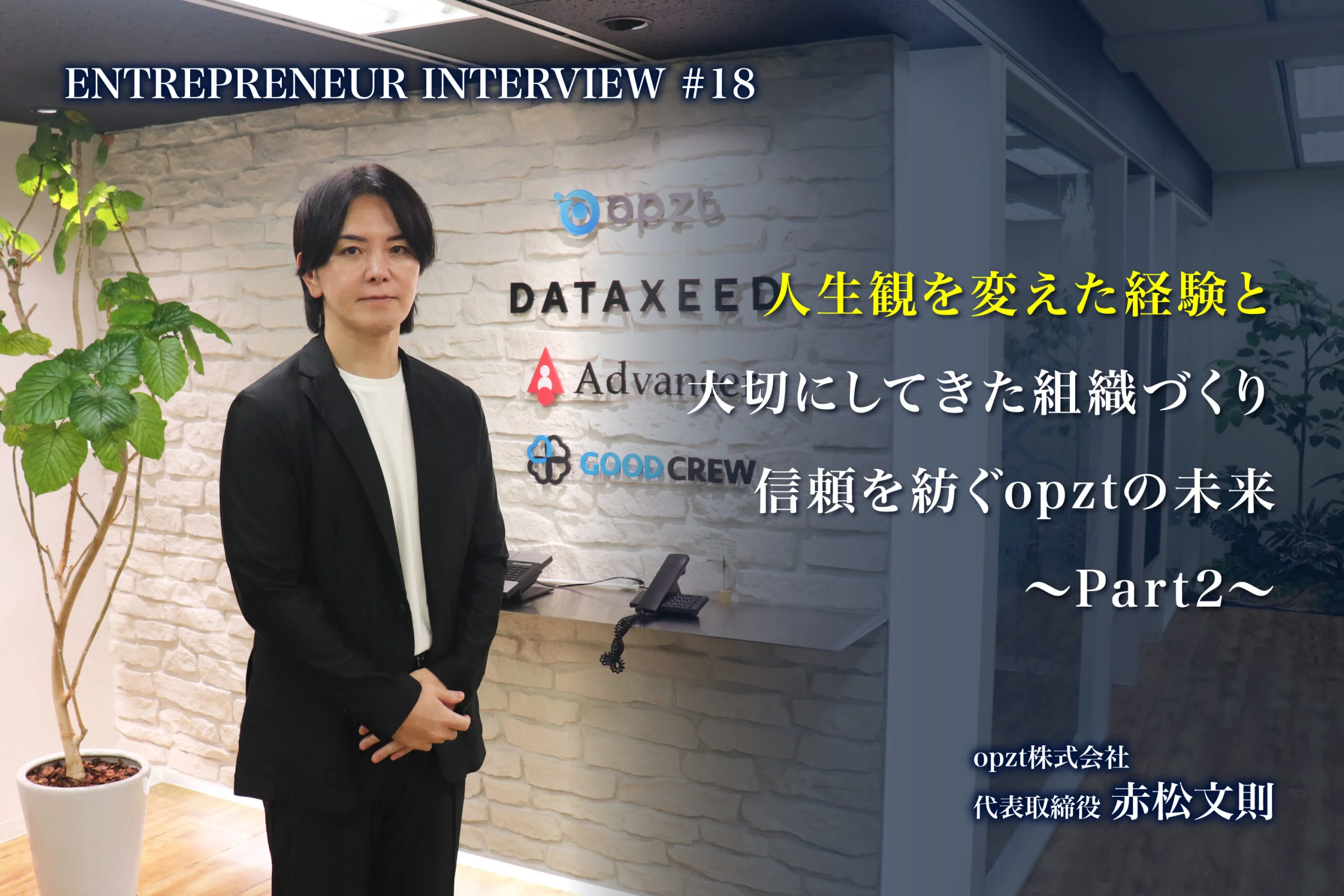
Life-Changing Experiences and a Valued Organizational Structure: opzt’s Future in Developing Trust
In this final installment of a two-part interview, we asked President Akamatsu about his experiences as a musician, what made him decide to be an entrepreneur, his dedication to organization building, the entertainment business he launched after a serious illness, the background of the M&A with D-POPS GROUP, his resonance with realizing a Venture Ecosystem, his vision for five years from now, and a message for our readers. (This interview was conducted in August 2026.)
This is the latter part of the interview. To read the first part, click the link below.
https://d-pops-group.co.jp/en/column/opzt-interview-first-part/
◆Applying Experiences from His Band Member Days to Business Management
Sugihara:
Let’s step away from the business topics for a bit and talk more about you. I’ve heard you used to be a musician. Is that true?
Akamatsu:
Yes, it is true. I played the bass when I was younger and lived in a world completely different from corporate management. However, in a band, if only one person is skilled, the team doesn’t come together. I think there are actually quite a few similarities with managing a company. Everyone has their own personality and abilities. But in the sense of trying to build a single stage on which to perform, I feel corporate management is much the same.
Sugihara:
So you cultivated a sense of teamwork and balance over a long period in the field of music. Has your experience as a musician back then helped you in your role as CEO?
Akamatsu:
I suppose so, though it’s hard to say for sure. The sense of reading the audience’s reactions during a live performance and grasping what they want might be something I still utilize today.
Sugihara:
That makes sense. You definitely can’t do business with major corporations if you can’t read the room.
◆Creating a Company to Be Proud Of: The Background of opzt’s Founding
Sugihara:
You touched on this briefly earlier, but could you tell us again: what was the catalyst for starting opzt, and how do you feel now looking back on the 13 years since founding it?
Akamatsu:
My original motivation for starting a business wasn’t a grand plan to build a massive corporation. Rather, it was a somewhat modest ambition to run a business I alone was responsible for, and create a company that my employees and I could truly be proud of and satisfied with. I didn’t have some sort of grand vision.
About 20 years ago, the HR industry was full of extremely exploitative, so-called “black companies”. While working in that environment, part of me felt a desire bubbling up to build a company that would value workers more and could respond more quickly and flexibly to clients. That was how I decided to start up opzt in 2013.
Looking back over these 13 years, more than the company’s sales or scale, my strongest feeling is that we’ve somehow made it this far thanks to the connections and relationships we’ve built with people.
Sugihara:
It’s wonderful that your journey began not with a grand corporate scheme—which doesn’t always go well for entrepreneurs without a concrete plan—but from a genuine desire to provide everyone with an ideal workplace due to your personal experience.
In my case, I joined my previous systems company intending to be an engineer, but as it turned out, it used to be a dispatch business back then. My boss would only show his face about once every six months, and I was constantly working at a client’s factory. In those days, we were just seen as unit prices. Even if I was highly evaluated on-site, it was never reflected in my salary at all. That was the era, wasn’t it? In the end, I quit three years later, ha ha.
Akamatsu:
That’s exactly how it was. In those times, dispatch staff weren’t allowed to take paid leave, and if we were short on people, we were told to go recruit strangers on the street. We were judged solely on numbers and told to push for more overtime. It really was an unreasonable era.
Sugihara:
Speaking of that, I get the impression that employees who joined around the time of your founding have stayed with you for a long time. Is there anything you prioritize or keep in mind regarding your people in terms of organization building and company management?
Akamatsu:
Honestly, I simply have nothing but gratitude towards them. I am truly thankful that many employees have stayed for so long.
What I value is not looking at employees merely from the perspective of job titles or numbers. Everyone has things they are good at and things they struggle with; some excel at sales, while others are great at administration. Rather than forcing everyone into the same mold, I consciously try to create roles where each person can thrive.
Also, rather than having only the founding members make decisions, I want to properly provide opportunities to newer employees and nurture the next generation of leaders and managers. While we’re intentionally preserving those values, at the same time we are trying to transition into an organization that operates according to systems rather than relying on specific individuals.
◆A Philosophy of Helping to Raise Up Executives Instead of Micromanaging Individual Branches
Sugihara:
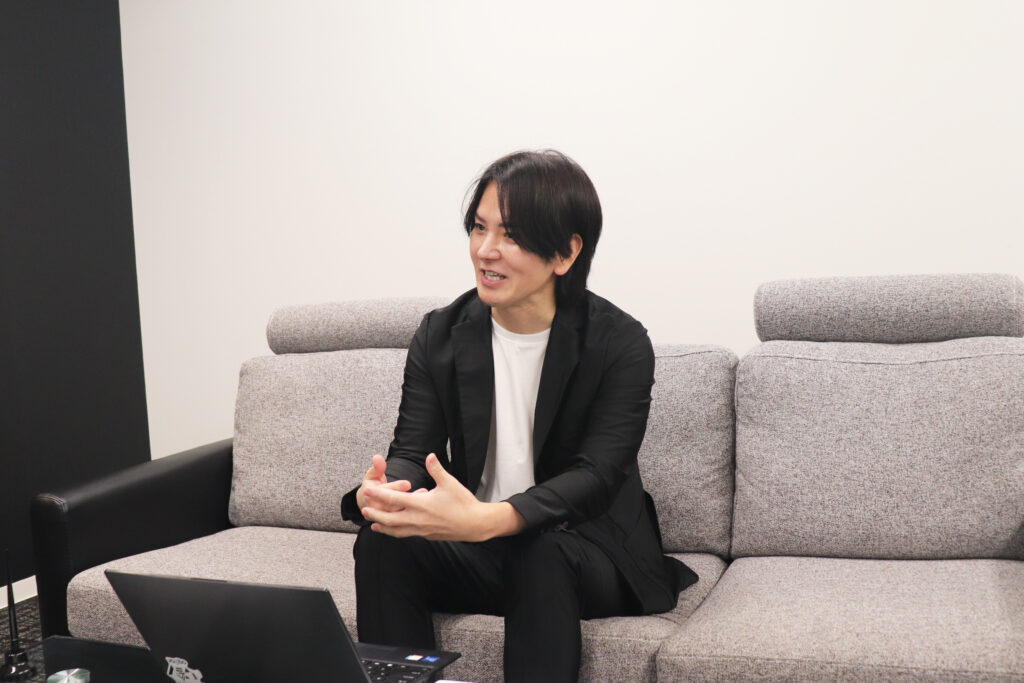
I often meet with the team members of opzt’s Tokyo branch based in Shibuya Hikarie. Even when you aren’t there, they work incredibly earnestly and harmoniously. They maintain a bright, positive atmosphere, mixing seriousness with jokes as they manage their tasks. With offices scattered across Nagoya, Shikoku, and Kyushu, as you mentioned earlier, how do your staff and employees work so independently and reliably?
Akamatsu:
Well, the key is actually to not micromanage each branch. The clients and recruitment markets are completely different depending on the region, and we’ve learned in the past that simply forcing them to use the patterns that are successful at our headquarters doesn’t work.
And I think a major reason the Tokyo team can operate autonomously is that the local members think for themselves, make decisions, and commit to the results. It feels less like managing a branch and more like helping branch managers to grow.
Sugihara:
That’s impressive. Everyone truly acts with a mindset like they’re also an executive, and seem driven to boost Tokyo’s performance.
◆Lessons from a Serious Illness: The Background Behind the Birth of the Entertainment Business “SELEBRO”
Sugihara:
On a different note, I understand you run an entertainment-related business separate from opzt, called “SELEBRO”. You launched this company after opzt, correct?
Akamatsu:
Yes, that’s right. Currently, through SELEBRO, we operate live music venues and nightclubs, manage artists, and do event planning for music festivals, etc.
As for our business model, we are also heavily involved in entertainment tech, a blending of entertainment and technology. It’s separate from opzt, and while its headquarters is also in Osaka, they aren’t here in this building. My love for music and entertainment was one of my original reasons for founding it, but the biggest factor was being hospitalized for a condition called cerebral artery dissection.
It happened around June or July of 2019, about six months after we joined D-POPS GROUP in December 2018. It was completely sudden; when I went to the hospital, I was told to be admitted immediately. It was a truly desperate situation, and I spent a month in a state where every day could have been my last.
That experience profoundly changed my outlook on life by 180 degrees. Before that, I assumed I still had a long future ahead and I would live until I was 80 or 90. That baseless assumption was turned upside down. I had vaguely thought it would be nice to try my hand at the music business at some point in my long life, but after going through that hospitalization, I realized that rather than thinking I’ll just do it someday, it was better for me to be intentional about doing it so I wouldn’t die with regrets.
When I put on that mindset, old connections of mine from the music world started getting back in contact with me, fantastic venues opened up, and opportunities like that kept coming to me. I figured now I had to do it. So I spoke properly with President Goto, telling him, “This is what I want to do.” He told me as long as I continued to run opzt properly, he was fine with it, making it clear he didn’t want me to do either half-heartedly.
By the way, I recovered from my medical condition. Eventually, my body was able to heal without surgery, and I’m in good health now. I feel like I’m getting a second chance at life. I no longer postpone what I want to do until “someday”, because you never know when you’re going to die.
◆Respecting Our Company’s Individuality: Why We Chose D-POPS GROUP
Sugihara:
Thank you for telling us so much about your personal life. You really went through a difficult experience. Now, you joined D-POPS GROUP in 2018 through an M&A. Could you tell us about that process and why you chose D-POPS GROUP out of the many offers you likely received?
Akamatsu:
At the time, my company was in its fifth year and approaching a scale of about 1 billion yen. As we grew to a certain size, I started to realize that to proceed to the next phase, we needed management resources and expertise that we couldn’t get on our own. That was the starting point.
Since we were growing steadily, we were receiving offers from various companies. The reason I chose D-POPS GROUP was that I was drawn to your CEO’s personality and your philosophies. You didn’t want to simply acquire a company; you wanted to grow together while firmly preserving my identity as a manager and my company’s individuality.
I have many peers who have gone through M&As, and I’ve seen numerous cases where the management policy changes after joining a group, or the founding manager leaves the business. In contrast, D-POPS GROUP continues to let me run the company, allowing opzt to grow while respecting our culture and strengths. I really appreciate how they gently watch over us.
I really decided not based on terms or conditions, but based on who would be managing the company alongside me and whether my employees could continue working positively after joining D-POPS GROUP.
Sugihara:
Just as you hoped back then, your 1-billion-yen company has kept growing over these past six years. Have you learned a lot from President Goto and D-POPS GROUP’s management study sessions while keeping your own structure intact?
Akamatsu:
Yes. Every day, I get to learn more about various aspects, I’m still receiving mentorship, and I feel like I am studying on a daily basis.
◆More and More Managers Emerging from the Group: Resonating with the Venture Ecosystem
Sugihara:
That’s wonderful. Finally, D-POPS GROUP has the slogan of “realizing a Venture Ecosystem”. Please tell us what aspects of this goal resonate with you, and if you’re doing anything to help build this Ecosystem.
Akamatsu:
I resonate with a lot of aspects, but most of all, with the philosophy that it’s not just about one company succeeding, but about new managers and new businesses emerging one after another from within the group.
As a founding manager myself, my goal isn’t solely to make my company bigger. I want to create a cyclical environment where the next business leaders and managers emerge from among our employees, and they in turn create new companies and businesses.
Even within opzt, we give each branch authority and discretion, having them run the branches with the mindset of managing a small company. I believe that circulating the talent, funds, and trust generated by those operations into the next business connects directly to realizing a Venture Ecosystem, so I also agree with that idea.
Sugihara:
It sounds like you are creating an ecosystem within opzt itself, too.
Akamatsu:
Yes. The scale is still small, but I think they share common elements.
◆Five Years from Now: A Company Supporting Corporate Growth with People and Technology
Sugihara:
Please tell us what opzt will look like in five years, or any specific goals you have.
Akamatsu:
In five years, as I mentioned earlier, I want us to be a company that doesn’t just dispatch talent, but supports corporate growth by combining people and technology. Our staffing business remains a major foundation, so while we will firmly maintain that, I want to increase our focus on AI, data, and the data center sectors, transforming into a highly specialized and profitable business structure. Beyond that, I want us to be a company where employees and staff can properly grow, where clients need us for a long time, and where we generate appropriate profits to invest in new businesses.
◆A Message to Our Readers
Sugihara:
Lastly, could you share a few words with our readers? Anything is fine.
Akamatsu:
opzt itself is still an immature company, and I believe technology, including AI, will continue to change at an incredible speed. However, as a company, we want to challenge ourselves with new things without being bound by past successes. If anyone looking for a job happens to read this article, I hope you won’t limit your potential based solely on your current experience. Even if you lack experience now, you can build a new career by learning and taking on challenges.
To any corporations reading this, we want to be a partner who can think alongside you, not just in introducing talent, but also in organization building, operational improvement, and taking on new business ventures. If you have even the slightest interest, please feel free to reach out to us.
Sugihara:
Wonderful. Thank you very much!
Interview conducted by D-POPS GROUP’s advisor Genta Sugihara.
opzt, Inc.
Company President and CEO: Fuminori Akamatsu
Address: 5F Nomura Real Estate Building, 4-2-12 Honmachi, Chuo Ward, Osaka
Established: September 10, 2013
Website: https://opzt.net/