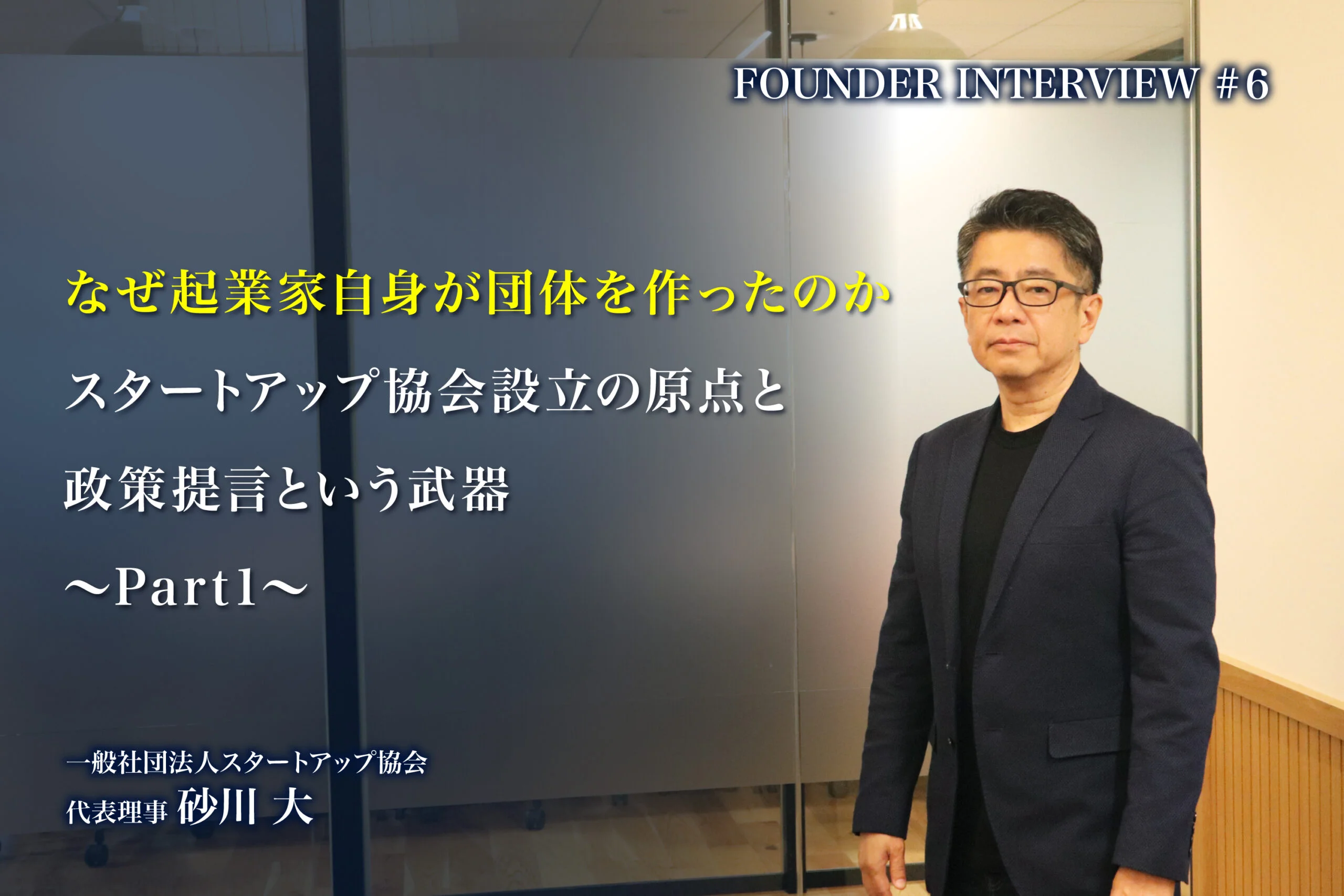
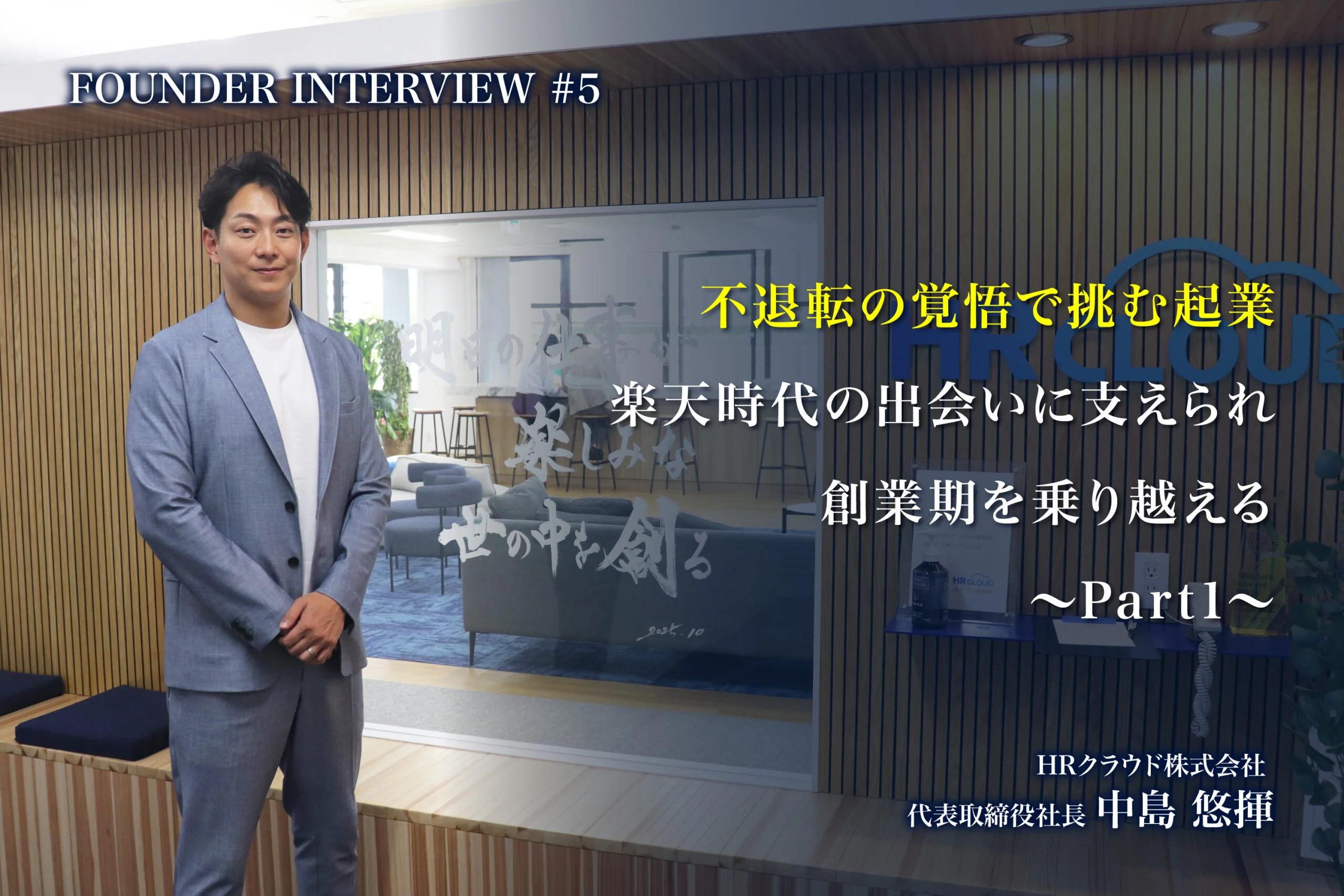
[Founder Interview #5] Masaru Sunagawa (Startup Association of Japan) – Part 1
Why an Entrepreneur Created an Organization Himself:
The Startup Association’s Origin Story
In this first entry of a three-part interview, we explore the backstory of serial entrepreneur Masaru Sunagawa establishing the Startup Association of Japan in 2022. We hear about how strange he felt the Ministry of Economy, Trade and Industry’s advisory committee was because it had virtually no representative from the entrepreneur side, and how that led to the establishment of an organization. We get a glimpse of their activities aimed at raising the level of the startup ecosystem, the meaning of their mission “policy making by startups, for startups”, and the difficulty of management compared to the example of a PTA. (This interview was conducted in May 2026.)
Professional Background:
Masaru Sunagawa, Representative Director of the Startup Association of Japan, President and CEO of Smartround Inc.
After working at Mitsubishi Corporation and obtaining a MBA from Harvard, he worked as a director at a US venture capital firm. After returning to Japan, he founded LocationValue Co., Ltd., and sold it to NTT DOCOMO. After serving as the managing director for Android at Google, he founded Smartround Inc. in 2018. In 2022, he established the Startup Association of Japan and became its Representative Director. He works on developing Japan’s startup ecosystem, and was even involved in the compilation of the “Startup Development Five-year Plan”.
Startup Association of Japan: https://www.startup-kyokai.org/
Smartround Inc.: https://jp.smartround.com/corporate
◆“There Were Almost No Entrepreneurs”: A Strange Advisory Committee Led to the Establishment of an Organization
Sugihara:
First, could you tell us the background of how you established this Startup Association four years ago in February 2022?
Sunagawa:
Originally, before joining Google, I was running a startup called “LocationValue”, and before that, I worked at an independent VC (venture capital) firm in the US, so I have been involved with startups in various positions.
When I came back to Japan and was managing a startup, there were many times when I thought that entrepreneurship here looked strange. The current Companies Act was enacted in 2006, so when I started my company in 2005, companies at that time had to follow the old commercial code. The law itself was written in katakana and was very hard to read, and moreover, the concept of preferred stock like we have now was not established. Therefore, we had no choice but to receive investment from VC through ordinary shares, and to avoid that associated risks, buyback clauses had to be included.
Although the Companies Act was enacted in 2006, it was around 2010 when preferred stock started to be used in earnest. I am one of the rare individuals who have experienced business management both from before and after that transition period.
Because of my background, a person named Ishii, who was a director at the Ministry of Economy, Trade and Industry at the time, reached out to me at some point in 2019 or 2020. Director Ishii said, “You seem to know a lot about the contents of investment contracts, so would you join our advisory committee?”
However, when I went there, virtually everyone was from academia or VC, and there were almost no entrepreneurs. I thought, “Even though we are discussing startup investment contracts, why are there so few people here who are actually from a startup?” The investing side and the side receiving the investment have conflicting interests. For example, at the time of an M&A, it always becomes a talk about who takes more, so an investment contract is a very delicate thing.
I told that to Director Ishii, who said to me, “I just didn’t know who to approach.” That became my inspiration to establish an organization.
However, it took time from there. I had to gather partners, and I also had my own job. Even figuring out how to make a general incorporated association was a matter of trial and error, and the preparations took time.
Sugihara:
At that time, you had already started your own company too, right?
Sunagawa:
I had started Smartround Inc. in 2018, and we had just launched services in 2019.
Sugihara:
Even so, when you presented your awareness of the problem at the advisory committee, you were told, “Why don’t you make it?”, and it was pretty much decided for you. Did you have a “Well, somebody’s gotta do it” sort of attitude?
Sunagawa:
Exactly. Thankfully, since I had successfully exited my first startup, I am not in much trouble financially. And since that’s the case, it’s natural to start thinking about what I can do for the next generation. That’s my philosophy behind Smartround, too. Smartround is a service that helps to optimize operating within the rules, but if the rules themselves are not good, there is nothing we can do. So the idea is to make sure the rules are properly fixed.
◆“Policy Recommendation”: The Only Thing They’re Really Doing
Sugihara:
On your association’s website, if one looks at the details of what your various working groups are up to, and what external collaborations are going on, it’s clear that in a wide range of areas, you are participating in commissions and events, as well as publishing reports. What area do you focus on the most?
Sunagawa:
What we are focusing on is policy recommendation, and you should think of that as all we’re really doing. Everything else we do is more like an accompaniment to that. Honestly, I think policy recommendation is everything. Our mission is “to evolve Japan into the ‘world’s best environment for startups’ through providing mutual aid for startups”. And since we are aiming to create the most startup-friendly ecosystem in the world, we definitely have to change the rules.
Sugihara:
When you make policies that benefit startups, do you get agreement from investors?
Sunagawa:
Naturally, they agree. The reason is clear. When many startups are born and successful startups appear, VCs can take the upside. If the number of startups in Japan decreases and they cannot get on a growth track, the VC industry cannot hold itself up. So, our interests clearly align there.
Sugihara:
At the same time, even if it’s unintentional, is there also the angle that you’re trying to reduce Japanese society’s emphasis on large companies?
Sunagawa:
I think large companies still have a role to play. I was also at Mitsubishi Corporation, and I still love their company. There are things that only large corporations are able to do, like building infrastructure, implementing energy policies, or excavating for rare earth materials. So that is how the roles are shared.
However, startups are better when it comes to driving innovation and creating seeds from scratch. For example, if you ask whether a large company can introduce totally new AI technologies in parallel at the same time and throw all their internal information into them, they absolutely cannot do it due to security reasons. On the other hand, startups can. What’s different is their agility.
◆Only Startup Executives Allowed: Strengths and “PTA-like Difficulties”
Sugihara:
As the founder of Smartround, you yourself are managing a startup, but I believe all of the other board members are also managing startups. What are the strengths of a support organization run by entrepreneurs? And, for that matter, what challenges or difficulties are there?
Sunagawa:
Both the weaknesses and the strengths come down to the fact that it is operated only by startups. We require that our regular members are also startup executives. No one else is allowed to become a regular member.
Sugihara:
How do you define a startup?
Sunagawa:
That is a difficult question. There is no clear definition anywhere in the world, so we have to evaluate each company one by one to see if it’s aiming for and actually attaining rapid growth. For example, a company that has been doing contract development for a long time but newly created its own product and grew rapidly is a startup. And a company that has just been established and does not have a product yet, but aims to go public, is also a startup.
Sugihara:
The fact that it is an organization led solely by startups is a feature, a strength, and also a challenge. What is that challenge?
Sunagawa:
You’re totally right. Because everyone has their own main business, there are differences in the time and passion they can dedicate to this activity. I often tell people to imagine it being like a school PTA (Parent-Teacher Association). Since everyone is a business executive, there is no hierarchical relationship, and decision-making is also very difficult. Everyone’s business domains are also scattered, and since they are all executives, they have solid opinions, but their ranges of interest are often different.
What I do not want people to misunderstand is that we do not think we are an organization representing 25,000 startups. That is impossible, and in the first place, there is no need to represent people who have no interest at all. I think it’s more about how to adjust opinions among the people who participate because they want to improve rule-making and the overall startup ecosystem.
Also, people may wonder what to do if a competitor of your company is in the organization, but even in the Federation of Economic Organizations, everyone is competing, so it is the same story. However, in our case, we concentrate only on raising the level of the overall ecosystem, so it is not about benefiting only one specific company, but we mainly make policy recommendations on things that benefit the whole.
Sugihara:
If it is an organization within the same industry, it is easy to face the same direction, but the Startup Association is not like that.
Sunagawa:
That’s right. But even though our industries are different, we can unite in the sense of making policies that allow startups to properly thrive. We do not have discussions specialized to certain industries or business types, so if we want to do that kind of thing, we take the form of doing it jointly with other related organizations, such as the Fintech Association or the Sharing Economy Association, for example. We do not take the lead ourselves; we cooperate with them in the direction they’re going. Otherwise, things just don’t go anywhere.
◆To Prevent Repeating Common Mistakes: A System of Off-the-Record Meetings
Sugihara:
Your association’s statement of purpose says, “Unless they are serial entrepreneurs, startup executives tend to repeat the same common mistakes as senior executives.” How do you prevent people from repeating those same mistakes?
Sunagawa:
There are all kinds of common mistakes, but I’m most knowledgeable in the area of financing policies. For example, if you accept a demand like “We will give you 5 million yen, so give us 50% of the company’s stock”, you won’t be able to continue fundraising after that. But if you know nothing, you would think, “They’re giving me 5 million whole yen! So that demand must be reasonable,” even though reality is different.
Another mistake is that the knowledge gained by predecessors is not passed down. One difficult trait of the Startup Association is that members eventually “graduate”. When they go public or get acquired, they are no longer startups. Since we gathered together in such a loose framework, not many people intentionally try to do something for another person. Rather, most have the mindset of trying to outsmart other members, so solidarity tends to be weak. What we’re aiming for is to reverse that cycle.
With that in mind—and by the way, we don’t usually mention this to outsiders—one thing we do which is very popular among our members is holding meetings off the record. The kinds of things that can never be said from a public stage happen to startups all the time, right? Matters that are practically life and death, too. By sharing those with everyone, we make it possible to avoid the same failures. Also, things like sharing information using real names, such as “You’d better watch out for investor so-and-so”.
Sugihara:
This is a great thing. It is often said that business managers are lonely. But by joining this organization, they enter a place where they can share information with peers in the same position. By the way, is there a membership fee?
Sunagawa:
1,000 yen per month.
Sugihara:
No way! That is incredibly cheap!
Sunagawa:
To be honest, we’re in the red, ha ha. We’re practically at the level of a student club.
◆Changing the Ecosystem by Paying it Forward: The Case of New York’s Transformation
Sugihara:
Really, it is not about beating someone, and it is fine if everyone succeeds. Even if 1,000 people start businesses, there’s no reason all 1,000 can’t succeed. But if most people have no intention to share their knowledge, they end up like single grains of sand.
Sunagawa:
There’s a very good example of this. New York City, which used to be a barren land for IT, transformed into the world’s second largest startup city after Silicon Valley, due to one entrepreneur named Kevin Ryan, who made the internet advertising company “DoubleClick” successful and launched prominent companies like MongoDB one after another. With this one great entrepreneur as the starting point, a regional system of paying it forward that circulates mentorship, angel investment, and the production of excellent human resources turned New York into a startup city.
What I want to say is that as long as there is such a person, there is a possibility for change. In Japan, despite many people saying “Let’s build another Silicon Valley together”, nobody cooperates with each other, so nothing happens. I think it’s definitely important for someone to engage and shift into gear.
Sugihara:
The leaders of VC funds on the US side are all originally serial entrepreneurs, aren’t they?
Sunagawa:
That’s right. In Japan’s case, quite a lot of people who become VCs did so straight out of financial companies, and haven’t started their own businesses before. Furthermore, entrepreneurs here often stay on as president for a long time without stepping down, even after going public. I don’t mean to criticize, but that’s the reality here. On the other hand, in the US, they have a worldview like AOL founder Steve Case, for example. They start teaching and investing in others, which creates an ecosystem.
~To be continued in Part 2~
Interview conducted by D-POPS GROUP’s advisor Genta Sugihara.
Next, in the second part of the interview, we discuss:
・Building up a trustworthy reputation recognized by the government
・Stock option reform: a policy proposal that turned scraps of paper into returns
・The honest thoughts of a serial entrepreneur who declared “I’ll quit in three years” on his third day at Google
・And other topics