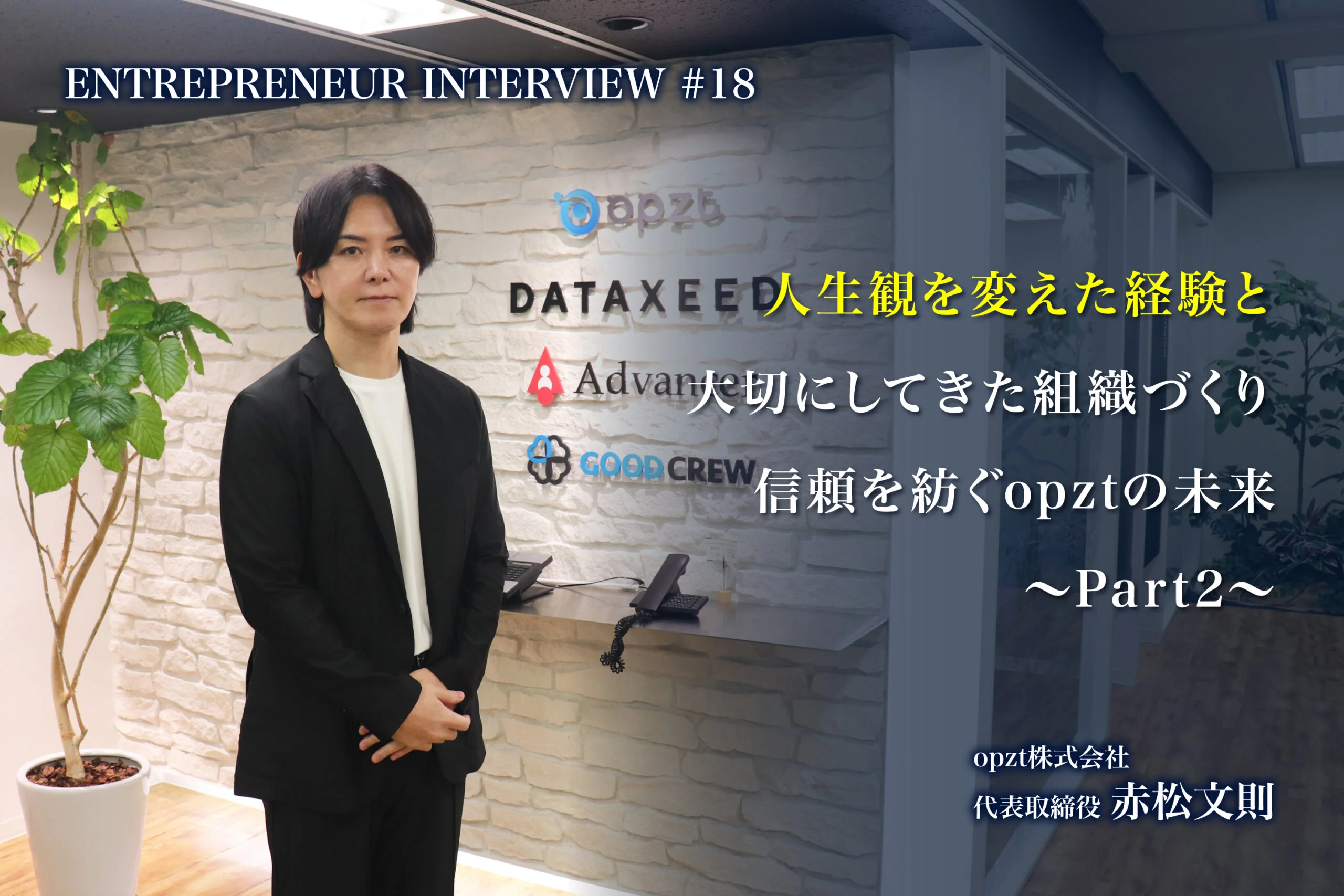
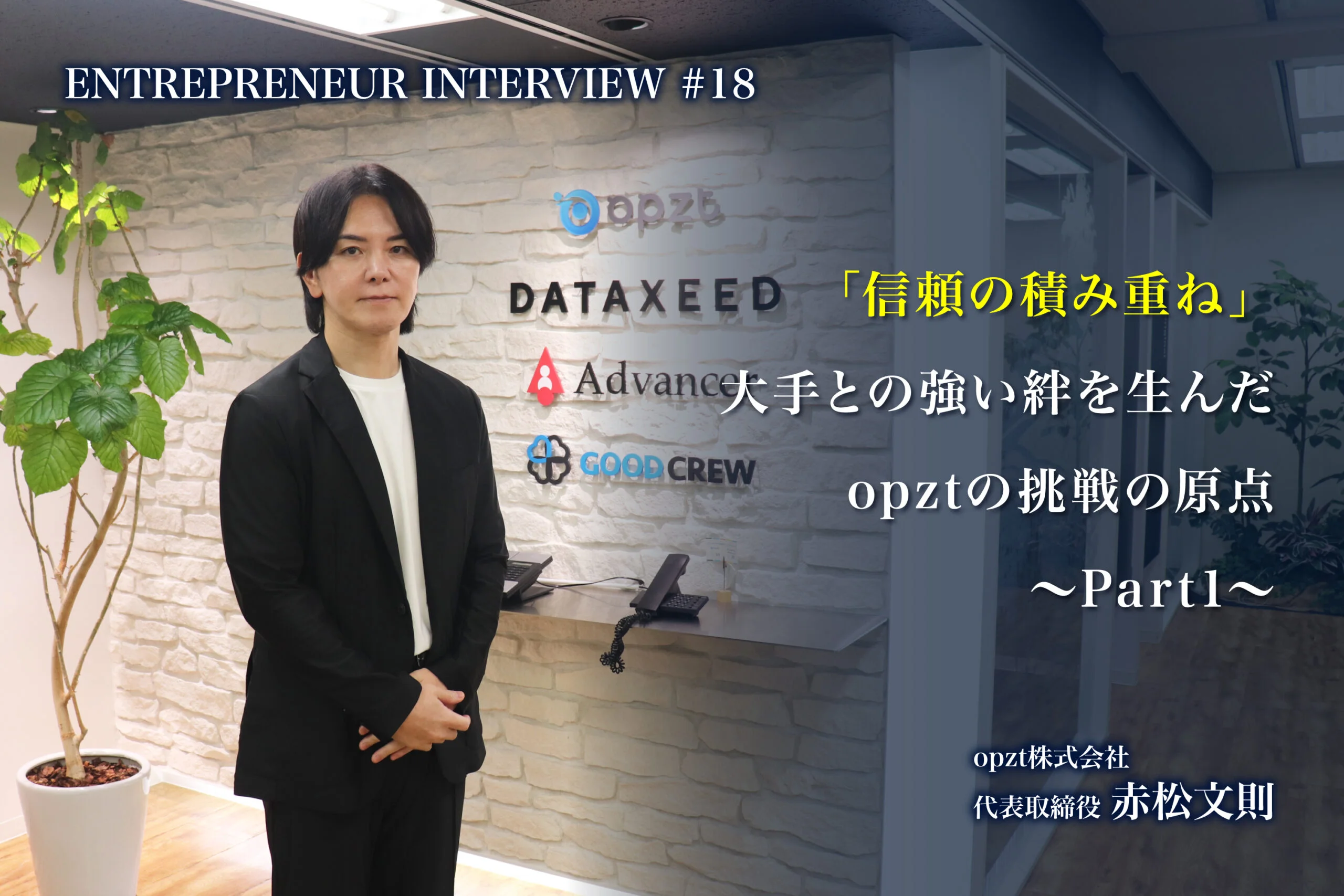
[Entrepreneur Interview #18] Fuminori Akamatsu (opzt) – Part 1
Building Trust with Major Corporations and Creating a Staffing Business that Develops Human Resources
In this first installment of a two-part interview, we asked Fuminori Akamatsu, opzt, Inc.’s founder and CEO, about their business operations, how they build trust with major corporations, their expansion into the technology sector, human resource development, and their approach to the generative AI era. (This interview was conducted in August 2026.)
◆Introducing a Nationwide Business with 5 Locations, Centered on HR and Technology
Sugihara:
Currently, 26 group companies belong to D-POPS GROUP. Today, we are interviewing Mr. Fuminori Akamatsu, president of opzt, Inc., which joined the group in 2018. Thank you for your time!
First of all, although it is posted on your website (available in Japanese only), could you give us an overview of your business in your own words?
Akamatsu:
Our core operations are centered around two main pillars: our HR business, which includes staffing, recruitment, and outsourcing; and our tech business, which handles the IT technology sector. Since our founding, we have provided HR services primarily for the telecommunications industry, focusing on administrative roles, call centers, and sales and promotional support. We currently operate out of five locations—Osaka, Tokyo, Nagoya, Shikoku, and Fukuoka—with many team members working throughout Japan. Recently, we have been focusing not only on conventional HR services but also on the IT technology sector, rolling out highly specialized HR services for roles such as AI specialists, data scientists, and infrastructure engineers.
Currently, we mainly provide System Engineering Services (SES) and operate on an outsourcing and contracting basis, but in the future, we hope to develop and release our own in-house products.
Sugihara:
By the way, could you tell us the origin of your company name?
Akamatsu:
It originally came from the desire for our company to be our clients’ first choice. However, the word “choice” itself implies picking from a variety of options, whereas “opt” carries the nuance of proactively selecting something, so we embedded our desire to become that kind of company into the name. Since there was already a famous company called Opt, we wanted to avoid using the same spelling. We added ‘z’, the last letter of the alphabet, to make a new word which we gave the meaning of “the ultimate, best company”.
Sugihara:
So you drew inspiration from English and coined a new word to make your company’s name. About how many employees do you have in terms of the scale of your staffing?
Akamatsu:
Including both our headquarters staff as well as all of our dispatch employees, there are currently about 550 people registered with our company.
◆Building Trust from Year Two: Forging Bonds with NTT
Sugihara:
You have a very large pool of talent. How do you go about connecting with the clients where you dispatch your employees? I’ve heard before that you have many clients related to NTT. How did you manage to get your company involved with such a massive corporation?
Akamatsu:
A major factor is that when I was working as a corporate employee, I was given a lot of responsibility within NTT Group. Even though I was really just a young kid at the time, various key figures took me under their wing, allowing me to build not only business relationships but also deep interpersonal trust. Later, when I decided to start my own business, an NTT executive who had been a great mentor to me said, “If you’re going independent, I want to support you,” and offered to help me as an advisor. While that’s not the only reason, when I launched my business, former colleagues and other excellent individuals within NTT helped me out in various capacities.
Because many of these individuals had long-standing trust, networks, and lots of personal connections with major companies like NTT, leveraging those connections to establish business deals became our starting point.
And then, truly miraculously, we were able to sign a contract with NTT at the very early stage of our second year in business. Given that we didn’t have a Teikoku Databank rating at the time and weren’t yet the kind of company that they would typically even look at, I think our dealing with NTT was quite the exception.
Sugihara:
I believe your clients include other major corporations besides NTT. Many startups struggle to establish working relationships, so how did you and your management team pave the way for that?
Akamatsu:
We were truly fortunate to do business with a massive company like NTT in our second year, as it allowed us to learn through trial and error the difficulties of working with large corporations (things like information management, compliance, and talent quality). Because we were able to build a certain level of trust with NTT and establish an organizational framework for engaging with major companies, we were able to apply that to other large corporations, which helped us to get up and running relatively quickly.
As has been the case for a while, rather than sales strategies that simply win contracts, we value strategies that focus on how long we can sustain those contracts. I believe our ongoing transactions with major companies like NTT and Docomo are the result of gradually building things up, one step at a time.
Sugihara:
What do you specifically pay attention to in order to maintain business with major corporations, or what do you think is the reason you enjoy such favor with your mentors?
Akamatsu:
I truly believe it’s the accumulation of consistently keeping small promises. It’s about trust—ensuring that the quality of our talent, compliance, and information management are solid, as I mentioned earlier. When a problem occurs on-site, we don’t hide it; we report it immediately and communicate how we will improve as a company. The larger the company, the more they scrutinize these aspects. So, we immediately and thoroughly address each issue. Our employees also strictly adhere to this principle, and I think the accumulation of all these efforts is what makes us stand out.
We started from nothing, and while our initial entry point may have been personal connections, I don’t believe business relationships last this long purely on personal ties. It’s all about the cumulative effort.
◆From Routine Tasks to Highly Specialized Fields: Differentiating Their Business in the Era of AI
Sugihara:
I have the impression that your services have pivoted over these past 13 years. In particular, you recently started a tech-related staffing business. How are you differentiating yourselves in that area?
Akamatsu:
We didn’t originally set out with a conscious decision to pivot. Rather, as we kept our eyes on the HR market, we realized that routine and standardized tasks would inevitably become automated by AI. At the same time, we saw market movement showing an increased demand for talent capable of utilizing AI, such as data scientists and professionals in the AI and data fields. Our company realized about three or four years ago that if we just continued our traditional HR services, we would definitely be weeded out, so we knew we had to focus on high-growth sectors.
However, we felt there was no point in doing the same thing as conventional SES companies. Therefore, we are specifically focusing on areas that directly tie into a company’s competitiveness moving forward, such as AI and data engineers, data scientists, and talent within the infrastructure field who can support data centers.
Additionally, rather than only hiring individuals who already possess high skills, we are running a parallel initiative where we hire high-potential individuals with no prior experience, educate them, and develop them into specialized professionals while they gain practical experience. I believe combining the know-how we’ve cultivated in the staffing industry with specialized expertise in the technology sector is our unique point of differentiation that other companies don’t have.
Sugihara:
Your focus on the data center field, as you just mentioned, is definitely the right move. I’ve seen news from the US where, despite an increase in IT engineer layoffs, the demand for electricians is surging, to the point where even certified public accountants are quitting to become electricians or plumbers. I simply thought it was about having a tangible trade, but it turns out these jobs are related to data center construction. I hear there is a severe labor shortage, and while Japanese manufacturers are profiting from semiconductors and servers, there's also an ultimate demand for the people who actually install them.
Akamatsu:
That’s exactly right. In Osaka, in particular, data centers are rapidly increasing as backups for ones running in Tokyo. They are currently being built at a rapid pace with the idea that even if Tokyo falls, data can be protected in Osaka. Because these facilities require 24-hour monitoring and are often located in remote areas, telecommunications carriers are constantly struggling with labor shortages. We decided we wanted to tackle this head-on and are putting significant effort into it. I may use AI quite a bit myself, but people really are starting to use AI more and more.
◆Hiring Strategies and Educational Programs to Become Clients’ First Choice
Sugihara:
Now, I’d like to ask about acquiring the talent you actually dispatch to the clients receiving these services. I’ve heard of companies even within our own group that are struggling with recruitment. With costs rising and a shrinking talent pool to begin with, how is opzt tackling this?
Akamatsu:
Not to say it’s going perfectly well for us either, but we make a point not to rely on just one recruitment method. Our defining characteristic is that we use a mix of multiple recruitment channels—job boards, recruitment agencies, referrals, social media, and hiring events—depending on the job role and region.
More important than that is becoming a company that applicants actively choose. Today’s job seekers look closely not only at the salary and job description, but also at what kind of experiences they will gain after joining, how it will lead to their future career, and how the company will treat them. Because of this, we make sure not to just say the good things, but to honestly explain everything: the job content, workplace environment, and expected roles. We place more emphasis on ensuring that the people who join us can thrive and work with us for a long time, rather than just focusing on the sheer number of hires.
Sugihara:
That’s wonderful. You mentioned that when people join opzt, you don’t necessarily just hire those who already possess high skills, but you also have programs to educate your employees. Could you elaborate on that? Can someone with no background in technology really become the kind of talent dispatched to that sector?
Akamatsu:
As part of our fundamental training, in addition to basic education on business etiquette, information security, and compliance, we conduct training tailored to each assignment. Especially in the tech sector, we don’t just have them learn online; we prioritize getting them to a point where they can use what they’ve learned in actual practice. We do this by creating assignments for them to present, supporting their acquisition of certifications, and pairing this with follow-up support from senior engineers.
Furthermore, we believe that the ability to report, communicate, ask for help, and to understand a client’s intent is just as crucial as technical skill. So, we adjust our programs for each individual to cover these areas as well. Our goal is to develop talent that makes clients say, “I want to request this person for the job again.”
◆The Era of AI Agents: Stormy Seas or Smooth Sailing?
Sugihara:
Now, for this kind of staffing business—especially within the tech talent sector you’re focusing on—generative AI, and more recently, agentic AI, is a point of concern. Do you view this trend as a tough situation, or an opportunity? What countermeasures or approaches are you taking?
Akamatsu:
I think it’s definitely a storm and a critical situation, but more than that, I consider it a massive opportunity. As I mentioned earlier, standardized and routine tasks are increasingly being replaced by AI, and I can already feel that replacement happening in reality.
However, if we just continue with the same kind of HR services we’ve offered up to now, I believe our company will undoubtedly disappear. On the other hand, I can feel a steady, upward trend in the demand for talent who can utilize data, talent who can implement AI into businesses, and talent with the level of communication and interpersonal skills that AI cannot replace. In that sense, if opzt itself can change and ride this wave, I believe we could be catching a very massive wave indeed.
At our company, we are trying to develop talent capable of using AI even in non-engineering roles like administration, management, and recruitment, beyond just AI specialists and data scientists. By educating people to be on the side that uses AI rather than being used by it, I hope to create a differentiation strategy not found elsewhere.
◆Three New Initiatives for Further Growth
Sugihara:
Thank you. Are there any specific new initiatives you are currently working on for the further growth of your business?
Akamatsu:
There are three main things. First, as we discussed earlier, we are prioritizing the growth of our AI and data business, as well as the infrastructure sector surrounding data centers. Second, instead of dispatching individuals one by one, we are steadily increasing contracts with higher added value through outsourcing, where we provide support as a team. Third, even within our existing HR services, we are utilizing AI to enhance productivity in tasks such as recruitment, interviews, and staff follow-ups.
Sugihara:
Are there clients who need an entire team to be dispatched?
Akamatsu:
There actually are. Right now, engineers with those specific skills are either no longer available, or their rates have become expensive. So, we are seeing an increase in cases where we form and dispatch a team combining experienced professionals with the young talent we are training. As they grow, we add the next wave of new staff to the team, creating a cycle of continuous on-site training.
Sugihara:
I see, the younger members gain experience working alongside their mentors on the same job and in the same field with the same client, building their skills to eventually become leaders themselves.
Akamatsu:
Right. Our clients are also unable to train such talent themselves, so there is a strong demand to outsource the whole process to us. While this system can make things difficult sometimes, it allows our company to bring in inexperienced individuals, so we have recently been proposing to send whole teams to client companies quite often.
Sugihara:
Indeed, while sending someone individually helps that specific person build skills and experience, it raises the question of whether know-how is accumulating within the company itself. Usually, that person would have to come back and act as an instructor for internal training. But that training time doesn’t translate to revenue right away. Instead of making them just play the role of a teacher, they are essentially providing on-the-job training for younger members while both are getting paid by the client, and they themselves learn something through that, as well.
Akamatsu:
Exactly. So we are rapidly expanding this method right now.
Interview conducted by D-POPS GROUP’s advisor Genta Sugihara.
opzt, Inc.
Company President and CEO: Fuminori Akamatsu
Address: 5F Nomura Real Estate Building, 4-2-12 Honmachi, Chuo Ward, Osaka
Established: September 10, 2013
Website: https://opzt.net/
In the second part of the interview, we discuss:
・President Akamatsu’s experience as a musician and how he applies it to business management
・The catalyst for founding opzt, its 13-year trajectory, and organization building
・“SELEBRO”, the entertainment business he launched after a serious illness
・The story of joining D-POPS GROUP and his resonance with realizing a Venture Ecosystem
・opzt’s 5-year vision and a message for the readers
・And other topics
Be sure to check it out here:
https://d-pops-group.co.jp/en/column/opzt-interview-latter-part/