

COLUMN

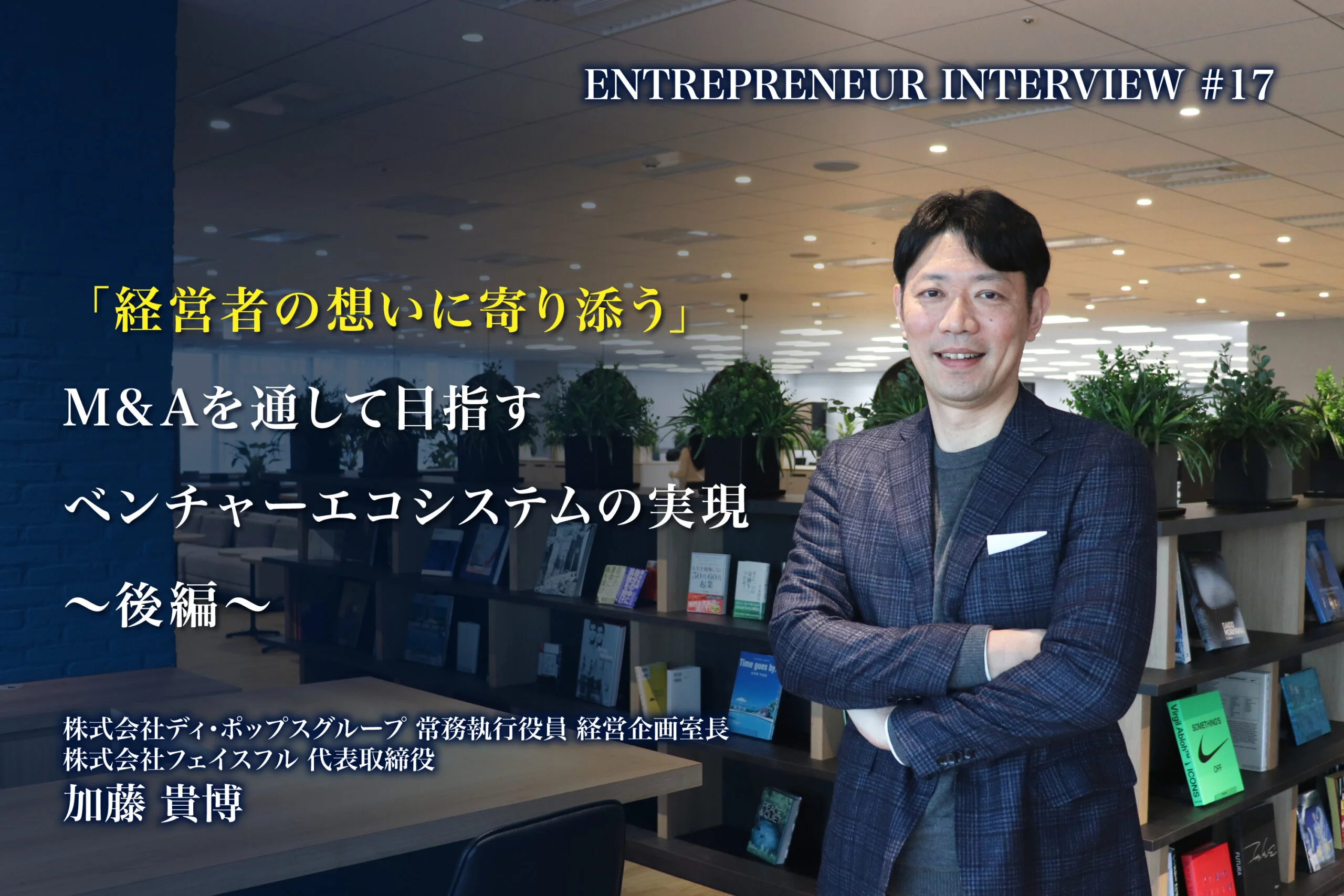
[Entrepreneur Interview #17] Takahiro Kato (Faithful) – Part 2

  • Interview
2026.03.17

“Leaning in closely to the vision of business leaders”
Realizing a Venture Ecosystem through M&A

D-POPS GROUP has 25 group companies that we call partners (at the time of publication).

For this article, we interviewed Takahiro Kato, the Managing Director, Operating Officer, and Corporate Planning Head of D-POPS GROUP Co., Ltd., as well as Co-President of Faithful Corporation, one of D-POPS GROUP’s first member companies. (This interview was conducted in December 2025.)

This is the latter part of the interview. To read the first part, click the link below.
https://d-pops-group.co.jp/en/column/faithful-interview-first-part/

◆Keeping Busy as the Head of M&A

Sugihara:
On the other hand, you continue to serve concurrently as the head of M&A. Regarding the weight of your responsibilities, how do you balance your role as President of Faithful with your M&A duties?

Kato:
The pressure of M&A occupies over 90% of my heart and mind, but what takes up more of my time is Faithful’s business operations.

This is especially because I started as a complete amateur with M&A. Because there are so many buyers in the market these days, good deals won’t just come around if you simply sit and wait.

Sugihara:
How did you manage to start accumulating deals when you didn’t even have any connections?

Kato:
I certainly wasn’t a very pretty sight during my first year. I attended every M&A seminar I could find, but those are usually designed to attract sellers. However, I made a point of sitting in the very front row, asking question after question, and at the end, I would approach them head-on and awkwardly ask to become friends with those agencies.

I would also boldly crash social gatherings even though I didn’t know anyone, and gradually, I began to get close to some people. After a solid year of relentlessly repeating this process of relationship-building, I finally connected with our first deal: graphD.

Sugihara:
Looking back at your core business at the time, wasn’t it a little unexpected to take on a new industry with graphD for your very first M&A deal?

Kato:
I think you’re exactly right. There were concerns that we would be spreading our domains a bit too thin with that first M&A. When I first proposed the deal, President Goto wasn’t very keen on it either.

However, the situation suddenly changed in a funny way. One of our major clients, a telecommunications carrier, gave us very positive feedback, saying, “Partnering with a company strong in POP production would be a very interesting move.” That’s when President Goto said, “Maybe this is a good idea after all.”
(Note: POP = Point of Purchase, i.e., advertising materials for sales promotion.)

But it gets even crazier after that! It turns out that back when Mr. Watanabe—who would later become D-POPS GROUP’s Managing Executive Officer—was still at Yodobashi Camera, he gave the advice, “Starting a POP company like this will be good, and it’ll make business come around more smoothly.” And that’s how graphD was founded!

Sugihara:
Such a wonderfully small world!

Kato:
At that time, I had absolutely no connection with Mr. Watanabe. Without knowing any of that background, I proposed it simply as a deal I had found by myself. When I discovered the facts later, it felt like the dots were finally connecting into a line.

Looking back over my 20 years here, there have been many such chaotic or coincidental events, but now I truly feel that each piece of the puzzle has come together to form the current shape of the group.

◆The Importance of People for D-POPS GROUP’s Style of M&A

Sugihara:
From the acquisition of graphD, I believe about 15 companies have joined D-POPS GROUP since then. Behind the scenes of closing that many deals, you must have been examining a vast number of projects.

Kato:
Yes, it’s more than I can count, ha ha. If I were to list out the cases for this year alone, I’ve inspected somewhere between 300 and 400.

M&A agencies often tell me, “There’s absolutely no other company with conditions like yours.” For example, I set high standards, such as profitable companies with annual sales of 1 billion yen or more, and they tell me such excellent deals won’t just come rolling by. Nevertheless, we’re going to keep on narrowing down the potential candidates to only the truly valuable ones.

Sugihara:
Out of those 300 to 400 cases that you examine, how many proceed to an actual interview?

Kato:
Only a very few hand-picked enterprises proceed to the interview stage. However, I believe that the selection process itself is extremely important.

Sugihara:
Among that vast number of projects, what criteria or standpoints do you have for deciding whether to meet with someone?

Kato:
Intermediaries often ask me to provide specific company names or industries, but that’s actually difficult to do.

The current challenges that are brought up at D-POPS GROUP’s board meetings, and the existing resources we possess: where these two intersect is our criterion for evaluation. When a group ecosystem becomes as developed as ours, if you map out industry areas represented by our companies, most are already filled. So how do you look for gaps? Although cases that are too far from our areas are out of the question, I think a vertical integration model that can only complement our existing businesses is not enough.

It’s not just about acquiring the competition and increasing the scale of our company, it’s about whether or not we can imagine a specific M&A opening up interesting future developments when combined with our current business. I always evaluate a case according to whether or not the company in question would fit within the vision we have for our future and create new value in a multi-dimensional way.
Sugihara:
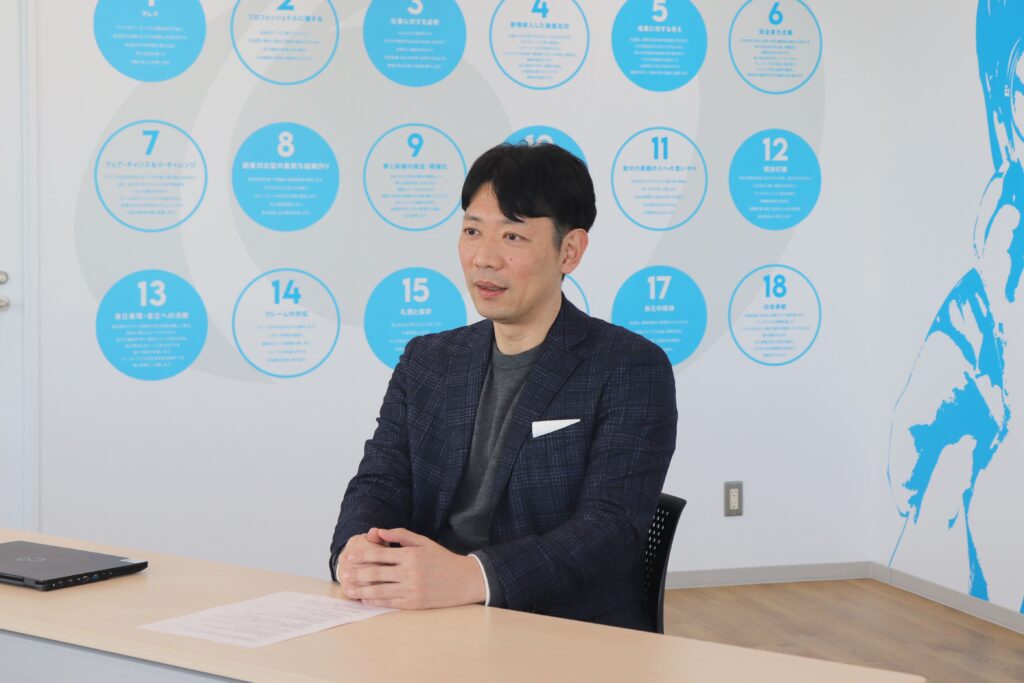
Suppose you do find a project that fills a missing piece or gap in D-POPS GROUP’s portfolio. After it passes the document review and you meet the CEO in person, what other areas are being checked?

Kato:
Above all, we place extreme importance on whether their atmosphere and culture match those of our other group companies. Even if the industry is different or they don’t use the exact same words as us, as long as our underlying values are the same, we can respect each other. We value that sort of instinct. On the other hand, people who take a one-sided approach to conversation from the very beginning are difficult to work with.

One particular thing I watch out for during interviews is whether they’re at a “presentation ceiling”, so to speak. By that, I mean putting on makeup to make themselves look better just for the interview. But I can see through that. There have been cases in the past where that makeup peeled off during the Due Diligence (DD) process, and the deal fell through.

Sugihara:
What specific steps do you take to discern that?

Kato:
We never conduct a so-called “stress interview”. We’re more interested in listening to each other’s dreams and figuring out if we can possibly enjoy a future together. To decide this, we usually meet twice. The first time is with me alone, and the second time is a deeper discussion with President Goto. However, there are many things you can’t see from just talking about theories, so we make it a point to have dinner together, as well.

The words that slip out when someone has had a drink, the passion they show when talking about dreams…once you finally break into those deep conversations, you will see a person’s true self.

President Goto’s interviews and dinner meetings are usually over three hours long. He intentionally takes that much time to deeply understand people’s backgrounds. While transmitting that level of intensity, we ultimately judge based on the essentially human question: “Do we want to create the future together with this person?”

Sugihara:
Among the M&A deals you’ve handled so far, are there any cases that were particularly memorable or challenging?

Kato:
Our M&A strategy is based on the policy of supporting business owners’ growth, so it is very rare for founders to exit their companies after their acquisition. In principle, our style is to have founders join our group and run together with us toward growth. That is precisely why, in the few cases where founders do exit their companies after joining D-POPS GROUP, the messages regarding the vision they’ve entrusted to us leave a very strong impression.

Even after the acquisition, I want those people to never stop thinking, “I’m so glad I entrusted my business to this group back then.” It is my absolute duty to take the baton and grow that business even further with our new partners, and I feel this responsibility more strongly than anyone else.

Sugihara:
On the other hand, have there been cases where you were forced to make a painful decision?

Kato:
Yes. I still ask myself from time to time whether we made the right decision regarding one company we had acquired, and then ultimately sold to another company.

From a business perspective—making an administrative decision, or in the sense of gaining a return on investment—that may have been the right choice at the time. However, my style is to enter the other person’s world and walk alongside them until closing out the deal, and valuing their feelings all the while. Because I care about individual companies as much as I cared about our individual stores, I still have lingering regrets about that one case.

Sugihara:
Precisely because you value people that much, people choose D-POPS GROUP for reasons beyond just the monetary value.

Kato:
Exactly. I don’t think the acquisition prices we offer are the highest compared to other companies. In fact, it’s more often not the case. However, CEOs will hand over their companies to us and say, “I’ll leave it to you.”

Because they don’t choose us just for the money, I feel the weight of responsibility for their entrusted vision even more heavily. I believe my mission as the M&A lead is to coordinate within the group to see that their trust produces results.

Sugihara:
You mentioned that in extraordinarily rare cases, founders pass the baton of their business to D-POPS GROUP and then step down. I heard that sellers usually don’t explicitly state their desire for how you should grow their companies, but in your position, how do you respond to that kind of expectation?

Kato:
Those expectations aren’t directly spoken in words. However, in the process leading up to them choosing us, I always make sure to ask, “Why did you decide not to go with another company?” Along with the details that we get through the intermediary agencies, I see that accumulation of information as the CEO’s feelings that they couldn’t express out loud, so I make sure to place high value on it.

What always gives me the greatest impression is the dinner that serves as a ceremony for passing the baton. The CEO will say to the employees who are staying with the company, “Thank you for everything. From now on, within this group, continue to do your best!” Those words are a testament of trust in us, effectively saying, “You’ll be fine with these people.” Coming on the back of that kind of moment, I feel a powerful sense of responsibility that I absolutely cannot ever betray those people.

◆The “Flow of Energy” that President Goto Values

Sugihara:
When it comes to the M&A process, has anything President Goto said left an impression on you?

Kato:
It would have to be one phrase: “The flow of energy is bad”. This is the toughest thing to deal with, ha ha. The intermediary agencies will work desperately to find the kind of deal that might only come around once a year or so, and we’ll reach a certain point. But if President Goto says, “The flow of energy is bad”...there’s simply nothing we can say to that, ha ha!

Sugihara:
When you investigate a case yourself and then propose it, only to be told such a thing, is it hard for you to accept that?

Kato:
To be honest, in the past, I really couldn’t accept it at all. Back then, I was only looking at the numerical aspects, group synergy, and positioning in the industry, but now I think I was completely missing the essential human element.

But after doing my homework many times, I’ve gradually come to a place of understanding. I’m able to realize, “Ah, this must be what President Goto was concerned about!” Nowadays, our intuitions are much more likely to align. Although, there are still some times I feel disappointed when a project I’m personally attached to gets rejected, ha ha.

Sugihara:
Besides the flow of energy, what other perspectives do you feel President Goto has regarding finances or business performance?

Kato:
I think President Goto keeps the sharpest eye on how other leaders make intentional decisions.

He often says, “A stack of blocks doesn’t grow just because one block stands out.” He means one person doesn’t need to be the top in everything. On the other hand, as Corporate Planning Head, I take pride in the fact that I’ve worked quite hard to make sure I’m not a burden to our group.

I’ve been given responsibility for practical numbers and for negotiating M&A terms, but for the highest level of decision-making that happens in our board meetings, the board members’ perspectives are also crucial. For large cases, President Goto personally holds preliminary discussions with President Naito and Chairman Semmoto to thoroughly bounce ideas off of them. I incorporate the feedback from that coordination process into our business plans and M&A contracts. After going through such a rigorous process, those CEOs and their businesses finally become our colleagues and join the list of our group companies and investment portfolio companies.
Sugihara:
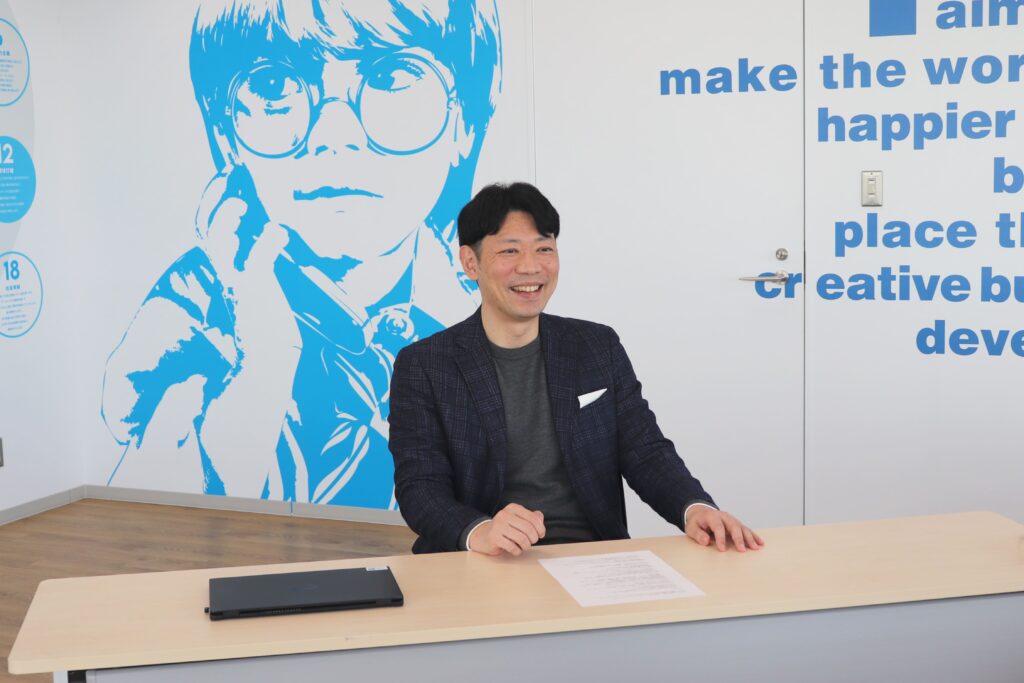
After handling M&A for this many years, what is the moment that made you feel the most fulfilled?

Kato:
For most entrepreneurs, an M&A is a once-in-a-lifetime, high-stakes endeavor into which they’ve poured their very lives. To be present at such a critical juncture is truly an honor.

Actually, everything I’ve done here at D-POPS GROUP stems from an ambition I’ve held since before I even joined that accounting firm: the desire to stand by and support the visions of entrepreneurs. Now, being able to support life-altering decisions through M&A makes me feel like I am right at the core of my professional purpose.

Sugihara:
You hold the major dual responsibilities of being Faithful’s CEO and the head of M&A for the entire group. Is there anything you have to keep in mind while wearing those two hats?

Kato:
After becoming a company president myself, my respect for the CEOs of our other group companies has grown even stronger. I don’t think I would have ever truly grasped this feeling if I had remained only in charge of M&A.

You can’t feel the true challenges and the sense of loneliness that comes with being a leader until you become one yourself. Back when I first joined and was focused on launching the administrative office, the staff working in the stores sometimes looked at me coldly, thinking, “Who does this ‘executive candidate’ think he is?” But now, having the perspective of a business owner, I understand how to bridge the gap between different departments and standpoints.

I can have a bird’s-eye view of the group as a whole, while also handling the management of a customer-facing business. That sort of environment is an extreme luxury, and it’s a challenge I find deeply rewarding.

Sugihara:
In your busy life with multiple roles, how do you balance your professional life with your private life, and what do you value most in life?

Kato:
One of the major catalysts for me aiming to become a CEO was joining Entrepreneurs’ Organization (EO). Ever since I joined the company around 2007, my mentors would tell me that EO is an incredible place, and I started aspiring to get there someday.

What I learned there wasn’t just management know-how; it was something more fundamental, like a philosophy of life. “We have to face the reality that all people eventually die. How do you want to meet your end?” I often have opportunities to talk deeply with my EO colleagues about topics like that.

My hope is that at the end of my life, my companions and I can look back and say, “We really worked hard back then.” Expanding this circle of gratitude has become my life’s guiding principle.

On a personal note, I’m still very close to my wife, whom I met when I was 19, and this year marks our 30th year together. Having a peaceful family life is a huge support for me.

My personal life hasn't always been smooth sailing. At age 41, I suffered from cancer, and then developed a complication that occurs in only one in a million people. Just the other day, my doctor told me, “You don't need to take medication anymore,” so my battle with that illness has finally settled down, and I feel a sense of relief. It is precisely because of this experience that the importance of family and companions has truly hit home.

By becoming ill and learning my own weakness, I feel that the words ‘integrity, humility, and gratitude’ are finally all connected inside me. From now on, just as I was supported by others, I want to be the kind of person who can be a support for someone else.

◆On “Realizing a Venture Ecosystem”

Sugihara:
D-POPS GROUP aims to realize a Venture Ecosystem. What parts of this goal resonate most with you? Are there any specific mindsets or activities you focus on while building this ecosystem together?

Kato:
Actually, during my job interview 20 years ago, President Goto spent three hours passionately talking to me about his concept for a department store. The idea was to have a cafe, a mobile phone shop, and a perfume shop all within the same building. He said it would be amazing if they could create synergistic effects to generate customer satisfaction.

While the exact shape of that has changed, I believe that was the prototype of the Venture Ecosystem we are aiming for today.

Twenty years have passed and our business model has evolved, but the underlying desire to “create delight and brightness for people” has not changed at all. In the past, it felt like our work was about survival plus a little extra, but now we have gained enough momentum to influence society more broadly, such as through educational support. I can feel that advancement firsthand.

Sugihara:
What do you intentionally do every day to make the Ecosystem even stronger?

Kato:
Almost like clockwork, a difficult situation has occurred roughly every five years, ha ha. But no matter whether we have a serious storm or smooth sailing, I stay focused on three things we have championed for a long time: stand your ground, never stop challenging yourself, and grow at triple speed.

The delight and brightness found in our company name (D-POPS stands for Dream–Produce One’s Pleasure and Shining) can never be created by maintaining the status quo. We apply a comfortable amount of stretch to ourselves and work together to take on lofty goals that at first seem impossible. That process of challenging ourselves creates triple-speed growth, which ultimately leads to someone else’s delight and our own brightness.

To me, the act of keeping this cycle going builds up our Ecosystem.

◆5-year Vision

Sugihara:
In five years, where do you want yourself to be and where do you want Faithful to be?

Kato:
I want to reach the level that when someone hears the term ‘direct marketing’ within the context of D-POPS GROUP, he or she will immediately think of Faithful (URIZO).

For nearly the first 10 years after joining, I was responsible for financial strategy, and in the period since then, I’ve handled M&A strategy. If I can firmly establish marketing strategy as a third pillar, I believe I can make a significant contribution as a foundation for the group. My ideal is for the next person who takes over the systems I’ve built to polish them and make them even stronger.

Sugihara:
Will the newly added service, URIZO, be the key going forward?

Kato:
Yes, I want to ensure it is seen as the key. This business, which we took over from a subsidiary of a listed company in 2024, plays an extremely important role in the overall marketing strategy of the group. It is still in the seed stage, but my current mission is to grow it into a large sprout as quickly as possible.

Sugihara:
With the spread of AI, the nature of marketing is changing. What challenges do you see up ahead?

Kato:
We live in an age where anyone can easily obtain primary information and launch marketing measures using AI. That is exactly why it’s absolutely necessary to differentiate ourselves by doing what AI cannot mimic.

I feel there is a literacy gap here similar to what we saw with mobile phones in the past. As digital becomes more prevalent, analog marketing such as mailing out letters attracts attention again, and proposals that carry human emotion rather than being left entirely to AI will gain value. It’s about the multiplication of the latest tools with human ingenuity and passion. I believe the battle from here on out will be determined by how we combine those two.

Sugihara:
Finally, do you have a message for those reading this article?

Kato:
Looking back on my experiences, my major failures leave a stronger impression than my successes. Even so, I learned from those failures, was given another chance, managed to fix those mistakes, and created things that made people happy. For me, one important aspect of this group’s corporate culture is getting a second chance, or many chances, so one can try again and again. I want to continue challenging myself without fear of failure and create new, enjoyable experiences that bring value to the group. If reading this article increases the number of colleagues who resonate with our Ecosystem, I couldn’t be happier. Let’s have fun challenging ourselves and change the world together!

Interview conducted by D-POPS GROUP’s advisor Genta Sugihara.

D-POPS GROUP Co., Ltd.

Managing Director, Operating Officer, and Corporate Planning Head Takahiro Kato

Faithful Corporation

Company Co-President: Takahiro Kato
Address: 32F Shibuya Hikarie Building, 2-21-1 Shibuya, Shibuya-ku, Tokyo
Related Articles

[Member Interview #1] D-POPS GROUP President’s Office Member Shane Hetrick
Overcoming the Language Barrier to Create a More Global Venture Ecosystem ①First, please tell us about where you’re from and your background. I was born in California, but while growing up, my family moved about a dozen times to various other places in the western part of the US as well as spending seven months in South Korea. As a result, my parents, my younger brother, and my two younger sisters were the only stable figures in my life, so I had to get used to constant change from an early age. In fact, I can confidently say that learning how to deal with so many transitions had a significant impact on my life. After moving to the city of Pullman in Washington to attend Washington State University, I earned a dual degree in microbiology and genetics and cell biology. In my freshman year, I became an active member of a Christian community for university students, and even after finishing my studies, I decided to remain in Pullman and volunteer with that group for two years as an intern and then one year as a staff member. Throughout this period, I enjoyed getting to hang out with friends often, not having many responsibilities, and ultimately realizing my life’s passions. I also gained a number of critical skills which I would soon utilize in my career: developing relationships with people from both similar and different cultures, guiding and coaching university students through strategizing how to tackle their personal problems, facilitating group discussions, and—perhaps most importantly—learning how to learn. ②How many years ago did you arrive in Japan? What was your reason for moving here? Towards the end of my time in Pullman, I started to meet more and more international students from various countries, and even met a student from Kansai Gaidai University in Japan, who even became my roommate for one semester. All of them suggested very seriously that I would make an excellent English instructor, and I became quite interested in the idea of starting a brand new adventure. Looking back on it now, I suppose I had also grown restless in my relatively safe and predictable life. First, I began working part-time at my university’s affiliated TEFL (Teaching English as a Foreign Language) program for about half a year, and then started to look into different options to live abroad as an English instructor. In the end, I was offered a full-time position as a dispatch worker through a small English teaching company in Japan, and in August 2015, I moved into a Japanese family’s house in Tokyo. I had met their son while he was studying abroad at my university, and his parents graciously offered me a place to stay when they heard I would be moving to Japan. I began facilitating English lessons at elementary and middle schools, trade schools, hospitals, hotels, and various other companies throughout the Tokyo area. Some were large classes with 10 to 20 children or young adults, while others were 1-on-1 with businesspeople, and I soon became capable of teaching English to Japanese people of all ages. ③Why did you join D-POPS GROUP? During my first year of teaching English full-time in Tokyo, I encountered a local branch of the same Christian university student organization in which I had been involved before. They were low on staff, so I volunteered for them and moved into their community house while continuing to teach English part-time at various places. I met a young woman from China through this group, we got married, then we had a daughter and were expecting a baby boy. During the months leading up to his birth, I was actively searching for a full-time job to provide for our family's finances, since my wife would soon go on maternity leave and she was our main breadwinner at the time. Then, a recruiting partner of D-POPS GROUP found my profile while looking for someone with English teaching experience and a Japanese driver's license to be hired as an English-speaking chauffeur for the CEO, and offered me an interview. While I was somewhat intrigued by the prospect, the position was very different from what I had been searching for. However, once I met President Goto at the interview, something inside me changed. I was deeply impressed by how he listened to me and was genuinely interested in me as a person, and when he spoke, I immediately believed in his vision. So, last November, I decided to join D-POPS GROUP and play even a small part in creating a society that will support my children to take risks, learn, and grow. ④What kind of work are you doing at D-POPS GROUP? I was originally hired to help President Goto to improve his English through natural conversation while riding in the car. While that is my highest priority, I quickly recognized that within the flexible and swiftly-changing scene of a startup, I couldn't limit my role in our company to such a narrow task. When I’m not driving, I was given the primary task of translating the articles on our company website from Japanese to English. From time to time, I also get to use my native English skills for corresponding with foreign guests and welcoming them to our office. As much as I can, I try to help out the other members of the President's Office, too. After all, the more work they can delegate to me, the more work President Goto can delegate to them, which frees him up to do more of the things that only he can do. I receive and send letters and packages, order various supplies, issue entry passes to our office, and handle other light administrative tasks. ⑤As you drive President Goto around and help him practice his English in the car, have you gotten used to driving in Tokyo? Has President Goto’s English actually improved? Ha ha… The car that President Goto chose for our company vehicle has a number of premium features that make it easier to drive safely in city traffic. It also helps that I’ve been driving for many years, so even though the streets in Tokyo are much more crowded and narrow than the roads in the US, I have been able to get used to driving here. In fact, I am always delighted every time I have the chance to drive President Goto to his various meetings and appointments and learn something from his wise words. And yes, as President Goto is using English more consistently, he is more capable of recalling the foundation that he built as a high school and university student in the US and the UK. All I’m doing is providing him with an atmosphere where he can comfortably practice and supplying him with correct vocabulary and natural English phrasing when appropriate. He has been making steady progress, and is definitely more visibly confident when speaking English compared to a year ago. However, he often likes to encourage me by saying that he wishes his English would improve as fast as my Japanese, ha ha. ⑥You seem to have a proactive stance towards speaking Japanese with everyone around you in our office. When did you learn Japanese? Is the Japanese business lingo that we use here difficult? While I was living with that Japanese family during my first year in Tokyo, they helped me learn the fundamentals of everyday conversation, and I became capable of basic communication. However, after I moved out of their home, my Japanese level essentially stagnated, since the only time I spoke it was in the exact same situations in daily life and did not usually seek out opportunities to study and improve my language abilities. After joining D-POPS GROUP last year, I found myself in a Japanese work environment for the first time in my life, so there have been countless moments where I’ve been challenged and stretched. It’s not just that business Japanese is difficult for me to learn, but also that I had virtually no experience in the business world before starting this job. As a result, while I’m trying to pick up polite Japanese phrases that are commonly used in the office, I’m also learning about the concepts, situations, and systems behind those phrases at the same time. I want to provide as much value to D-POPS GROUP as possible, since I understand that I can contribute to society more this way. To that end, I have undertaken a lot of challenges and overcome almost as many obstacles, thanks to the patience and understanding of my excellent and gracious coworkers, though there are still many more to go. And I want to tell everyone within our Venture Ecosystem that I am always happy to practice my Japanese, so when you see me, please don’t hesitate to say hello! ⑦What differences have you felt between living and working in Japan compared to the US? In my opinion, the biggest way that life in Japan is different from life in the US is the perception of peer pressure. From what I’ve seen over the past ten years, Japanese people seem to be very considerate of other people, to the point that they try to remain aware of the outward behaviors and even the unspoken feelings of the people around them. In addition, they usually have a deep reverence for common courtesy, harmony, and consensus, and would rather inconvenience themselves than voice an opinion contrary to the majority. On the other hand, Americans place a very high value on the personal independence of the individual. From a young age, we are taught that we should think before we copy what everyone else is doing, and we prize uniqueness above uniformity. There are obviously many reasons why these two cultures are so opposite, but I think one primary root may be the lack of livable space in Japan combined with the history of frequent natural disasters here. When the threat of earthquakes, tsunamis, or other dangers is always near, and your neighbors live so close that a house fire can spread to surrounding buildings almost instantly, it becomes critical to maintain amicable relations with all the people you interact with on a regular basis, so that you can rely on their help in an emergency, rather than watch them gleefully loot your belongings as you lay dying. I’ve also noticed some smaller contrasts between Japanese and American lifestyles that our readers may find interesting. For one, Japanese tend to keep their social circles cleanly distinct from each other, so family, acquaintances, and coworkers rarely mix. Americans, however, are much less shy about introducing family to their friends and colleagues who are close to them, so I’ve had to get used to knowing next to nothing about my team members’ personal lives, even though I talk with them all the time. Another is that while most Japanese eat rice at least once a day as part of their diet, Americans aren’t usually loyal to a single staple food, and will even eat meals that contain no staple food at all. Finally, this isn’t necessarily a major difference between Japan and the US, but rather something that’s starting to change in both cultures. Until recently, fathers did not usually take a long paternity leave. However, I decided to take advantage of the Japanese government’s childcare provisions to stay with my wife and children at my parent’s house in the US for much of December and January. My coworkers at D-POPS GROUP were very supportive, and though I’ve heard horror stories of fathers at Japanese companies coming back from paternity leave to find their position relocated or minimized, in my case there was nothing of the sort. ⑧After joining D-POPS GROUP, you have been working on the English version of our company’s website. What are your most important considerations for writing English translations? First of all, I try to imagine the audience who will be reading these translations. They could be executive members of foreign companies thinking about expanding their business into Japan, or venture capital investors looking for a good return from a Japanese startup, or even members of D-POPS GROUP or our partners who simply want to practice their English reading ability. This affects the word choice and overall tone of each article I translate, and also helps me decide how to convey phrases or ideas that have no direct translations. Next, I do my best to paint a clear picture of the mission, vision, and values of D-POPS GROUP and our leaders in such a way that anyone who reads the pages of our website in English will be able to sense them through what parts are emphasized and even through the vocabulary I use. After all, I believe that the energy surrounding us really is special, so I hope to share as much of that spark as possible with our readers. Finally, since I am still quite far from being bilingual, I would not be able to accomplish the task of translating our website without the support of our corporate advisor, Genta Sugihara. Without his wisdom, experience, and especially his deep knowledge of startups and corporate venture capital, you would not be reading this now. Not only with translation, but he has also given me invaluable advice on navigating the unfamiliar world of working at a Japanese company, and I can’t express in words how much I sincerely appreciate him. ⑨In August, we hosted a group of delegates from the Japan-America Student Conference. You helped to create English presentation materials that were oriented towards students, and also did a little bit of interpretation on that day. What were your impressions of all the work that went into making those materials and what you experienced on the day of their visit? That event was my first taste of getting to work more closely with President Goto, and it was definitely awe-inspiring to witness firsthand how much thought and effort he puts into anything he does. He was put in a position where he was out of his element, and I would guess that is not usual for someone at his level of professionalism. But even in the midst of a situation like that, he was able to think strategically about what he could do in the limited time before the presentation, and also what was not possible. For example, I first prepared a script for him that might have seemed quite impressive to an academic audience in an English-speaking country. However, it contained a significant amount of high-level vocabulary he was not familiar with. President Goto pointed out to me that since he did not have a long time to prepare, it would be better for him to focus on practicing fluently speaking words he already knows than on learning a bunch of new words. Then we went back and forth over the next several weeks, refining his script and his presentation slides until he was satisfied with them. This was also an educational experience for me, as I learned that being able to reach a state of 90% perfection in a timely manner is much more important in a business setting than finally getting to the point of 100% perfection long after the deadline has already passed. When the students arrived at the Shibuya Hikarie Building, I had the honor of showing them around various parts of our inspirational office space and explaining their significance in English. Then, after we listened to President Goto and Advisor Sugihara share their lectures, I was supposed to help interpret for the students and our company leaders, but it turned out that between President Goto’s English skills and the Japanese ability that several of the American students had, I hardly needed to say anything. Given my work background in connecting with university students, I was so happy to see a deeper understanding of the value of entrepreneurship dawn on their faces over the course of our time together. ⑩What kinds of activities at D-POPS GROUP do you hope to participate in from now on? My knowledge and experience in the venture capital business is still almost zero, but someday I hope to be a more active participant in the process of welcoming new partners to our Venture Ecosystem. Over the past couple of months, I’ve been given the privilege of facilitating communication between the members of our CVC team and a pair of foreign entrepreneurs who want to more firmly establish their business in Japan. This has been exhilarating for me, and I want to increase my capabilities in this regard. Besides the CVC team, I hope to support any other conversations that take place between members of our Venture Ecosystem and non-Japanese speakers. One of my personal goals at D-POPS GROUP is to utilize my English skills to serve our expansion onto the global stage. In accordance with that, I want to keep myself available as an asset anytime there is a need for a native English speaker. Speaking of which, I'm hoping to start some English-related activities within D-POPS GROUP's Ecosystem sometime soon. If anyone is interested, please feel free to contact me! Beyond this, I’d really like to continue improving my Japanese language and business skills to the point that not only am I a professional English translator for D-POPS GROUP, but also that I prove to be truly useful in other areas. I’m excited to see what I look like after another year of working here!
  • Interview
2026.04.09
[Founder Interview #3] Ayumi Fujimoto (Startup Ecosystem Association) – Part 3
From Startup to Scale-up: Mutual Growth and Realization of an Advancing Ecosystem For this article, we interviewed the Startup Ecosystem Association’s President Ayumi Fujimoto, a leader who shares our vision for Japan’s entrepreneurial future. (This interview was conducted in January 2026.) See Part 1 and Part 2 of the interview here. ◆The Joy of Creating Something from Zero Learned at Google Sugihara: Let’s take a step back into the past for a moment. we actually joined Google in the same year—2007. Back then, Google still felt like a true startup. If a problem arose, people from different departments would huddle together to solve it. We were the pioneers…there wasn’t an atmosphere of an established, incumbent corporation yet. Later on, we both left Google at close to the same time. You moved on to Money Design (a fintech startup), and then to Plug and Play Japan, but the whole time, you’ve stayed in the startup world. I have to ask…what has driven you to consistently choose this career path? Fujimoto: Once you experience that Google era like we did, you never forget the joy of building something from scratch. It becomes much more addictive than working on something that is already established. When I first joined Google, I used to wonder why some of my senior colleagues were leaving so early in their careers. But they told me, “You’ll understand one day. Different phases of a company require different types of people, and I personally love the launch phase.” Now, I understand exactly what they meant. Sugihara: What is your favorite phase in a company’s lifecycle? Fujimoto: For my seniors, it might have been when the company was completely unknown. For me, my specialty lies in the phase where something has just started to sprout, but doesn’t quite have a clear identity yet. I love the process of giving it a name and helping it grow. I tried to replicate that at Money Design, but I eventually ran into a dilemma: a single company cannot keep up with the sheer speed of change in the world today. That’s when I decided to pivot. Instead of running a business myself, I chose to build and steer an ecosystem that could support multiple innovators in order to achieve a lot more. ◆Resolving the Gender Gap Sugihara: So, you chose your current path out of a desire to deepen the role of scale-ups (the growth phase following the initial creation of something from nothing). I also remember you being in charge of the Women Will project back in the Google era. Many of my friends were involved in that fantastic initiative. Could you explain for our readers what that project was about? Additionally, the startup world tends to be male-dominated. How do you view the current lack of female entrepreneurs, and what is your approach to changing this? Fujimoto: Women Will was an initiative that started even before women’s empowerment became a buzzword. The core idea was to use the power of technology to empower women. Startups are inherently places where people use technology to drive change, so there should be immense opportunities for anyone to succeed, regardless of gender or age. While the number of female entrepreneurs and investors has grown steadily over the last decade, the lack of balance remains an issue that’s shared across the world. One specific factor is the bias in fundraising. Female founders are often asked questions that men are not, such as “Do you plan to get married?” or “What about children?” While this could be considered as risk-hedging, we must create an environment where we face the business itself, flatly and without bias. Our association is currently working with the Financial Services Agency (FSA) on a survey regarding the gender gap in the ecosystem. Following the increased attention on harassment issues over the last couple of years, the industry’s sense of crisis is very high. Recognizing that unfair practices are unacceptable is the first step toward improvement. Sugihara: In a single company, you can manage this with rules and KPIs, but changing the culture of an entire ecosystem is a massive challenge. Fujimoto: That is the hardest part. Since an ecosystem isn’t managed by one single person, it’s not enough to just chase a quota like “30% women”. We have to ensure true diversity where more people have access to opportunities. Lately, more event organizers are paying attention to the balance of gender, age, and nationality among speakers. This is a great first step. The supporters of international accelerator programs are now being held strictly accountable for the diversity of their cohorts. I hope to see this approach take root in Japan as well. Sugihara: In the past, female entrepreneurs were often “invisible” unless you were intentionally trying to find them. Fujimoto: Exactly. However, from an innovation standpoint, the data is clear: diverse teams grow significantly faster. There was once an unwritten rule in Japan that a homogeneous team with shared values could move faster in the early stages. Recent studies have debunked this. If you don’t build a diverse organization from the very beginning, you won’t be able to scale the company later. Success in scaling up depends entirely on the organizational environment. It’s no longer just a binary of male vs. female. Broad diversity, including nationality, is an essential element for Japanese startups to leap forward. Sugihara: That is a vital perspective. I’ve seen research showing that companies with diverse public relations and branding are more highly valued. Fujimoto: Our gender gap survey showed something interesting: while women feel they are at a disadvantage, men also expressed feeling a sense of suffocation or an inability to speak their minds in the current culture. It’s not about one side or the other being bad. It’s about mutual understanding. When I think back on our time at Google, we were told not to assume that we fully understood the other person. We made sure never to operate under any kind of unspoken understanding, and we communicated clearly through dialogue to move things forward correctly. In Japan, we often proceed with the assumption that others know what we need, and when things go wrong, we get frustrated. We need to move toward a culture where we communicate under the premise that we don’t automatically understand each other. ◆Japan’s Future Strength: Turning Technology into Business and Communicating It Sugihara: Indeed, it is precisely because a diverse range of personalities come together that we can create exceptional services that reach a global audience. On that note, I’d like to ask a final question about the future. From the perspective of entrepreneurship and new business development, which domains do you believe will hold the key to Japan’s growth moving forward? Fujimoto: I’ve traveled the world, and thought about what Japan’s future strength will be. At this point, I am convinced the answer lies in “deep tech”. Japan’s R&D, technical capabilities, and ideas are world-class. However, our ability to turn that into viable businesses hasn’t caught up. Japan’s big opportunity lies in bridging that gap. A supporter in South Korea once told me: “Japanese people think if they make something good, it will be recognized. But you have to tell people it’s good, or else no one will know its value.” That might be Japanese modesty, but it doesn’t work in startups. If we can strengthen our ability to convey our products and our business acumen, we have enormous potential. The same applies to SaaS. Japanese services tend to stay domestic. But if we can break through the international wall and focus on scaling globally, we have a real chance. Sugihara: To break through that wall, it seems crucial to have a multinational team from the early stages so that launching simultaneously in multiple countries becomes the standard mindset. Fujimoto: I completely agree. In many other countries, that’s already the norm. We must have a sense of urgency—if we spend too much time thinking “Japan first”, we’ll end up falling a full lap behind the rest of the world. I don’t believe every single service has to expand overseas, but there is simply too much you cannot see if you remain closed off within Japan. When a team includes members of diverse nationalities, your speed and perspective naturally shift, and you begin to notice global changes. I feel that this kind of organizational structure will ultimately dictate the growth of Japanese startups moving forward. Sugihara: That’s a very helpful perspective. Moving on to a question about current trends: we often see discussions in the news or in books about specific professions disappearing due to AI. What are your thoughts on this? Fujimoto: The impact of Generative AI is certainly obvious, but if you look back at history, there have always been certain roles jobs that disappeared and new ones that emerged. However, this time, the feeling of being robbed by AI or being replaced by something non-human is particularly strong, which is causing a lot of anxiety. But the most important premise to remember is that everything is always changing. At the same time, isn’t the rise of AI giving us a chance to re-examine what it is that only humans can do? It’s a great time to realize our unique human value and figure out how we want to contribute and what skills we should master. There’s really nothing to fear. It’s much more exciting to think about how to master these tools. Just try using them first! This isn’t just about AI. We need to change our tendency to reject anything new. A mindset of “just try it, and if it doesn’t work, quit” is perfectly fine. The biggest waste of all is to limit your own potential by disliking something without having tried it first. ◆The Essential Quality of a Supporter: Outgrowing the Startups Sugihara: As the social environment shifts and the future is constantly being rewritten, both individuals and startups must adapt to survive. In this context, what is the role of the “scalerator”, a supporter who focuses on scaling up rather than just accelerating the early stage? Fujimoto: Whether you are an incubator or a “scalerator”, the most vital thing is to ensure you are growing faster than anyone else. If the person supporting a startup’s growth isn’t growing themselves, why would a founder want their help? Unfortunately, there are many “supporters” who have never touched a new tech tool or have stopped studying the latest global trends. Being a supporter doesn’t make you superior or omnipotent. As business models and the nature of startups evolve, it is crucial that the supporter evolves at a speed that exceeds the startup itself. If you keep doing the same old thing, you’ll be seen as out of touch, or simply uncool, and startups will leave you behind. We often say that in three years, we’ll likely be talking about something completely different from today. That isn't flip-flopping, it’s positive evolution. To constantly reinvent oneself without fearing change…that is the essential quality of a modern ecosystem supporter. ◆Defining a Startup Ecosystem Sugihara: Finally, could you share your personal definition of a “startup ecosystem”? Fujimoto: By definition, an ecosystem involves the mutual interaction of organic and inorganic elements. Support often feels like a one-way street, from the supporter to the startup, but a true ecosystem requires reciprocity. The startup should be at the center, but they shouldn’t be treated like a guest or a customer. Everyone must act as a stakeholder and a member of the ecosystem. As everyone influences one another, the ecosystem itself grows. The only way to enrich the ecosystem is for every single member to commit to continuous growth. Sugihara: That philosophy aligns perfectly with the vision of D-POPS GROUP. We aim to build a Venture Ecosystem where we aren’t just managing or investing, but growing together as peers. We reinvest the profits from our 25 group companies into the next generation and learn alongside them. Do you see synergy or potential for collaboration here? Fujimoto: I think it’s a fantastic approach. Whether we call them startups or ventures, we are all part of the same foundation of the Japanese ecosystem. The important thing isn’t who is the boss, but the shared attitude of contributing to society through business and developing together. Ideally, this creates a chain of paying it forward, where those who were once supported by the ecosystem eventually become the ones who support it. To be honest, now that government support in Japan has become quite generous, we are seeing cases where people build businesses solely to get subsidies, effectively capping their own potential. This is a massive information loss…a lack of awareness of the speed of the global market. That is why it’s so important for ecosystems to interact and for rich knowledge to spread. When players with a strong philosophy like D-POPS GROUP join hands with us, that contagious mindset becomes the driving force that will truly keep Japan up to date. Interview conducted by D-POPS GROUP’s advisor Genta Sugihara. Startup Ecosystem Association President: Ayumi Fujimoto Address: 15F Toranomon Hills Business Tower, 1-17-1 Toranomon, Minato, Tokyo Established: March 30, 2022 Website: https://startupecosystem.org/home-en
  • Interview
2026.04.07
[Founder Interview #3] Ayumi Fujimoto (Startup Ecosystem Association) – Part 2
From Startup to Scale-up: Mutual Growth and Realization of an Advancing Ecosystem For this article, we interviewed the Startup Ecosystem Association’s President Ayumi Fujimoto, a leader who shares our vision for Japan’s entrepreneurial future. (This interview was conducted in January 2026.) See Part 1 of the interview here. ◆Impact and Diversity: Over 500 Attendees Gather at the “Startup Ecosystem Summit” Sugihara: It’s true that while national and local governments make a big deal about startup support, there are legal complexities that make it difficult for local governments to invest directly in startup equity. However, providing support in the form of recruitment is a very practical workaround. I also find it impressive when financial institutions go beyond just providing capital to actually running alongside startups to assist with sales and business development. Regarding your three courses of action, I’m particularly interested in the second one, eliminating information inequality. Could you share some specific success stories or milestones from your activities overall? Fujimoto: I would say the Startup Ecosystem Summit is our most significant achievement and a prime example of our impact. We have held it for four consecutive years now, and last year, we introduced our first “Global Roundtable”. While many international ecosystem stakeholders were visiting Japan, there were surprisingly few opportunities for them to gather in one room and collaborate, so we created that space for them. Last year, the Summit drew between 500 and 600 participants. Players from every corner of the domestic market mingled together, and I believe that sheer diversity is a tangible manifestation of the ecosystem itself. Sugihara: Just gathering hundreds of people from so many different sectors in a single venue is itself quite a feat. Fujimoto: It really is. I feel like the scope of the event expands every year. We started with about 100 people, mostly just the supporters. From that point, we started to hear feedback like, “Actually, startups should participate too,” “We should exchange information with regional governments,” or “Every single government ministry should attend.” The sense of connectedness is growing, and the diversity increases every year. Our philosophy is that rather than just repeating the same thing, the Summit should be a place where participants can actually experience the growth of the ecosystem. That’s why we aim to challenge ourselves with something different every year. We’re grateful that those who attend can feel that the scale is truly growing and the diversity is deepening. While it’s almost like a kind of class reunion for the industry, our ultimate goal is for it to be a place where you can feel the evolution of the ecosystem and where startups can find every piece of new information they need. One way we are currently expanding our activities is by utilizing the Tokyo Innovation Base (TIB) in Yurakucho, which is supported by the Tokyo Metropolitan Government, and collaborating with them on the operational side. ◆Overseas Collaboration: Where Supporters Connect on a Global Stage Sugihara: Since the Startup Ecosystem Association is a non-profit, your activities feel very pure and ambition-driven as opposed to being motivated by profit. I also get the impression that your team is incredibly high-caliber, with members coming from prestigious backgrounds like Google. Regarding the previous Startup Ecosystem Summit you held last October, I saw on your website that your association was deeply involved in organizing it together with the Tokyo Metropolitan Government. Could you tell us more about the global perspective of that event and the reception it received? Fujimoto: Last year’s event was particularly successful in its global focus. While other events hosted by VCs or massive government initiatives like “SusHi Tech Tokyo” attract many international visitors, there are actually surprisingly few opportunities for startup supporters to have deep, substantive conversations with each other. For our event, we invited supporters and people in charge of operating large-scale facilities or acceleration programs from different countries within Asia, the US, Europe, and other places. Hearing directly from them about the current trends among Singapore’s startup supporters or the transitions happening in France was incredibly meaningful. Also, I like trying new things every year, so last year, we introduced the “Triangle Session” format: three speakers and one moderator. We picked specific themes such as legal affairs, accelerators, or entrepreneurship education, and limited the time per session to just 15 minutes, to keep the speakers focused on sharing what initiatives they were undertaking. In previous years, we had larger panels with about ten speakers, but the content often became too broad. Participants told us they wanted to dive deeper into specific niches and hear how three different companies handle the same challenge. When I first proposed a 15-minute limit, neither the speakers nor the Tokyo government officials could imagine achieving anything in such a short window, so they were skeptical. But it turned out to be a massive hit. The goal wasn’t to tell the whole story on stage, but to provide just enough essence to spark a direct conversation or a follow-up later. Creating that spark was the major development of last year’s Summit. Sugihara: That 15-minute format sounds like something that could be applied to many other types of conferences. Fujimoto: Absolutely. I’d love for others to adopt it. Over the past year, our association has been continuously conducting an “Ecosystem Survey”, and we’ve visited roughly 20 countries to study their local scenes. There’s no point in us keeping that knowledge to ourselves. Whether it’s a unique conference format, a workshop style, or a specific program we saw abroad, we want to share those ideas. Even if we don’t implement them ourselves, it’s important that someone else is able to do so. Sugihara: I imagine that it must be intimidating to reach out to a lot of very busy leaders for these events, but is that process usually smooth? Fujimoto: I think this is a testament to what we’ve built over the years. Most people seem to trust that “if the association is doing it, it’s going to be worthwhile”. Rather than saying “Hmm, we’ll think about it”, they usually say “Let’s do it!” almost immediately. I believe this is possible precisely because everyone, including our founding supporters, recognizes the necessity of this activity. I also believe the fact that we operate as a non-profit is a major reason why people are so willing to accept our requests. We aren’t looking to turn this into a profitable business, but acting purely for the sake of the ecosystem. Our hope is that the association’s events serve as a catalyst for what each participant is working on to be shared with the wider world. If this were a request for cooperation coming from a specific private company for their own business interests, I don’t think things would go nearly as smoothly. ◆Global Trend: From Startup to Scale-up Sugihara: I’ve read the association’s reports as well, and I’d love to hear about the major global trends you notice during your travels. Among those, you pointed out a transition from startup support to scale-up support. Is this a shift that is happening right now? Fujimoto: It sure is. Over the last two years, the term ‘scale-up’ has exploded globally. Previously, it was lumped into the general category of startups, but now startups and scale-ups are being treated as two distinct nouns. Currently, many countries are discussing startup policies and scale-up policies separately, as well. Sugihara: Why has it become necessary to differentiate the two? Fujimoto: Take France, for example. They began enacting startup policies about ten years ago and have since seen the emergence of rapidly growing companies called ‘unicorns’. From a government perspective, if you are investing tax dollars to maximize employment and tax revenue, you eventually need to help those companies grow to a certain size. While startup initiatives are about broadening the supporter base, scale-up initiatives are about building higher, aiming for the scale of a company like Google. Because the support required for these two phases is entirely different, they are now being discussed as separate entities. Sugihara: Is this a different nuance from what we typically call “growth” companies in Japan? Fujimoto: The term ‘growth companies’ is used in Japan, but the difference between that and the global definition of scale-up lies in the trajectory of the growth. While growth company often implies linear progression, scale-up refers to non-linear, J-curved growth. Rather than just growing slowly over a long period, it’s the argument that we need to create scale-ups that grow at explosive speeds, right now. Over the past year, to the degree that the terms are different, Japan has begun to realize that building higher carries the same degree of importance. While it hasn’t been fully codified into policy yet, Japan is poised to change by following the examples of leading nations. Actually, in one sense, the Tokyo Metropolitan Government was ahead of the curve here. When they announced their strategy last October, they were already beginning to distinguish between the terms startup and scale-up. ◆How a New Company Was Established: Japan’s Globally Competitive Sense of Speed Sugihara: That’s great! To focus specifically on scale-ups, you recently co-founded a new company called FoundersNation with Mr. Nagura. How is this new company segregated from the Startup Ecosystem Association? Fujimoto: The Startup Ecosystem Association does not provide individual support to specific industries or companies. After all, we’re structured to develop the ecosystem as a whole, and focus on the big picture. However, as we were continuing our work, we were receiving more and more requests for help from individual startups or specific industries. From the association’s standpoint, I had to decline these requests because we must remain neutral, but I constantly felt the dilemma about being unable to act on these specific needs. This sense of urgency became even stronger as the scale-up trend took hold. Laying the soil where an ecosystem can grow takes a very long time. While we can eventually build an ecosystem that produces scale-ups organically, I felt that if we simply waited for that to happen, Japan would lose its competitive edge on the world stage. Right now, the number of players we have in this specific niche is overwhelmingly small, and we don’t have the luxury of time. I decided that we needed a separate, for-profit entity specifically dedicated to supporting scale-ups. That is why we established a new company. ~To be concluded in Part 3~ Interview conducted by D-POPS GROUP’s advisor Genta Sugihara. Startup Ecosystem Association President: Ayumi Fujimoto Address: 15F Toranomon Hills Business Tower, 1-17-1 Toranomon, Minato, Tokyo Established: March 30, 2022 Website: https://startupecosystem.org/home-en In the third and final part of the interview, we discuss: ・The Joy of Creating Something from Zero Learned at Google ・Resolving the Gender Gap ・Japan’s Future Strength: Turning Technology into Business and Communicating It ・Defining a Startup Ecosystem ・And other topics Be sure to check it out here: https://d-pops-group.co.jp/en/column/startupecosystem-part3/
  • Interview
2026.04.02
Back to COLUMN