COLUMN

The Office of Unicorns: Introducing D-POPS GROUP’s Iconic Headquarters within Shibuya Hikarie

  • Media
2025.07.22

D-POPS GROUP relocated to Shibuya Hikarie in September 2021.

The Shibuya Hikarie Building opened in April 2012 on the former site of the Tokyu Bunka Kaikan, a cultural landmark in Shibuya which proposed cutting-edge lifestyles. Shibuya Hikarie aims to be a platform for “creating and disseminating new value” as a symbolic tower in the ever-changing city of Shibuya.

At D-POPS GROUP, we believe our office is more than just a place to work; it’s also a place to communicate the company’s vision and philosophy as a powerful message.

So, in this article, let us introduce the office that symbolizes D-POPS GROUP.

◆Entrance

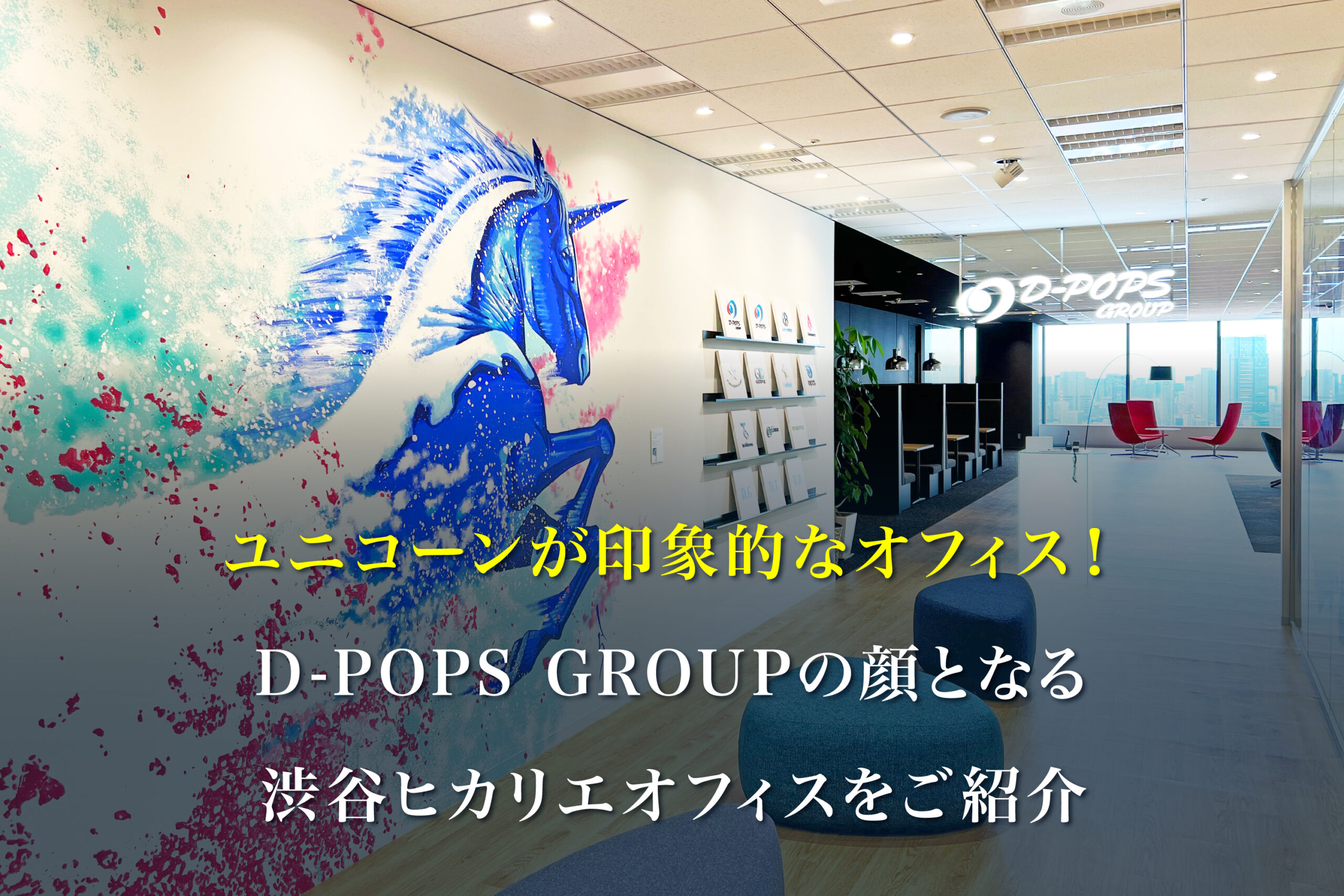
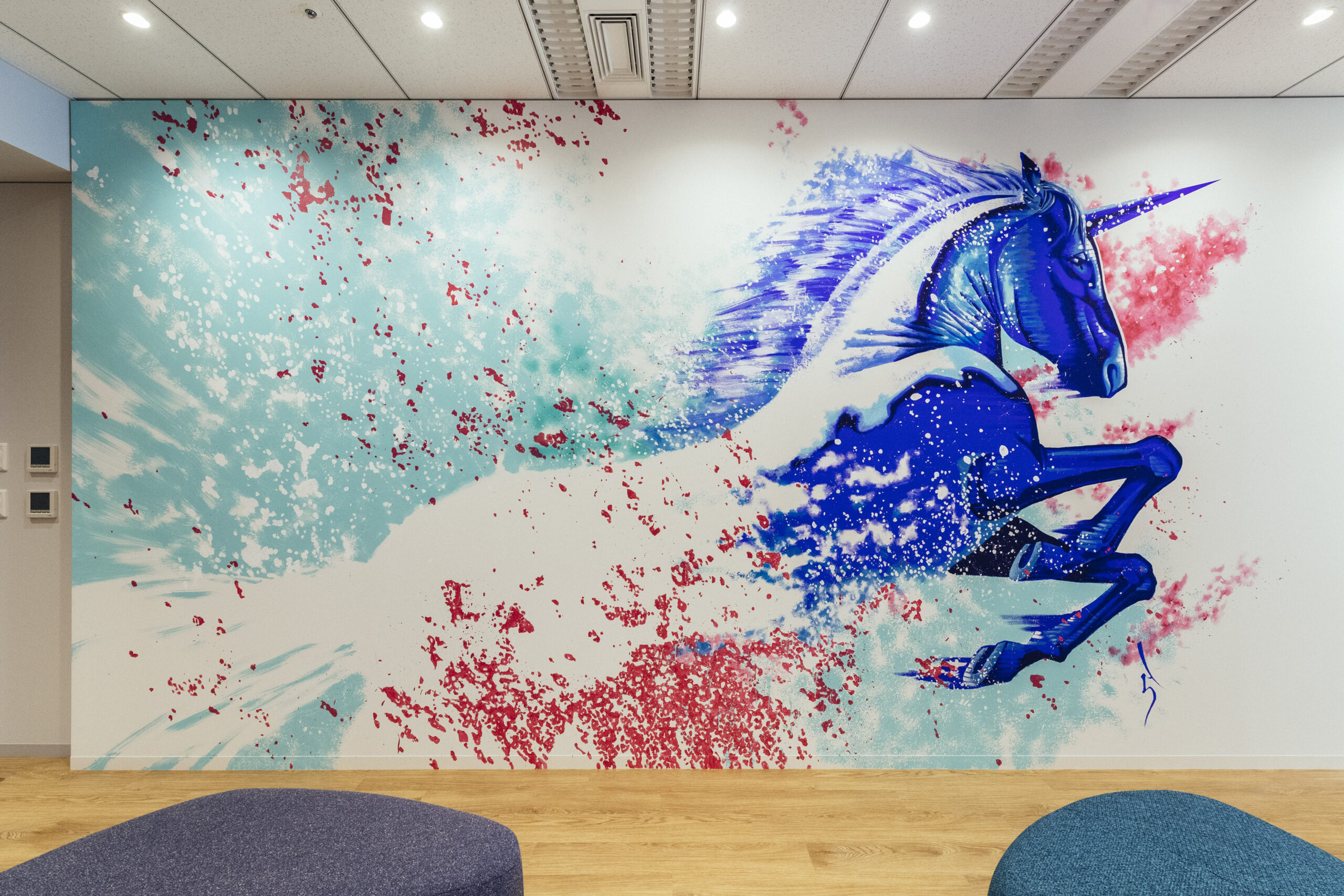
As you enter the office, you are greeted by a unicorn mural covering the entire left wall.

Opposite the mural are two conference rooms. Their glass walls are painted to look as if the unicorn galloping across from them was splashing them with water on its way up to the sky.

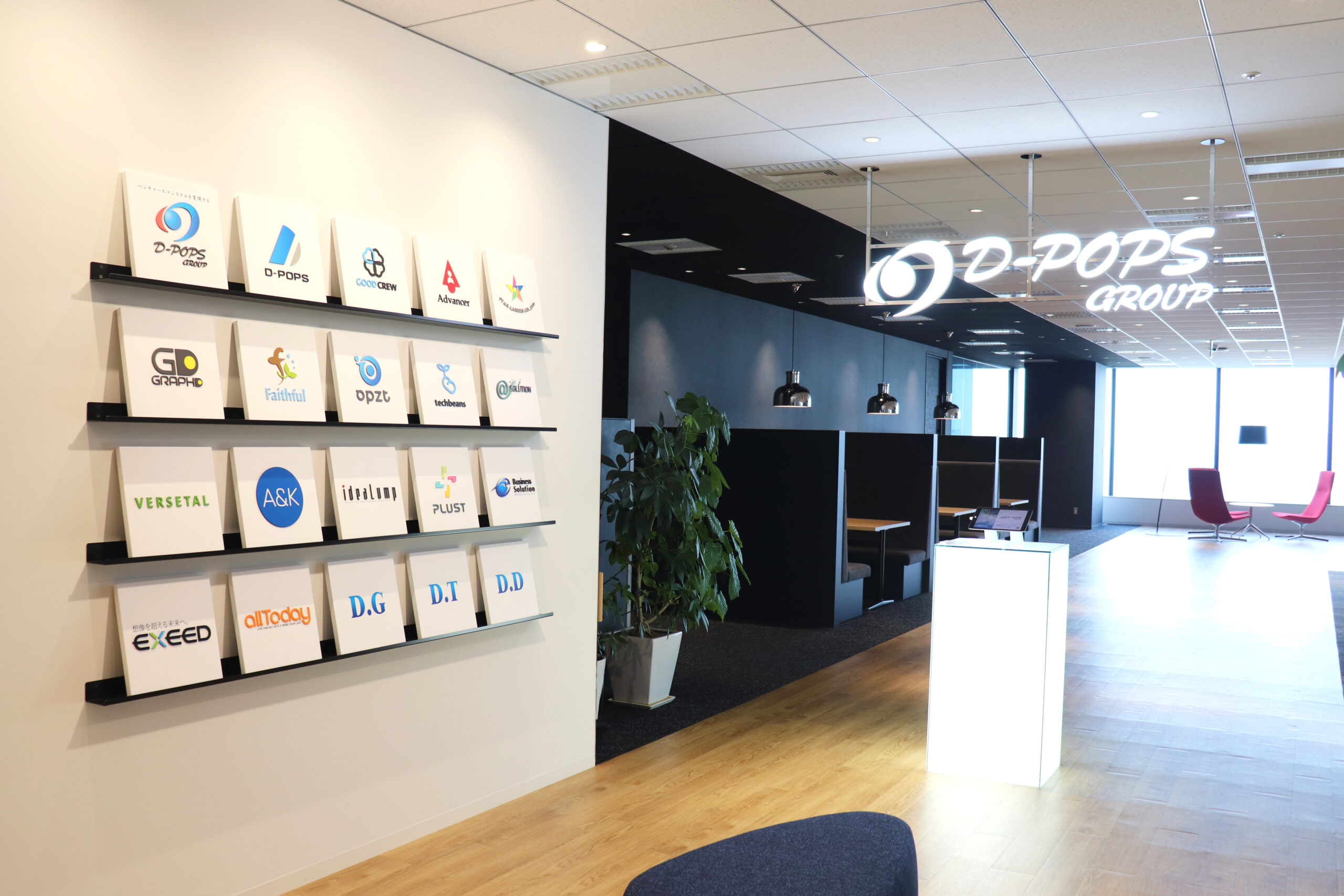
The entrance is also home to a shelf full of panels representing each of our group companies.

Beyond the entrance, the office opens up to a space almost like a hotel lobby.

The striking bookshelves were professionally directed by CCC Art Lab of Culture Convenience Club Co., Ltd. Books and pieces of art are displayed based on the keywords challenge, innovation, and growth.

◆Workspace

The workspace is divided into fixed-seating and free-seating areas, which are used according to the needs of the group companies that share our office space.

The free-seating area offers a long table seating up to 16, several smaller tables for groups of 2-4 people, and a number of individual work booths.

The fixed-seating area was designed with attention to detail in the tables and chairs to create an environment more conducive to uninterrupted concentration.

The break area offers a panoramic view of the Tokyo skyline!

In fact, this stunning sight can be enjoyed from anywhere in the office—not just the break area, but also the entrance, workspace, and some of the conference rooms. A unique benefit of our office is that because it is spacious and located on the building’s corner, you can enjoy a variety of vistas depending on your vantage point.

◆Meeting Rooms

The office has meeting rooms of various sizes.

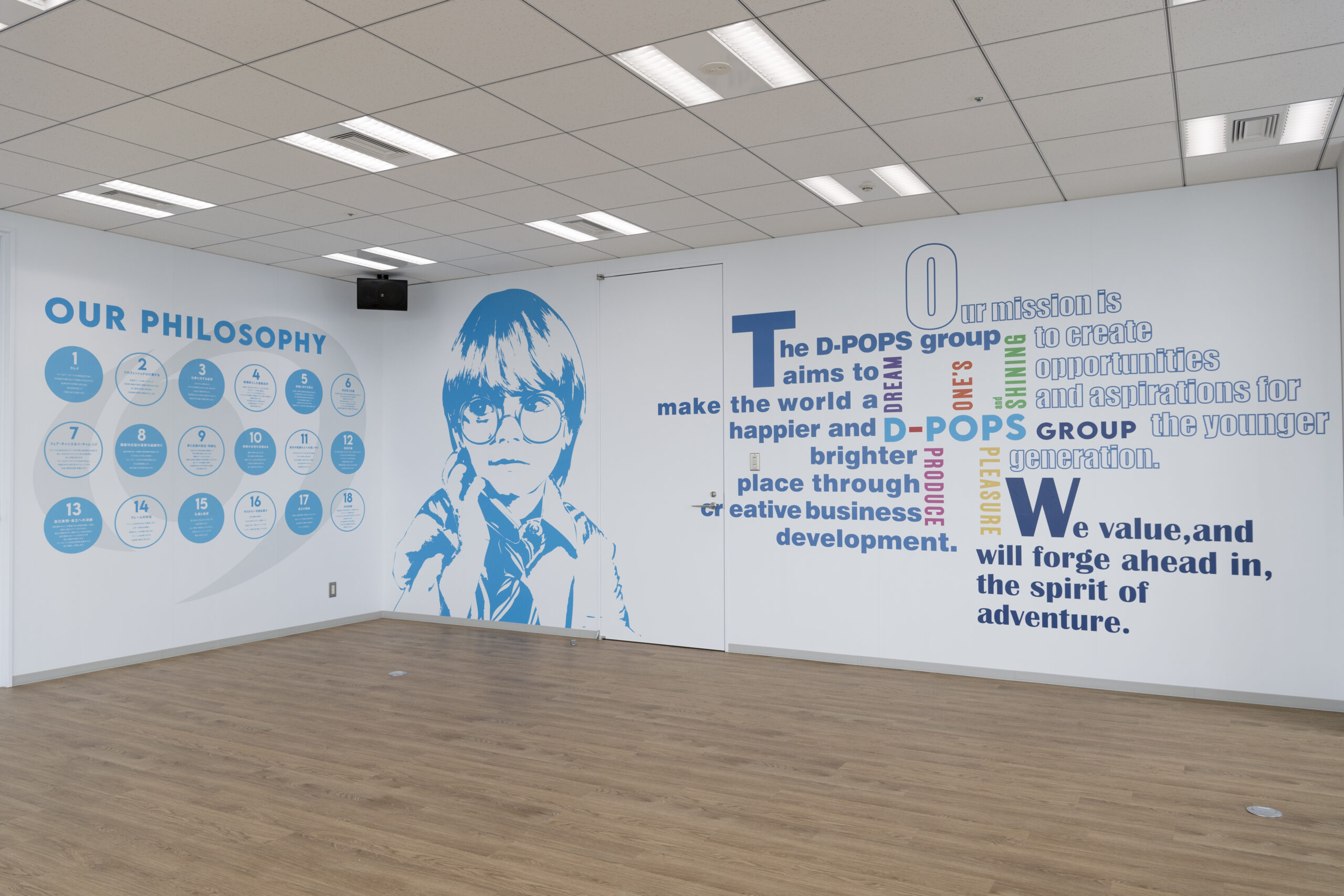
The largest space, the seminar room, features the time-honored Creed and symbolic “Boy with Glasses” photograph of D-POPS, the mobile phone retail chain originally founded by D-POPS GROUP’s President and CEO.

This “Boy with Glasses” photo was also painted in the entrance of the Shibuya Cross Tower office, where D-POPS was based for ten years before moving to Shibuya Hikarie. It is a meeting room that retains the pop flair of the old office, evoking a sense of nostalgia for those who were familiar with the Shibuya Cross Tower location.

The executive boardroom is designed with a sophisticated, formal black aesthetic.

Each of these meeting rooms has its own individual name, adorned with our unicorn motif.

In fact, the image of a unicorn is ubiquitous throughout the entire office.

The unicorn, which is the chosen symbol of D-POPS GROUP, embodies the ambition for D-POPS GROUP to become a unicorn company itself, as well as the hope to continuously produce $100M+ companies, IPOs, and unicorn companies from within D-POPS GROUP’s Venture Ecosystem.

This concludes the presentation to our impressive, unicorn-themed office.

Related Articles

End-of-Year Greeting: Big Challenges Coming in 2026
In this busy, year-end season, only a few short days remain in 2025. This year, as we pursued our vision of “realizing a Venture Ecosystem”, together with the partners in our group, we pushed ourselves to the utmost limit. From our company’s founding in 1998 until achieving a value of 10 billion yen, we concentrated most management resources on our two original companies to expand our business. However, on our 20th anniversary, we transitioned to full-scale group company management. Since then, we have poured all our efforts into “realizing a Venture Ecosystem” (i.e., ecosystem management). Currently, we operate with 25 group companies and 35 investment companies. I believe that we have finally reached the starting line for our vision of realizing a Venture Ecosystem. One year ago, we made a pivotal decision: to share our group’s initiatives and our Venture Ecosystem with the world. Our goal was to host a life-changing event where entrepreneurs and executives could find the inspiration to grow and change the future. After an extensive period of preparation, we held Venture Ecosystem Summit 2025 on October 2nd, at the Sheraton Miyako Hotel Tokyo. We were relieved and deeply gratified to welcome 270 participants, whose feedback (which came in overwhelming amounts) has been truly heartening. I look forward with great anticipation to seeing the future unicorn companies that will emerge from this group of attendees. The management of a startup company is never straightforward; it is a complex and highly demanding endeavor. Only a handful of startups successfully go public and scale to become 10-billion-yen enterprises or 100-billion-yen unicorns. This is precisely why one of our Venture Ecosystem’s biggest missions is to provide a robust support system for and walk alongside entrepreneurs, offering the logistical backing they need to overcome significant hurdles. Moving forward, we aim to welcome even more ambitious, high-potential entrepreneurs and startups that have established sophisticated business models in our focus fields. Our five-year goal is to expand our network to a sum of 100 companies (including group companies, investment firms, and capital/business alliance partners). By doing so, we will realize a startup support platform that is truly indispensable to the world, thereby contributing to society. In the past year alone, we have welcomed nine new partners through branching off of our existing group companies, CVC initiatives, and strategic capital and business alliances. Half of these are AI companies or firms that fully utilize AI, while the other half have established innovative business models that respond to the rapidly changing needs of our era. Whether looking at the entrepreneurs themselves, their business models, or their management strategies, every one of these companies shows magnificent potential. By further developing an environment and platform where the youth of future generations can easily take on challenges, we aim to spread a culture of doing so, and realize a society with the depth to embrace and encourage these efforts. Furthermore, as in previous years, through our involvement in the Walking Together Hand-in-Hand with Children Foundation, we were able to donate to 27 children’s psychiatric treatment facilities across the country. We also supported seven other children’s homes and organizations, including Lights On Children, Bond Project, and the Frances and Sachio Semmoto Foundation. Every year, we receive significant donations from many supportive entrepreneurs and executives. Just at Venture Ecosystem Summit 2025, participants contributed a total of 2.56 million yen. I would like to take this opportunity to express my sincere gratitude for your generosity. Moving forward, we will continue to strengthen our support for the children who will lead Japan’s future. At D-POPS GROUP, together with our partners in the Venture Ecosystem, we remain dedicated to our vision with unwavering focus and high aspirations. We ask for your continued support and cooperation. I sincerely wish all of you a prosperous and happy new year in 2026. D-POPS GROUP President and CEO Kazuhiro Goto
  • Media
2025.12.26
Cash Conversion Cycle
D-POPS GROUP is a community of enterprises that combine “real business, technology, and group synergy” in their operations, aiming to realize a Venture Ecosystem that remains essential to society even 100 years from now. In this article, we will explain the cash conversion cycle (“CCC” from here on). 1. What is the Cash Conversion Cycle (CCC)? CCC is a financial metric that indicates the period of time from when a company spends cash to procure raw materials or goods until it sells those goods or services and that cash gets returned to them. The CCC is an indicator of how much funding a business requires (working capital). The shorter the period, the less working capital is needed, and the more efficient the business is. In other words, a shorter CCC means less required working capital, faster business growth, increased surplus funds available for business growth investment, and minimization of financing needs. To get straight to the point, the amount of working capital a business requires depends on the duration of the CCC. For example, in a somewhat simplified case, the required working capital for a business that spends 10 million yen per month on procuring raw materials or goods is only 10 million yen if the CCC is 1 month (10 million yen multiplied by a 1-month CCC); but it’s 20 million yen if the CCC is 2 months (10 million yen multiplied by a 2-month CCC). If this business grows and procurement costs become 20 million yen per month, then the required working capital increases by 10 million yen (to 20 million yen) if the CCC is 1 month, and by 20 million yen (to 40 million yen) if the CCC is 2 months. Assuming a monthly operating profit of 1 million yen, profit retention required for working capital would be 10 months’ worth of profit if the CCC is 1 month, but 20 months’ worth of profit if the CCC is 2 months. As you can plainly see, CCC is a critical metric for business growth speed, increasing surplus funds for business growth investment, and minimizing financing. 2. How to Calculate the CCC Here, we will explain the details of how to calculate the CCC. Basically, the CCC is calculated by combining the following three elements: CCC = days sales outstanding + days inventory outstanding - days payable outstanding Days sales outstanding (DSO) The average number of days it takes to collect payment after selling goods or services. For example, contracts often stipulate payment at the end of the next month after the month of sale, in which case the DSO is the number of days in that specific month (30, 31, etc.). For retail businesses that only accept cash payments, the DSO is 0 days. Recently, with the spread of cashless payments like credit cards and electronic money, the DSO in retail may also be lengthening depending on the payment settlement cycle of the cashless payment companies. Days inventory outstanding (DIO) The average number of days from when raw materials or goods are procured, processed, and stored as inventory, until they are finally sold. Days payable outstanding (DPO) The average number of days from when raw materials or goods are procured until payment is made to the supplier. Similar to DSO, if the contract requires payment at the end of the next month after the month of procurement, the DPO will be the number of days in that specific month (30, 31, etc.). Theoretically speaking, these above definitions are true, but it becomes quite difficult in practice to calculate the average days using a weighted average based on transaction amounts when dealing with many suppliers. Therefore, the average days are calculated more practically using the following formulas: Days sales outstanding = accounts receivable  ∕  (annual sales  ∕  365 days) Days inventory outstanding = inventory  ∕  (annual sales  ∕  365 days) Days payable outstanding = accounts payable  ∕  (annual sales  ∕  365 days) Since (annual sales  ∕  365 days) is simply a calculation of daily sales, (monthly sales  ∕  # of days in the month) can also be used in the above formulas as a replacement. Furthermore, as the above formulas calculate each turnover in relation to daily sales, multiplying the CCC by the daily sales allows us to calculate the required working capital for the business: Required working capital = CCC ✕ (annual sales  ∕  365 days) 3. How to Shorten the CCC So, how can we shorten the cash conversion cycle? While it is not easy to control the days sales outstanding, days inventory outstanding, and days payable outstanding, in the world of retail, it is still possible to control the days inventory outstanding through a company’s concerted efforts. If we rearrange the previous formula for days inventory outstanding, we get the following: DIO = (inventory ÷ annual sales) ✕ 365 days = (1 ÷ annual sales ÷ inventory) ✕ 365 days = (1 ÷ inventory turnover rate) ✕ 365 days This shows that days inventory outstanding is inversely related to inventory turnover rate. Therefore, the higher the inventory turnover rate, the shorter the days inventory outstanding will be. You can see how this article on CCC is related to our article written by Senior Managing Director Watanabe, “Inventory Turnover: The Retail Industry’s Hidden Platform”. If you want to know how to increase the inventory turnover rate—in other words, how to shorten the days inventory outstanding—be sure to read it. Now, the consumer electronics retailer mentioned in that article, which we called Company B, had an inventory turnover rate of 18 times per year, so the days inventory outstanding is calculated as follows: DIO = (1 ÷ inventory turnover rate) ✕ 365 days = (1 ÷ 18) ✕ 365 days ≈ 20 days What is important here is that the days payable outstanding (the so-called payment cycle) for most consumer electronics retailers is said to be 60 days or more. This is believed to be based on strong negotiation power stemming from the fact that consumer electronics retailers are a critically important sales channel for manufacturers. However, if we assume for the moment that this consumer electronics retailer only accepts cash payments, meaning the days sales outstanding are 0, the CCC is calculated as follows: CCC = DSO (0 days) + DIO (20 days) - DPO (60 days) = −40 days The result is negative 40 days. A CCC of negative 40 days means that the required working capital is negative, implying that working capital is unnecessary for business growth, surplus funds for business growth investment will increase, and financing will be minimized. Since Company B, the consumer electronics retailer, is set with annual sales of 750 billion yen, the amount of surplus funds is calculated as follows: Surplus funds = CCC ✕ (annual sales ÷ 365 days) = −40 days ✕ (750 billion yen ÷ 365 days) ≈ 82 billion yen This means that not only is working capital unnecessary for business growth, but approximately 10% of annual sales is secured as surplus funds, separate from retained earnings. While negotiating the days payable outstanding (the so-called payment cycle) requires strong negotiation power with suppliers and is difficult to control in the short term, it remains a vital factor for reducing the required working capital and accelerating business growth. The drugstore industry has also achieved not only lower procurement prices but also an extension of the days payable outstanding (i.e., payment cycle) by leveraging strong negotiation power based on continuously growing sales volume. This has been a factor enabling accelerated store expansion. Generally, the days payable outstanding (i.e., payment cycle) for drugstores is said to be 60 to 90 days or more. Furthermore, many drugstores build their logistics networks in partnership with specialized wholesalers, systematically achieving a shorter inventory turnover rate (in other words, a smaller number of days inventory outstanding), which also contributes to a shorter CCC. 4. Summary In this article, we have explained the Cash Conversion Cycle (CCC). Although we used many examples from the retail industry, the essence of the CCC is how long it takes for funds spent (essentially, invested) in the business to be recovered. By calculating this based on sales, you can figure out the amount of funds required for operations (i.e., working capital). Therefore, we believe that with a little ingenuity, the CCC is an important metric that can be applied to all industries, not just retail, and can provide a company with many insights. For example, by calculating the turnover period for liabilities related to selling, general, and administrative expenses and incorporating it into the CCC, the applicable industries can be broadened, and more insights can be gained. Moreover, by incorporating the payback period for customer acquisition cost (CAC) into the CCC, it can also be applied to the SaaS model. As Peter Drucker once said, “What gets measured gets managed”, so we hope that calculating your company’s CCC will serve as a reference point for focusing attention on your required working capital. Finally, as Kazuo Inamori wrote in Practical Learning of Management and Accounting, while profit is a very important metric, cash flow is the essence and an even more critical indicator. Modern accounting, with its accrual basis, is highly sophisticated and complex. The CCC is a crucial calculation and tool for business growth in accurately capturing the cash flow that has become less visible, and for practicing cash flow management. We hope that you learned something from this article and look forward to working with you in the future. D-POPS GROUP Executive Officer, President’s Office Head Yoshihiro Yoneya
  • Media
2025.10.23
Mountaineering and Leadership: Similarities Between Running a Startup Company and Climbing a Mountain
At D-POPS GROUP, we understand a “Venture Ecosystem” to be a dynamic platform that enhances the growth and sustainability of a community of enterprises. United by a shared identity and philosophy, these companies continuously innovate to address critical social challenges through groundbreaking business models. We are committed to making this ideal a reality through daily strategic efforts and unwavering dedication. *Please check out this page for more details: Venture Ecosystem: A Platform for Growth and Sustainability In this article, we’ll look at the parallels between managing a startup company and mountaineering. Specifically, the mindset required, the importance of accumulating steady steps, and how to deal with risk. 1. Similarities Between Mountaineering and Business Management When you stand at the foot of a large mountain you’re about to climb, you instinctively hold their breath. The sheer height of the summit, the distance to it, and the ruggedness of the terrain stir the heart. It’s an indescribable feeling—a mix of anticipation, anxiety, excitement, and fear. The Japanese term musha-burui (a warrior’s trembling before the start of a battle) perfectly captures this sensation. However, once you start walking, the summit quickly disappears from view. What you see instead are the rocks at your feet, wet tree roots, diverging paths, and steep slopes. You adjust your pace to avoid exhaustion, focus on your breathing, and accumulate one careful step after another. Simultaneously, you remain on the lookout for sudden weather changes or sounds from the bushes. Mountaineering is a progressive series of unassuming, unspectacular endeavors, while also being accompanied by significant danger. This is very similar to founding a company or working at a startup company. While pursuing a grand vision to solve a societal issue, the day-to-day work is often unglamorous, unpredictable, and complicated, and carries the weight of staking your whole life on a venture that may or may not survive. These six examples illustrate the similarities between mountaineering and management. (1) Mountaineering: Preparation → Management: Vision Setting Mountaineering is not possible to do without preparation. You decide which mountain to ascend, study maps, determine the route, and procure the equipment and physical strength necessary for the climb. In management terms, this equates to setting a vision, collecting capital and information, and assembling the development team and sales structure for your product. (2) Mountaineering: Party → Management: Team Formation The presence of companions is also crucial in mountaineering. Ideally, you climb together with people who have similar stamina and share your mountaineering style and goals. This closely mirrors the team building essential in startups and new businesses, so they say deciding “who to put on the bus first” is critical. (3) Mountaineering: Understanding the Surrounding Environment → Management: Responding to Market Changes While climbing, you must constantly monitor your surroundings for sudden shifts in the weather, unstable rocky paths, or turns that are easy to miss. In business operations, these correspond to “environmental variables” such as market fluctuations, competitor movements, and easily overlooked product defects or customer feedback. (4) Mountaineering: Knowing Your Current Position → Management: Tracking KPIs During the execution phase, knowing your current position is also critical. You need to accurately determine your current location and altitude using a GPS, and check your heart rate, perspiration levels, and sometimes even your blood oxygen saturation. In management, this is equivalent to checking KPIs and financial data and monitoring the well-being of your team members. (5) Mountaineering: Courageous Retreat → Management: Business Withdrawal or Pivot If you determine that continuing to climb is no longer feasible due to changes in the external environment, limits to your physical stamina, or sustaining an injury, one option is to turn back down the mountain. In management, this looks like a business withdrawal, downsizing, or a pivot. When leaders choose one of these options, it can protect lives, shareholders, and team members, and even sometimes lead to greater success later on. (6) Tenacious Spirit Finally, the boldness to challenge oneself, an unyielding spirit, and perseverance are essential in both mountaineering and startup company management. Although this may seem contradictory to the “courageous retreat” or “business withdrawal” mentioned in the previous point, there are many situations where the failure or success of your business entirely depends on whether you think to yourself “I can’t go on” or “Just one more step”. This mindset is a vital component of operating a startup company.   Mountaineering Business Management Vision-Setting and Preparation Phase Decide which mountain to summit Set the company’s vision and goals Train up the necessary physical fitness Acquire fundamental work skills Prepare the necessary gear for the climb Prepare management resources and capital Form a climbing party Gather partners with the same philosophies Execution Phase Accumulation of steps, one by one Accumulation of routine daily efforts Pay attention to the weather and terrain Pay attention to environmental variables Track your current location with a compass Track business KPIs Judge when it’s time to turn back Judge when it’s time to pivot or withdraw Overcome the difficult trail to reach the top Overcome difficulties to achieve your goals Safely descend the mountain Properly reflect and review performance Growth Phase Aim for an even taller mountain Take on the next business challenge 2. The Big Difference Between Theory and Practice Today, we are constantly being bombarded with information. Countless texts are being published, including autobiographies and “how-to” guides from business leaders, marketing books, and MBA-related textbooks. Learning about and discussing these intense experiences can sometimes create the illusion that we ourselves took part in them somehow. It’s certainly not useless to gain business operation knowledge from books. However, reading these concepts and stories is only the equivalent of reading information about a mountain or looking at a tall mountain from our mountaineering analogy. So, what constitutes “the experience of climbing”? It’s simply climbing—even a familiar mountain like Mount Takao—one step at a time with your own feet, breaking a sweat, losing your breath, and taking in the view from the summit with your own eyes until your very skin can feel it. It’s getting caught in the rain, getting lost, enduring pain in your feet, and still moving forward. It’s in these moments that you develop the strength to push yourself with just a little more effort and the guts to say, “This is as far as we go today” and turn back. These emotions and decision-making skills can never be gained just by reading a book. This very experience is what we compare to starting with the small things on the job. The accumulation of practical, small-scale tasks—like customer acquisition, sales channel development, new business launches, and hiring—is like continuing to go on small climbs, until eventually you build up the muscle and judgment needed to summit a major mountain. The information in your head and the feelings you internalize through your body are completely different things. We can never become true business leaders with knowledge alone. However, by continually climbing small mountains in our daily work, we eventually gain the strength to tackle the mountain of a major business venture, and our unceasing efforts eventually lead us to success. Even the most monumental achievement begins with a single, tiny step, and it is only through the accumulation of these steps that it is ever realized. 3. How to Train Your Mountaineering Feet and Business Skills There is a saying among mountaineers: “Mountain feet can only be trained on the mountain.” The same is true in business operations. Professional ability can never be enhanced through desk-based learning alone. (1) The Difference Between Gym Training and Mountain Training You cannot get authentic mountaineering feet by walking flat roads for dozens of kilometers, running on a treadmill at the gym, or lifting weights. A mountain trail isn’t just a flat path. You might slip on tree roots or fine gravel and injure your hand, sprain your ankle on a loose rock, or sometimes even fall and suffer a major injury. The act of continuously ascending a steep slope for hundreds of meters or scrambling up and down a rocky peak puts a unique strain on the body that you cannot get from repeating squats in a gym or climbing flights of stairs in a city building. It is through the repeated experience of climbing various mountains under diverse conditions that your core strength and cardiovascular function gradually adapt and are trained for the mountain. Only then will you truly have the mountaineering feet that no amount of gym training can provide. (2) Job Skills Can Only Be Enhanced on the Job The same principle applies to business capability. A consultant can draw a beautiful and perfect business strategy plan using management theory, SWOT analysis, and market research. If you attend business school, you might learn many theories and success stories, and perhaps even participate in negotiation role-playing exercises. However, this is merely the gym training mentioned in our climbing analogy. The despair when a client contract negotiation falls apart at the last minute, contrasted with the joy of successfully concluding a deal by having foreseen and avoided the exact cause of the previous failure. The anguish of being forced to decide on a withdrawal because a new startup failed to secure funding. The exhilaration of resolving a conflict of opinion with a team member through persistent dialogue. These are all experiences that can never be fully captured in a textbook or a role-play—they can only be gained on the “practical mountain” of business. Unlike a textbook, no real-life situation proceeds exactly as planned. Unlike role-playing, the people you deal with in business are sincere, flesh-and-blood individuals. The market environment is constantly changing. There is a time gap of several years or even decades between when the finished theories written in textbooks were developed and the present day. It is all of you readers who are currently creating the case studies and business theories relevant to today’s social, technological, and competitive environment. And as we repeatedly climb various work “mountains”, we acquire authentic business operation skills. We intuitively find the shortest path to success through repeated failures. We empathize with a customer to figure out their unspoken true needs. We sense potential obstacles to a project by reading a team member’s slight change in expression. These abilities are the intuition and judgment that can never be learned in a classroom; they can only be forged through the act of working itself. 4. The Importance of Reserves (1) Financial Reserves In mountaineering, the weight of your pack is a constant concern. A lighter pack conserves energy and makes long days easier. However, if you don’t pack certain supplies in the pursuit of lightening your load, it could be fatal. Sufficient water for the temperature and duration of your trip. Food according to your meal planning. Quick-energy snacks. Rain gear and a first-aid kit for emergencies. These are essential supplies for any climb. Having spare water, emergency food, and contingency gear drastically changes your actions and decisions when an emergency strikes. And above all, having such peace of mind makes a world of difference. This is exactly the same in the business world. It’s important to run a company lean and efficiently, but cutting buffers too deeply leaves you unable to withstand a crisis when it hits. What if, one day, a product defect is discovered and you have to issue a complete recall? Or what if, like during the COVID-19 pandemic, socio-economic activity grinds to a halt for months at a time? Having enough working capital on hand to survive for six months even if revenue drops to near zero—this is the “minimum baseline” cited by most management textbooks and business practitioners. A cash buffer provides that peace of mind, allowing you to act calmly in a crisis. It reduces the chance of making poor decisions due to cash flow pressure. Furthermore, this cushion allows you to take an offensive step and launch a challenge when the overall social environment is unstable. (2) Human Resource Reserves Financial reserves aren’t the only buffer needed; human resources are just as critical. Organizations operating on razor-thin staffing have no room for people to take time off, leading to an accumulation of physical and mental fatigue. As people approach their physical and mental limits, their judgment and creativity inevitably decline, and the risk of turnover increases. Once in this negative spiral, the entire organization becomes exhausted. In contrast, teams with staff and time buffers operate differently. They can respond flexibly to sudden trouble or new challenges and have time for improvement activities and learning. That peace of mind for individual members leads to the overall stability of the organization. (3) Buffers Are a Critical Investment In mountaineering, you don’t decide, “I’ll skip the emergency water, food, and first-aid kit because they add extra weight.” These items aren’t unnecessary burdens, they are the minimum preparation required to survive and return home safely. The cash reserves, spare personnel, and time buffers in business are the same. They may seem wasteful in peaceful times, but in an emergency, they become your only lifeline. Moreover, that very surplus is the driving force for taking the next strategic step and the energy for tackling new domains. The true measure of capability in both mountaineering and management is how you balance a lower carry-weight with having more reserves. Maintaining a buffer enables the peace of mind to reach the goal and return safely. In business operations, investing in both your working capital and the mental wellbeing of your team members is a certain strategy for success. 5. Both Mountaineering and Leadership Are a Series of Decisions Mountaineering constantly demands on-the-spot judgment. You must personally decide on your climbing pace, when to take a break, and when to replenish water or energy based on your physical condition and current location. Ultimately, making the call to call off the entire climb depending on the weather is also up to you. The sport of triathlon is popular among business executives. However, a triathlon is a race competing for rank, conducted within set rules, and fought in a venue where safety is perfectly secured. The decision to cancel due to bad weather is made by the organizers. In a company context, you might say this decision is made by the board of directors. Contests that involve competing within established rules are arguably better suited for directors of large corporations or hired professional managers. In contrast, mountaineering is a challenge where you attempt to defy nature, adapt to environmental changes, come face to face with danger at all times, and proceed based on your own judgment alone. Entrepreneurs or business professionals working at newly established startups and venturing into completely uncharted territory have the same attitude and mindset. They encounter a continuous stream of difficult decisions daily, constantly confronting risk while pursuing relentless effort to tackle major societal issues. In this way, mountaineering and managing a startup company truly go hand in hand. --- This analogy comparing the mindset of startup company leadership to mountaineering was written as a reference for the activities undertaken by D-POPS GROUP in promoting a Venture Ecosystem. We hope you enjoy this article and look forward to working with you sometime in future. D-POPS GROUP Advisor Genta Sugihara Appendix Advisor Sugihara, who supports the members of our Venture Ecosystem, is undertaking the challenge of conquering the “100 Famous Japanese Mountains” while wearing our company’s signature unicorn T-shirt, to illustrate the spirit of a startup company.
  • Media
2025.09.29
Back to COLUMN