

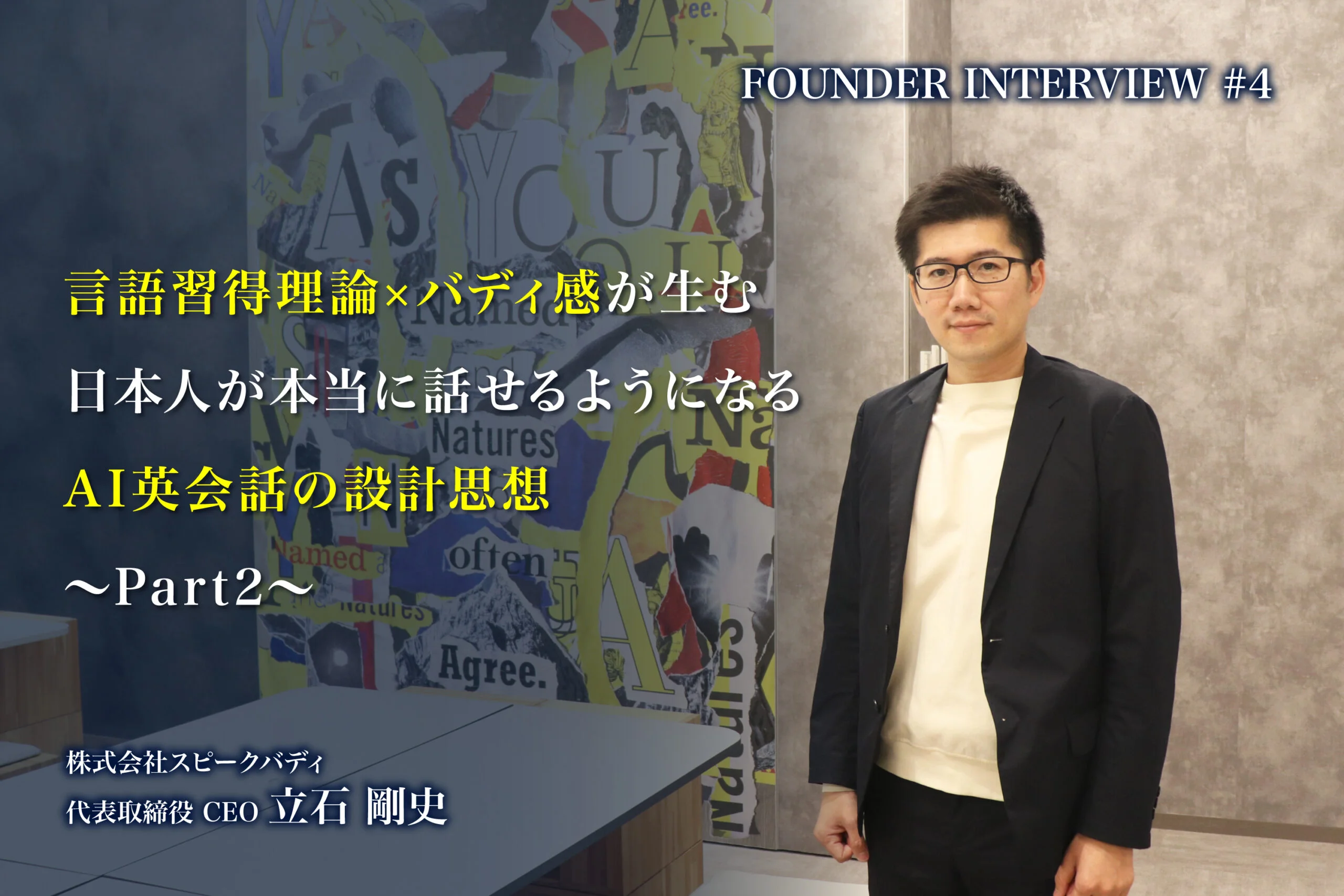
Design Concept that Combines SLA Theory and a Sense of Companionship to Truly Teach Japanese People to Speak
In Part 1, President Tateishi shared the story of how 5,000 hours of studying led to his mission of utilizing technology to tackle the challenge of learning English.
In Part 2, we dig into the core of SpeakBUDDY’s rapidly growing AI English conversation service, which has been adopted by over 300 companies. What is the decisive difference between SpeakBUDDY and major competitors like Duolingo or Speak?
Beyond simply being available anytime, anywhere, for anyone, President Tateishi discusses their unique Second Language Acquisition (SLA) theory and meticulous design philosophy that enables Japanese learners to achieve true fluency.
(This interview was conducted in March 2026.)
◆The Four Pillars of SpeakBUDDY’s Competitive Advantage
Sugihara:
Now that we’ve heard the particulars of how SpeakBUDDY came about, could you explain to our readers about your company’s AI English conversation service that has come this far?
Tateishi:
SpeakBUDDY is an English conversation service where you practice with AI characters, which we call “Buddies”, rather than human instructors. It’s not just a back-and-forth exchange with these Buddies, though. The service is designed so you learn essential expressions through immersive storylines. These expressions are categorized by level, allowing users to master key phrases suited to their specific proficiency in each lesson.
There are four key reasons why this approach is superior to face-to-face lessons.
The first is that you can learn anytime, anywhere.
The second is that it is significantly more affordable than hiring human tutors.
The third is particularly relevant for Japanese learners, who often feel embarrassed about making mistakes or intimidated by talking to foreigners. With an AI, those barriers vanish, so you can make mistakes and learn with total confidence.
The final reason is learning efficiency. AI-driven analysis allows for a more effective learning cycle than a human teacher can provide.
AI English conversation excels in these four places.
Sugihara:
The anytime, anywhere aspect is a big one. How long does a typical lesson take?
Tateishi:
A single lesson is completed in about 15 minutes. We’ve heard from many users that even online video lessons can be a hassle because they feel they have to dress up, do their hair, put on makeup, etc., before jumping into a call with a human instructor. Our app eliminates that friction, allowing people to learn whenever they have a spare moment without any preparation.
◆Where SpeakBUDDY Differs from Duolingo and Speak
Sugihara:
Recently, we’ve seen a rise in similar services like Duolingo and Speak. Could you walk us through where SpeakBUDDY excels and what makes it unique compared to those other players?
Tateishi:
We have immense respect for Duolingo as a service. However, we view them more as a comprehensive learning platform focused on vocabulary and grammar rather than specialized for speaking. Because they prioritize gamification, they are an excellent entry point for beginners to engage with a new language as if they were playing a game.
In contrast, we are hyper-focused on speaking. For the Japanese people who have studied English to some extent in middle and high school but still find themselves unable to speak, SpeakBUDDY is the more effective fit.
Regarding Speak, the US-based AI app that also focuses on verbal expression, I believe we have the edge in two areas. The first is ease of use. Our UI and UX are meticulously crafted to be intuitive, making it easier for users to build a daily habit. The second is our scientific foundation. We’ve integrated rigorous Second Language Acquisition (SLA) theories into the very core of our design to ensure users achieve actual fluency. The fusion of these two elements is where we stand out.
Sugihara:
I’ve noticed the app can be quite persistent with having me review expressions right when I’m about to forget, ha ha.
Tateishi:
That’s the idea! Our review system is based on Ebbinghaus’ “forgetting curve”. We ensure that learning is reinforced through spaced repetition to guarantee retention. Packaging such high-level pedagogical expertise into an app is one of our greatest strengths.
The other differentiator is in the name itself: the “Buddy”. While apps like Speak can feel like you’re talking to a somewhat mechanical interface, SpeakBUDDY is built on storytelling and rich character development. We’ve created a world where you interact with human-like IP (original characters) within realistic scenarios, and that fundamental philosophy sets us apart.
Sugihara:
The character design is certainly distinct. You encounter characters like a boss with a realistic Indian accent, which makes the conversation feel grounded in the real world. The entire app feels like one cohesive universe. Is this design aesthetic a point of particular focus for you?
Tateishi:
Absolutely. We are a company that is obsessed with design, and I take great pride in our incredibly talented design team. We even received the Good Design Award in 2021.
Actually, our entire design team currently consists of international talent. I’ve always personally loved the type of UI/UX aesthetics found in the West, so having international designers lead the creative process is a defining characteristic of our product.
At our core, we believe that consistency is key to language acquisition, and the key to consistency is enjoyment. Internally, we often use the terms ‘Buddy-ness’ or ‘Buddy sense’ to describe how we want every aspect of our app experience, from the characters to the interface, to embody a sense of companionship and rapport.
◆Over 300 Clients: Rapid Growth in the Corporate Market
Sugihara:
Have you been putting a lot of effort into developing your corporate client base? What kind of companies are adopting your services, and what are their primary objectives?
Tateishi:
We have focused heavily on corporate expansion over the last three years. Due to the increasing need for communication driven by corporate globalization, we have now surpassed 300 corporate clients. Most companies implement the service as part of their self-improvement programs or employee benefit packages.
In terms of industries, while we naturally serve global enterprises, we’ve seen a recent surge across all sectors due to a recent trend towards management of human capital. More companies want to support their employees’ self-development through paying for our services. After all, there are people who genuinely want to improve their English in every company. We see a particularly high rate of adoption in the IT, manufacturing, and customer service industries. We already provide sector-specific content, and we plan to further strengthen our corporate-oriented curriculum moving forward.
Sugihara:
What kind of feedback are you getting from these companies?
Tateishi:
It’s incredibly rewarding to hear from HR managers that their employees no longer feel a resistance to speaking English or that they have begun participating proactively in international meetings. We often hear from HR and training coordinators that they have never seen such a positive internal response to an English training program before.
Sugihara:
I see, so the employees themselves are reporting their satisfaction back to the HR department.
Tateishi:
Right, and then the number of applicants for the program is often multiple times higher than the original estimated number of applicants. Apparently, the turnout has been up to ten times higher than for in-person English conversation training. I’m pretty sure the fact that you can start so casually, with such a low barrier to entry, must be a big factor.
We’re also seeing significant adoption in the hospitality sector, such as hotels. With the rise in inbound tourism, SpeakBUDDY is proving very effective in lowering the so-called “English allergy” barrier for staff when international travelers drop by their shops or hotels.
◆More Employee-Friendly than Traditional English Training
Sugihara:
In many large Japanese corporations, English training often comes with rigid requirements, like having to achieve a specific TOEIC score.
Tateishi:
That’s true. Traditional corporate English training usually felt like a burden…you had to hit a certain score, or you might even have to pay for it yourself if your attendance was too low. SpeakBUDDY’s greatest strength is its ability to be offered to a wider range of people at a lower cost. Instead of a mandatory chore, it becomes an employee benefit that people want to take advantage of.
Sugihara:
That approach is only possible because so many of your customers study consistently. Is the corporate segment still growing at this point?
Tateishi:
Yes, it’s continuing to grow very rapidly. If there are any companies out there struggling with their English training programs, please do introduce them to us, ha ha!
~To be concluded in Part 3~
Interview conducted by D-POPS GROUP’s advisor Genta Sugihara.
SpeakBUDDY, Ltd.
President and CEO: Tsuyoshi Tateishi
Address: 3F +SHIFT Nihonbashi Sakuradori, 3-14-3 Nihonbashi, Chuo-ku, Tokyo
Established: May 2013
Website: https://www.speakbuddy.com/en
In the third and final part of the interview, we discuss:
・Gathering all employees together for an honest confession of short funding
・Building a great company that balances autonomy and discipline
・Creating an AI language learning startup that will drive globalization in Asia
・And other topics
Be sure to check it out here:
https://d-pops-group.co.jp/en/column/speakbuddy-part3/