

COLUMN

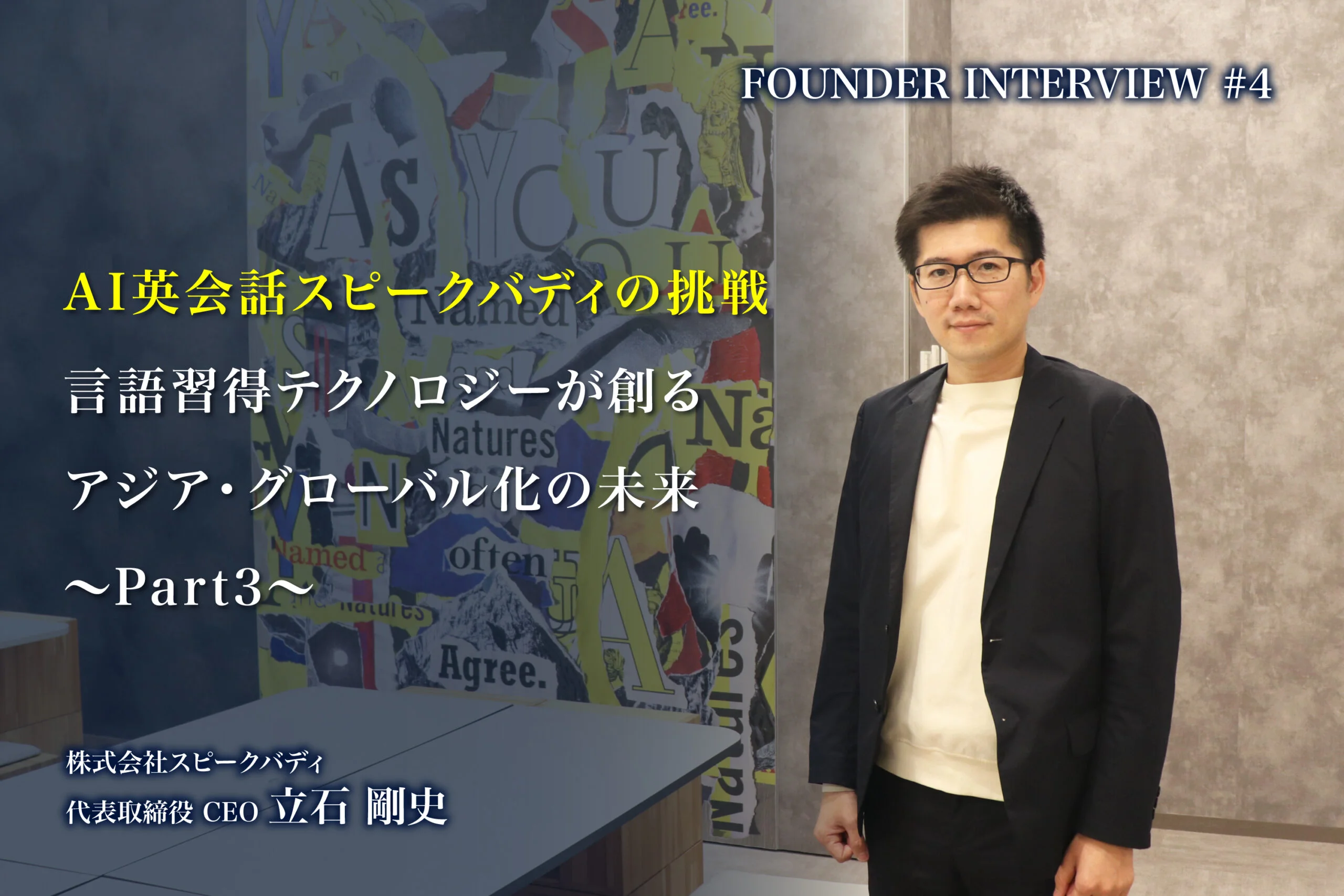
[Founder Interview #4] Tsuyoshi Tateishi (SpeakBUDDY) – Part 3

  • Interview
2026.04.28

The Challenge for an AI English Conversation App:
Creating a Language Acquisition Technology to Globalize Asia

In this final part of our three-part series, we look back at the greatest crisis SpeakBUDDY faced in its 13-year history.

President Tateishi shares how he navigated a dire situation, with only three months of runway left, by being brutally honest with his employees. We also discuss the company’s unique organizational culture, where a multinational team of over 10 nationalities balances autonomy with discipline, and explore his grand vision for leading Asia’s globalization. Finally, we reveal how their partnership with D-POPS GROUP is accelerating SpeakBUDDY’s ambition to become a unicorn company. (This interview was conducted in January 2026.)

See Part 1 and Part 2 of the interview here.

◆Understanding How Long a Year Can Feel to an Entrepreneur

Sugihara:
It has been exactly 13 years since you founded your company. During that time, you’ve navigated various shifts, including the COVID-19 pandemic. Looking back over these 13 years, what were the major turning points or obstacles that you encountered, both personally and as a company?

Tateishi:
While the company was founded quite a while ago, for the first three years, I was developing non-AI English learning apps and operating solely on my own personal capital. The situation changed dramatically around 2016, when we pivoted fully to AI-driven English conversation and began receiving investment from venture capitalists.

In that sense, it has been a long road. One thing that surprises you when you become an entrepreneur is that one year feels incredibly long. You’ve likely heard of Janet’s Law, which suggests that time feels like it passes faster as you get older. By my seventh year at the investment bank, my colleagues and I would often say, “This year is already almost over!” I think that happened because I had mastered most of my tasks, the work had become routine, and there were fewer new stimuli.

However, when you start a business, new challenges appear one after another, day after day. Each time, you have to acquire new skills or come up with fresh solutions. This density of experience makes a single year feel exceptionally long. Doing that for over a decade has been a very lengthy, yet fascinating process.

Regarding the COVID-19 pandemic, AI English conversation benefited a lot from the stay-at-home environment at first. However, as the period of restricted travel dragged on, Japanese people sadly stopped studying English. With no business trips, no international visitors coming to Japan, and no overseas vacations, their opportunities to think about English virtually disappeared. The entire English learning industry slumped, and it was a very difficult time for us. Fortunately, demand has now fully returned.
◆The Ultimate Crisis: An Honest Confession with 3 Months of Runway Left

Sugihara:
Of all the situations you’ve faced over the years, if you had to pick one, what was the biggest hurdle? And more importantly, how did you manage to overcome it?

Tateishi:
It was undoubtedly the period during the lead-up to our funding round, when our runway (the time left before we ran out of cash) was nearly gone. In a startup setting, you’re constantly accelerating hiring to fuel growth. When the pressure to raise capital hit at the same time as the need to keep the organization unified, it was incredibly intense.

Developing AI services is a marathon. At first, the tech can’t quite match human performance, so you go through years of not being able to amount to much. But then, you hit a tipping point where the AI suddenly starts outperforming humans, and growth just takes off. 2019 was that turning point for us, and it was also our hardest year.

We were right on the cusp of our Series A, but we only had about three months of cash left in the bank. I was running myself ragged trying to secure funding, while the team seemed—at least to my eyes—a bit too relaxed. Eventually, I couldn’t bear the stark contrast between my stress levels and their composure any longer.

Until then, I had kept our financial numbers and cash flow concerns private because I didn’t want the team to worry, but I had finally hit my limit. I called everyone together and told them honestly, “This is exactly how much cash we have left, and this is how much we burn every month. If you do the math, we have three months. Our payday is the 25th, so I can pay you this month, but three months from today, I won’t be able to pay you any more.”

I knew the risk that everyone might jump ship. But I couldn’t keep going with that emotional disconnect, so I decided to put all the cards on the table.

While one person did choose to leave, the remaining ten members said, “Let’s find a way to push through this together,” and they really worked hard. That moment erased the inconsistency I had been feeling, and seeing them commit gave me the courage to keep going myself. First, I went to my former boss and humbly asked for a bridge loan to extend our runway by another three months. Then, during those three months, a new feature we developed became a massive hit.

Our KPIs skyrocketed, and revenue went up as well. People started telling me, “Since you’ve come this far, I’ll throw in my investment.” We successfully raised about 300 million yen in our Series A. That was the most grueling time of my life. Since then, I’ve made it a point to share the details of our company’s expenses and exactly how much cash we have on hand.

Sugihara:
By doing that, I imagine the employees feel like they are truly in the same boat.

Tateishi:
Exactly. At the end of the day, you can’t reach the same decision if you don’t have the same information. I believe that if you make that information open to others, you’ll eventually reach a shared understanding.

◆A Team of 10+ Nationalities: The Strength and Struggle of True Diversity

Sugihara:
SpeakBUDDY is a remarkably global company. About a third of your employees are non-Japanese, representing over ten different countries. What are the benefits of this multinational team, and what challenges have you faced?

Tateishi:
It’s a bit of a chaotic mix, ha ha. ‘Diversity’ sounds great as a buzzword, but in reality, managing it is incredibly difficult. Everyone has different perspectives and values. It’s a constant challenge to keep everyone aligned.

However, the upside is that it naturally brings in ideas we never would have had otherwise. We can flexibly adopt global best practices and viewpoints that aren’t bound by Japanese common sense. Plus, since we are a language company, many of our Japanese hires join specifically because they studied English and want to work in an international environment. For them, working in a cross-cultural team is a source of genuine professional fulfillment.

From a management standpoint, it’s a huge strength. For specialized roles where the domestic talent pool is small, such as engineers and designers, widening our search to include global talent allows us to hire elite performers. Although, running all-hands meetings in both English and Japanese with simultaneous interpretation can be rough, ha ha.

◆Encountering D-POPS GROUP

Sugihara:
You recently attended our business briefing and social gathering. What were your impressions?

(Click here to read more about the event.)

Tateishi:
I was primarily struck by the sheer number of people in attendance, since they were all executives! It made a deep impression to see leaders of that caliber listening so intently to our story, asking sharp questions, and offering collaboration ideas on the spot.

During the formal briefing, I felt a bit of a distance, but once the drinks started flowing at the social gathering and we got into our personal stories, I felt like I was immediately accepted as a companion. I really felt that D-POPS GROUP is a company with a strong family vibe.

Actually, we have a new feature currently in the R&D stage that hasn’t been released yet. When I shared the idea at the briefing, the reaction from the audience was overwhelming. Afterward, our Executive Officer Morimoto and I were talking about it, and we’re pretty sure that idea is going to be a hit. Having that kind of validation from a room full of entrepreneurs gave us the confidence that we’re heading in the right direction.

Sugihara:
SpeakBUDDY already has many supporters and investors. Why did you decide to accept our investment, and what has the experience been like so far?

Tateishi:
The biggest reason was that President Goto, and you as well, really listened to us with such sincerity. It made us really want to grow alongside you. D-POPS GROUP is a very unique organization, and there are many elements of your company that make me think, “This is the kind of company I want to build.”

When we were raising the funds, I told my team, “I want entrepreneurs whom I truly respect to become our shareholders. I want us to aim to become a company like D-POPS GROUP, so I absolutely want to accept their investment.” My thoughts at the time were, “I want us to learn from you, so please invest in us!”
◆Building a Great Company that Balances Autonomy and Discipline

Sugihara:
Regarding our company’s aim of realizing a Venture Ecosystem, are there any parts of that vision that resonate with you?

Tateishi:
Above all, I deeply resonate with your commitment to developing unicorns. To be honest, I’ve never been the type of person to put stickers on my laptop, since I always felt, “I don’t want to ruin a machine that I’m trying to keep clean!” However, since the D-POPS GROUP unicorn sticker has a genuinely cool design, and more importantly, it serves as a constant reminder of your ambition for us to reach unicorn status, I decided to put that sticker on my laptop.

Sugihara:
We really appreciate that, especially since you don’t even put your own company’s stickers on it, ha ha!
Now, where do you see SpeakBUDDY in 5 to 10 years?

Tateishi:
Over the next five years, our vision is “to become the AI language acquisition startup driving Asia’s globalization”. And in ten years, we want to fully realize our mission: “Open a world of opportunities by achieving true language acquisition.”

Lately, one thing I’ve been consciously trying to pursue is “to build a truly great company”. This may be an abstract goal, but I want SpeakBUDDY’s very existence to make people say, “I’m glad this company exists.” To achieve that, I feel like we really need to return to the roots of our mission, vision, and values.

Organizationally, we spent the last year significantly strengthening our discipline. Startups are often free-spirited, autonomous environments, and we ourselves operate on a hybrid model centered on full-remote work. I’m personally someone who didn’t originally like to create rules, but as we grew past 60 employees, errors and accidents inevitably started to occur. So, I decided to steer us toward a culture that strongly asks for discipline and accountability.

I recently read that “only by balancing autonomy and discipline can one create a great company”, and it struck a chord. Autonomy without discipline is chaos, but discipline without autonomy is stagnation. I want both at a high level.

Sugihara:
Autonomy and discipline seem like opposites, but they are actually two sides of the same coin. At companies like Google, the environment looks free, but the governance and the focus on achieving goals are incredibly intense. You are free to choose how you work, but you are also held totally responsible for the mission. Both aspects co-exist.

Tateishi:
Very true. That’s directly related to the recent moving of our office and us paying closer attention to the culture we’re building.

◆From Asia to the World: Leading Global Integration

Sugihara:
Do you have concrete plans or an outlook for expanding into the market in Asia and the rest of the world?

Tateishi:
We do. While we’ve temporarily paused our efforts to enter the Taiwanese market, we’re looking at opportunities to move into East Asia first, followed by Southeast Asia. Ultimately, we want to expand to Europe and the rest of the world.

Sugihara:
Right, since Southeast Asia alone has a population of over 600 million.

Tateishi:
It is a remarkably attractive market. There are billions of people worldwide struggling with English, so we want to provide our services to them, for sure. First, we’ll focus on succeeding in Japan, and then scale up from there.

◆A Message to Readers: “A New Way to Master English”

Sugihara:
Finally, do you have a message for our readers? This column is read closely by executives, entrepreneurs, and investors who have a real eye for professionalism.

Tateishi:
Everyone can feel the staggering pace of AI evolution every day. In an era like this, I believe we are being asked to question traditional methods and try something new. For English learning, too, I encourage everyone to try different methods from what you’ve done before.

At the risk of sounding biased, I believe English is only going to become even more important for business professionals as AI makes international collaboration easier. We are seeing an increasing number of young people for whom English fluency is a given. We hope the professionals currently leading our industries will also take advantage of SpeakBuddy to brush up on their language skills, develop their own unique English style, and not get left behind by the younger generation.

Interview conducted by D-POPS GROUP’s advisor Genta Sugihara.

SpeakBUDDY, Ltd.

President and CEO: Tsuyoshi Tateishi
Address: 3F +SHIFT Nihonbashi Sakuradori, 3-14-3 Nihonbashi, Chuo-ku, Tokyo
Established: May 2013
Website: https://www.speakbuddy.com/en
Related Articles

[Founder Interview #6] Hiroshi Yamaguchi (Aoyama-Itchome Chiropractic Clinic) – Part 3
An Executive’s View on the Importance of Health in Avoiding Mistakes in Management, and a Message to Startups In this final installment of our three-part interview, we hear about Director Yamaguchi’s altruistic habits that paved the way for his numerous television appearances. He also shares priceless quotes from Soichiro Honda (the legendary founder of Honda Motor Co., Ltd., who frequented the high-level clinic where Director Yamaguchi was training) regarding the fundamental reason executives must remain healthy and the speed of executive decision-making. Finally, we discuss the parallels between a thriving Venture Ecosystem and Director Yamaguchi’s philosophy of looking at how a system connects overall. (This interview was conducted in March 2026.) See Part 1 and Part 2 of the interview here. ◆The Move to Aoyama-Itchome and the Spirit of Altruism that Led to Appearing on TV Sugihara: You have been running your chiropractic clinic in the Aoyama district for a quarter of a century now. Could you share the story of how you relocated to your current spot? Yamaguchi: Actually, I originally opened my practice in Shibuya. However, back in those days, the area around Tower Records in Shibuya had aggressive street hawkers who would even grab women by the arm to try and sell something to them. My patients would frequently give me feedback such as, “Today as well, I got intercepted twice on my way here,” or “The streets are so crowded, it’s not easy to walk down them.” I decided it was time to find a new location, and at the time, I noticed that areas like Omotesando and Gaienmae already had chiropractic clinics with active websites, but Aoyama-Itchome had none. I figured that if my existing Shibuya clientele used the Hanzomon subway line, switching to Aoyama-Itchome wouldn’t be too much of an inconvenience. When I visited the neighborhood myself, I saw that the streets were wide enough, and in the year 2000, I officially relocated to Aoyama-Itchome. Shortly after, the Oedo Subway Line opened, making our accessibility even better. Around the same time, a number of major television networks besides NHK began setting up their offices in Minato Ward. Consequently, assistant directors from various TV programs started calling my clinic requesting research on chronic stiff shoulders and lower back pain. Instead of just giving them quick answers over the phone, I took the time to meticulously summarize my responses into Word documents, email them over, and even send out documents by post. Then suddenly, one of them asked, “Would you be willing to appear on TV?” That single moment became the catalyst for my appearances on a wide variety of television programs. Later on, he was promoted to a full director, and I asked him, “Why did you choose me out of all the practitioners in Tokyo?” He replied, “More than anyone else, you responded to me politely, putting together and mailing professional documents. I promised myself back then that the moment I was given my own show, you would be the very first person I called.” In the words of business philosopher Kazuo Inamori, this is the “spirit of altruism”. I didn’t do all that expecting something in return; simply treating that director with sincerity in my heart eventually came back to me in a much more impactful way. If I had approached the person while specifically looking to get something, it probably wouldn’t have turned out that way. When I share this story with the executives who visit my clinic, many of them say, “It’s the same with business management.” Many of them have experienced that rather than demanding to get something, doing something sincerely for another person is what ultimately results in receiving something in return. ◆Essential Reasons Why Business Leaders Must be Healthy, According to Soichiro Honda Yamaguchi: At the clinic where I trained, a lot of our regular clients were business executives. One particular story from that time is still being passed down to this day. It involves Soichiro Honda, the founder of Honda Motor Co., Ltd. I never met Mr. Honda face-to-face myself, but one of my senior colleagues was responsible for treating him. One day, my colleague asked him, “Mr. Honda, as the head of a massive corporation, you carry an immense workload. Yet you don’t seem to suffer from any specific pain or physical ailments. So, why do you make it a point to come here so regularly?” I was told Mr. Honda replied like this: “As the leader of a company, there’s no feeling like when business is going well and you’re blowing the trumpet to command everyone to advance. However, there are times when you must stop that advance, and you sound the trumpet to signal a retreat. If you don’t time that retreat well, you will severely damage the company. But unless you are in good health, you will not be able to sound the retreat accurately, and that is why I keep coming here.” This quote was passed down among my senior colleagues. It reminds us that for a business leader, staying healthy is not simply a matter of managing one’s physical condition, but rather, it is the very core of being able to correctly make important decisions. I heard another fascinating story about Mr. Honda. While the clinic’s director was treating him, the director mentioned that the car seats of that era (which were so soft that drivers would sink deeply into the cushion) were not good for the body. Mr. Honda said, “I see,” and left, and then the next day, a whole team of Honda engineers arrived at our clinic. Apparently, they sat down with the director and drafted a seat schematic. That prototype seat was immediately used in the next vehicle models they released. What amazed me most was how fast his decision-making ability was, and that when he realized “This would be a benefit for our drivers,” he put it into action by the next morning. I deeply felt the significance of having a leader who can move like that. ◆The Japan Posture Education Association – Spreading the Value of Alignment Globally Sugihara: While running your clinic in Aoyama for a quarter of a century, you have also been busy with various other activities. Could you tell us about your work with the Japan Posture Education Association? Yamaguchi: The goal of this association is to train people to understand the fundamental importance of posture and communicate it clearly to others. Our ultimate mission is to support both mind and body through proper posture, contributing to a long-lived, healthy society. While almost everyone knows that posture is important, it’s actually difficult to explain in an accessible way why it matters, what’s wrong with having bad posture, and how to correct it. To address this, we established the formal qualifications of “Posture Education Advisor” and “Posture Education Instructor”, and we train people in attaining them. We also host seminars tailored to interested parties as well as to those aiming to become educators. ◆Lectures at the Open University of Japan: The Secret Behind a Course So Popular, It’s Lottery-Based Sugihara: Something else you’ve been doing for many years is teaching at the Open University of Japan. What kind of audience are your courses geared toward, and what are they about? Yamaguchi: Initially, I taught a course titled “Posture and Health”. Later on, I handed that class over to a younger instructor from our association, and now I teach a course titled “Building an Undefeatable Body with the Study of Posture”. Not many students of the Open University of Japan are pursuing a college degree; most of them are after personal and social enrichment. A lot of them are in their 40s, 50s, and 60s, you know. My course doesn’t include any aspect of chiropractic medicine at all. Sugihara: So it’s designed for those from the general public who seek enrichment. It must be very popular. Yamaguchi: Somehow, enrollment has to be determined by a lottery system every single time. It has become one of the most highly attended courses at the Open University of Japan. Before the pandemic, there were even students who would fly in from places like Hokkaido and Kyushu just to attend. Because it’s structured as an intensive course with eight modules on Saturdays and Sundays, out-of-town students can attend on weekends while staying one night in a hotel. Simply hearing stories of such dedication is enough to make us instructors even more motivated to give the lectures our absolute best. ◆Venture Ecosystem and Chiropractic Philosophy: Resonating With Making Big-Picture Connections Sugihara: At D-POPS GROUP, our aim is to realize a Venture Ecosystem through integrating “Real World × Technology × Synergy”. We are building a platform where companies both within and outside our group are supported not just through funding, but through sales cross-promotion, talent recruitment, etc. Do you feel like any of these have something in common with your initiatives, or are there any points you particularly resonate with? Yamaguchi: Where I deeply resonate with your vision is looking at the overall flow and connections, rather than focusing on a single, isolated part. For us chiropractors, too, if a patient bumps their elbow and experiences numbness in their pinky finger, for example, we don’t just treat the pinky; we analyze their posture overall to figure out why that happened. Similarly, for stiff shoulders, we look beyond the shoulders themselves, checking the height of their computer monitor, their chair’s position, and their environment in general to help their shoulders get better. I feel like where your perspective aligns with mine is the way we look at something through its connections. Sugihara: The part you said about improving the overall flow is really true. During our company’s regular board meetings, the executives from all of our group companies give their progress reports, and then afterwards, they have a second meeting where they share their concerns and dilemmas, and discuss their ideas and experiences with each other. We also maintain the same kind of relationship with companies outside our immediate group, which are members of our Venture Ecosystem through our corporate investments. It’s never just about the money; we co-pitch to clients, introduce human resources, and connect them with key customers. That is exactly what it means to improve the flow within an ecosystem. And while we’ve been talking, I think that’s really similar to healthy blood circulation. Yamaguchi: Blood circulation gets hindered by the physical fatigue of supporting the body’s own weight, but it’s also affected by mental, neurological exhaustion. While you can reduce physical fatigue simply by exercising, in the case of mental fatigue, you can stimulate serotonin production, boost creativity, and stabilize your feelings by being emotionally moved or laughing deeply, or even by taking a slow morning walk in the sunlight, synchronizing your breath with your stride. You can see why so many business leaders go on walks in the morning. I suggest not wearing sunglasses for your morning walks, unless your eyes have some medical condition that won’t allow it. When direct sunlight enters your eyes, it dramatically increases serotonin secretion. This fact is thoroughly verified by scientific researchers. ◆A Message to Our Readers: The Greatest Doctor Is Inside Your Own Body Sugihara: To bring our interview to a close, do you have a final message for our readers? Yamaguchi: I urge everyone to invest in their bodies and their health. After all, your health is directly linked to your business performance. Where do you think the world’s greatest doctor resides? At a famous university hospital? The truth is, the best doctor in the world lives inside your own body. The moment something goes wrong, your body alerts the brain, and the brain immediately sends corrective measures back to the body. Your autonomic nervous system is responsible for this. Most of the autonomic nerves travel through your spine to your organs and limbs. In other words, your spine’s health is extremely important to your whole body’s health. Furthermore, your spine and your posture are equal. If your posture gets out of shape, your spine will also get out of shape. Therefore, keeping good posture is connected to maintaining your autonomic nervous system. Once again, if you don’t keep moving your joints, you won’t be able to. If your body remains continuously slouched, it will gradually lose the ability to straighten out entirely. That is exactly why you must make a conscious, daily effort to move. Your investment in your health is an investment in the success of your business. I sincerely hope these insights offer some support to you all. Thank you very much. Interview conducted by D-POPS GROUP’s advisor Genta Sugihara. Aoyama-Itchome Chiropractic Clinic Director: Hiroshi Yamaguchi Address: 740 Win Aoyama, 2-2-15 Minamiaoyama, Minato, Tokyo Website: https://aoyama1.jp/
  • Interview
2026.06.02
[Founder Interview #6] Hiroshi Yamaguchi (Aoyama-Itchome Chiropractic Clinic) – Part 2
The Body is an Executive’s Precious “OS”: Maximizing Productivity by the Investment of One’s Posture In this second part of our three-part interview, we dive deep into the profound impact that loneliness and mental stress can have on executives’ physical bodies. We reveal the striking parallels between a professional’s perspective—analyzing patients’ walking style, facial expression, and tone of voice before they even sit in the chair—and an investor’s evaluation of an entrepreneur’s “human OS”. Director Yamaguchi also shares the fundamental, biological truth that posture and facial expression mutually reinforce each other, and he opens up about the exact moment that set him on his lifelong path to chiropractic medicine. (This interview was conducted in March 2026.) If you haven’t read Part 1 yet, you can do so here. ◆An Entrepreneur’s Body is Like an “OS”, and Posture is an Investment towards Maximizing Productivity Sugihara: I believe this topic is incredibly vital for young entrepreneurs in the IT and tech sectors. Many of these founders belong to a generation that has had a smartphone in their hands for as long as they can remember. Could you break down what happens when you have poor posture in a way that speaks directly to them? Yamaguchi: As I emphasized earlier, I want leaders to view correcting their posture not simply as a health routine, but as a direct investment to ensure the success of their current business—an investment to maximize their productivity. For corporate executives and others who work in startups, your physical body is like your OS (Operating System). No matter if you have amazing software (i.e., your skills and strategies), they’re meaningless if the underlying OS isn’t running smoothly. That OS is your own body. Sugihara: Right, if the OS is full of bugs, you won’t be able to realize the framework you’ve envisioned in your head, even if you have great apps. Yamaguchi: Precisely. While your health is not all about posture, posture is still a deeply important part. That is the exact message I want to convey. ◆Stress Stiffens the Body: the Mechanism of Mental Fatigue Sugihara: Within D-POPS GROUP, we have 25 group companies and have invested in about 30 other portfolios. Their leaders are all working incredibly hard across various fields to solve pressing social issues. However, various forms of pressure—such as cash flow issues or HR problems—start to hit once people step into an executive role, yet many find themselves in a position where they can’t talk about it with anyone. Call it the loneliness of leadership if you will, but they have to persevere while carrying burdens they can’t share. Does this kind of condition easily contribute to physical ailments? Yamaguchi: There is physical fatigue, which comes from holding up or carrying something. But there is also mental and emotional fatigue; the exhaustion caused by constantly having to be overly mindful of others, the pressure of endless problem-solving, or being caught in the middle of conflicting parties. This also can cause muscles to stiffen. In fact, while physical fatigue can be relieved to some extent by moving and stretching, mental fatigue often causes a greater effect on the physical body. Take the old Japanese idiom, “Drowning in debt so deeply your neck won’t turn”. Continuously worrying about something or experiencing hardships one after another causes your neck and shoulders to become incredibly stiff, leading to insomnia, migraines, etc. People in ancient times were purposely verbalizing those exact physical symptoms. That phrase describes one of the classic physical symptoms triggered by extreme stress. When the idiom was coined, the word “stress” didn't even exist, but to put it in modern terms, “stress physically prevents your neck from turning”. I once treated a CEO from a foreign company who didn’t know much Japanese. Suspecting that his chronic headaches and neck pain were purely stress-induced, I asked him in English, “How do you like your new boss?”, to which he replied, “He’s a pain in the neck.” In Japanese, the equivalent phrase would directly translate to ‘He hurts my head’, but it’s clear that in both Japanese and English, people express the biological truth that stress targets the neck. ◆Cranial Nerves Directly Affect the Neck and Shoulders: the Biological Mechanism of Stress Sugihara: So, continuing to internalize all that pressure will impact the body. Yamaguchi: Exactly. People who spend an entire day working alongside someone they have to tiptoe around or completely clash with, they’ll often have stiff necks and headaches by evening, even if they weren’t sitting down. That isn’t physical exhaustion; it comes entirely from emotional fatigue. The reason for this is that most movements below the shoulders are controlled by nerves originating from the spinal cord—a body part with no emotions—so no matter how mentally exhausted or stressed you are, your arms or legs won’t suddenly refuse to move. However, motions in the head, neck, and shoulders are connected to the cranial nerves, which emerge directly from the brain itself, which processes your emotions. Mental stress, anxiety, frustration, and worry travel directly along those nerves, causing the muscles in the neck and shoulders to immediately tense up. There are 12 pairs of cranial nerves. Among them, the 11th pair—known as the accessory nerves—directly stimulates the major muscles responsible for moving the neck and shoulders, such as the sternocleidomastoid muscle. When this specific nerve is compromised by emotional stress, your neck won’t turn and your shoulders become as hard as rocks. Also, nerves come out of either the left or the right sides of the body. If a right-handed person experiences tension exclusively on their left neck and shoulder, there’s a chance that it’s not being caused by a behavioral habit like how they hold their smartphone, but rather, it might be resulting from a cranial nerve. ◆The Path from Young Train Enthusiast to Chiropractor Sugihara: Spoken by a true professional, ha ha. By the way, had you been aiming for this specific career path since your student days? Yamaguchi: No, not at all, ha ha! Back in my student days, I was completely obsessed with steam locomotives. I spent all my time traveling across Japan, from the wilderness of Hokkaido down to the southern tips of Kyushu, just to take photos of trains. I was a total fan of train photography. But since I had absolutely no money, I traveled on an incredibly grueling budget and schedule. I’d catch a train at midnight, scramble to make a transfer around 3:00 AM, and finally arrive at my destination around 6:00 AM. Combined with the return trip home, it was quite rough on my body. My family home was in Shinjuku, so I would frequently drop by the Kinokuniya bookstore to stand in the aisles, using books about stretching as references. Even after graduating from university, that habit of visiting Kinokuniya stuck with me. One day, while wandering through the orthopedics section, I found a book written by a chiropractor titled Improper Backbone Shape Triggers These Illnesses. When I picked up that book, I had no idea what was inside, but it became the very reason why I entered the chiropractic world. The book’s contents were absolutely fascinating to me. Until that moment, I had always assumed physical pain was exclusively caused by overdoing things or bumping into something. But this book claimed that poor posture alone could cause problems for all sorts of body parts. I found it so intriguing that I immediately called the phone number printed in the book, and they pointed me toward an institution where I could actually study chiropractic medicine. ◆Quitting a Job, Working Part-Time Every Night, and Studying until Morning Yamaguchi: I agonized over the decision for a few months, but I finally made up my mind, quit my corporate job, and worked part-time while studying. At the time, I worked at Potomac, a traditional-style coffee shop inside the Akasaka Prince Hotel. My shifts ran from 4:00 PM until 12:30 AM. Afterward, I’d get a ride back to my home in Waseda and keep studying until daybreak. However, that study schedule didn’t bother me in the slightest. Perhaps because my sympathetic nerves were stimulated from my part-time job, I was able to stay very focused deep into the night. Just like when I was studying for university entrance exams, my brain was operating at full power. Every single day, I would completely lose myself in anatomy textbooks until dawn. Just as it was becoming light outside and people were starting to walk around, I’d fall asleep. Then, I’d wake up in the afternoon, and head back to work again. Looking back, I sometimes wonder if my father’s experience as a combat medic treating wounded soldiers in the war got passed down to me through DNA or something. He wasn’t a military surgeon, but as a combat medic, he still treated countless individuals under extreme pressure. I am not a medical doctor either, but the fact that I have dedicated my life to preserving people’s health makes me feel connected to him somehow. Sugihara: How many years ago did you first become independent? Yamaguchi: My first time trying to go independent was about 40 years ago. I was naive, so I simply registered my home address as a chiropractic research institute and mailed advertisements to dozens of companies listed in the quarterly business journal. I remember pouring a drink and eagerly waiting by the phone to see how many responses I’d get…but of course, there weren’t any, ha ha. There were no personal computers back then, so I had simply typed a plain text document on a word processor. No diagrams, and no one whom I could use as a reference. It was just a letter stating, “I wish to help meet the health needs of your company’s employees.” However, when I shared what I was doing with my mentors and close friends from university, three of them actually went out of their way to negotiate with their respective employers. They managed to get permission for me to utilize their companies’ medical rooms and employee lounges once a week or twice a month. Instead of having to force my way in, I was able to build up my practice through those companies officially. Later on, I was contacted by a famous practitioner in Shibuya who recruited me into one of Japan’s top-tier chiropractic clinics. Their clients were prominent figures from various fields, including three former Prime Ministers, professional athletes, executive members of major businesses, major real estate companies, and the aviation industry, well-known celebrities, etc. Sugihara: And you call that your ‘training period’? Ha ha… Yamaguchi: Yes, that really was my training period before I went independent. At that clinic, some of the patients wouldn’t pay any attention to me, but when the director entered, they would smile happily and start a conversation. When I saw that, it ignited a fighting spirit inside me. After all, it was perfectly natural that none of them would be particularly interested in talking with a young kid, since they were coming to see the director, who they felt would keep their bodies in good health. At some point, I had the thought that I would become like him someday. ◆A Professional’s Perspective: Analyzing a Person through Walking Style, Facial Expression, and Tone of Voice Sugihara: In your line of work, dialogue must be a critical component of administering an effective treatment, right? Yamaguchi: It is absolutely necessary. Observing the way a patient walks through the door, their responsiveness when speaking, or any subtle deviations from their usual baseline is part of the treatment, not just the physical adjustment. Keep in mind that patients who are bordering on clinical depression, for example, present themselves with a rounded spine and a downward gaze the moment they enter. Even the person’s response to a greeting can signal that something is not right. I approach every treatment by holistically evaluating a person’s walk, sitting posture, facial expression, and voice. Sugihara: I resonate with that deeply. Back when I worked in business development, and even now when I interview entrepreneurs as an investor, it is exactly the same. Naturally, I ask structural questions about their business model, market domain, and technical solutions. However, what I am truly analyzing is the expression on their face when they walk into the room, the level of confidence radiating from their answers, and the way their eyes light up when you hit them with a poignant, spot-on question. My primary goal is to thoroughly evaluate the individual’s underlying OS. It’s the same sort of evaluation. Yamaguchi: I actually conducted a survey among students at Waseda University regarding their impressions of individuals with rounded backs. The overwhelming responses were descriptions like “lacks confidence”, “frail”, or “looks like life isn’t going well”. Furthermore, a slouched posture is a primary reason people look prematurely aged. Conversely, an upright, elongated spine not only projects youthfulness but physically lifts the muscles that control facial expression and optimizes blood flow to the brain. When posture collapses, cerebral blood flow stagnates, causing brain activity to decelerate. Correcting your alignment is truly a strategic investment that simultaneously optimizes both your internal state and your external presence. Sugihara: Absolutely, a slouch immediately projects a lack of confidence. I pay close attention to facial micro-expressions during interviews as well. Occasionally, someone will give off a distinct negative vibe or energy. No matter how eloquently they speak, it makes me pause and reconsider forming a deep partnership with them. Alternatively, when reconnecting with an entrepreneur after a while, even if they say, “I’m doing great,” I will cross-reference that statement against their posture, eye strength, and overall expression. If I sense an underlying misalignment, I gently prompt them to tell me if anything is wrong, and adjust how I interact with them if necessary. Yamaguchi: Facial expressions dictate your physical state, and your physical state dictates your facial expressions. This goes both ways. For example, when a patient’s stomach lining is inflamed, the distress often manifests as acute tension in the upper back. While I cannot physically massage someone’s internal organs, relieving the tension in the back muscles can indirectly soothe the stomach. The same principle applies to depression. By physically unburdening and loosening the spine, I can often alleviate some of the emotional weight clouding the mind. The body and the mind are profoundly and inextricably linked. ~To be continued in Part 3~ Interview conducted by D-POPS GROUP’s advisor Genta Sugihara. Aoyama-Itchome Chiropractic Clinic Director: Hiroshi Yamaguchi Address: 740 Win Aoyama, 2-2-15 Minamiaoyama, Minato, Tokyo Website: https://aoyama1.jp/ Next, in the third part of the interview, we discuss: ・The move to Aoyama-Itchome and the spirit of altruism that led to appearing on TV ・Essential reasons why business leaders must be healthy, according to Soichiro Honda ・Similarities with a Venture Ecosystem ・And other topics Be sure to check it out here: https://d-pops-group.co.jp/en/column/aoyama1-yamaguchi-part3/
  • Interview
2026.05.29
[Founder Interview #6] Hiroshi Yamaguchi (Aoyama-Itchome Chiropractic Clinic) – Part 1
Before Your “Health Circuit Breaker” Trips: What Executives Need to Know About the Body’s Warning Signs and the Power of Posture For this installment, we interviewed Director Hiroshi Yamaguchi, a chiropractic professional with a career spanning nearly 40 years. After encountering one single book, Dr. Yamaguchi quit his job to pursue chiropractic medicine, studying while working part-time jobs in the evenings, and began working at a chiropractic clinic in 1987. Driven by a desire to practice a treatment philosophy aligned with his own values, he went independent and opened the Aoyama-Itchome Chiropractic Clinic, which has been operating to this day. He has treated a cumulative total of over 90,000 patients. As a director of the Japan Posture Education Association, he has taught courses at the Open University of Japan and appeared across various media platforms, serving as a prominent figure in the field for many years. We sat down with Director Yamaguchi to learn a professional’s perspective on why leaders ought to consider their bodies as an asset, which provided critical insights for building a Venture Ecosystem. (This interview was conducted in April 2026.) ◆What is a “Health Circuit Breaker”? — The Moment the Body Hits Its Limit Sugihara: One passage from the pre-interview report you shared with me left a deep impression on me. “For people who work incredibly hard, even if they aren’t sick, sometimes their physical health will very suddenly fail. I think of this as a “health circuit breaker” tripping. To use an electrical analogy, it’s like running your appliances right at maximum capacity, and the moment you turn on the microwave, the breaker trips.” I think a lot of people have seen this happen to themselves or their coworkers. Could you elaborate on the intent behind these words? Yamaguchi: When you are throwing yourself entirely into your work, you are usually aware that your body is tired. But if you aren’t experiencing actual pain, how do you react to that? Most people think, “If it doesn’t hurt, I must be fine. I can keep going.” This sort of “no pain means I’m fine” mindset is exactly what makes it easy for your health circuit breaker to trip all of a sudden. Even when the body is fatigued, even when joints are stiffening and muscles are swimming in lactic acid, it can still maintain high performance. This is because the body secretes “hustle hormones” like adrenaline to override the fatigue. Furthermore, the brain has a built-in filter that blocks out minor discomfort signals so they don’t disrupt our focus. In fact, if our brains didn’t do this, we wouldn’t be able to get any work done. To return to the electrical analogy, if an average person operates on a 30-amp capacity, an adrenaline-fueled executive’s capacity gets up to nearly 60 amps. Even while using a massive amount of electricity, the breaker doesn’t trip. However, because a person like that is running so close to the limit, the smallest, most trivial thing could suddenly blow the entire circuit. What I hope is that leaders will intervene before their bodies reach that point. ◆The Body Speaks in Tension and Stiffness, Not Words Yamaguchi: At the stage where you start thinking, “Am I using too much power?” like in the electrical example, tension and stiffness are the body’s signals. I want people to catch themselves at that exact stage and do something about it. Your body cannot communicate in words. Instead, it uses stiffness and tightness to tell you, “I’m exhausted”. For example, it can’t say, “If you stay seated for another 30 minutes, your lower back is going to seize up when you stand.” Instead, it gives you a heavy, dull ache while you sit. Your body gives you these kinds of signs. The thing that’s dangerous to do is to mask that discomfort with painkillers and keep pushing. There was a case where a patient repeatedly took medication to numb back pain and be able to keep playing golf, only for it to escalate into excruciating agony. The person finally went to the hospital, and learned it was a compression fracture. This is the equivalent of a small fire breaking out in your house, the smoke detector going off, and you disabling the alarm because it’s too noisy. If you ignore the warning, the entire house burns down. I am by no means anti-medication; it is absolutely necessary. However, using medicine solely to silence pain so you can continue working past your limits will result in damaging your body. Sugihara: I am sure this hits home with many of the executives and hard workers reading this right now. There must be a lot of people who experience a dull, lingering ache in their backs that they don’t think they could convey to a doctor even if they went to a clinic, but then the moment their stress levels drop, it vanishes naturally. At least, I know I myself experienced that during times when I had a lot of stress, ha ha. ◆What Diverse Leaders from Office Workers to Cruise Ship Captains Have in Common Sugihara: For our second question, from what professional backgrounds do Aoyama-Itchome Chiropractic Clinic’s patients come? Yamaguchi: The majority of my clients are everyday office workers and homemakers. However, I also treat a significant number of business executives and high-profile leaders. For instance, the captain of one of Japan’s largest luxury cruise ships is a regular patient. While a cruise ship’s route is predetermined, it is the captain’s responsibility to assess the waves and wind conditions in real time, deciding whether to steer slightly ahead or take a wide detour, and ensuring the passengers enjoy the safest, most comfortable voyage possible. In short, they are the ultimate decision-makers responsible for thousands of lives. Because of that heavy burden, they realize their own bodies must remain healthy. That is the mindset that brings them to my clinic. Sugihara: That’s a great point. To use a corporate analogy, the ship’s crew members are the employees, and the passengers are the customers receiving the service. The captain is the President or CEO. If the person at the top isn’t healthy, you simply cannot provide a safe, high-quality service. Yamaguchi: Precisely. Businesses are the same way. I also treat a woman who served as a top executive for a world-renowned theme park. She oversaw multiple massive divisions, including the theme parks, retail shops, music, and films, and she achieved incredible results. Even though she is highly dedicated to her own personal fitness training, she visits us regularly in order to keep up her physical condition. She once told a friend of hers, who was the CEO of a TV network, “The only reason I can perform this job properly is because I have a chiropractor looking after my body.” The role of chiropractors is to act as the behind-the-scenes supporters who help leaders to be able to succeed and smile, so hearing that was incredibly rewarding. Another long-time regular is a legendary broadcasting executive who led Japan’s massive transition from analog to digital television. The switch required replacing every single piece of broadcasting equipment and receiver in the country. He had to negotiate extensively with major electronics manufacturers, saying, “The networks are switching to these specifications, so you need to build products that match them.” For the manufacturers, making massive financial investments to build new factories in an uncertain climate was an immense risk. One of his subordinate directors later visited my clinic and admitted, “I could never have pulled off a negotiation that intense.” So, the fact that we enjoy seamless digital broadcasting today as a matter of course is entirely due to the grueling efforts of leaders like him. He came to us during a time when his body was under severe physical strain, and I am profoundly grateful I could be of some help. I urge everyone in your Venture Ecosystem, please take care of your bodies. Despite their demanding schedules, many of the executives who visit us make time for sports and hobbies—golf, tennis, mountain climbing, playing musical instruments, and so on. I like to ask them, “What do you do with your sports gear or instruments after you finish using them?” Almost all of them reply, “Of course, I clean and maintain them thoroughly before putting them away.” It certainly feels good to see your beloved tools looking nice and clean. Now, all I’m asking is for you to take just a fraction of the care and respect you show your gear, and direct it toward your own body. Strangely, many leaders meticulously maintain their equipment but leave their own bodies pushed to the absolute limit. If you keep stacking task after task onto an exhausted body and falling asleep without first winding down, fatigue will build up until it manifests as severe, debilitating symptoms. Even if it’s only for a brief moment in between tasks or after getting home, slowly stretching your joints and muscles will improve blood circulation and be beneficial to your health. ◆The Terrible Experience and Perception of Posture Both Shared by Executive Regulars Sugihara: You’ve shared several fascinating case studies of high-level leaders. Assuming their initial visit to your clinic was triggered by acute physical discomfort, do they typically continue to visit you on a regular basis? How do they end up there? Yamaguchi: Of course, I get many patients who only walk through my door after their circuit breaker has already been tripped. However, there are plenty of corporate executives who establish a routine of regular visits explicitly to prevent that breakdown from happening in the first place. The reason is simple: almost all veteran leaders have suffered some sort of terrible experience at least once in their past. They know from firsthand experience that if you wait until the system crashes to seek help, the pain is severe, it takes time, and it costs money as well. They have learned for themselves that regular maintenance ensures that symptoms remain mild or are prevented entirely. The more seasoned the executive, the better they understand the strategic value of regular checks and corrections. Unfortunately, they almost always have to go through a painful experience to learn that lesson initially. It is easy for people to respect conditions like bone fractures because the pathology is visible on an X-ray. Conversely, it’s much harder to keep in mind the compounding value of maintaining proper posture and proactively conditioning the body. People frequently interpret good posture as simply one type of hygiene, but actually, I want to tell people that keeping proper posture is an investment that leads to the success of what they’re doing now. Companies have a leader at the top, the directors, the employees, their families, clients, and shareholders. The physical vitality of that leader directly dictates the performance of the entire organization. Therefore, health is an investment towards realizing your corporate vision. ◆The Mechanics of Poor Posture: What Happens When We Stop Moving? Sugihara: Depending on the industry, leaders face vastly different physical environments. Some stand all day, while others are entirely sedentary. For executives, sitting in a boardroom for a five-hour marathon meeting is part of the job. What kind of negative mechanical impact does prolonged poor posture have on one’s physical health? Could you walk us through that specific mechanism? Yamaguchi: To put it basically, humans are animals. As the word suggests, we’re supposed to move. *Note: ‘animal’ in Japanese is dobutsu (動物), which literally translates to ‘moving thing’. When you sit for hours without moving, freezing your joints and leaving your muscles unengaged, your blood circulation stagnates. Blood is the transit system responsible for delivering oxygen and vital nutrients throughout the body while carrying away metabolic waste. What happens when that infrastructure stalls? Imagine forcing an employee to work from dawn until dusk while denying them meals and locking the restrooms. Anyone would collapse under those conditions. When you sit continuously and restrict your blood flow, that exact same systemic deprivation is occurring inside your tissues. Specifically, habits like crossing your legs or staring down at a low monitor compound this structural stress. The point I emphasize most heavily to patients is the layout of the environment where they spend the vast majority of their lives: the height of the chair, the height of the desk, the position of the monitor, and the ergonomics of the keyboard. This setup is critically important. Not just for five or ten minutes, you are locking your body into these positions for hours on end, so how it’s set up has an immeasurable impact on your body. Sugihara: I try to be mindful of it, but maintaining perfect posture over a long period feels incredibly difficult. Before I know it, my alignment slumps. Furthermore, modern business professionals can accomplish work via a smartphone, so is it definitely bad to have a posture that’s looking down? Yamaguchi: When you use a smartphone and tilt your head forward by 15, 20, or 30 degrees, the burden on your neck increases dramatically. It’s said that the posture typical of smartphone usage can be equivalent to placing roughly one-third of your entire body weight directly onto your neck and shoulders. The human head alone accounts for approximately 10% of your total body weight. Think of it like holding two 2-liter plastic water bottles. If you hold them tightly against your chest, it requires very little effort. But if you extend your arms straight out in front of you and try to hold those same bottles, the physical leverage multiplies the strain. Your muscles will give out in less than five minutes. That exact compounding fatigue is what accumulates in your upper back and shoulders every time you look down at a screen, triggering chronic shoulder stiffness, tension headaches, and an inevitable drop in mental concentration. The above illustration shows how much the tilt of one’s head impacts the strain on one’s neck. ~To be continued in Part 2~ Interview conducted by D-POPS GROUP’s advisor Genta Sugihara. Aoyama-Itchome Chiropractic Clinic Director: Hiroshi Yamaguchi Address: 740 Win Aoyama, 2-2-15 Minamiaoyama, Minato, Tokyo Website: https://aoyama1.jp/ Next, in the second part of the interview, we discuss: ・An entrepreneur’s body is like an “OS”, and posture is an investment towards maximizing productivity ・Stress stiffens the body – the mechanism of mental fatigue ・The path from young train enthusiast to chiropractor ・And other topics Be sure to check it out here: https://d-pops-group.co.jp/en/column/startupecosystem-part2/
  • Interview
2026.05.27
Back to COLUMN