

COLUMN

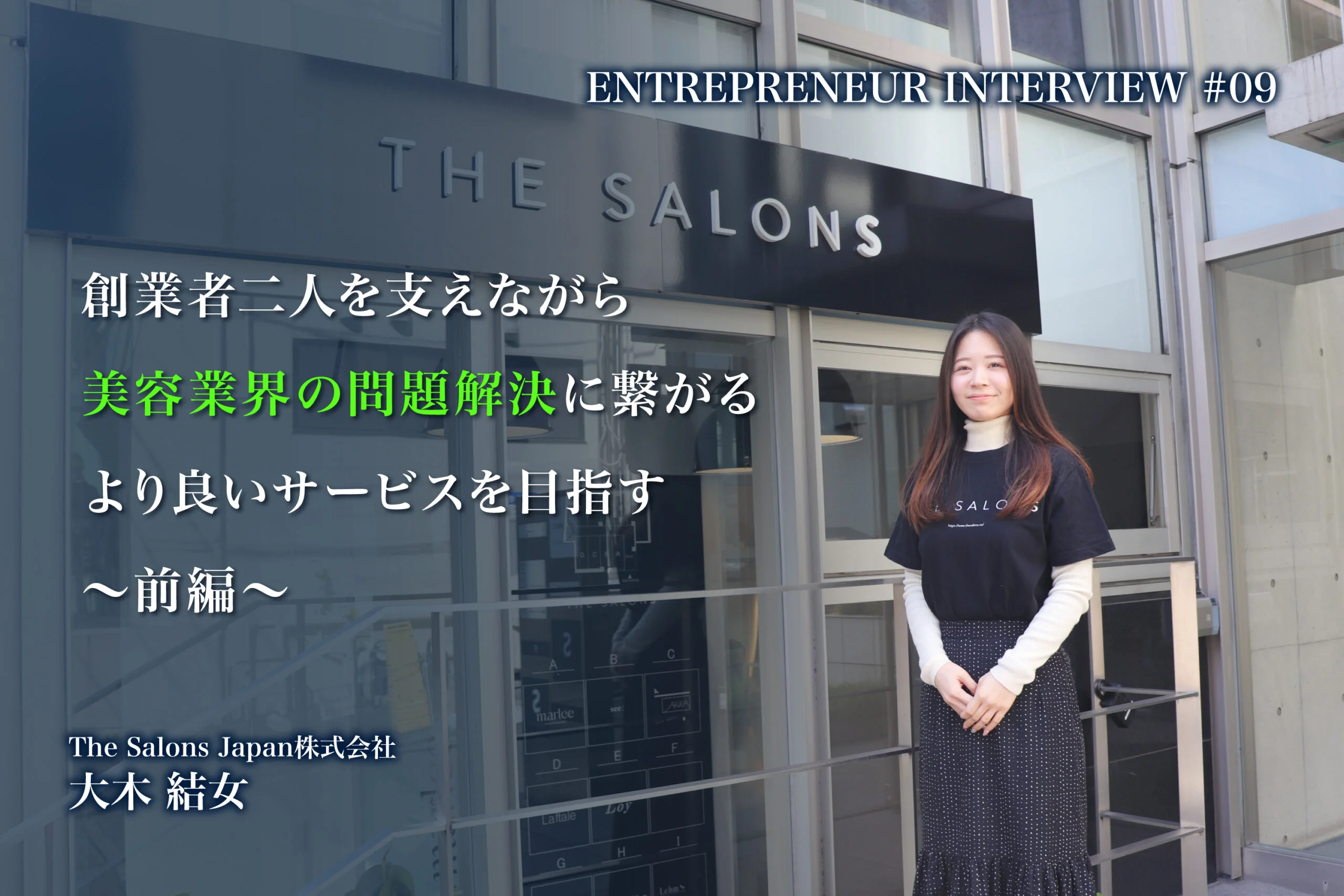
[Entrepreneur Interview #09] Yume Oki (The Salons Japan) – Part 1

  • Interview
2025.02.13

Aiming to Improve Services to Solve Problems in the Beauty Industry While Supporting Two Founders

Last year, our company entered into a strategic capital and business alliance with The Salons Japan, Inc., which leases private salon studios for professional beauticians, and we began our journey together as partners in the Venture Ecosystem.

☆You can see the press release regarding this strategic capital and business alliance with The Salons Japan Inc. on the following page:
https://d-pops-group.co.jp/en/column/the-salons-japan/

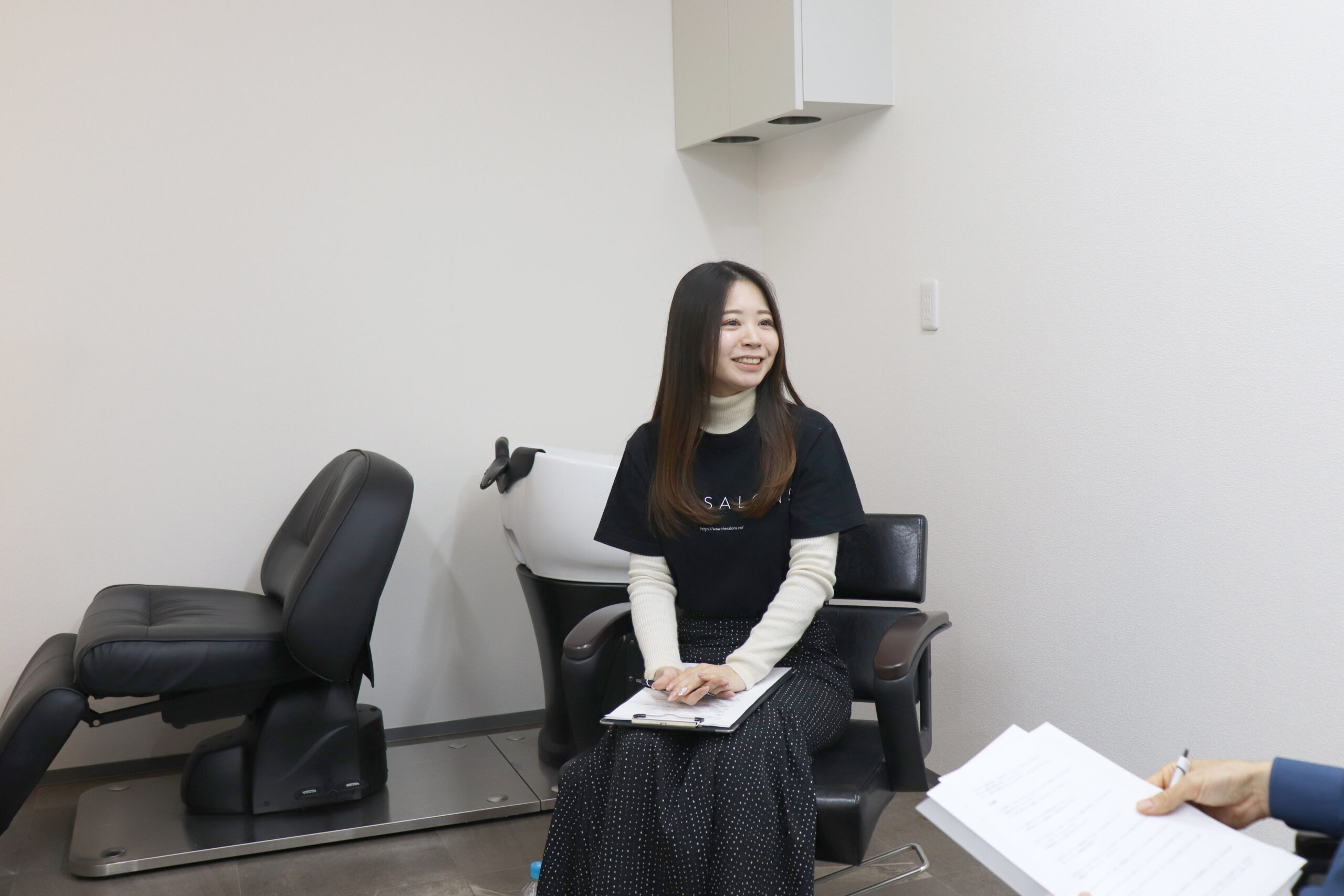
For this article, we interviewed Yume Oki, the first employee at The Salons Japan supporting the company’s two founders. (This interview was conducted in January 2025.)

◆The Path to Joining the Company

Sugihara:
Today, we are interviewing Yume Oki, The Salons Japan’s first employee. Thank you for your time. To start, could you tell us about how you came to join The Salons Japan?

Oki:
The first member I met was Director Kuboshima. I had previously worked as a receptionist at a hair salon. Knowing my background, Director Kuboshima told me, “Actually, we have a private salon studio leasing business at our company, The Salons Japan.” I felt that this beauty mall service could solve the issues I had felt were a problem when I was working at the salon reception. Because of that, I became very interested in The Salons Japan and hoped to join the company.

Sugihara:
When did that happen?

Oki:
I first met him in 2019, and I joined in April 2020. It was right at the start of the COVID-19 pandemic.

Sugihara:
The Salons Japan was established in November 2018, and the first location opened in 2019, so you became the first employee following the two founders. Could you tell us about your current role at The Salons Japan?

Oki:
My main duties are handling inquiries from beauty professionals and managing the facility viewings that accompany them. I conduct the viewings together with President Shimizu, our CEO, and arrange the procedures up to the application and contract stages.

I also handle various arrangements for new store openings, contract writing, and tasks related to facility management, such as setting up communication devices. I also handle correspondence with external vendors and take care of troubleshooting.

Sugihara:
So, you also manage contracts! I would assume the number of tenants moving in is high, but just how many contracts have you prepared at this point?

Oki:
Yeah…I can’t even count them, ha ha. Initially, I had no knowledge of contracts or real estate, but for contracts related to our company, I can now explain the important points written in them. I prioritize communication most highly in my work. Not just day-to-day communication, I make sure to properly convey important things while empathizing with the other person’s feelings.

This is where my previous experience as a salon receptionist truly comes into play—making sure communication isn’t one-sided and staying close to the other person’s feelings. Since my reception work included customer support and handling complaints, I value using feedback to solve problems, as this is a step towards continuous improvement.

Sugihara:
That’s wonderful. Do you feel that experience in the beauty industry is necessary to handle contracts and viewings for THE SALONS?

Oki:
Yes, I think it might be smoother for someone who has been involved in the beauty industry compared to someone who has experience in real estate.

However, this is also the most frustrating part for me: while I have been involved in the beauty industry, I am not a practitioner myself. When I meet beauty professionals, I feel there is a mutual understanding that exists only between them. Sometimes, when a viewing progresses quickly, I get asked, “Are you a beauty professional?” Every time that happens, I get this mild sense of regret that things would be even better if I were one.

After all, during viewings President Shimizu often says, “I’m a beauty professional too!”, ha ha.
◆The Difference Between THE SALONS and the Shared Salon Model

Sugihara:
Now, we hear the term “shared salon” quite frequently. But could you explain how THE SALONS is different from a shared salon?

Oki:
Certainly. The clearest difference is that while typical shared salons offer only chairs or semi-private spaces for rent, THE SALONS provides fully-partitioned individual units that can be used in the same way a business owner can use a street-facing storefront.

With the chair rental model I just mentioned, even though the entire floor is rented by the operating company (as is the case for THE SALONS), the control of all sales and operations is tied to the owner that rents to the beauty professionals.

However, at all THE SALONS locations, we obtain permission from the building owners to treat each private studio like a separate salon. Therefore, the biggest difference is that our clients can operate as if they owned their own shops, and build track records as business owners even though they’re renting private rooms.

Sugihara:
So, they can truly become the owner of their own shop. In that case, I guess there are beauty professionals who choose THE SALONS after comparing with shared salons?

Oki:
Yes, absolutely. And quite a few people switch to THE SALONS from shared salons, as well. We also think there must be some professionals who wish to be independent but can’t immediately afford to move into THE SALONS.

We now offer many plans to lower the barrier slightly. However, the people who are not fully decided are probably more interested in hearing “By becoming independent at a shared salon or chair rental space, you can increase your salary” than “You can have your own shop.”

However, I get the idea that those who consider both and ultimately choose THE SALONS are often those who eventually want to open a ground-level shop.

Sugihara:
I haven’t seen any advertising put on the outside of THE SALONS’ private studios. Is this because most of the salon owners’ clients are already fixed?

Oki:
Basically, yes. While some are aiming to attract new customers, the overwhelming majority of salon owners already have a secure client base. To explain why, I’ll use the shared salon model as an example for comparison. Shared salons take a percentage of sales, and seat usage fees are in the tens of thousands of yen.

If a stylist makes ¥500,000 in monthly sales, their payment might be 10% (¥50,000) plus the seat usage fee. In our THE SALONS model, the cost to rent a space is around ¥300,000 to ¥400,000 per month. This amount is difficult to afford for those who don’t have established sales. Therefore, when they consider their revenue, my impression is that most have the confidence that their customers will reliably follow them.

◆Characteristics of THE SALONS Studio Renters

Sugihara:
What kind of people are most of THE SALONS studio renters?

Oki:
Beauty professionals generally have an intense desire for improvement, and my overall impression is that most of them have very strong personal preferences. However, there are surprisingly few clashes or facility-related troubles between them. To help prevent such issues, we set a rule that price lists and menu displays are not to be shown on the outside of our salon studios.

Also, since our salon studios are private, most are operated by appointment only, and the customers go directly to the studio where their reservations are. Given that, I don’t think customers typically wander around inside of THE SALONS checking out all of the different studio spaces. As a result, there is no competition between our salon studio renters for customers nor for staff.

Sugihara:
Are there any success stories of beauty professionals who went from ordinary employees to becoming salon owners after moving into THE SALONS?

Oki:
Yes, there are! Salaries in the beauty industry are expected to be low. Working hours are long even though the pay and benefits aren’t great, and it takes a long time to become a full-fledged beauty professional. But one individual, after having worked under those conditions for a long time, joined THE SALONS and received a sevenfold increase in income.

Sugihara:
A sevenfold increase in income?! That’s incredible!!

Oki:
It is! I was truly shocked when I heard that. Of course, I couldn’t ask for details about the person’s previous salary, but the fact that it increased sevenfold was one surprising thing, and it also left me thinking that if such growth is possible, the potential for THE SALONS tenants is truly unlimited.

Also, the use of THE SALONS spaces is varied. One salon started with a single studio space, but their sales grew faster than expected, so they hired employees and decided to rent the neighboring spaces. In the end, they expanded to a total of four studios.

Oh! And this is a super heartwarming story, but there was a lead salon owner and an assistant who rented a studio together. They both increased their sales, and the assistant eventually “graduated” and began to rent a separate studio.

The fact that someone who started out in THE SALONS chose to rent another of our studios even after attaining independence showed that they thought highly of THE SALONS’ service, which made me very happy.

Sugihara:
So, what this means from a beauty professional’s perspective is this. In the shared salon model, payments to a shared salon owner increase proportionally as sales increase, while payments to THE SALONS are fixed, so anything above those fixed costs becomes capital for their own salon. In that respect, they are truly the owners of their own business. Speaking of which, are all your tenants able to handle the business management aspect of things?

Oki:
Business management is what everyone worries about most, at first. When giving facility tours, we meet a lot of people who say, “I don’t know anything about running a business.” However, since it essentially becomes their own salon, they have to learn as they go. Of course, if they do have questions, our company is happy to provide support.

Now, one impressive thing about beauty professionals is how many of them are truly dedicated to learning. Some consult with tax accountants on their own, while others start by figuring it out themselves and then hire tax accountants when they incorporate their businesses.

Sugihara:
Does THE SALONS provide services to tenants for introducing tax accountants and such?

Oki:
Yes, we do. Tax accountants offer their services at a special rate for THE SALONS members. As for social insurance consultants and lawyers, in case our tenants have any issues or troubles, we are connected with individuals who are available for consultation. However, this is not a package deal…we can introduce them to lawyers and consultants who are familiar with THE SALONS’ services, but the contract is directly between them and the professional.

Sugihara:
President Shimizu once told me a story about a very popular salon owner who kept money in a cardboard box for a while after moving in, ha ha.

Oki:
Ha! Yeah, we do have people like that. When they first open their salons, they have so much to do that they get overwhelmed and lose their composure.

Along those lines, the rent at THE SALONS includes utilities. I think people who are busy might forget to pay if they have too many bills, so we hope this arrangement reduces the hassle of payments. Some tenants really are that crazy busy at the start.
◆Characteristics of THE SALONS Facilities

Sugihara:
I’m sure it would be helpful to have a single, all-inclusive payment like that.

Now, to change the subject, THE SALONS had opened a total of seven locations until last year. Do they each have a unique characteristic?

Oki:
First, we have one consistent, overall design concept: not to upstage the individual salons. From a stylistic standpoint, the common areas tend to be simple rather than overly extravagant, so that they won’t offend most people’s tastes.

However, while the Omotesando location was initially founded on a really simple white design, it has gradually evolved. President Shimizu often talks about a “New Vintage” or American hotel style, so while we stayed out of the way of the salon studios, we upgraded the design of the common areas by trying to add light gray tones to make them more satisfying.

Also, at the Harajuku Cat Street location, we upgraded the space by addressing two issues that were brought to our attention. Since THE SALONS houses many individual salons, many people walk through the common areas, and the sound of footsteps is sometimes bothersome. So, starting with the Harajuku Cat Street location, we’ve been installing carpet tiles to dampen the sound. Secondly, since pure white floors show dirt easily, we’ve been changing to a slightly darker color. These improvements from previous locations are used to upgrade other locations in the future.

Then there's atmosphere. The Aoyama location is below the ground level, so we added extra lighting to make it feel less subterranean, and we utilized the existing steel doors to create a somewhat warehouse-like ambiance. It’s full of President Shimizu’s distinct personal touch.

For the Harajuku Cat Street location, President Shimizu started to entrust some of the decision-making to me. I got to help choose materials for the flooring and other things! And for the Shinjuku location opening this month, we decided on everything together with the new members who joined the team.

Sugihara:
With eight locations just in Tokyo currently, do the beauty professionals at each location have any distinctive characteristics?

Oki:
In the case of the Harajuku Cat Street location, the Harajuku area has tons of salons that specialize in bleaching and dyeing hair, so most of our tenants in that location focus on bleach and high-tone hair dyeing. Also, their customers as well as the stylists themselves are often younger in age.

By contrast, at our Ginza location, the age range of both customers and professionals is greater, and there are many high-priced salons focusing on hair-quality improvement and straightening.

At the Kichijoji location, which is a bit more suburban, there are many community-focused salon owners. Many of their clients apparently live nearby, and all of the beauty professionals there say they want to continue working in Kichijoji. I feel that many of them put a high value on creating an at-home atmosphere.

Sugihara:
What is the occupancy status of your locations?

Oki:
Almost all locations are fully booked. Currently (as of January 2025), the only studios available for immediate move-in are one at our Aoyama location and two at our Harajuku location.

The Kichijoji location is completely full, and yet there are people who come for viewings who tell us, “We want to move in as soon as someone leaves”, which makes us feel very grateful.

◆ Challenges and Sense of Fulfillment

Sugihara:
After working here for the past five years, do you want to share any stories about challenges you faced or satisfying moments?

Oki:
One big challenge was when we were getting ready to open our Aoyama location, and the communication equipment shipment was delayed. We had placed the order, but due to the global semiconductor shortage, we were told the equipment wouldn’t arrive on time…

Since the Aoyama location has a basement floor, nothing could be done there without a Wi-Fi connection. The time when we had to rely on pocket Wi-Fi was the biggest pinch. Because they were small devices, they would overheat when everyone was using them. So, we placed fans in front of the machines to cool them down, and in order not to overuse them, we used every other trick in the book before connecting to them.

Having no internet meant our tenants couldn’t take appointments, they had no way to process their sales, and they couldn’t receive contact from their customers, so it really was a terrible time.

As for moments of satisfaction, in addition to the story I shared about the sevenfold income increase, I occasionally get to hear stories from people whose working environment has improved. For example, being able to take days off on weekends and holidays.

In an ordinary salon, the days when the average working person is free are the busiest days. However, since their loyal customers will come on whatever days the salon owners designate, their clients are understanding of them taking weekends off, and I’m always very happy to hear how they can finally go traveling and stuff.

Also, at one of our THE SALONS location’s year-end parties, I heard one of the beauty professionals say, “I’m so glad I moved in!” I was so touched that I even cried a little. I felt incredibly happy to realize that we have created a service that can truly change a tenant’s life.

On a personal note, securing a salon studio contract on my own was a huge moment. It felt like my efforts had helped an individual to imagine the future and solve problems, so that was also a source of fulfillment.


Interview conducted by D-POPS GROUP’s advisor Genta Sugihara.

The Salons Japan

Company President and CEO: Hidetoshi Shimizu
Address: 2F Kid Ailack Building, 2-43-11 Matsubara, Setagaya-ku, Tokyo
Established: November 30, 2018
Website: https://www.thesalons.co/


Next, in the latter part of the interview, we discuss:

・Changes since the company’s founding
・Changes after the strategic capital and business alliance
・The founders, President Shimizu and Director Kuboshima
・The status of new store openings
・“Realizing a Venture Ecosystem”
・And other topics

Be sure to check it out here:
https://d-pops-group.co.jp/en/column/the-salons-japan-interview2-latter-part/
Related Articles

[Founder Interview #4] Tsuyoshi Tateishi (SpeakBUDDY) – Part 1
From 280 Points on TOEIC to a Perfect Score and 5,000 Hours of Studying, Forming a Belief in the Necessity of AI English Conversation In December 2025, D-POPS GROUP invested in SpeakBUDDY Ltd., the developer and operator of the “SpeakBuddy” AI English conversation app. (Read more about it here.) How did someone who was once considered the worst English student in his grade go on to build a cutting-edge, AI-powered English conversation service? In this three-part series, we look into the entrepreneurial journey of SpeakBUDDY’s founder Tsuyoshi Tateishi and the future he envisions for language learning. In Part 1, we explore his incredible transition from a low TOEIC score of 280 to 5,000 hours of dedicated study, his experiences at a foreign investment bank, and how a trip around the world sparked the idea for AI-driven English conversation. (This interview was conducted in March 2026.) ◆“Worst at English in the Entire Grade” Sugihara: To start off, could you tell us what gave you the initial push to develop the SpeakBuddy app? Tateishi: First of all, the biggest reason I chose the field of English was because I was actually terrible at it during my student years. English requires consistent, cumulative effort, but I hit a wall in my first year of junior high school and just couldn't keep up with my classes after that. By high school, my teacher told me I was "the worst at English in the entire grade." Sugihara: So the student who was the worst in his grade became the CEO of an English conversation app company, ha ha! Tateishi: Exactly. That was my reality in high school, but the turning point came during my job hunt in university. I received a tentative offer from a foreign investment bank, and starting my career there was what finally forced me to start learning. Sugihara: It was a foreign-owned firm, so didn't they interview you in English? Tateishi: Oh, they did. The final interview was in a boardroom with the then-CEO of Citigroup Global Markets Japan and a row of executives from various departments. At the time, they were testing whether candidates could handle that kind of pressure. Since investment banking is a business where people are the only real assets, they were looking for character. That 10-on-1 interview was mostly in Japanese, but at the very end, the HR Director said, “Alright, I’m going to ask you a question in English, so please answer in English.” Up until that point, all the interviewers were Japanese, so they were probably assuming, “He graduated from Keio University, so he can probably handle it.” But in fact, my English was non-existent. My TOEIC score was only 280, so I knew I wouldn’t be able to understand any questions if they asked me in English, so I had prepared exactly one response in my head: “I can’t speak English. But I will study hard. So, no problem!” I said it with total confidence, but in fact, that single sentence was the only English I had learned. Back at that time, just memorizing that one phrase had been a struggle for me! The entire room of interviewers froze. Everyone was like, “Wait, what? You applied here with that level of English? This is a foreign firm…what are you expecting to do?” However, this was during my third year of university, so I told them, “I still have one year until I graduate.” At the time, I had just become the youngest person that year to pass the CPA exam at age 20. I was studying 14 hours a day…other than study and sleep, I would spend only two hours a day to shower, eat, and commute. I was used to finishing an entire textbook in a single day. So, I truly believed it when I told them, “I have a year, and that’s enough time for me, seriously.” At the time, I figured if I could get a 750 on the TOEIC, I would be basically fluent. Compared to the CPA exam, where if you fail, you have to wait another year, I felt no pressure at all. When I said, “I’ll start tomorrow”, they looked at me and said, “You do look like the type of guy who would actually do that.” Still, I walked out thinking I had definitely failed the interview, since it was a global firm and I couldn’t speak a word of English. But later that day, someone from their HR called me. Apparently, the CEO had been my biggest advocate. He told them, “Hire that guy.” The HR worker asked me, “What on earth did you say to the CEO?” Now, what I had told the CEO was this: “I might not speak English now, but through my CPA studies, I realized there isn’t that much difference in the capacity of human brains. It’s all about having grit. I know for sure that if I put my mind to something, there’s nothing I can’t achieve, and I will absolutely get this done.” The CEO decided, “Let’s hire one interesting guy like this”, and that’s how I got the job. ◆The Problem for Japanese Who Study English for 5,000 Hours Tateishi: Over the following years, I reached a perfect score on the TOEIC, passed the Eiken Grade 1 (the highest level of Japan’s most popular English proficiency test), and logged a cumulative total of approximately 5,000 hours of English study. Through those 5,000 hours, I had a painful realization: learning English would be far more difficult than I thought it would be when I was job hunting. I realized that this might be the single greatest challenge facing the Japanese people. I struggled with it while at that foreign-owned firm, and even after I moved to a Japanese brokerage, I was stationed in Hong Kong where I had to use both English and Chinese. If you can't use the language, you simply cannot do the job. I learned enough Chinese in Hong Kong to handle daily conversation, but if people ultimately can't understand what you're saying, you can't conduct business. Japanese people are excellent workers, but just because their English isn't great, my compatriots were being looked down on by people from headquarters or other overseas branches, and I couldn't stand it. During global training sessions and such, Japanese participants may not be able to speak English at all, but when it comes to the actual work output, they are consistently the best. Changing the reality that Japanese people are brilliant but are dismissed because they can’t communicate in English became my core motivation. I spent 5,000 hours to get there, but that’s not a realistic path for everyone. I want to use the power of technology to drastically shorten that time. This is the fundamental reason I chose the field of English education and began developing SpeakBuddy. ◆Making a “Doraemon” Who Can Speak English at Home Sugihara: Did you always have the desire to be an entrepreneur, even as a student? Tateishi: I did. I remember asking during my job interviews, “If I work at this investment bank, will it help me when I start my own company later?” But after seven years of intense, high-pressure work, I had completely forgotten that dream. However, as my desire to create a service that truly helps society grew stronger, I remembered, “Oh right, I actually wanted to start a company!” So, I quit as soon as I returned from my overseas assignment. I decided to quit first, and think of a business plan later. So, with my back against the wall, I finally went on the world tour I had always wanted to do, and I mapped out my business plan while traveling. While hopping from country to country, I was also teaching myself app development. The English learning app I built during that trip actually reached number 1 in the overall App Store rankings. Sugihara: Hitting an overall ranking of 1 is incredible! Was that app the prototype for what SpeakBuddy is today? Tateishi: Yes, I’d say that was the prototype. During my world tour, I also did a short-term study abroad program. Even when you are overseas, you find yourself wanting someone to practice English conversation with. But making friends in English out of thin air is incredibly difficult. People always say, “Just get a foreign boyfriend or girlfriend”, and I actually tried to do that while I was abroad, but it’s not as easy as it sounds, ha ha! While I was abroad, I thought, “If only I had a Doraemon* at home who could speak English with me, that would be enough.” That desire to create a Doraemon who speaks English was the starting point of our service. *Note: ‘Doraemon’ is a beloved character from a Japanese children’s cartoon who always helps the other characters with their various problems. I included a voice recognition feature in that first app, and I’m proud to say it was likely the first app in Japan to feature English voice recognition. However, back in 2014, the accuracy was still quite low. But over the next year or two, I felt the technology improving at an exponential rate. I became convinced that in the future, I would be able to create a real AI English conversation partner. In 2016, I stopped everything else I was working on and focused all my resources on AI English conversation. ◆The Problem with AI-related Branding in 2016 Sugihara: When you released the precursor to your current app back in 2016, were you already using the word ‘AI’? Tateishi: Yes. Even at the 2016 launch, we were calling it ‘AI English Conversation’. Since we had no capital at the start, we began with a crowdfunding campaign. It went surprisingly well—we raised about 4 million yen—and we were already positioning it as an AI-driven service even then. Sugihara: The speed of AI adoption and evolution lately is staggering. While language models have developed explosively in the last year or two, you were really at the forefront. Tateishi: We were the only ones in that space back then. But honestly, the immediate aftermath of the release was a struggle. People in 2016 were very vocal with their skepticism, asking, “Where exactly is the AI in this?” They’d complain, “I’m talking, but this doesn’t recognize my voice at all!” Back then, AI conversation meant little more than speaking to a character with an electronic voice. The conversational AI was still in its infancy, with a simple tree structure where we programmed specific responses to specific phrases. You couldn’t engage with it via truly free conversation like we have now. In the end, because we were getting so many reviews asking “Where’s the AI?”, we actually removed the word ‘AI’ from our branding around 2017. Having AI in the title seemed to raise expectations so high that it led to people leaving 1-star reviews, so we decided to take it out for a while. Then, around 2019, speech recognition technology started to improve dramatically. We also built our own proprietary speech recognition engine, which boosted our accuracy significantly. From that point on, the quality of our conversational AI was able to truly shine. Sugihara: When I try using features like BuddyChat now, the AI responds naturally even if I say something completely random or trivial. It clearly isn’t just simple pattern recognition anymore. Tateishi: Yes, it can handle tangents and keep the conversation going. I feel like I can finally say “This is AI” with my head held high. Back in 2015 and 2016, we were right in that peak of inflated expectations on the hype cycle, which was followed by a valley of disillusionment. During that valley, people kept telling me, “AI is a joke; it’ll never work.” But gradually, it became the real deal. Sugihara: For someone who has been working on this for a decade, do you feel like it's about time for the AI boom to finally sweep across the world? Tateishi: In a way, yes. It feels like things are moving exactly as I expected, though there’s a bit of a time lag in terms of when the world finally noticed. To be honest, even with GPT, we were looking at GPT-2 and saying, “This is going to be incredibly useful.” So by the time GPT-4 arrived, our reaction was like, “Well, it’s already been impressive since the beginning.” It’s only been in the last few years that speech recognition, Natural Language Understanding (NLU), and personalized teaching methods have finally synced up. Because the level of inference has jumped so significantly recently, we can now provide high-level free talk like BuddyChat. It feels like the times have finally caught up with SpeakBUDDY. ~To be continued in Part 2~ Interview conducted by D-POPS GROUP's advisor Genta Sugihara. SpeakBUDDY, Ltd. President and CEO: Tsuyoshi Tateishi Address: 3F +SHIFT Nihonbashi Sakuradori, 3-14-3 Nihonbashi, Chuo-ku, Tokyo Established: May 2013 Website: https://www.speakbuddy.com/en Next, in the second part of the interview, we discuss: ・The four pillars of SpeakBUDDY's competitive advantage ・Where SpeakBUDDY differs from Duolingo and Speak ・Rapid growth in the corporate market and feedback from business clients ・And other topics Be sure to check it out here: https://d-pops-group.co.jp/en/column/speakbuddy-part2/
  • Interview
2026.04.15
[Member Interview #1] D-POPS GROUP President’s Office Member Shane Hetrick
Overcoming the Language Barrier to Create a More Global Venture Ecosystem ①First, please tell us about where you’re from and your background. I was born in California, but while growing up, my family moved about a dozen times to various other places in the western part of the US as well as spending seven months in South Korea. As a result, my parents, my younger brother, and my two younger sisters were the only stable figures in my life, so I had to get used to constant change from an early age. In fact, I can confidently say that learning how to deal with so many transitions had a significant impact on my life. After moving to the city of Pullman in Washington to attend Washington State University, I earned a dual degree in microbiology and genetics and cell biology. In my freshman year, I became an active member of a Christian community for university students, and even after finishing my studies, I decided to remain in Pullman and volunteer with that group for two years as an intern and then one year as a staff member. Throughout this period, I enjoyed getting to hang out with friends often, not having many responsibilities, and ultimately realizing my life’s passions. I also gained a number of critical skills which I would soon utilize in my career: developing relationships with people from both similar and different cultures, guiding and coaching university students through strategizing how to tackle their personal problems, facilitating group discussions, and—perhaps most importantly—learning how to learn. ②How many years ago did you arrive in Japan? What was your reason for moving here? Towards the end of my time in Pullman, I started to meet more and more international students from various countries, and even met a student from Kansai Gaidai University in Japan, who even became my roommate for one semester. All of them suggested very seriously that I would make an excellent English instructor, and I became quite interested in the idea of starting a brand new adventure. Looking back on it now, I suppose I had also grown restless in my relatively safe and predictable life. First, I began working part-time at my university’s affiliated TEFL (Teaching English as a Foreign Language) program for about half a year, and then started to look into different options to live abroad as an English instructor. In the end, I was offered a full-time position as a dispatch worker through a small English teaching company in Japan, and in August 2015, I moved into a Japanese family’s house in Tokyo. I had met their son while he was studying abroad at my university, and his parents graciously offered me a place to stay when they heard I would be moving to Japan. I began facilitating English lessons at elementary and middle schools, trade schools, hospitals, hotels, and various other companies throughout the Tokyo area. Some were large classes with 10 to 20 children or young adults, while others were 1-on-1 with businesspeople, and I soon became capable of teaching English to Japanese people of all ages. ③Why did you join D-POPS GROUP? During my first year of teaching English full-time in Tokyo, I encountered a local branch of the same Christian university student organization in which I had been involved before. They were low on staff, so I volunteered for them and moved into their community house while continuing to teach English part-time at various places. I met a young woman from China through this group, we got married, then we had a daughter and were expecting a baby boy. During the months leading up to his birth, I was actively searching for a full-time job to provide for our family's finances, since my wife would soon go on maternity leave and she was our main breadwinner at the time. Then, a recruiting partner of D-POPS GROUP found my profile while looking for someone with English teaching experience and a Japanese driver's license to be hired as an English-speaking chauffeur for the CEO, and offered me an interview. While I was somewhat intrigued by the prospect, the position was very different from what I had been searching for. However, once I met President Goto at the interview, something inside me changed. I was deeply impressed by how he listened to me and was genuinely interested in me as a person, and when he spoke, I immediately believed in his vision. So, last November, I decided to join D-POPS GROUP and play even a small part in creating a society that will support my children to take risks, learn, and grow. ④What kind of work are you doing at D-POPS GROUP? I was originally hired to help President Goto to improve his English through natural conversation while riding in the car. While that is my highest priority, I quickly recognized that within the flexible and swiftly-changing scene of a startup, I couldn't limit my role in our company to such a narrow task. When I’m not driving, I was given the primary task of translating the articles on our company website from Japanese to English. From time to time, I also get to use my native English skills for corresponding with foreign guests and welcoming them to our office. As much as I can, I try to help out the other members of the President's Office, too. After all, the more work they can delegate to me, the more work President Goto can delegate to them, which frees him up to do more of the things that only he can do. I receive and send letters and packages, order various supplies, issue entry passes to our office, and handle other light administrative tasks. ⑤As you drive President Goto around and help him practice his English in the car, have you gotten used to driving in Tokyo? Has President Goto’s English actually improved? Ha ha… The car that President Goto chose for our company vehicle has a number of premium features that make it easier to drive safely in city traffic. It also helps that I’ve been driving for many years, so even though the streets in Tokyo are much more crowded and narrow than the roads in the US, I have been able to get used to driving here. In fact, I am always delighted every time I have the chance to drive President Goto to his various meetings and appointments and learn something from his wise words. And yes, as President Goto is using English more consistently, he is more capable of recalling the foundation that he built as a high school and university student in the US and the UK. All I’m doing is providing him with an atmosphere where he can comfortably practice and supplying him with correct vocabulary and natural English phrasing when appropriate. He has been making steady progress, and is definitely more visibly confident when speaking English compared to a year ago. However, he often likes to encourage me by saying that he wishes his English would improve as fast as my Japanese, ha ha. ⑥You seem to have a proactive stance towards speaking Japanese with everyone around you in our office. When did you learn Japanese? Is the Japanese business lingo that we use here difficult? While I was living with that Japanese family during my first year in Tokyo, they helped me learn the fundamentals of everyday conversation, and I became capable of basic communication. However, after I moved out of their home, my Japanese level essentially stagnated, since the only time I spoke it was in the exact same situations in daily life and did not usually seek out opportunities to study and improve my language abilities. After joining D-POPS GROUP last year, I found myself in a Japanese work environment for the first time in my life, so there have been countless moments where I’ve been challenged and stretched. It’s not just that business Japanese is difficult for me to learn, but also that I had virtually no experience in the business world before starting this job. As a result, while I’m trying to pick up polite Japanese phrases that are commonly used in the office, I’m also learning about the concepts, situations, and systems behind those phrases at the same time. I want to provide as much value to D-POPS GROUP as possible, since I understand that I can contribute to society more this way. To that end, I have undertaken a lot of challenges and overcome almost as many obstacles, thanks to the patience and understanding of my excellent and gracious coworkers, though there are still many more to go. And I want to tell everyone within our Venture Ecosystem that I am always happy to practice my Japanese, so when you see me, please don’t hesitate to say hello! ⑦What differences have you felt between living and working in Japan compared to the US? In my opinion, the biggest way that life in Japan is different from life in the US is the perception of peer pressure. From what I’ve seen over the past ten years, Japanese people seem to be very considerate of other people, to the point that they try to remain aware of the outward behaviors and even the unspoken feelings of the people around them. In addition, they usually have a deep reverence for common courtesy, harmony, and consensus, and would rather inconvenience themselves than voice an opinion contrary to the majority. On the other hand, Americans place a very high value on the personal independence of the individual. From a young age, we are taught that we should think before we copy what everyone else is doing, and we prize uniqueness above uniformity. There are obviously many reasons why these two cultures are so opposite, but I think one primary root may be the lack of livable space in Japan combined with the history of frequent natural disasters here. When the threat of earthquakes, tsunamis, or other dangers is always near, and your neighbors live so close that a house fire can spread to surrounding buildings almost instantly, it becomes critical to maintain amicable relations with all the people you interact with on a regular basis, so that you can rely on their help in an emergency, rather than watch them gleefully loot your belongings as you lay dying. I’ve also noticed some smaller contrasts between Japanese and American lifestyles that our readers may find interesting. For one, Japanese tend to keep their social circles cleanly distinct from each other, so family, acquaintances, and coworkers rarely mix. Americans, however, are much less shy about introducing family to their friends and colleagues who are close to them, so I’ve had to get used to knowing next to nothing about my team members’ personal lives, even though I talk with them all the time. Another is that while most Japanese eat rice at least once a day as part of their diet, Americans aren’t usually loyal to a single staple food, and will even eat meals that contain no staple food at all. Finally, this isn’t necessarily a major difference between Japan and the US, but rather something that’s starting to change in both cultures. Until recently, fathers did not usually take a long paternity leave. However, I decided to take advantage of the Japanese government’s childcare provisions to stay with my wife and children at my parent’s house in the US for much of December and January. My coworkers at D-POPS GROUP were very supportive, and though I’ve heard horror stories of fathers at Japanese companies coming back from paternity leave to find their position relocated or minimized, in my case there was nothing of the sort. ⑧After joining D-POPS GROUP, you have been working on the English version of our company’s website. What are your most important considerations for writing English translations? First of all, I try to imagine the audience who will be reading these translations. They could be executive members of foreign companies thinking about expanding their business into Japan, or venture capital investors looking for a good return from a Japanese startup, or even members of D-POPS GROUP or our partners who simply want to practice their English reading ability. This affects the word choice and overall tone of each article I translate, and also helps me decide how to convey phrases or ideas that have no direct translations. Next, I do my best to paint a clear picture of the mission, vision, and values of D-POPS GROUP and our leaders in such a way that anyone who reads the pages of our website in English will be able to sense them through what parts are emphasized and even through the vocabulary I use. After all, I believe that the energy surrounding us really is special, so I hope to share as much of that spark as possible with our readers. Finally, since I am still quite far from being bilingual, I would not be able to accomplish the task of translating our website without the support of our corporate advisor, Genta Sugihara. Without his wisdom, experience, and especially his deep knowledge of startups and corporate venture capital, you would not be reading this now. Not only with translation, but he has also given me invaluable advice on navigating the unfamiliar world of working at a Japanese company, and I can’t express in words how much I sincerely appreciate him. ⑨In August, we hosted a group of delegates from the Japan-America Student Conference. You helped to create English presentation materials that were oriented towards students, and also did a little bit of interpretation on that day. What were your impressions of all the work that went into making those materials and what you experienced on the day of their visit? That event was my first taste of getting to work more closely with President Goto, and it was definitely awe-inspiring to witness firsthand how much thought and effort he puts into anything he does. He was put in a position where he was out of his element, and I would guess that is not usual for someone at his level of professionalism. But even in the midst of a situation like that, he was able to think strategically about what he could do in the limited time before the presentation, and also what was not possible. For example, I first prepared a script for him that might have seemed quite impressive to an academic audience in an English-speaking country. However, it contained a significant amount of high-level vocabulary he was not familiar with. President Goto pointed out to me that since he did not have a long time to prepare, it would be better for him to focus on practicing fluently speaking words he already knows than on learning a bunch of new words. Then we went back and forth over the next several weeks, refining his script and his presentation slides until he was satisfied with them. This was also an educational experience for me, as I learned that being able to reach a state of 90% perfection in a timely manner is much more important in a business setting than finally getting to the point of 100% perfection long after the deadline has already passed. When the students arrived at the Shibuya Hikarie Building, I had the honor of showing them around various parts of our inspirational office space and explaining their significance in English. Then, after we listened to President Goto and Advisor Sugihara share their lectures, I was supposed to help interpret for the students and our company leaders, but it turned out that between President Goto’s English skills and the Japanese ability that several of the American students had, I hardly needed to say anything. Given my work background in connecting with university students, I was so happy to see a deeper understanding of the value of entrepreneurship dawn on their faces over the course of our time together. ⑩What kinds of activities at D-POPS GROUP do you hope to participate in from now on? My knowledge and experience in the venture capital business is still almost zero, but someday I hope to be a more active participant in the process of welcoming new partners to our Venture Ecosystem. Over the past couple of months, I’ve been given the privilege of facilitating communication between the members of our CVC team and a pair of foreign entrepreneurs who want to more firmly establish their business in Japan. This has been exhilarating for me, and I want to increase my capabilities in this regard. Besides the CVC team, I hope to support any other conversations that take place between members of our Venture Ecosystem and non-Japanese speakers. One of my personal goals at D-POPS GROUP is to utilize my English skills to serve our expansion onto the global stage. In accordance with that, I want to keep myself available as an asset anytime there is a need for a native English speaker. Speaking of which, I'm hoping to start some English-related activities within D-POPS GROUP's Ecosystem sometime soon. If anyone is interested, please feel free to contact me! Beyond this, I’d really like to continue improving my Japanese language and business skills to the point that not only am I a professional English translator for D-POPS GROUP, but also that I prove to be truly useful in other areas. I’m excited to see what I look like after another year of working here!
  • Interview
2026.04.09
[Founder Interview #3] Ayumi Fujimoto (Startup Ecosystem Association) – Part 3
From Startup to Scale-up: Mutual Growth and Realization of an Advancing Ecosystem For this article, we interviewed the Startup Ecosystem Association’s President Ayumi Fujimoto, a leader who shares our vision for Japan’s entrepreneurial future. (This interview was conducted in January 2026.) See Part 1 and Part 2 of the interview here. ◆The Joy of Creating Something from Zero Learned at Google Sugihara: Let’s take a step back into the past for a moment. we actually joined Google in the same year—2007. Back then, Google still felt like a true startup. If a problem arose, people from different departments would huddle together to solve it. We were the pioneers…there wasn’t an atmosphere of an established, incumbent corporation yet. Later on, we both left Google at close to the same time. You moved on to Money Design (a fintech startup), and then to Plug and Play Japan, but the whole time, you’ve stayed in the startup world. I have to ask…what has driven you to consistently choose this career path? Fujimoto: Once you experience that Google era like we did, you never forget the joy of building something from scratch. It becomes much more addictive than working on something that is already established. When I first joined Google, I used to wonder why some of my senior colleagues were leaving so early in their careers. But they told me, “You’ll understand one day. Different phases of a company require different types of people, and I personally love the launch phase.” Now, I understand exactly what they meant. Sugihara: What is your favorite phase in a company’s lifecycle? Fujimoto: For my seniors, it might have been when the company was completely unknown. For me, my specialty lies in the phase where something has just started to sprout, but doesn’t quite have a clear identity yet. I love the process of giving it a name and helping it grow. I tried to replicate that at Money Design, but I eventually ran into a dilemma: a single company cannot keep up with the sheer speed of change in the world today. That’s when I decided to pivot. Instead of running a business myself, I chose to build and steer an ecosystem that could support multiple innovators in order to achieve a lot more. ◆Resolving the Gender Gap Sugihara: So, you chose your current path out of a desire to deepen the role of scale-ups (the growth phase following the initial creation of something from nothing). I also remember you being in charge of the Women Will project back in the Google era. Many of my friends were involved in that fantastic initiative. Could you explain for our readers what that project was about? Additionally, the startup world tends to be male-dominated. How do you view the current lack of female entrepreneurs, and what is your approach to changing this? Fujimoto: Women Will was an initiative that started even before women’s empowerment became a buzzword. The core idea was to use the power of technology to empower women. Startups are inherently places where people use technology to drive change, so there should be immense opportunities for anyone to succeed, regardless of gender or age. While the number of female entrepreneurs and investors has grown steadily over the last decade, the lack of balance remains an issue that’s shared across the world. One specific factor is the bias in fundraising. Female founders are often asked questions that men are not, such as “Do you plan to get married?” or “What about children?” While this could be considered as risk-hedging, we must create an environment where we face the business itself, flatly and without bias. Our association is currently working with the Financial Services Agency (FSA) on a survey regarding the gender gap in the ecosystem. Following the increased attention on harassment issues over the last couple of years, the industry’s sense of crisis is very high. Recognizing that unfair practices are unacceptable is the first step toward improvement. Sugihara: In a single company, you can manage this with rules and KPIs, but changing the culture of an entire ecosystem is a massive challenge. Fujimoto: That is the hardest part. Since an ecosystem isn’t managed by one single person, it’s not enough to just chase a quota like “30% women”. We have to ensure true diversity where more people have access to opportunities. Lately, more event organizers are paying attention to the balance of gender, age, and nationality among speakers. This is a great first step. The supporters of international accelerator programs are now being held strictly accountable for the diversity of their cohorts. I hope to see this approach take root in Japan as well. Sugihara: In the past, female entrepreneurs were often “invisible” unless you were intentionally trying to find them. Fujimoto: Exactly. However, from an innovation standpoint, the data is clear: diverse teams grow significantly faster. There was once an unwritten rule in Japan that a homogeneous team with shared values could move faster in the early stages. Recent studies have debunked this. If you don’t build a diverse organization from the very beginning, you won’t be able to scale the company later. Success in scaling up depends entirely on the organizational environment. It’s no longer just a binary of male vs. female. Broad diversity, including nationality, is an essential element for Japanese startups to leap forward. Sugihara: That is a vital perspective. I’ve seen research showing that companies with diverse public relations and branding are more highly valued. Fujimoto: Our gender gap survey showed something interesting: while women feel they are at a disadvantage, men also expressed feeling a sense of suffocation or an inability to speak their minds in the current culture. It’s not about one side or the other being bad. It’s about mutual understanding. When I think back on our time at Google, we were told not to assume that we fully understood the other person. We made sure never to operate under any kind of unspoken understanding, and we communicated clearly through dialogue to move things forward correctly. In Japan, we often proceed with the assumption that others know what we need, and when things go wrong, we get frustrated. We need to move toward a culture where we communicate under the premise that we don’t automatically understand each other. ◆Japan’s Future Strength: Turning Technology into Business and Communicating It Sugihara: Indeed, it is precisely because a diverse range of personalities come together that we can create exceptional services that reach a global audience. On that note, I’d like to ask a final question about the future. From the perspective of entrepreneurship and new business development, which domains do you believe will hold the key to Japan’s growth moving forward? Fujimoto: I’ve traveled the world, and thought about what Japan’s future strength will be. At this point, I am convinced the answer lies in “deep tech”. Japan’s R&D, technical capabilities, and ideas are world-class. However, our ability to turn that into viable businesses hasn’t caught up. Japan’s big opportunity lies in bridging that gap. A supporter in South Korea once told me: “Japanese people think if they make something good, it will be recognized. But you have to tell people it’s good, or else no one will know its value.” That might be Japanese modesty, but it doesn’t work in startups. If we can strengthen our ability to convey our products and our business acumen, we have enormous potential. The same applies to SaaS. Japanese services tend to stay domestic. But if we can break through the international wall and focus on scaling globally, we have a real chance. Sugihara: To break through that wall, it seems crucial to have a multinational team from the early stages so that launching simultaneously in multiple countries becomes the standard mindset. Fujimoto: I completely agree. In many other countries, that’s already the norm. We must have a sense of urgency—if we spend too much time thinking “Japan first”, we’ll end up falling a full lap behind the rest of the world. I don’t believe every single service has to expand overseas, but there is simply too much you cannot see if you remain closed off within Japan. When a team includes members of diverse nationalities, your speed and perspective naturally shift, and you begin to notice global changes. I feel that this kind of organizational structure will ultimately dictate the growth of Japanese startups moving forward. Sugihara: That’s a very helpful perspective. Moving on to a question about current trends: we often see discussions in the news or in books about specific professions disappearing due to AI. What are your thoughts on this? Fujimoto: The impact of Generative AI is certainly obvious, but if you look back at history, there have always been certain roles jobs that disappeared and new ones that emerged. However, this time, the feeling of being robbed by AI or being replaced by something non-human is particularly strong, which is causing a lot of anxiety. But the most important premise to remember is that everything is always changing. At the same time, isn’t the rise of AI giving us a chance to re-examine what it is that only humans can do? It’s a great time to realize our unique human value and figure out how we want to contribute and what skills we should master. There’s really nothing to fear. It’s much more exciting to think about how to master these tools. Just try using them first! This isn’t just about AI. We need to change our tendency to reject anything new. A mindset of “just try it, and if it doesn’t work, quit” is perfectly fine. The biggest waste of all is to limit your own potential by disliking something without having tried it first. ◆The Essential Quality of a Supporter: Outgrowing the Startups Sugihara: As the social environment shifts and the future is constantly being rewritten, both individuals and startups must adapt to survive. In this context, what is the role of the “scalerator”, a supporter who focuses on scaling up rather than just accelerating the early stage? Fujimoto: Whether you are an incubator or a “scalerator”, the most vital thing is to ensure you are growing faster than anyone else. If the person supporting a startup’s growth isn’t growing themselves, why would a founder want their help? Unfortunately, there are many “supporters” who have never touched a new tech tool or have stopped studying the latest global trends. Being a supporter doesn’t make you superior or omnipotent. As business models and the nature of startups evolve, it is crucial that the supporter evolves at a speed that exceeds the startup itself. If you keep doing the same old thing, you’ll be seen as out of touch, or simply uncool, and startups will leave you behind. We often say that in three years, we’ll likely be talking about something completely different from today. That isn't flip-flopping, it’s positive evolution. To constantly reinvent oneself without fearing change…that is the essential quality of a modern ecosystem supporter. ◆Defining a Startup Ecosystem Sugihara: Finally, could you share your personal definition of a “startup ecosystem”? Fujimoto: By definition, an ecosystem involves the mutual interaction of organic and inorganic elements. Support often feels like a one-way street, from the supporter to the startup, but a true ecosystem requires reciprocity. The startup should be at the center, but they shouldn’t be treated like a guest or a customer. Everyone must act as a stakeholder and a member of the ecosystem. As everyone influences one another, the ecosystem itself grows. The only way to enrich the ecosystem is for every single member to commit to continuous growth. Sugihara: That philosophy aligns perfectly with the vision of D-POPS GROUP. We aim to build a Venture Ecosystem where we aren’t just managing or investing, but growing together as peers. We reinvest the profits from our 25 group companies into the next generation and learn alongside them. Do you see synergy or potential for collaboration here? Fujimoto: I think it’s a fantastic approach. Whether we call them startups or ventures, we are all part of the same foundation of the Japanese ecosystem. The important thing isn’t who is the boss, but the shared attitude of contributing to society through business and developing together. Ideally, this creates a chain of paying it forward, where those who were once supported by the ecosystem eventually become the ones who support it. To be honest, now that government support in Japan has become quite generous, we are seeing cases where people build businesses solely to get subsidies, effectively capping their own potential. This is a massive information loss…a lack of awareness of the speed of the global market. That is why it’s so important for ecosystems to interact and for rich knowledge to spread. When players with a strong philosophy like D-POPS GROUP join hands with us, that contagious mindset becomes the driving force that will truly keep Japan up to date. Interview conducted by D-POPS GROUP’s advisor Genta Sugihara. Startup Ecosystem Association President: Ayumi Fujimoto Address: 15F Toranomon Hills Business Tower, 1-17-1 Toranomon, Minato, Tokyo Established: March 30, 2022 Website: https://startupecosystem.org/home-en
  • Interview
2026.04.07
Back to COLUMN