COLUMN

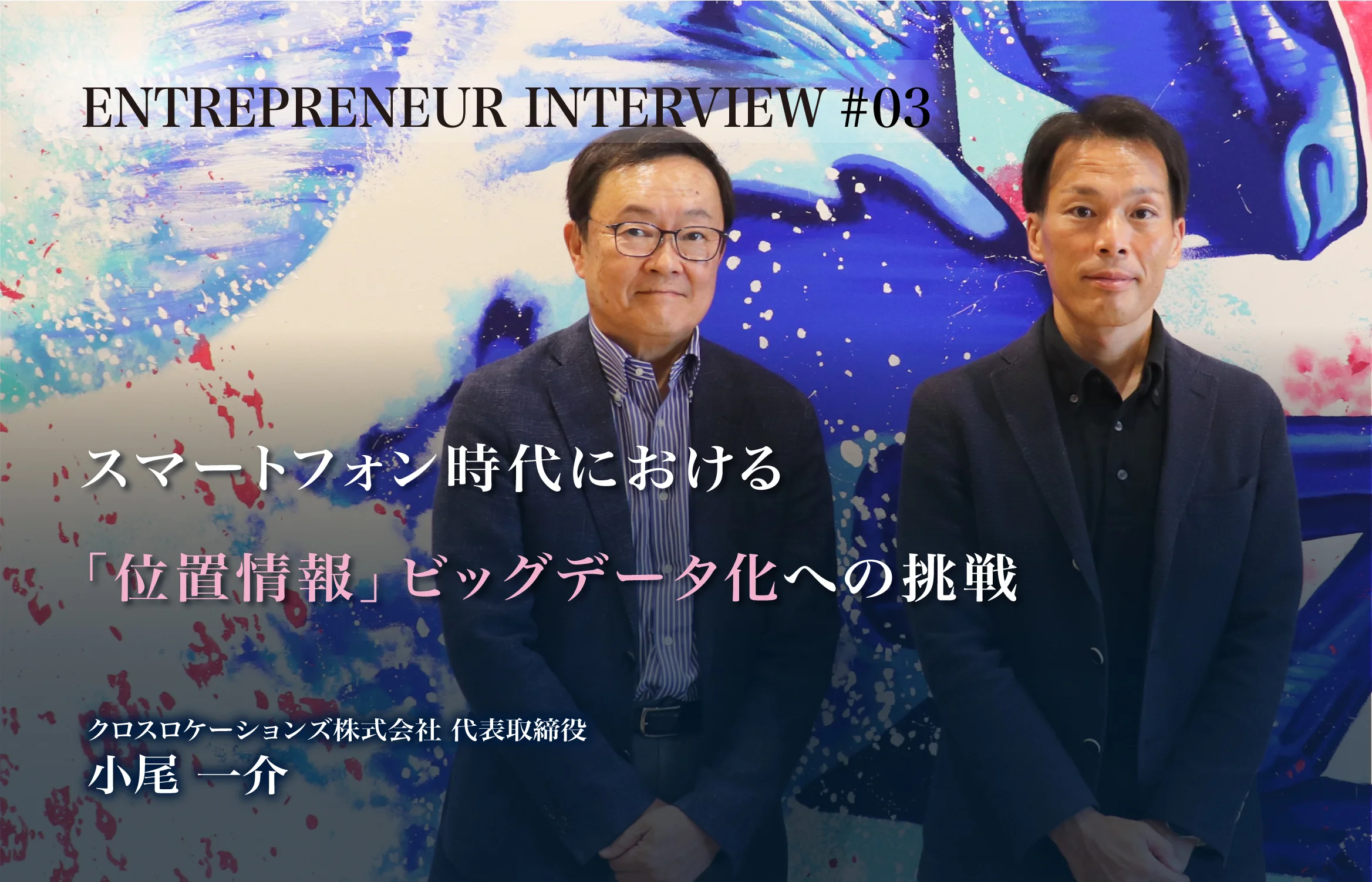
[Entrepreneur Interview #03] Kazusuke Obi (X-Locations)

  • Interview
2024.09.19

The Challenge of Turning Location Information into “Big Data” in the Age of Smartphones

Recently, D-POPS GROUP made an investment in X-Locations Inc., which provides people flow data analysis platforms and advertisement delivery services using smartphone location data, and we have begun walking together as fellow members of our Venture Ecosystem.

☆The press release regarding this investment in X-Locations Inc. is here:
https://d-pops-group.co.jp/en/column/x-locations/

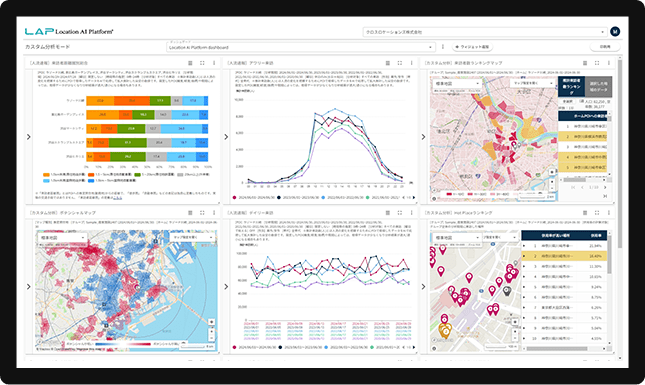
For this article, we interviewed Kazusuke Obi, CEO and founder of X-Locations Inc., about the circumstances of the company’s founding and about Location AI Platform® (referred to as LAP from here on), the company’s proprietary system for analyzing people flow data.

① What was the impetus for founding your company?

With the widespread adoption of smartphones, we have entered an era where everyone can use convenient services that utilize our location information (latitude and longitude over time) through smartphone apps. Behind these services, enormous amounts of location data exist as big data in the network. Location information that was previously overlooked as mere “log data” can now be newly collected and analyzed due to recent technological innovations in mobile internet, GPS, GIS, and AI, making it possible to use statistical modeling, visualization, etc., to extract valuable insights. That value will only continue to increase in the future.

Our company is convinced that “a new era of extracting and utilizing useful information from vast amounts of data”, like search engines and generative AI, has arrived. I believed that a platform was needed to utilize this information for daily life and business purposes, so I established X-Locations to realize this vision.

② Please give us a brief summary of your services.

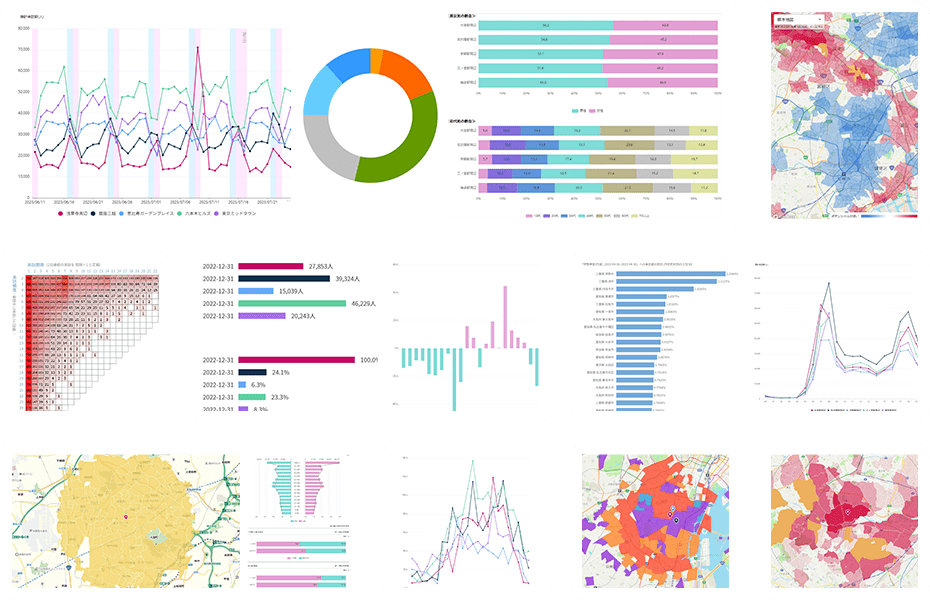
X-Locations’ people flow analysis platform LAP is a service that analyzes location-based big data via AI to provide visualization and other insights.
Additionally, our advertising services utilize people flow data to provide effective advertisement delivery based on the user’s movement history. We support optimization of marketing and tourism initiatives for travelers by utilizing behavioral data of inbound foreign visitors, including inbound advertising and analysis.

③ What points make you superior to any similar companies?

X-Locations’ strongest advantages are as follows:
1. Use of comprehensive, unbiased data sources (sample data)

The sample data that forms the basis of our analysis primarily uses data obtained by smartphones from GPS satellite signals, utilizing data that is not dependent on specific carriers or apps. We have been integrating various data sources and conducting comprehensive location data collection and analysis since before COVID-19, and our ability to provide accurate, unbiased people flow data is a strength that differentiates us from other companies.

2. High-precision location data and proprietary AI analysis technology with no privacy concerns

We provide a proprietary platform (LAP) that can capture highly accurate analysis results and insights (visualization of people’s real behavior) by collecting and analyzing location-based big data at high frequency and utilizing proprietary AI algorithms. By completely disconnecting the acquisition and analysis of location-based big data from the smartphones and their users, there are no concerns about violating personal information, and pinpoint location analysis and visualization are also possible.

3. Smartphone advertising services utilizing Japan’s largest-scale location data

By combining high-precision people flow data with AI analysis, we provide smartphone advertising (i.e., geo-targeted advertising) based on specific areas and behavioral patterns. We also possess one of Japan’s largest collections of increasingly in-demand behavioral data for inbound foreign visitors, which puts us in a position to design effective inbound advertising and promotions. By deploying advertisements at optimal timing and locations based on data for each region and tourist facility, our services enable efficient marketing without waste.


④ What have been your biggest challenges since starting the company?

As a startup, working with limited resources (funding, personnel, etc.) to accumulate big data, develop proprietary algorithms and continuously develop our unique user interface, while communicating the usefulness of this newly-emerging “people flow data” to companies and getting them to adopt it.
Also, when we launched our services on the market, it was right when the COVID-19 pandemic hit, so we had to deal with that.

⑤ What do you most expect from shareholders?

It’s certain that the usage of “people flow data” will become extremely fundamental in economic and social activities going forward. We would like to ask for your support in activities that spread the awareness of its usefulness.

⑥ What is the best part about receiving investment from D-POPS GROUP?

Our services have been widely utilized across D-POPS GROUP’s Venture Ecosystem, including both group companies as well as other investee companies. This has created opportunities that serve as catalysts for business development for every company, including ours.

⑦ What aspects of realizing a Venture Ecosystem resonate with you?

Startup companies usually have to focus on growing their businesses by themselves. However, by forming connections within an Ecosystem, they can share information and opportunities, so I resonated with the idea of creating a place like that.

⑧ What is your ideal vision for the company 10 years from now?

In 10 years, I want X-Locations to be a global company.

⑨ What challenges do you foresee in achieving that future?

Developing the necessary technology and building the right partnerships. By “partnerships”, we don’t mean just recruiting reseller partners for our products, but partners who will also contribute to the Ecosystem as third parties on our people flow data analysis platform.

⑩ Any closing comments you’d like to briefly share?

We sincerely thank D-POPS GROUP for advocating for our mission, and for supporting us in both funding and business development.

Company Information

Company Name: X-Locations Inc.
Company President and CEO: Kazusuke Obi
Address: 6F Kobayashi Bldg., 1-2-9 Ebisuminami, Shibuya, Tokyo
Established: January 2018
Company Website: https://www.x-locations.com/

Related Articles

[Founder Interview #01] Kazuhiro Goto (D-POPS GROUP) – Part 2
Personal ideals, and ideals as a business owner, all about realizing a Venture Ecosystem For this article, we interviewed our own President and CEO of D-POPS GROUP! Our company is aiming to realize a “Venture Ecosystem” that is indispensable to society. We are striving to create a platform where startup companies can grow. We asked President Goto about his thoughts on realizing a Venture Ecosystem and contributing to society. (This interview was conducted in July 2025.) This is the latter part of this interview. You can check out the first part here. Sugihara: So, all of your preparations and activities are for the sake of your vision of “realizing a Venture Ecosystem”. You currently have 25 group companies and 35 portfolio companies. Could you share some examples of companies or situations that have had success or experienced benefits that are unique to the Ecosystem? Goto: There are so many ways to answer this question that I can’t tell you all of them, and of course, I can’t reveal specific company names. However, I can certainly share from my own experience about how to avoid a shortage of funds. When it comes to raising funds, there are a tremendous number of ways to do it. If you pursue all of them simultaneously with a furious momentum before the deadline, in most cases, a large-scale fundraising will be realized. Similarly, when it comes to a V-shaped recovery, if you change everything at once—your business model, organization, sales methods, etc.—most companies that are in the red will become profitable. I am the type of business owner who takes on big challenges and makes a huge gamble when the time is right. As a result, I have experienced countless dire situations in the past, but even then, I always work with a smile on my face so others don’t seem to notice, ha ha. Ultimately, my personal philosophy is that when business owners achieve exponential self-growth and can clearly articulate their strategy, their performance will grow significantly, and they will almost never fall into the red. I prioritize helping CEOs to grow, because when they achieve that kind of growth, their performance often improves dramatically afterward. Sugihara: You sometimes use the phrase taoguang yanghui (韜光養晦)* when talking about your “complexification strategy”, and this website was one example of that. Could you share a few more examples of how D-POPS GROUP has implemented the idea of taoguang yanghui? *These Chinese characters loosely translate to “hide your strength, bide your time”. Goto: I’ve been talking about our complexification strategy for a long time. To put it simply, it’s a strategy for throwing competitors off our scent. It refers to a state of being so complex that a competitor couldn’t imitate you even if they tried. I was taught the phrase taoguang yanghui by our company’s Advisor Fujisaki, Japan’s former Ambassador to the United States. He said that Deng Xiaoping, the supreme leader of China in the 1990s, used this phrase to represent China’s foreign policy and security strategy. Even within D-POPS GROUP, we opened the first ten mobile phone shops of our D-POPS chain under different names. And when Dr. Semmoto (the founder of Japanese’s well-known KDDI and eAccess) joined as the chairman of our board, we kept it a secret for the first three years. In the same way, we also limited the information on our previous website to about 30% of what is now publicized, and even now, we still don’t list all of the names of our group companies, which together account for over 10 billion yen in sales. Sugihara: You often say that our Venture Ecosystem is only about 30% of the way to reaching the ideal form you have in mind. Could you reveal a bit of your vision of what 100% would look like, with some concrete numbers? Or is it still confidential, ha ha? Goto: The goal is to evolve our Venture Ecosystem to the point that when entrepreneurs in Japan look for investment or support, their first thought is “D-POPS GROUP”. When we get there, one simple metric is that the combined sales of our group companies and portfolio companies will exceed one trillion yen, and if we narrow it down to our group companies (those included in our monthly consolidated balance sheets), we will have achieved 100 billion yen in sales. I also imagine that we will have several times the current number of top-class advisors and super-professional talent on board. I envision supporting, assisting, and staying in tune with around 500 companies in total. Of course, it would be impossible for me to accomplish all of that alone, so I will need to create an unbelievably high-quality support system. Before I started my own business, I figured that as long as I had passion and strategy, I could recruit and partner with any number of excellent people. In reality, the truth was much harsher: no one showed any interest in a company with virtually no sales, and I would even be able to pay them proper compensation. So, my vision is that as a Venture Ecosystem, we will possess all the necessary management resources—human resources, financial power, know-how, information, and network—on behalf of startup business owners, allowing us to provide the right kind of support at the right time. I believe that whether or not they use these resources is up to each company’s owner. D-POPS GROUP’s support is not a top-down approach; it’s a form of backing that we provide as needed. I also believe that in the future, when our group companies or other companies we support reach unicorn-level size, we must have the financial strength to spare several billion to tens of billions of yen. In addition, I see our current focus on investing in AI-related companies as a way to build a system that can support cutting-edge digital strategies by having a large number of talented engineers join our team. When I think about how to build this kind of system, the goalposts gradually move further and further away, so I guess we will never really stop chasing this ideal. Sugihara: It was recently announced that you will be holding the “Venture Ecosystem Summit 2025” this October. What kind of event are you aiming to create? What has the response been like from the people you invited: entrepreneurs, business owners, and some guests from large corporations? Goto: The response has been phenomenal. It was fully booked in less than a week, and even I myself wasn’t expecting the seats to go that fast! At the same time, I had been preparing for this for a full year with the clear intention that if I were to host such an event, I would plan and execute it at the maximum level of my production capabilities. Every year, at D-POPS GROUP’s annual all-hands event, we have the privilege of listening to lectures from prominent figures like Chairman Semmoto and Advisor Fujisaki. However, at last year’s event, an inspiration suddenly came to me: “It would be a waste to society to keep this within our group alone.” So, on the spot, I declared that we would hold a Venture Ecosystem Summit for promising entrepreneurs and business owners. I guess the business owners to whom we sent invitations really caught my passion, because we had originally expected to invite about 500 guests and only have about 250 of them sign up, but over 90% of them indicated they wanted to participate, so it instantly became fully booked. Currently, the expected number of attendees is about 250, but we are planning to negotiate with the venue and make adjustments so that a few dozen more people can participate (up to a maximum of 270). There are still entrepreneurs and business owners I want to invite, so I guess some of you reading this article may be disappointed and wondering, “Why didn’t I get an invitation??”, ha ha. Please feel free to contact me, and I will work on getting you a seat. Anyway, the event’s itinerary has become jam-packed with evocative learning opportunities, from lectures and panel discussions to live performances by calligraphers and musicians. I believe it will be an incomparable event, and hope this one day will become a turning point in the lives of all those who participate. Sugihara: It sounds like it's going to be a fantastic event. Now, focusing on the Ministry of Economy, Trade and Industry, the Japanese government finally seems to be putting a lot of effort into supporting startups. In that sense, creating a Venture Ecosystem as a private company is a truly timely initiative. Do you feel a tailwind from this? Goto: I feel it very strongly. Lately, inquiries about CVC investments, capital and business alliances, and M&A offers are all flooding in. Even though I don’t feel like our Venture Ecosystem is complete yet, many people are asking to join it. I hope to continue providing solid support to entrepreneurs with high aspirations, great potential, and a strong desire to contribute to society. Through trial and error, I want to further analyze how to create the Venture Ecosystem that Japan needs the most. I believe that I must, in the remainder of my life, complete an Ecosystem that only D-POPS GROUP can create. Sugihara: Once you have achieved a certain degree of success in creating a Venture Ecosystem in Japan, do your vision include the rest of the world? Goto: Of course. We are already investing in the US, India, and Israel, but the global Venture Ecosystem still has many gaps. We plan to increase the number of partners who can work with us on a global level as a matter of course and to work out a system for that. Sugihara: What is your ideal vision for yourself and D-POPS GROUP in five years? Goto: My personal ideals and my ideals as a business owner are both centered on realizing a Venture Ecosystem. I have a great ambition and a strong will to leave behind something that, at the moment of my death, I can confidently say made a great contribution to the world. I plan to accomplish this with absolute tenacity. In five years, I hope that when people are talking about support for startup companies, they will mention “D-POPS GROUP’s Venture Ecosystem” without even having to think. Of course, I have clear KPIs that I am consciously working toward, such as the number of group and portfolio companies, sales, and profits. But in the end, it’s all about realizing my vision of a Venture Ecosystem. Sugihara: Lastly, do you have a final message for the readers who are visiting this website? Goto: Life is a one-time thing for everyone, so I believe it’s important to live without regrets. The bigger the vision you have, the more you will need partners. If any of the people who have read this interview become our partners in the future, it would make me incredibly happy. And I would also be very happy if this interview provided some kind of business insight.   Interview conducted by D-POPS GROUP’s advisor Genta Sugihara. D-POPS GROUP Company President and CEO: Kazuhiro Goto Address: 32F Shibuya Hikarie Bldg., 2-21-1 Shibuya, Shibuya-ku, Tokyo Established: October 1, 2015 (Founded: February 4, 1998) Website: https://d-pops-group.co.jp/en/
  • Interview
2025.08.05
[Founder Interview #01] Kazuhiro Goto (D-POPS GROUP) – Part 1
Personal ideals, and ideals as a business owner, all about realizing a Venture Ecosystem For this article, we interviewed our own President and CEO of D-POPS GROUP! Our company is aiming to realize a “Venture Ecosystem” that is indispensable to society. We are striving to create a platform where startup companies can grow. We asked President Goto about his thoughts on realizing a Venture Ecosystem and contributing to society. (This interview was conducted in July 2025.) Sugihara: It’s been over 27 years since you founded your original company, D-POPS, and this October 1st will mark exactly 10 years since D-POPS GROUP was established and you transitioned to a group company management system. About five years ago, you started advocating for ecosystem management. Could you describe your journey of these past 27 years, as well as the past 10 years of group management and the last five years of ecosystem management? Goto: To put it simply, I’d say my life as a business owner has been like that of a Buddhist monk training in the mountains, ha ha. It’s been a continuous series of hardships—all kinds of adversity, headwinds, and hitting rock bottom. At the same time, there’ve been many moving experiences and memorable encounters, and I can truly say it’s been a fulfilling 27 years. Initially, as the CEO of a startup, I focused on business and built a 10-billion-yen company. But I also experienced how focusing solely on one business and being dependent on a single revenue stream could be a major risk. From there, I decided to transition to full-scale group company management. After transitioning to group management and managing 10, then 15 companies, I received a lot of requests to give lectures and lead study groups. As I accepted these requests within my capacity, I got to know the reality of entrepreneurs and business owners who, like me, were truly struggling to manage their businesses. The study group where I felt the most direct connection, where I could remember the faces and businesses of all participants over the years, eventually developed into the “Goto School” intensive training sessions that I now hold almost every month. So far, approximately 300 entrepreneurs and business owners have participated. As a result, the inspiration to dedicate my life to realizing a Venture Ecosystem—or, as you said it, the start of “ecosystem management”—suddenly came to me. Through the creation of this Venture Ecosystem platform, we increase our number of allies, enable the sharing of know-how, information, and networks with each other, and even if one company suddenly faces headwinds, suffers a big deficit, or hits rock bottom, the Venture Ecosystem protects and supports it, achieving a strong risk portfolio. These allies can be in any form, such as group companies, investment portfolio companies, or strategic capital and business alliances. I even support companies with which we have no financial relationship. Ultimately, what I want to achieve is the establishment of a social system that supports entrepreneurs and managers by walking alongside them. Sugihara: As an entrepreneur, you have walked a difficult path that the average company employee in the world today couldn’t even imagine. What has been the source of your drive and passion? Goto: When it comes to passion, I have never lost it since starting my business. It’s been overflowing continuously since I was 25. The source of it was a study abroad experience in the UK. I saw so many students from around the world who had a clear dream for the future and were studying incredibly hard to achieve it. Before studying abroad, I honestly spent my college years just having fun (like being the president of a tennis club and an intercollegiate club), but I started to feel a great sense of anxiety about the future of Japan. I worried that 10 or 20 years from now, with Japan’s economic power declining and other countries developing significantly, especially in Southeast Asia and the BRICS nations, I feared that we would be unable to maintain the prosperous Japan that our predecessors built before and after the war. Then, just as I was thinking how I wanted to powerfully nurture and change young Japanese people, I came across a book by Konosuke Matsushita and realized that company management could be a way to foster young talent. Initially, my passion was focused on directly nurturing young people. When the number of employees grew to several hundred, I focused on nurturing executives. When the number of employees reached several thousand, I dedicated my efforts to fostering entrepreneurs and presidents. But the core principle has always been the same: I want to create an environment where young people who will lead Japan’s future can grow and take on challenges. I believe that has continuously been the source of my passion. I always hope to leave a better society for the next generation of children and the generations after them, even after I am gone. Ultimately, I want to do this not only for Japan but for all people on Earth. Sugihara: I imagine that your difficult journey was saved by many instances of great fortune and strong luck. Could you share with our readers any secrets you have for “taking hold of strong luck”? Goto: Simply put, I place a lot of importance on being the kind of person that even God might want to support. I also believe it’s important to have an unrivaled passion, to put in effort that is second to none, and to have a vision and goals that have social significance. In addition, I think one needs to have a heart of sincerity, humility, and gratitude. Even I am shocked by how good luck completely disappears when I stray away even slightly from these practices, but when I follow them diligently, then astonishingly great circumstances occur. One more thing I would add is that I think it’s very important to associate with people who also have good fortune. I feel that our chairman, Dr. Semmoto, and our corporate advisor, Mr. Fujisaki, are like sources of strong luck for me. I feel the same way about our non-executive director, Mr. Naito, and our advisor, Ms. Ishiguro. Sugihara: In your stories, you often say that you owe everything to your connections*. What conscious efforts are you doing on a daily basis to maintain good connections? *The original Japanese term connotes both fate as well as one’s connections with others. Goto: My answer is quite similar to my response about strong luck. I believe that good connections are born from making sure that positive energy overflows from within myself. In other words, from having an altruistic heart and love. And also, when an opportunity presents itself, making sure to properly convey the vision and social impact I am trying to achieve. I feel that when people are on the same page as me, our bond deepens; sometimes they support or help me; and in the end, it becomes a good connection. Sugihara: You as an individual and D-POPS GROUP as a company are involved in many social contribution activities, such as supporting the “Walking Together Hand-in-Hand with Children Foundation” and the non-profit organization “bond Project”. Are these efforts in CSR activities also based on your idea of improving your luck? Goto: Yes, that’s right. My desire to help suffering children—even just a little—is pure, but when I put my energy into activities like these, I also have this mysterious feeling that good fortune will come to me as a result. However, even if good fortune doesn’t come, I think it’s a natural human instinct to wonder if you can do something to help when you see a child or a person who is suffering. Sugihara: So, you’ve grown D-POPS GROUP to this large size through your management skills, your constant effort, and being blessed with good fortune and great connections. The company’s sales have surpassed 30 billion yen, and it is already big enough to be listed on the Tokyo Stock Exchange, even under the newly-revised listing requirements. Could you tell us why you are choosing to remain unlisted? Goto: Naturally, I understand the benefits of being a listed company, but my management style is quite unique, so I think it would be difficult for all investors to understand it. I’m constantly investing with a medium-to-long-term vision (I don’t worry too much about short-term results), and I devote about 15% of my time to the activities of the aforementioned foundation that supports abused children. Another form of volunteering I do is to spend about 20% of my time on the so-called Goto School (supporting the individual growth of entrepreneurs), which I convene when requested. If I were the president of a listed company, my mission would naturally be to focus on producing results for my company, and I feel that doesn’t fit with who I am right now. However, listed companies have already emerged from within our Venture Ecosystem, and many more are expected to be born from it in the future. Sugihara: So, for you personally, going public is not a goal or an objective. On the other hand, you support startups aiming to go public by offering investment and management advice. You also have a vision of building a platform that will produce numerous “unicorns”. What kind of support activities do you engage in, both as an individual and as D-POPS GROUP? Goto: Honestly, this is also difficult to answer in one word. I could say that I am available to entrepreneurs and business owners for advice and questions 24 hours a day, 365 days a year. I fully mobilize all my knowledge, experience, know-how, network, and the majority of my time for the sake of CEOs who are going through a particularly tough phase or to the leaders of growing companies that are experiencing a growth curve. And as balls get tossed into my court from every angle, I use my 27 years of experience and database to provide support. As an active business owner who has managed many companies, and now with almost 60 group and investment companies, holding Goto School for representatives from 300 companies, and other various activities in my life, I believe there are extremely few business owners in the world in a similar position as mine. That’s why I work hard every day with the belief that I must be the one to create a Venture Ecosystem in Japan. When I’ve been able to guide the CEO of a company on the verge of bankruptcy to make a V-shaped recovery, I can truly feel the social significance of my work. Sugihara: Although it’s a private company, the board of directors and advisory team have a truly impressive lineup. You have also gradually increased the number of advisory members, including myself. As much as you can share publicly, could you explain your thoughts on the meaning and purpose of this structure? Goto: Frankly speaking, I am a total expert in management strategy, so I believe that technical matters are best handled by professionals in those fields. In that sense, I think it’s very important to have many “super specialists” on my team of advisors, and I find them all to be incredibly reliable. The people we support are entrepreneurs, and as such, they won’t listen to someone unless that person has skills that are on another level. Because of this, I am always on the lookout for such people, hoping that even just one of them will join our team every few years. The members of our Board of Directors and our advisors are my mentors, coaches, and sometimes even feel like a father, an older brother, or an older sister to me. In other words, the Venture Ecosystem is also functioning for my own growth, and I am always being helped by it.   Interview conducted by D-POPS GROUP’s advisor Genta Sugihara. D-POPS GROUP Company President and CEO: Kazuhiro Goto Address: 32F Shibuya Hikarie Bldg., 2-21-1 Shibuya, Shibuya-ku, Tokyo Established: October 1, 2015 (Founded: February 4, 1998) Website: https://d-pops-group.co.jp/en/   Next, in the latter part of the interview, we discuss: ・Success stories unique to the ecosystem ・The complexification strategy ・The “ideal form” of a Venture Ecosystem ・Venture Ecosystem Summit 2025 ・And other topics Be sure to check it out here: https://d-pops-group.co.jp/en/column/executive-interview02-latter-part/
  • Interview
2025.07.28
[Entrepreneur Interview #14] Nishikawa and Matsutani (@Solution) – Part 2
Tackling the Development of the Next Generation to Further Invigorate Japan’s IT Sector D-POPS GROUP has 23 group companies that we call partners (at the time of publication). For this article, we interviewed Co-president & COO Akio Nishikawa and Co-president & CFO Yorito Matsutani of @Solution, which joined D-POPS GROUP in 2021. (This interview was conducted in April 2025.) This is the latter part of the interview. To read the first part, click the link below. https://d-pops-group.co.jp/en/column/atmarksol-interview-first-part/ ◆Greatest Strengths and Features Sugihara: The role of the engineer is becoming increasingly sophisticated. Coding itself may no longer be necessary, but what is important is the ability to determine the required program structure, the ideal interface, and the specifications of the final product, and finally coordinate all of those together. In that regard, what is @Solution’s greatest strength or distinguishing feature? Nishikawa: This goes back to our two businesses we described at the start of this interview, but our strength lies in our ability to build and propose solutions not just for surface-level applications, but also for their underlying infrastructure. Ultimately, all systems and services rest on an infrastructural foundation, so our capability to offer total solutions starting from the base infrastructure is our key advantage. Furthermore, we have members who specialize in direction and project management. This ensures we can fully engage with what the client wants and effectively communicate that to our engineers. @Solution is broadly seen as a System Integrator (SIer), and people often have the impression that it’s difficult to communicate with SIers, since they are mostly staffed by engineering-type people. However, in our case, people say “It’s easy to consult with @Solution because they have project managers.” So, this is definitely another of our strengths. Sugihara: That kind of service is definitely high in demand. No matter how widespread AI becomes, it will always be essential to display warmth and kindness, be able to read the room, and other things that only humans can do. The realm of communicating from person to person is where AI should be differentiated from humans. Nishikawa: I agree. In foreign companies, especially those overseas, engineers are considered almost god-like professionals who only need to write code well. They never attend project briefings, but that’s acceptable as long as their productivity is high. However, we prioritize communication and want our clients to know that we value it. That is why some of our members are dedicated to direction and project management. Sugihara: What scale are your typical client companies? Matsutani: We don’t have a size limit either way, so we handle projects for both large corporations and start-ups that have recently launched their own services. By industry, most of our contract development supports BtoC-oriented services. Our SES business has usually seen larger-scale projects since the beginning. Sugihara: What are the main reasons companies come to @Solution with projects? For example, is it because they’re looking to outsource coding, or because they have a lack of manpower? Nishikawa: It’s typically the latter. Clients often seek us out due to a lack of manpower, and they also find us through networking. We are increasingly involved in projects where we partner with companies that simply do not have engineers in-house. For instance, many clients who operate their own services have internal teams for promotion and marketing but not a single development engineer on payroll. They might have had a specific app running for about ten years, and because they lack engineers, they were relying on various vendors. We are now seeing an increase in cases where we are taking over and managing these projects. ◆Recruitment Sugihara: Speaking of which, the general consensus is that Japan is facing an engineer shortage. How is @Solution approaching recruitment in light of this? Matsutani: In engineer recruitment, the biggest salary bubble was around two years ago, when engineers were jumping into the companies that offered the highest salaries. Then, with the emergence of AI and the conversation about whether engineers will be needed in the future, things calmed down somewhat. However, there is still a persistent shortage of engineers, so salaries remain relatively high compared to other industries. After 20 years of trying various methods at @Solution, we’ve found that new graduates are the best fit for our hiring patterns. The cycle of bringing in new grads and providing proper training works well for us, so we are focused on this area. Last year, we ran an internship program. These were not short-term, but year-round long-term internships, totaling about 20 people. They would work on projects, sometimes for a few hours a week and sometimes full-time. We would love for these excellent students to join us, but recently, so many of them are talented enough that they go on to work for companies like CyberAgent, DMM, and IBM. Sugihara: How did such talented students come to apply for an internship at @Solution? Matsutani: After receiving their feedback, we found that last year, there was an overall trend among engineers toward using the more “packaged” technologies like Flutter for mobile. However, students with some experience wanted to work on in-house projects through a lab-based or contract development model like ours, where they could really get their hands dirty writing native code. The more ambitious students had a strong desire to personally experience writing code from scratch, which is why they applied for our internship. During the initial orientation, we tell them this: “Since our management philosophy is ‘Developing the Next Generation’, we want you to gain extensive experience here and become a successful professional.” We believe that Japan’s IT sector still has plenty of room to grow compared to other countries, so an increase in highly skilled IT talent benefits the whole country. We look forward to connecting with them as future partners. Sugihara: Ah, so this is where your management philosophy truly comes to life. It would be fantastic to see cases where students who interned at @Solution thrive as skilled IT professionals and later rejoin the company a few years down the line. What are your future recruitment strategies? Nishikawa: We currently have about 35 engineers, but we plan to increase that number. Our maximum goal is to reach around 200 members within the next 10 years. Sugihara: That’s a great target! Will you be hiring mid-career professionals as well as new graduates? Matsutani: Yes. More specifically, we intend to focus on hiring inexperienced individuals. We are looking for young people, especially in their 20s, who are studying at coding schools or even those who are self-taught. Since becoming an engineer requires interest, curiosity, and passion, we want to hire those who are motivated and studying on their own initiative. ◆“Realizing a Venture Ecosystem” Sugihara: D-POPS GROUP’s vision is to increase the number of growing startup companies that bring about societal transformation. In short, we aim to “realize a Venture Ecosystem”. What are your thoughts on this Venture Ecosystem? Nishikawa: First and foremost, I feel incredibly fortunate to be part of this community every day. Particularly on the financial side of things, D-POPS GROUP provides us with an extremely encouraging and reassuring environment. While managing finances is originally a huge part of running a company, the assistance we receive as a part of the group allows us to concentrate entirely on our core business, so we are truly grateful. Without this environment, we wouldn’t even be able to discuss recruitment plans or consider strategic investments. We feel incredibly supported. Matsutani: I have essentially the same impression as Co-president Nishikawa. I believe this is a truly unique and interesting environment and structure. The individual members of the Venture Ecosystem are relentless challengers, yet they are incredibly kind, gentle, and cooperative. It feels like we are comrades, but at the same time we also have a healthy competition, and it’s rare to find both of those deeply rooted in a single culture. Here, we can pursue many challenges, and the structure for taking on those challenges is already in place. For example, having advisors readily available for consultation is a huge benefit. I am deeply thankful to be in this environment. Sugihara: That’s very true. D-POPS GROUP emphasizes two things regarding challenges. First, to increase the probability of success for those who take them on. We strive to create mechanisms and environments that—even if they aren’t perfect—are just what people need. Second, if an endeavor doesn’t succeed, they can try again within the Ecosystem. We have many examples of successful re-attempts. Matsutani: Exactly. There is internal competition, mutual assistance, and abundant opportunities to generate group synergy, which is a great benefit. When most people hear M&A, they picture strict supervision from the head office, but there is virtually none of that in D-POPS GROUP. We have meaningful support systems without suffering from someone breathing down our necks. ◆Group Synergy (Collaboration among the 3 IT Companies) Sugihara: I believe President Goto prioritizes respecting the will of each company’s managers, working with them to build up those companies, because he can understand those business leaders’ feelings better than anyone. Speaking of the Venture Ecosystem, I heard that @Solution recently started a business collaboration with Techbeans and Idealump. How did this three-way partnership come about, and what is its current status? Matsutani: Originally, the companies in our group who had IT engineers were only @Solution and Techbeans, and we were already collaborating, with us joining projects accepted by Techbeans, and vice-versa. When Idealump joined the group last year, there was one more IT engineering company, allowing us to formalize the collaboration further. So, we currently have various forms of partnership: all three companies are involved in certain projects; we hold joint proposals; sometimes two out of the three collaborate between each other. We are also planning to create opportunities for members to get to know each other and host joint study sessions for all three companies. We plan to accelerate these efforts going forward. Sugihara: Speaking of study sessions, there was a business presentation and Q&A session recently held by BLUEISH, one of D-POPS GROUP’s investment companies. I remember BLUEISH’s President Tameto having a very engaging discussion with Co-president Nishikawa at the social gathering afterward. Are there any insights you’ve gained from members of the Venture Ecosystem like that? Nishikawa: It was a very lively discussion! President Tameto had quite a big impact on me. His presentation style was memorable, but the actual business content was a shock: he explained how they originally did contract work but pivoted to AI based on industry trends, specifically focusing on AI Agents. AI utilization, or AI-driven development as it’s often called now, was an area where I honestly felt my knowledge was lacking. While I could understand some of what President Tameto was saying, I had a strong realization that I needed to do more research. From that point on, I began to change the focus of my own input. I feel that the BLUEISH study session directly led to my idea of wanting to offer consultation services that utilize AI. It was an extremely valuable learning experience. ◆5-Year Goals and How to Get There Sugihara: I’m glad the session was beneficial. We will continue to create opportunities for collaboration within the Venture Ecosystem. Could each of you share where you think @Solution will ideally be in five years and the challenges you face in reaching it? Nishikawa: First of all, from a financial standpoint, I believe sales are important. @Solution is currently a ¥300 million company, and I want that number to become ¥3 billion. To achieve that, all members, including myself, must level up our skills. We will focus on applying AI and lab-based development, and continue to work on improving our skills while acting as project partners for our clients. The most important thing, and I feel this strongly, is for the two of us to grow as leaders. The reason I feel this way stems from attending the all-hands meeting for Findstar GROUP about two years ago, after being invited by President Goto. At that meeting, Findstar GROUP’s President Naito—who is also the Non-Executive Director of D-POPS GROUP—said, “The growth of a company, or how far it can take a leap, is truly limited by its top leader.” That message really stuck with me. We tend to focus on employee growth, but I feel that unless we, the leaders, raise our own ceiling first, the company’s ceiling will not rise. Therefore, our initial focus is on our own growth. Matsutani: I want us to become the hub for digital talent within D-POPS GROUP. I strongly want our company, as well as Idealump and Techbeans, to become the go-to place that everyone consults when they want to pursue anything digital. The prerequisite to achieving this is to continuously learn and absorb knowledge, as this ecosystem offers many learning opportunities—especially for business leaders—and then to produce more output as a result. For me personally, I want to create a greater sense of community, so I will need to act on that premise as much as possible. ◆Message to Readers Visiting Our Website Sugihara: Finally, could you each offer a closing message to the readers visiting our website? Nishikawa: Thank you for reading our interview. We are a team of system and IT experts, so if you need anything IT-related, please think of us first. And let’s go out for a drink sometime, ha ha! Matsutani: D-POPS GROUP is a truly fascinating group of people, so if you are interested, please feel free to visit us in Shibuya Hikarie!   Interview conducted by D-POPS GROUP’s advisor Genta Sugihara.   @SOLUTION Co-president & CEO: Katsuto Masuda Co-president & COO: Akio Nishikawa Co-president & CFO: Yorito Matsutani Address: 32F Shibuya Hikarie, 2-21-1 Shibuya, Shibuya-ku, Tokyo Established: July 2005 Website: https://atmarksol.jp/
  • Group Companies
  • Interview
2025.06.09
Back to COLUMN