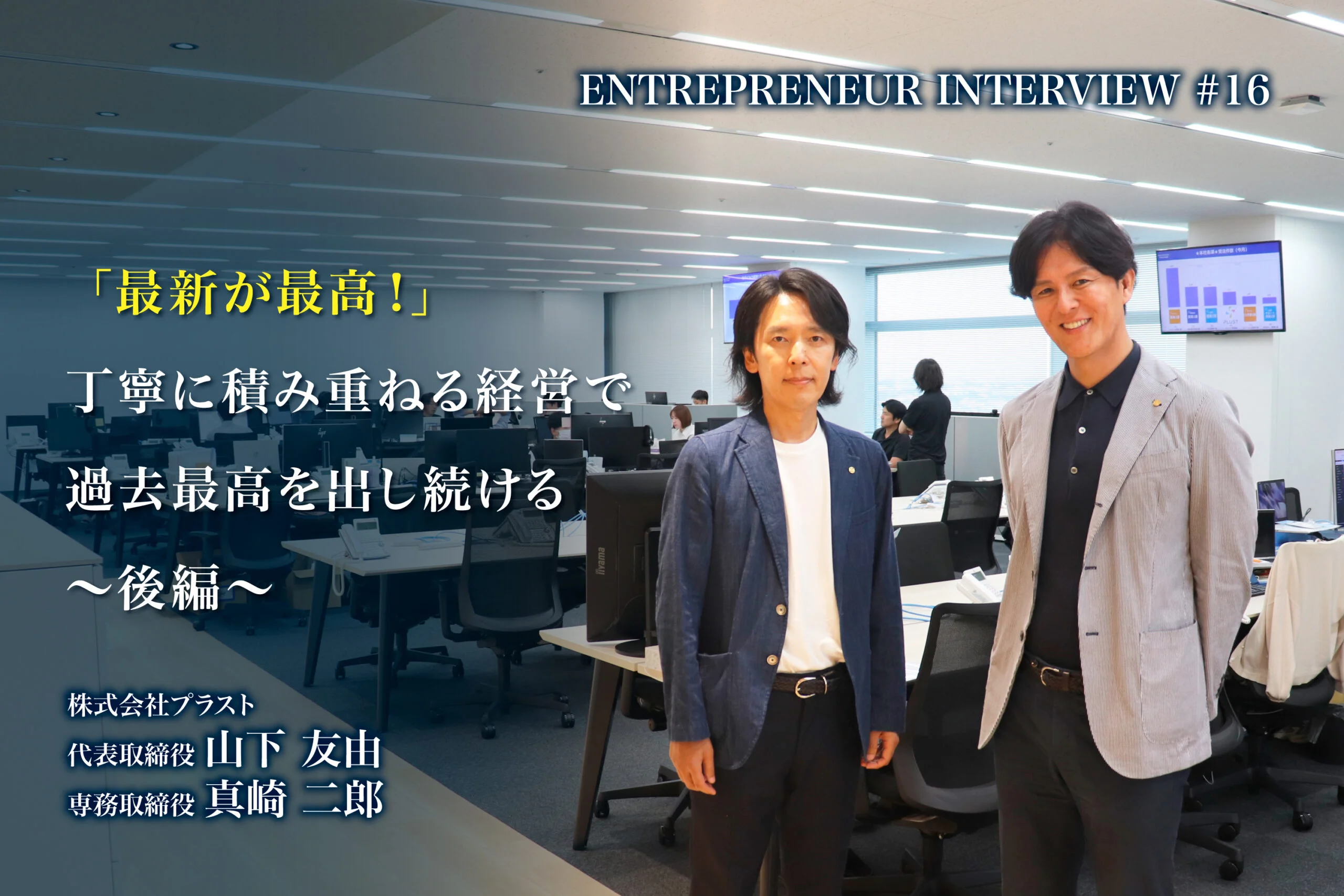
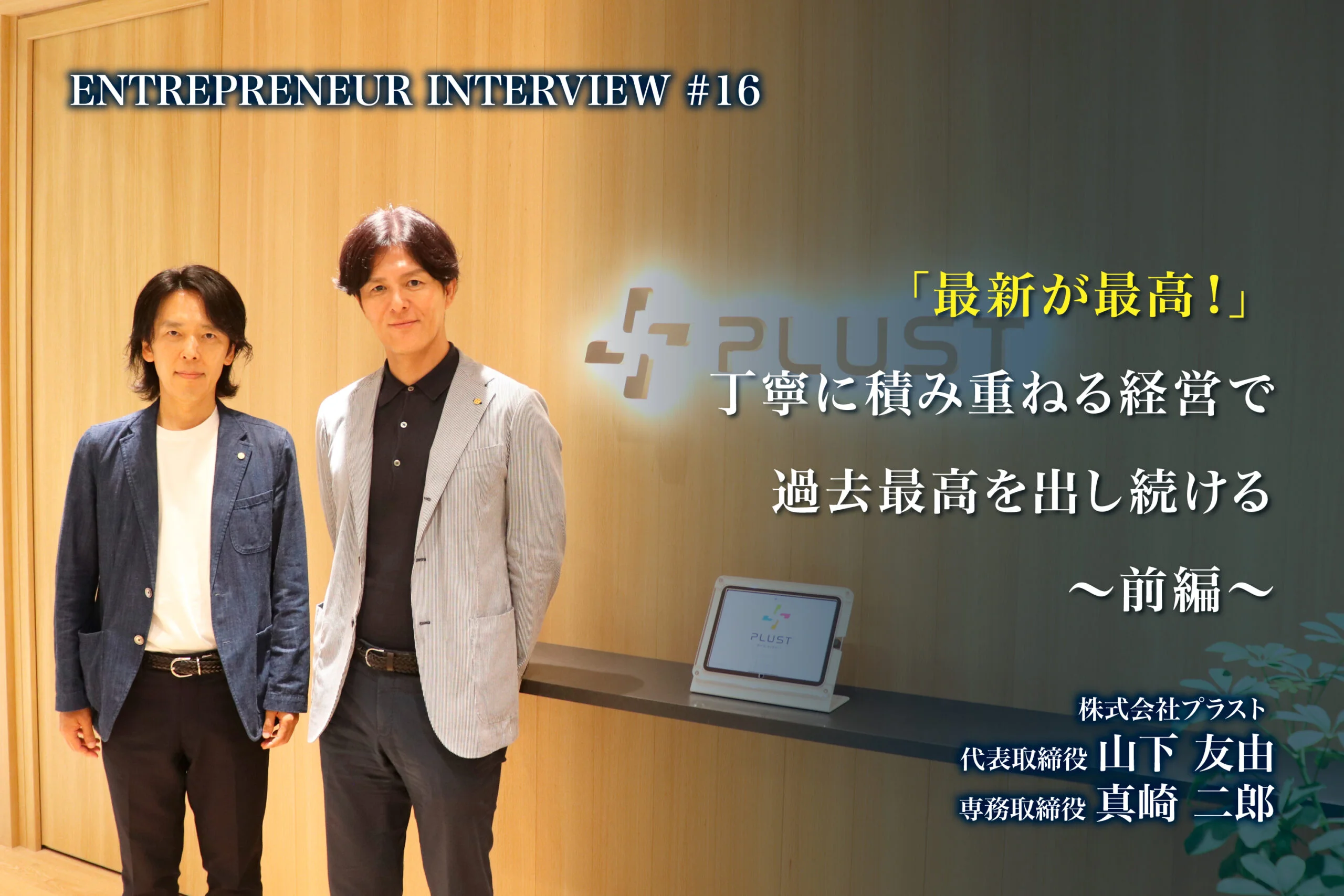
[Entrepreneur Interview #16] Tomoyoshi Yamashita and Jiro Masaki (Plust) – Part 2
“Newest is best!”
Careful, Consistent Management for Continuous Record Growth
D-POPS GROUP has 24 group companies that we call partners (at the time of publication).
For this article, we interviewed Tomoyoshi Yamashita, the President and CEO of PLUST.Co.,Ltd. (Plust from here on)—which joined our group in September 2024—and Jiro Masaki, Plust’s Senior Managing Director. (This interview was conducted in July 2025.)
This is the latter part of the interview. To read the first part, click the link below.
https://d-pops-group.co.jp/en/column/plust-interview-first-part/
◆Case Study Interview Videos
Sugihara:
I watched the interview videos of case studies published on Plust’s website, and I was very impressed by one customer who said, “All their staff, both men and women, have such great personalities that it really underscores their company’s merit, and even the CEO’s merit…” I felt like the sales and marketing teams’ sincere attitudes have become a part of the company’s branding itself.
Yamashita:
Thank you. Before adopting a product or service, it’s not uncommon for customers to worry, “Can I really trust Plust with this?” or “How do other business owners in the same industry actually feel after implementing this?” We believed that customer voices were the solution to alleviate these anxieties even a little. Naturally, we started from zero, asking our customers one by one for their feedback.
As the number of such interviews gradually increased, it allowed us to view our company objectively. For example, understanding why they chose to work with us, or specifically how our support delighted the customers, has become a reference for how to support future customers. We realized things like, “If we respond this way, the customer will say they were helped”, and “If we think together about the store like this, the owner will be pleased.”
Also, through watching these interview videos, our customers basically teach us about our own strengths all over again, and it enables us to think, “Ah, this is definitely our forte. Well, in that case, let’s bring out our team’s strengths even further!”
Sugihara:
The Japan Marketing Research Organization (JMRO) ranked your company as first place for “Number of Public Interviews of Satisfied Customers” in both the “Storefront App Development” and “Web Development” divisions.
It’s remarkable that you conduct so many interviews. How do you go about arranging them?
Yamashita:
Actually, during the contract phase, we ask questions like, “If you implement our services and are satisfied with the results, would you be willing to cooperate in a post-implementation customer interview at a later date?” We also write this request directly into our contracts.
Many of our customers respond by saying things like, “As long as it turns out well, that’s fine” or “If you produce good results, then we’ll be happy, and your sales and marketing teams can certainly use them!” But I can’t say there aren’t some who politely decline our request because they are honestly shy. Almost all of the interview videos are produced by our company’s media production department’s video team.
Sugihara:
That’s wonderful. What kind of reactions do you get from all of the customers and employees who watch those videos?
Yamashita:
First, for our employees, we basically created a “Case Study Interview Video” channel on our internal Slack, so when an interview is released, it’s shared company-wide.
I think they are also displayed on monitors in the office, but when we share the interview with our company Slack, we can let everyone know who the support staff member was, who initially connected with the customer, and who the sales representative was. The customers’ own words let everyone understand in what manner they received their support.
Normally, people in different departments or those in sales roles don’t know in detail how closely the support team works with customers. When a customer speaks highly of the support, sometimes they mention them by name, which shines a spotlight on the support staff and on those who are doing a good job with their sales.
Also, in cases where customers watch the video during a business negotiation, some of them immediately say, “All right, then. We’ll leave it to you!” And others will call us in the following days to say they’ve decided to proceed with the contract. So I think those videos really help customers to envision a good working relationship.
Sugihara:
In that sense, you’ve created a system where the acquisition sales team members share the spotlight with the customer support and customer success team members.
Yamashita:
That’s right. Masaki and I are constantly mindful of creating a system that puts the spotlight not only on sales staff but also on employees who are doing important work that may not be easily quantifiable. Of course, in a sales company, sales often get the most recognition. But I believe that the whole company gets more energized when we make sure that the people who are working hard in their respective, important positions are properly acknowledged, rather than just the sales staff.
Sugihara:
Back-office staff departments like accounting and HR, which don’t have direct customer contact, are also certainly vital. Do you have ways of highlighting them within your company?
Yamashita:
We do have a Monthly MVP program, where the person who shone the brightest that month is selected from each division or department.
About 15 candidates are selected for the Monthly MVP across the entire company. From those, we decide on one person each for the top sales award, the division MVP, and the Plust Monthly MVP. The final award recipients receive a certificate of commendation and a bonus, and the results are also publicized externally on our social media platforms like Instagram. Our public relations team makes sure these social posts are written so that when the employees, their family, or friends see them, they can feel like they are doing good work and being successful.
In June, the information systems team leader, who responds to everyone with system-related questions every day and even worked on weekends to handle our recent head office relocation, was the company-wide MVP. Sometimes the MVP is the top salesperson with an overwhelming lead, and sometimes it’s a support staff member who received high praise from customers. It’s different every time.
◆Origin of the Company Name
Sugihara:
I’m glad to hear about such positive initiatives.
Moving on to the next question. The mission and values page on your website explains the origin of your company name, and it’s quite impressive. The circles of “PLan”, “Unique”, and “Solution” are all encompassed by the foundational circle of “Trust”. As your customer feedback suggests, it seems that all of Plust’s employees work to build a strong relationship of trust with your customers. Could you elaborate on this philosophy?
Yamashita:
“Plan” refers to a total commitment to providing plans aligned with the customer’s perspective. “Unique” means offering proposals to customers out of our own originality. “Solution” means solving the problems that customers face. By fully committing to these three initials—PLUS—we ultimately aim to win the “Trust” of our customers. That’s the full meaning behind our company name.
This has been the case since our establishment. Although I mentioned earlier that we were working every day without deeply internalizing it, our philosophy itself was actually always there. However, when trying to integrate those ideals into our daily operations, there was a large gap between the stated ideal and the reality on the ground at the time. I was a less mature manager then and couldn’t successfully connect the two.
Sugihara:
So the meaning of the company name was decided at the time of its founding. Have the mission and philosophy remained the same since then?
Yamashita:
The core foundation of our ideology hasn’t changed, but our mission, vision, values, and their verbalization were discussed and finalized over about six months, approximately three years ago, with Masaki and the heads of each division working together. To create something that could lead to the realization of our values, leaders from different roles gathered and created it, compiling it into a brand book.
When deciding on the values, we turned ideas like, “Everyone at Plust often uses this kind of language” or “This really feels like us” into written statements.
Masaki:
That’s right. Even if we had a vague doctrine in the beginning, no one was really looking at it or striving for it. But as the number of people grew, we realized that wasn’t sustainable. President Yamashita provided the opportunity, and we undertook a project to create our philosophy and mission.
We established these principles by asking “What are the things that Plust must value?” and “How can we maintain Plust as the foundation for everyone’s happiness?”, and then we made those our permanent motifs by preserving them in the form of a brand book.
Since our brand book was created, it’s become easier to convey our values to new recruits. We can show them the brand book and say, “This is what we aim for”, and communicate that we only want people who resonate with this to work at Plust. In terms of recruitment, we have people who apply because they saw our philosophy, mission, vision, and our five values and felt an affinity for them.
◆Local Area Sustained Support Project
Sugihara:
I can see the history of your extensive social contribution activities on your website, with a cumulative total of about 40 million yen. What was the thinking behind these donations and support activities?
Yamashita:
We call these activities our Local Area Sustained Support Project.
Now, this might not be the best way to say it, but the work that we do from day to day could be described as the “ultimate repetition”. It involves sales activities, carefully setting appointments, enthusiastically negotiating, providing solid support, and satisfying customers with website production.
However, I believe that if there is a greater cause, or if we can feel that the work we do every day is useful to society and contributes to someone’s happiness, we can approach the tasks at hand with a more earnest attitude. Also, emotionally speaking, doesn’t it feel good when someone thanks you for your work? While our contributions may be very small, we hope that through donations and activities, we feel we are helping those in need even a little bit.
That being said, our mindset is a little bit different from those involved in purely voluntary work, in the following sense. We feel good if we can make someone happy, even a little, but it wouldn’t be right if making that person happy meant reducing our business profits and effectiveness.
If we could generate solid profits and also contribute to the world at the same time, that would be pretty cool, since people usually assume you can only achieve one or the other. If you look at it that way, it makes sense for us to commit to doing both. We want to generate solid profits, give back to employees through their salaries, and contribute to society while growing the business. Then no one would be able to complain about our company, so we want to continue these types of activities as long as possible.
Sugihara:
That’s a wonderful plan. Now, onto the next question. You moved your head office in May this year, so what was the concept behind the design of the new office?
Yamashita:
This was a head office expansion and renovation within the same building, the first in 11 years. Since we have sales offices all over Japan, I wanted a space that truly felt like, “Now, this is where the headquarters are!” We discussed the interior design extensively with the contractors and paid close attention to every detail, not just because we wanted it to be stylish or cool, but because we wanted it to reflect our ideology and brand book.
We spoke with various contractors to create it, and because we plan to use it for a long time, we wanted an atmosphere that wasn’t overly flashy—a bright office with good energy that people would want to commute to. One that is calm and somehow exudes trust. We have to perform a lot of stressful tasks every day, so we wanted an environment that would offer our employees a moment of healing when they’re at our headquarters, facilitate brainstorming, and not become tiresome over time.
◆A Decision for the Sake of Growth
Sugihara:
Thank you. By the way, you decided to join D-POPS GROUP last fall. It’s easy to imagine that Plust, being such an excellent company, was receiving numerous M&A offers at the time. What was the main factor in your decision to join D-POPS GROUP from among those?
Yamashita:
I think it was ultimately President Goto. I met many other truly excellent people, including CEOs and executive members of publicly-listed companies, who would talk about how they wanted our group to be or what field they wanted us to be active in…but they rarely asked what I or Plust wanted to do.
I told Masaki this before, but as the founder who started the company, joining any group—even a large corporation—was not an easy decision for me. Furthermore, I felt that if I were to make that decision, it had to be a partnership that would genuinely lead to a brighter future for Plust and all the employees working in the company.
President Goto was the only one who focused on asking, “What do you want to do going forward, President Yamashita?” I was very pleased that he prioritized hearing my intentions first. I told him that I wanted to grow further as a manager, and I wanted the company to develop even more to realize its values. I then shared what I was thinking and what I anticipated our future challenges might be.
As we met several times and had meals together, President Goto told me, “We will continue to entrust the management of Plust to your leadership, President Yamashita. We intend for D-POPS GROUP to essentially be a cheerleading squad, supporting Plust’s development and the flying leap that you and your team are aiming for.” That statement was huge for me, and it gave me a strong vision of working together in the future.
Because of this, I was almost fully decided on moving forward with President Goto and D-POPS GROUP. Then, I went to dinner with Masaki, shared my thoughts on joining the group and my future plans, and he also agreed.
We informed our employees after September’s accounting was closed, so it was around October. We explained it in about seven phases.
Sugihara:
Senior Managing Director Masaki, what did you think when President Yamashita told you about joining the group?
Masaki:
When President Yamashita first told me about it, our company had been growing in size, and we were reaching a point where we had to consider how to continue for many more years on our own. President Yamashita was already contemplating various things. When he suddenly told me the plan, I recognized that joining this group was the optimal solution for resolving the various issues that would inevitably arise. I was convinced after hearing all the details.
Also, even up to now, whenever President Yamashita approves someone, or should I say is impressed by someone, they are generally wonderful people, so I trusted that this was not a mistake. At the time, I hadn’t met President Goto yet, but I wasn’t worried about that aspect at all.
Sugihara:
On the night of the signing day for joining the group, there was a charity party hosted by D-POPS GROUP’s Chairman Semmoto, and both you and President Yamashita attended, right?
Masaki:
That’s right. I was working at the Saitama office when I got a call telling me to come to Nihombashi immediately, ha ha. I left for Nihombashi right away, while wondering to myself whether it was really such an amazing party that I had to drop everything. When I arrived, every single one of the participants were truly remarkable people, and it was great to attend such a fantastic event and hear such valuable stories.
◆“Realizing a Venture Ecosystem”
Sugihara:
D-POPS GROUP’s aim is “realizing a Venture Ecosystem”. What parts of this goal do you resonate with? Do you have any shared mindsets or activities aimed at creating this Venture Ecosystem together?
Yamashita:
When it comes to Venture Ecosystems, Plust currently has three group companies, so we kind of have our own small-scale Venture Ecosystem. By working together on things, we are experiencing the generation of synergy that transcends the borders between divisions.
For example, our website support members sell security products (OA equipment), or we generate referrals when we encounter a company that wants to build a website. When I consider that such things are happening across divisional boundaries, I deeply resonate with the Venture Ecosystem that D-POPS GROUP is trying to create. Even just by having invoices that previously went externally now circulate within the group, money flows better, and we may even see the creation of new businesses. Even our own management team thinks that this system is a good way for our company to survive without collapsing.
◆5-Year Vision
Sugihara:
Thank you. What is your 5-year vision for Plust?
Yamashita:
In any case, we want to see, even more than today, people who are glad they work at Plust. I view sales as a means, not an end, so I honestly don’t have a strong focus on reaching a specific target for profit or business structures.
However, I’ve always paid special attention to the idea that both myself and everyone I work with must continue to embody our value of “newest is best”. Five years from now, rather than raising a glass over glorious memories from the past, saying “Those were the good old days” or “I was amazing back then”, I want us to have taken on lots of challenges, and piled up more failures as well, and then with more employees than before, say with a smile, “We, right now, are the best Plust has ever been!”
Sugihara:
Then, in order to reach this future where all your employees and stakeholders feel happy, what challenges and efforts do you think you’ll have?
Masaki:
In the same way that we’ve been running this company for the past 20 years, we don’t think too much about the future, and I mean that in a good sense. Our thinking is that we shouldn’t be focused on the past or the future, but on how things are right now, and if things now aren’t the best, that’s not acceptable.
So, I don’t think it’s good to look too far ahead, and we should definitely not dwell on the past. What we see today is the result of building up year by year, while being conscious of whether we are happy right now and whether this is the best we’ve ever been.
Obviously, as managers, we have to think about the next five years, but we don’t have many numerical targets. I can say one thing, though, which is that we want to continuously update our performance record every year as much as possible.
Yamashita:
Actually, there was a period when we created five-year and ten-year plans, but unexpected events like the Lehman Shock, the Great East Japan Earthquake, the COVID-19 pandemic, and the Noto Peninsula Earthquake kept occurring every few years, meaning plans didn’t go as intended. From that experience, I’ve come to feel over these 21 years that, although it’s not glamorous, dedicating ourselves to doing our best and building up day by day is ultimately the shortest path to a bright future.
◆Message to Readers Visiting Our Website
Sugihara:
Finally, could you each offer a closing message to the readers visiting our website?
Yamashita:
I will speak to entrepreneurs who might be considering joining our group. I think many founders like me, who have run their companies for years on their own, might have resistance to joining a group in the middle of leading their own companies. I also struggled internally with that same sense of reluctance, but D-POPS GROUP really allows me to continue leading my company.
In addition, they act like a cheerleading squad, supporting us strongly from behind, and aid in the growth of our company. So, if anyone is considering joining, I think it’s worth having a conversation. Also, when more excellent people join the group, it stimulates us, making things even more interesting. So, if fate brings us together, please don’t hesitate to reach out!
Masaki:
After joining D-POPS GROUP, they have such amazing leaders and advisors, so being able to receive valuable advice from them is an unprecedented benefit for us.
Interview conducted by D-POPS GROUP’s advisor Genta Sugihara.
PLUST.Co.,Ltd.
Company President and CEO: Tomoyoshi Yamashita
Address: 20F and 24F Meiji Yasuda Life Insurance Saitama Shintoshin Bldg., 11-2 Shintoshin, Chuo-ku, Saitama, Saitama-ken
Established: October 22, 2004
Website: https://www.plust.jp/