COLUMN

[Venture Ecosystem Case Study] Breaking Through the Online Wall! The Challenge of Three Companies to Expand Kodomamo Across Japan’s Mobile Phone Shops

  • Group Companies
2025.10.30

“Is my child being bullied at school?”

The parents and guardians of children everywhere share this same anxiety, and the parental control app Kodomamo seeks to resolve it using the power of AI.

Today, this innovative service is gaining significant presence in mobile phone shops across Japan. This success is the result of a strategic partnership built on the strengths of three companies: the provider of the app itself, Adora Inc.; the company with extensive know-how in mobile phone shop operations, D-POPS Corp. (website in Japanese only); and the partner with a robust network across mobile phone shops nationwide, Advancer.inc (website in Japanese only).

This article outlines how these three partners in our Venture Ecosystem tackled the challenge of distributing the Kodomamo app across Japan and led the project to a successful resolution.

[The Challenge] Increasing Awareness of Kodomamo

① What is Kodomamo?

Kodomamo*, provided by Adora, is an original parental control application designed to safeguard children. Specifically, when installed on both the child’s and parent’s smartphones, it can detect when a child is involved in dangerous online chats, enforce screen time limits to prevent overuse, and help prevent use of a smartphone while walking.
*The name is a portmanteau of the Japanese words ‘kodomo’ (children) and ‘mamoru’ (to protect).

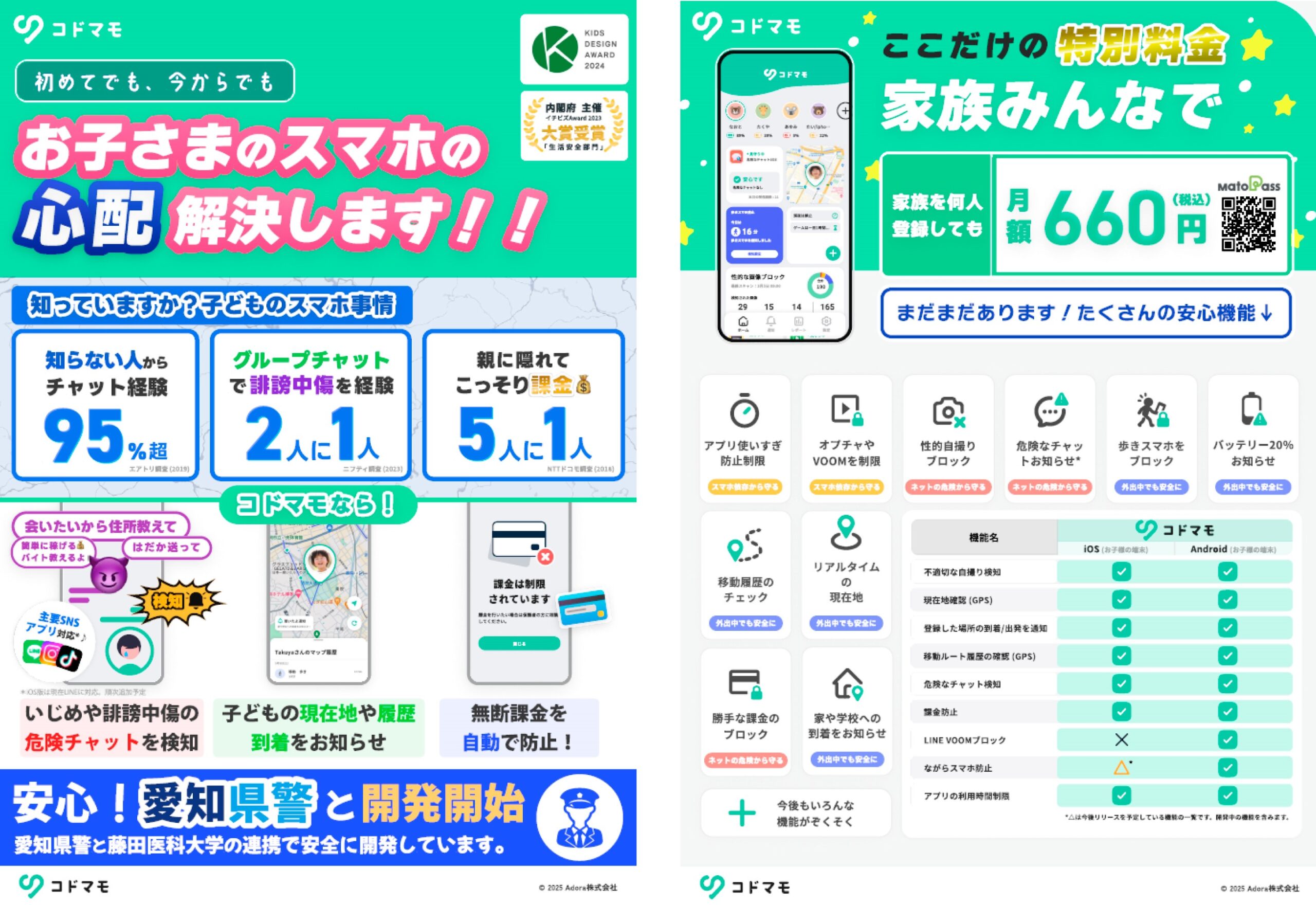
The above graphic shows off some of Kodomamo’s key app features and accolades.

However, when the service was first launched, it faced a major obstacle: the wall of awareness: how to get the people who need Kodomamo to know it exists.

② Points of Contact Between Kodomamo and Customers

Kodomamo’s customer touchpoints were primarily limited to online channels and within the app itself. While efforts were made to direct users to the official website through social media and web advertisements, it was difficult to reach potential customers through passive advertising alone. Furthermore, the in-app chat function served only to support existing users and could not act as a contact point for new customers.

While countless parents were worrying about their children being bullied, there was a stark lack of opportunity for them to learn about the potential solution of Kodomamo. Without overcoming this situation, the service could not truly contribute to society.

[The Hypothesis] Reach Customers through Mobile Phone Shops

To solve the challenges mentioned above, we hypothesized that a network of mobile phone shops throughout Japan could be the best way to connect Kodomamo with its customers. The realization of this hypothesis would not have been possible without support from D-POPS (with its expertise in managing mobile phone shops) and Advancer (with its strong network across shops nationwide).

There are many benefits to introducing Kodomamo through mobile phone shops:

① Direct Customer Contact

Staff can propose Kodomamo directly to parents who visit the store, especially when their children are getting their first smartphone.

② Support from Specialized Staff

Just as carrier payment plans can be complicated, there is significant demand for support in selecting and setting up the most suitable app from a large selection. Knowledgeable staff can also assist both parents and children in getting the application installed and functioning on their devices.

③ Continuous Service

Customers gain the peace of mind that they can ask questions at a physical store if any issues arise after they begin using the service.

The concept of maximizing the value of a “face-to-face” experience in a physical store to solve problems that cannot be solved online perfectly embodies D-POPS GROUP’s core business model of Real Business × Technology × Group Synergy.

[The Strategy] A Three-Pillar Approach for Expansion in Japan

To turn our hypothesis into reality, we constructed a strategy based on three key pillars:

① Sales Channel Expansion

Even among the approximately 7,000 mobile carrier shops around Japan, the major telecommunication company NTT docomo boasts an overwhelming number of “docomo Shops”, so we set our sights on working with them. To do this, we had to go through their proprietary product application system, an approval process necessary for retailers to handle their own unique products and services. Part of our strategy involved submitting our application through D-POPS, which manages a number of docomo Shops. After it was approved, Advancer leveraged their network of dispatched personnel to pitch our services at docomo Shops nationwide.

② System Integration

Initially, Kodomamo only supported in-app purchases, which was unsuitable for sales in mobile phone shops. The in-app purchase model made it impossible to accurately track sales performance at each individual shop and provided insufficient incentives to those businesses due to high payment processing fees. To resolve this, we sought system integration that aligned with the shop owners’ business models, creating a mechanism that could visualize sales results and provide appropriate incentives.

③ Sales Scheme Construction

Through consultation with D-POPS’ top sales members, who have extensive know-how of sales in mobile phone shops, we established the most effective sales scheme. Specifically, this involved combining the proposal with the mandatory guidance provided to customers under 18 regarding filtering services. This scheme allows Kodomamo to be naturally proposed as an option precisely at the moment parents are considering safety measures for their children’s smartphones.

This multifaceted strategy, driven by the close cooperation of these three companies, transformed a mere concept into a plan ready to be executed across Japan.

[The Execution] Growth Trajectory Accelerated by the Venture Ecosystem

Here is a timeline of the execution based on the challenges, hypothesis, and strategies we explained so far.

July 2024: D-POPS GROUP invested in Adora (Press Release on Investment in Adora Inc.)

August 2024: The project was launched by a team from Adora, D-POPS, and Advancer.

October 1, 2024: Sales were initiated at Smartphone Consultation Desk TOP1, D-POPS’ chain of mobile phone shops. At this beginning stage, they accumulated sales know-how, and promotional materials were produced by fellow group company graphD.

Late October 2024: The proprietary product application for docomo Shops managed by D-POPS was approved. Armed with this approval and their newly-acquired sales experience, campaigns began at docomo Shops nationwide. Kodomamo received favorable reactions at many shops as “a socially meaningful and profitable product that is easy to sell together with a smartphone”.

February 2025: The proprietary product application for Rakuten Mobile Shops managed by D-POPS was approved. This secured a new sales channel for future store expansion.


The above graphic advertizes Kodomamo’s relevance for minors who use smartphones, its collaboration with the Aichi Prefectural Police, and a pricing guide with a list of available features.

In this way, D-POPS GROUP’s Venture Ecosystem became a powerful engine accelerating Adora’s growth.

[Results and Next Challenge] Rapid Expansion and Future Issues

The sales channel expansion targeting docomo Shops, which began in earnest in November 2024, achieved adoption in approximately 300 stores in less than a year. The breakneck speed at which it spread is a significant achievement brought about by the collaboration of the three companies.

However, the next challenge is now clear: improving the rate of acquisitions per shop. While the number of shops adopting Kodomamo has increased, there is some variation in the number of acquisitions at each location. To address this, Advancer, which has offices all over Japan, established a new support team composed of members with mobile phone shop sales experience. They are working to raise the overall performance by providing tailored support to shops struggling with acquisition rates.

Additionally, D-POPS and Advancer are jointly supporting Adora in securing adoption with their partners, such as MVNOs (Mobile Virtual Network Operators) and device manufacturers.

[Conclusion] Potential for Unlimited Growth through the Venture Ecosystem

This article summarizes the case where three partners in our Venture Ecosystem collaborated to successfully tackle the difficult objective of boosting Kodomamo awareness—a task that would have been impossible for a single small company—and achieved substantial results.

These efforts go beyond the simple provision of funds. Pooling the expertise and resources of various companies within the group in this way shows a strong case for the successful model of supporting the growth of a startup company. D-POPS GROUP will continue to leverage the unlimited potential of the Venture Ecosystem to create new value to benefit society.

Written by:
Shoichi Sakamaki (D-POPS Corp.)
Shuhei Hosoda and Nizo Ohashi (Advancer.inc)

Related Articles

[Venture Ecosystem Case Study] The Power of Three Arrows
“One Tech World”, a Development Alliance Formed by Three IT Companies “We lack engineers.” “One company alone can’t handle enterprise-scale projects.” These are the recurring problems in an IT industry facing severe labor shortages and increasingly complex project requirements. To address these challenges, three IT companies within D-POPS GROUP joined forces in May 2024 to form “One Tech World”, a strategic development alliance designed to leverage their collective strengths. The alliance consists of techbeans inc., an AI-leading company specializing in system development and AI solutions; @SOLUTION, the founding architect of this alliance, and a powerhouse in system development, infrastructure, mobile apps, and consulting; and idealump Co., Ltd, experts in web service development, UI/UX design, and other creative productions. This article explores how these three companies generate group synergy to secure large-scale enterprise contracts that would be unfeasible for any of them to obtain individually. 1. The “Wall” for Small to Mid-Sized IT Firms Certain areas of business are inaccessible for individual IT companies except for larger ones due to three main factors. ①Chronic Talent Shortages Large-scale projects require a massive headcount. Many firms must decline lucrative opportunities simply because they lack the internal resources. ②The Jack-of-All-Trades Trap Modern projects require a diverse elite skill set—PMs, designers, frontend/backend specialists, and infrastructure engineers. High-level mastery of every field within one company is rare. ③Ceiling on Internal Education Relying solely on internal projects limits a junior engineer’s growth. There are not many opportunities to learn from veteran engineers at other companies, so from an educational standpoint, they cannot overcome the limitations of in-house-only training. 2. The “Three Arrows” Concept: Unbreakable When Bundled There is a Japanese parable about “Three Arrows”, where a single arrow is easily broken but three held together are not. ①Exceeding the Limits of One To solve the challenges mentioned above, we arrived at a clear conclusion. By forming an alliance between the three IT companies within our group, we could flexibly handle large-scale projects that would be impossible for a single company to manage alone. Just like the Three Arrows—where a project that might snap a single firm’s resources can be successfully supported when three firms are bundled together—this vision was set into motion by a call to action from our organizer, @SOLUTION. ②The Right Talent, at the Right Time By forming this alliance, we can assign engineers across company lines, making it possible to take on project scales that a single firm simply could not accept. In an era where the shortage of IT talent is a major social issue, our ability to mobilize a large workforce all at once whenever necessary is a significant competitive advantage. ③Bringing Together Our Strong Points We are able to demonstrate our synergistic strength by combining the specific expertises of each company, including project management and direction, design, creative, frontend, backend, AI implementation, etc. Furthermore, skill sets that are difficult to assemble within a single organization can be fully covered when our three companies collaborate, vastly expanding the technical domains we can handle. ④Cultivating Talent Across Company Borders When veterans from one company work together with junior engineers from another on the same project, it creates growth opportunities that cannot be found within a single firm. Exposure to the different corporate cultures and technical approaches of other companies provides engineers with invaluable professional experience that accelerates their development. 3. The Three Coming Together: The Birth of “One Tech World” ①Why We Chose the Alliance Model We chose this system over a simple outsourcing relationship to ensure speed and quality by collaborating on a daily basis, rather than searching for new partners for every individual project. We believed that by teaming up with trusted colleagues who understand each other’s strengths and weaknesses, we could provide significantly higher value to our clients. ②Agility Through a Horizontal Structure By accepting projects as a horizontal alliance of three equals, we are able to keep the commercial flow simple and costs low while maintaining a flexible team structure. We have established a system where the primary contractor serves as the single point of contact while the alliance as a whole manages the project. ③Speed and Simplicity of Communication We utilize tools such as Slack to ensure smooth communication between our three companies. We also place a heavy emphasis on creating systems for information sharing and problem-solving through regular meetings. This commitment to open communication has been the key to increasing our collaborative speed. ④Development Rules as a Common Language We are actively developing standardized development rules for the alliance, clarifying the boundaries of responsibility and standardizing project management protocols. When different companies work together, keeping a set of rules that we have in common is essential for guaranteeing high-quality output. ⑤Keeping Everyone Up-to-date with AI Led by techbeans, we hold AI-related study sessions to create an environment where employees from all three companies can acquire AI utilization skills. As an AI-leading company, techbeans also actively publishes blogs and interviews, helping to drive AI adoption across the entire alliance. 4.The Journey to Launching: Inevitability, Rather than Coincidence Pre-2020 (Laying the Groundwork for Collaboration) The birth of One Tech World was preceded by a history of collaboration within the group. Around 2020, techbeans and @SOLUTION participated in the development of “DAMO”, the proprietary CRM system for D-POPS. This period allowed us to accumulate a track record of successful joint projects, cultivating the fertile ground necessary for a deep-seated partnership. December 2023 (Adding the Power of Creativity) idealump, a firm with significant strengths in design and creative production, joined D-POPS GROUP. This expanded the group’s IT capabilities into a three-company system, completing a lineup that could cover everything from technical development to high-end design. May 2024 (The Alliance Starts Moving) Following a call to action by @SOLUTION, the One Tech World development alliance was formally established between the three companies. Group synergy was demonstrated immediately, with idealump taking charge of renewing D-POPS GROUP’s corporate website during the same period. 2024–2025 (Expanding to Over 20 Collaborative Projects in 18 Months) In the year and a half or so since the alliance’s inception, the number of collaborative projects within the group reached approximately 20. By establishing a solid communication infrastructure, we have realized a higher speed of collaboration than we ever had before. Honestly, the sense of momentum we are experiencing is unlike anything any of us felt in the past. November 2025 (Stepping Outward: DXPO Exhibition) One Tech World made its debut as a unified entity by co-exhibiting at a major IT seminar event series in Japan called DXPO. By highlighting our strengths as an alliance—such as our AI-integrated products and our deep pool of talented engineers—we are working to increase our appeal among external clients. 5. Future Challenges: Racing Through the AI Era as a Unified Trio ①Overcoming the “Turning Point” in Development Since the launch of the alliance, we have successfully driven more than 20 collaborative projects within the group. Through continuous efforts to streamline communication, we have achieved a level of collaborative speed that we’ve never experienced before. This has made it possible for us to handle projects of a scale and scope that would have been impossible for a single company to manage alone. ②Accelerating Development with AI The development landscape is currently at a major crossroads. As the industry shifts toward accelerating development speeds through AI, techbeans—as an AI-leading company—is spearheading this movement by publishing AI-related blogs and interviews and hosting internal study sessions for the alliance. By supporting the employees of all three companies in mastering AI, we are significantly strengthening the collective development power of the entire alliance. ③Becoming the “Preferred Choice” through Creative Excellence Among the three companies, idealump possesses particularly strong design and creative capabilities, serving as a powerful asset when approaching external clients. While it comes a bit later than our initial launch a year and a half ago, we plan to significantly strengthen our inbound marketing strategy in 2026. We aim to capture new markets by fully utilizing the unique strengths of our three-member partnership. ④Opening the Door to Enterprise-Level Projects The alliance was brought together by the vision of the originator, @SOLUTION. Much like the bundling of three arrows, this partnership has turned the dream of approaching major corporations—once impossible for a single firm—into a reality. In an era of chronic IT talent shortages, the ability to mobilize a large, skilled workforce the moment it is needed serves as a massive competitive advantage. ⑤Expanding Collaboration with External Partners Moving forward, we plan to invite partner companies from outside D-POPS GROUP to participate in our projects. However, this will not be open to everyone. We will only admit partners who meet the specific high standards set by One Tech World. Our goal is not simply to become a large IT organization, but to be a collective of highly skilled IT talent and, above all, a group of companies that clients can trust implicitly. We will continue to increase the value of this alliance by balancing the expansion of our scale with strict quality assurance. 6. Summary: Choosing to “Bundle Together” In this article, we have summarized the initiatives of One Tech World, the development alliance formed by three IT companies within D-POPS GROUP. In this era when IT is accelerating faster and faster, issues that a single company cannot solve alone are increasing. Just as in the Three Arrows parable, by leveraging group synergy and mutually complementing each other’s resources, expertise, and talent cultivation, One Tech World represents a new collaborative model that IT companies in the future will be pursuing desperately. D-POPS GROUP will continue to harness the potential of our Venture Ecosystem, striving to make new, valuable contributions to society through the sharing and nurturing of exceptional IT talent. techbeans inc. Kazuhiro Maekawa
  • Group Companies
2025.12.18
[Entrepreneur Interview #16] Tomoyoshi Yamashita and Jiro Masaki (Plust) – Part 2
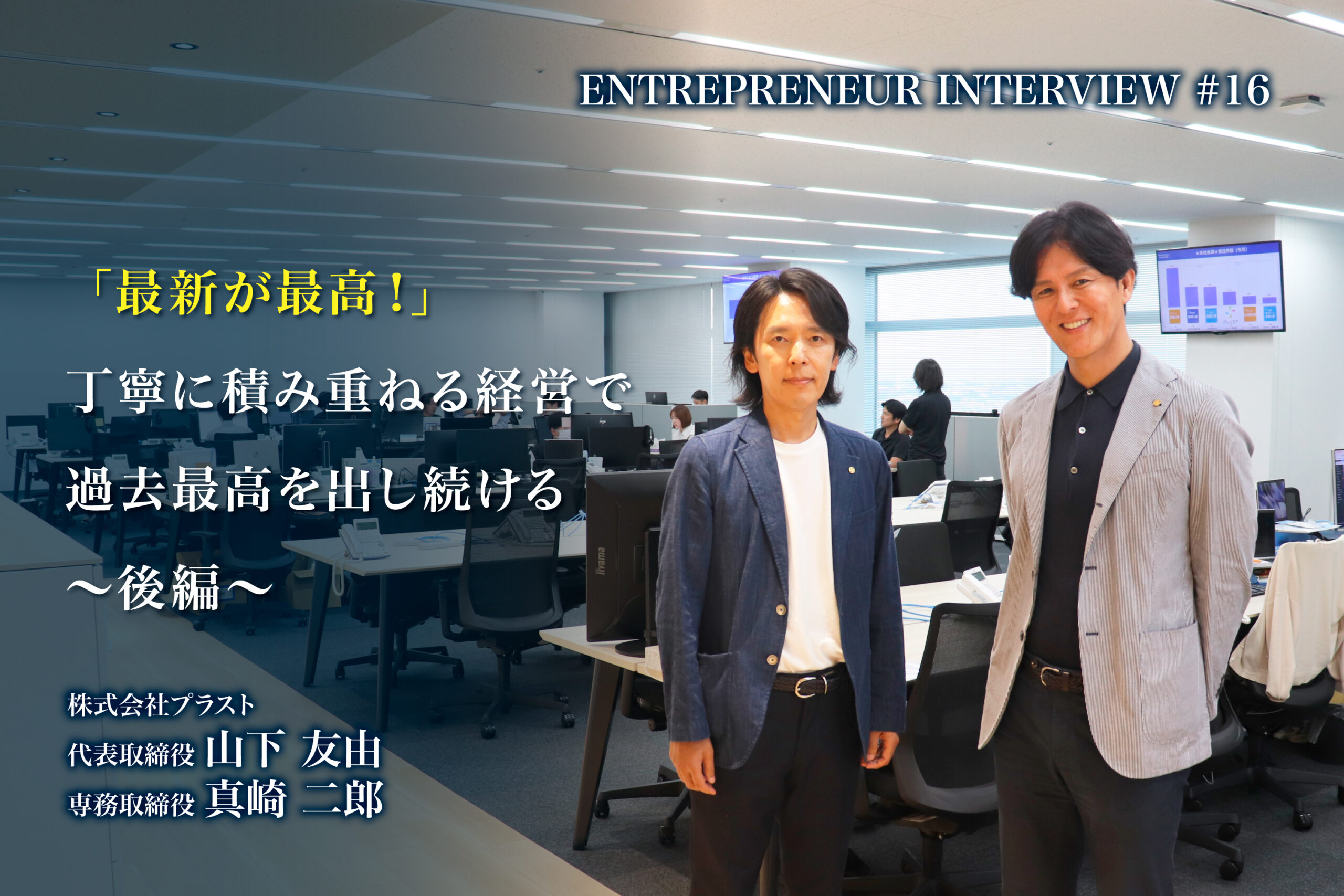
“Newest is best!” Careful, Consistent Management for Continuous Record Growth D-POPS GROUP has 24 group companies that we call partners (at the time of publication). For this article, we interviewed Tomoyoshi Yamashita, the President and CEO of PLUST.Co.,Ltd. (Plust from here on)—which joined our group in September 2024—and Jiro Masaki, Plust’s Senior Managing Director. (This interview was conducted in July 2025.) This is the latter part of the interview. To read the first part, click the link below. https://d-pops-group.co.jp/en/column/plust-interview-first-part/ ◆Case Study Interview Videos Sugihara: I watched the interview videos of case studies published on Plust’s website, and I was very impressed by one customer who said, “All their staff, both men and women, have such great personalities that it really underscores their company’s merit, and even the CEO’s merit…” I felt like the sales and marketing teams’ sincere attitudes have become a part of the company’s branding itself. Yamashita: Thank you. Before adopting a product or service, it’s not uncommon for customers to worry, “Can I really trust Plust with this?” or “How do other business owners in the same industry actually feel after implementing this?” We believed that customer voices were the solution to alleviate these anxieties even a little. Naturally, we started from zero, asking our customers one by one for their feedback. As the number of such interviews gradually increased, it allowed us to view our company objectively. For example, understanding why they chose to work with us, or specifically how our support delighted the customers, has become a reference for how to support future customers. We realized things like, “If we respond this way, the customer will say they were helped”, and “If we think together about the store like this, the owner will be pleased.” Also, through watching these interview videos, our customers basically teach us about our own strengths all over again, and it enables us to think, “Ah, this is definitely our forte. Well, in that case, let’s bring out our team’s strengths even further!” Sugihara: The Japan Marketing Research Organization (JMRO) ranked your company as first place for “Number of Public Interviews of Satisfied Customers” in both the “Storefront App Development” and “Web Development” divisions. It’s remarkable that you conduct so many interviews. How do you go about arranging them? Yamashita: Actually, during the contract phase, we ask questions like, “If you implement our services and are satisfied with the results, would you be willing to cooperate in a post-implementation customer interview at a later date?” We also write this request directly into our contracts. Many of our customers respond by saying things like, “As long as it turns out well, that’s fine” or “If you produce good results, then we’ll be happy, and your sales and marketing teams can certainly use them!” But I can’t say there aren’t some who politely decline our request because they are honestly shy. Almost all of the interview videos are produced by our company’s media production department’s video team. Sugihara: That’s wonderful. What kind of reactions do you get from all of the customers and employees who watch those videos? Yamashita: First, for our employees, we basically created a “Case Study Interview Video” channel on our internal Slack, so when an interview is released, it’s shared company-wide. I think they are also displayed on monitors in the office, but when we share the interview with our company Slack, we can let everyone know who the support staff member was, who initially connected with the customer, and who the sales representative was. The customers’ own words let everyone understand in what manner they received their support. Normally, people in different departments or those in sales roles don’t know in detail how closely the support team works with customers. When a customer speaks highly of the support, sometimes they mention them by name, which shines a spotlight on the support staff and on those who are doing a good job with their sales. Also, in cases where customers watch the video during a business negotiation, some of them immediately say, “All right, then. We’ll leave it to you!” And others will call us in the following days to say they’ve decided to proceed with the contract. So I think those videos really help customers to envision a good working relationship. Sugihara: In that sense, you’ve created a system where the acquisition sales team members share the spotlight with the customer support and customer success team members. Yamashita: That’s right. Masaki and I are constantly mindful of creating a system that puts the spotlight not only on sales staff but also on employees who are doing important work that may not be easily quantifiable. Of course, in a sales company, sales often get the most recognition. But I believe that the whole company gets more energized when we make sure that the people who are working hard in their respective, important positions are properly acknowledged, rather than just the sales staff. Sugihara: Back-office staff departments like accounting and HR, which don’t have direct customer contact, are also certainly vital. Do you have ways of highlighting them within your company? Yamashita: We do have a Monthly MVP program, where the person who shone the brightest that month is selected from each division or department. About 15 candidates are selected for the Monthly MVP across the entire company. From those, we decide on one person each for the top sales award, the division MVP, and the Plust Monthly MVP. The final award recipients receive a certificate of commendation and a bonus, and the results are also publicized externally on our social media platforms like Instagram. Our public relations team makes sure these social posts are written so that when the employees, their family, or friends see them, they can feel like they are doing good work and being successful. In June, the information systems team leader, who responds to everyone with system-related questions every day and even worked on weekends to handle our recent head office relocation, was the company-wide MVP. Sometimes the MVP is the top salesperson with an overwhelming lead, and sometimes it’s a support staff member who received high praise from customers. It’s different every time. ◆Origin of the Company Name Sugihara: I’m glad to hear about such positive initiatives. Moving on to the next question. The mission and values page on your website explains the origin of your company name, and it’s quite impressive. The circles of “PLan”, “Unique”, and “Solution” are all encompassed by the foundational circle of “Trust”. As your customer feedback suggests, it seems that all of Plust’s employees work to build a strong relationship of trust with your customers. Could you elaborate on this philosophy? Yamashita: “Plan” refers to a total commitment to providing plans aligned with the customer’s perspective. “Unique” means offering proposals to customers out of our own originality. “Solution” means solving the problems that customers face. By fully committing to these three initials—PLUS—we ultimately aim to win the “Trust” of our customers. That’s the full meaning behind our company name. This has been the case since our establishment. Although I mentioned earlier that we were working every day without deeply internalizing it, our philosophy itself was actually always there. However, when trying to integrate those ideals into our daily operations, there was a large gap between the stated ideal and the reality on the ground at the time. I was a less mature manager then and couldn’t successfully connect the two. Sugihara: So the meaning of the company name was decided at the time of its founding. Have the mission and philosophy remained the same since then? Yamashita: The core foundation of our ideology hasn’t changed, but our mission, vision, values, and their verbalization were discussed and finalized over about six months, approximately three years ago, with Masaki and the heads of each division working together. To create something that could lead to the realization of our values, leaders from different roles gathered and created it, compiling it into a brand book. When deciding on the values, we turned ideas like, “Everyone at Plust often uses this kind of language” or “This really feels like us” into written statements. Masaki: That’s right. Even if we had a vague doctrine in the beginning, no one was really looking at it or striving for it. But as the number of people grew, we realized that wasn’t sustainable. President Yamashita provided the opportunity, and we undertook a project to create our philosophy and mission. We established these principles by asking “What are the things that Plust must value?” and “How can we maintain Plust as the foundation for everyone’s happiness?”, and then we made those our permanent motifs by preserving them in the form of a brand book. Since our brand book was created, it’s become easier to convey our values to new recruits. We can show them the brand book and say, “This is what we aim for”, and communicate that we only want people who resonate with this to work at Plust. In terms of recruitment, we have people who apply because they saw our philosophy, mission, vision, and our five values and felt an affinity for them. ◆Local Area Sustained Support Project Sugihara: I can see the history of your extensive social contribution activities on your website, with a cumulative total of about 40 million yen. What was the thinking behind these donations and support activities? Yamashita: We call these activities our Local Area Sustained Support Project. Now, this might not be the best way to say it, but the work that we do from day to day could be described as the “ultimate repetition”. It involves sales activities, carefully setting appointments, enthusiastically negotiating, providing solid support, and satisfying customers with website production. However, I believe that if there is a greater cause, or if we can feel that the work we do every day is useful to society and contributes to someone’s happiness, we can approach the tasks at hand with a more earnest attitude. Also, emotionally speaking, doesn’t it feel good when someone thanks you for your work? While our contributions may be very small, we hope that through donations and activities, we feel we are helping those in need even a little bit. That being said, our mindset is a little bit different from those involved in purely voluntary work, in the following sense. We feel good if we can make someone happy, even a little, but it wouldn’t be right if making that person happy meant reducing our business profits and effectiveness. If we could generate solid profits and also contribute to the world at the same time, that would be pretty cool, since people usually assume you can only achieve one or the other. If you look at it that way, it makes sense for us to commit to doing both. We want to generate solid profits, give back to employees through their salaries, and contribute to society while growing the business. Then no one would be able to complain about our company, so we want to continue these types of activities as long as possible. Sugihara: That’s a wonderful plan. Now, onto the next question. You moved your head office in May this year, so what was the concept behind the design of the new office? Yamashita: This was a head office expansion and renovation within the same building, the first in 11 years. Since we have sales offices all over Japan, I wanted a space that truly felt like, “Now, this is where the headquarters are!” We discussed the interior design extensively with the contractors and paid close attention to every detail, not just because we wanted it to be stylish or cool, but because we wanted it to reflect our ideology and brand book. We spoke with various contractors to create it, and because we plan to use it for a long time, we wanted an atmosphere that wasn’t overly flashy—a bright office with good energy that people would want to commute to. One that is calm and somehow exudes trust. We have to perform a lot of stressful tasks every day, so we wanted an environment that would offer our employees a moment of healing when they’re at our headquarters, facilitate brainstorming, and not become tiresome over time. ◆A Decision for the Sake of Growth Sugihara: Thank you. By the way, you decided to join D-POPS GROUP last fall. It’s easy to imagine that Plust, being such an excellent company, was receiving numerous M&A offers at the time. What was the main factor in your decision to join D-POPS GROUP from among those? Yamashita: I think it was ultimately President Goto. I met many other truly excellent people, including CEOs and executive members of publicly-listed companies, who would talk about how they wanted our group to be or what field they wanted us to be active in…but they rarely asked what I or Plust wanted to do. I told Masaki this before, but as the founder who started the company, joining any group—even a large corporation—was not an easy decision for me. Furthermore, I felt that if I were to make that decision, it had to be a partnership that would genuinely lead to a brighter future for Plust and all the employees working in the company. President Goto was the only one who focused on asking, “What do you want to do going forward, President Yamashita?” I was very pleased that he prioritized hearing my intentions first. I told him that I wanted to grow further as a manager, and I wanted the company to develop even more to realize its values. I then shared what I was thinking and what I anticipated our future challenges might be. As we met several times and had meals together, President Goto told me, “We will continue to entrust the management of Plust to your leadership, President Yamashita. We intend for D-POPS GROUP to essentially be a cheerleading squad, supporting Plust’s development and the flying leap that you and your team are aiming for.” That statement was huge for me, and it gave me a strong vision of working together in the future. Because of this, I was almost fully decided on moving forward with President Goto and D-POPS GROUP. Then, I went to dinner with Masaki, shared my thoughts on joining the group and my future plans, and he also agreed. We informed our employees after September’s accounting was closed, so it was around October. We explained it in about seven phases. Sugihara: Senior Managing Director Masaki, what did you think when President Yamashita told you about joining the group? Masaki: When President Yamashita first told me about it, our company had been growing in size, and we were reaching a point where we had to consider how to continue for many more years on our own. President Yamashita was already contemplating various things. When he suddenly told me the plan, I recognized that joining this group was the optimal solution for resolving the various issues that would inevitably arise. I was convinced after hearing all the details. Also, even up to now, whenever President Yamashita approves someone, or should I say is impressed by someone, they are generally wonderful people, so I trusted that this was not a mistake. At the time, I hadn’t met President Goto yet, but I wasn’t worried about that aspect at all. Sugihara: On the night of the signing day for joining the group, there was a charity party hosted by D-POPS GROUP’s Chairman Semmoto, and both you and President Yamashita attended, right? Masaki: That’s right. I was working at the Saitama office when I got a call telling me to come to Nihombashi immediately, ha ha. I left for Nihombashi right away, while wondering to myself whether it was really such an amazing party that I had to drop everything. When I arrived, every single one of the participants were truly remarkable people, and it was great to attend such a fantastic event and hear such valuable stories. ◆“Realizing a Venture Ecosystem” Sugihara: D-POPS GROUP’s aim is “realizing a Venture Ecosystem”. What parts of this goal do you resonate with? Do you have any shared mindsets or activities aimed at creating this Venture Ecosystem together? Yamashita: When it comes to Venture Ecosystems, Plust currently has three group companies, so we kind of have our own small-scale Venture Ecosystem. By working together on things, we are experiencing the generation of synergy that transcends the borders between divisions. For example, our website support members sell security products (OA equipment), or we generate referrals when we encounter a company that wants to build a website. When I consider that such things are happening across divisional boundaries, I deeply resonate with the Venture Ecosystem that D-POPS GROUP is trying to create. Even just by having invoices that previously went externally now circulate within the group, money flows better, and we may even see the creation of new businesses. Even our own management team thinks that this system is a good way for our company to survive without collapsing. ◆5-Year Vision Sugihara: Thank you. What is your 5-year vision for Plust? Yamashita: In any case, we want to see, even more than today, people who are glad they work at Plust. I view sales as a means, not an end, so I honestly don’t have a strong focus on reaching a specific target for profit or business structures. However, I’ve always paid special attention to the idea that both myself and everyone I work with must continue to embody our value of “newest is best”. Five years from now, rather than raising a glass over glorious memories from the past, saying “Those were the good old days” or “I was amazing back then”, I want us to have taken on lots of challenges, and piled up more failures as well, and then with more employees than before, say with a smile, “We, right now, are the best Plust has ever been!” Sugihara: Then, in order to reach this future where all your employees and stakeholders feel happy, what challenges and efforts do you think you’ll have? Masaki: In the same way that we’ve been running this company for the past 20 years, we don’t think too much about the future, and I mean that in a good sense. Our thinking is that we shouldn’t be focused on the past or the future, but on how things are right now, and if things now aren’t the best, that’s not acceptable. So, I don’t think it’s good to look too far ahead, and we should definitely not dwell on the past. What we see today is the result of building up year by year, while being conscious of whether we are happy right now and whether this is the best we’ve ever been. Obviously, as managers, we have to think about the next five years, but we don’t have many numerical targets. I can say one thing, though, which is that we want to continuously update our performance record every year as much as possible. Yamashita: Actually, there was a period when we created five-year and ten-year plans, but unexpected events like the Lehman Shock, the Great East Japan Earthquake, the COVID-19 pandemic, and the Noto Peninsula Earthquake kept occurring every few years, meaning plans didn’t go as intended. From that experience, I’ve come to feel over these 21 years that, although it’s not glamorous, dedicating ourselves to doing our best and building up day by day is ultimately the shortest path to a bright future. ◆Message to Readers Visiting Our Website Sugihara: Finally, could you each offer a closing message to the readers visiting our website? Yamashita: I will speak to entrepreneurs who might be considering joining our group. I think many founders like me, who have run their companies for years on their own, might have resistance to joining a group in the middle of leading their own companies. I also struggled internally with that same sense of reluctance, but D-POPS GROUP really allows me to continue leading my company. In addition, they act like a cheerleading squad, supporting us strongly from behind, and aid in the growth of our company. So, if anyone is considering joining, I think it’s worth having a conversation. Also, when more excellent people join the group, it stimulates us, making things even more interesting. So, if fate brings us together, please don’t hesitate to reach out! Masaki: After joining D-POPS GROUP, they have such amazing leaders and advisors, so being able to receive valuable advice from them is an unprecedented benefit for us.   Interview conducted by D-POPS GROUP’s advisor Genta Sugihara.   PLUST.Co.,Ltd. Company President and CEO: Tomoyoshi Yamashita Address: 20F and 24F Meiji Yasuda Life Insurance Saitama Shintoshin Bldg., 11-2 Shintoshin, Chuo-ku, Saitama, Saitama-ken Established: October 22, 2004 Website: https://www.plust.jp/
  • Group Companies
  • Interview
2025.09.25
[Entrepreneur Interview #16] Tomoyoshi Yamashita and Jiro Masaki (Plust) – Part 1
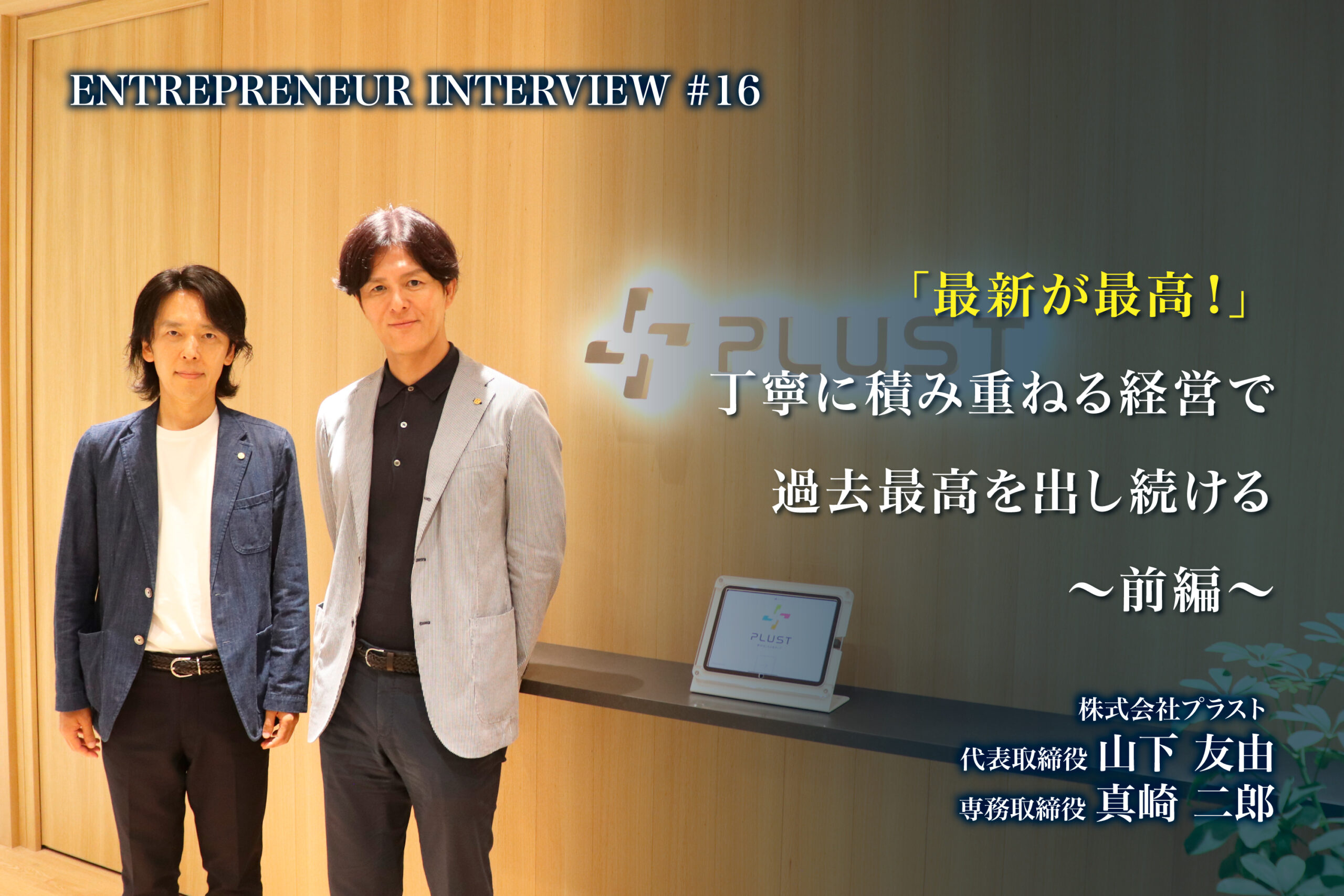
“Newest is best!” Careful, Consistent Management for Continuous Record Growth D-POPS GROUP has 24 group companies that we call partners (at the time of publication). For this article, we interviewed Tomoyoshi Yamashita, the President and CEO of PLUST.Co.,Ltd. (Plust from here on)—which joined our group in September 2024—and Jiro Masaki, Plust’s Senior Managing Director. (This interview was conducted in July 2025.) ◆The Motivation for Founding a Company Sugihara: Thank you for agreeing to this interview, President Yamashita and Senior Managing Director Masaki! First I wanted to say, President Yamashita, I always notice your wonderful smile whenever we meet. I imagine being a business owner involves a lot of hardship. What I want to know is, are you constantly cheerful by nature, or have you already overcome so much difficulty that now you can be this sunny? Yamashita: Oh, you’re too kind! I have experienced countless difficulties, ha ha. Experiencing various difficulties is just my normal mode. When I founded my company, there were times when I looked quite stern. I think I unconsciously wore an unhappy look when our sales weren’t growing or when there were issues with management. However, I feel like I was consciously trying to smile and be cheerful. Sugihara: Senior Managing Director Masaki, you’ve been with President Yamashita since before the company even existed. What is your perspective? Masaki: Recently, as the number of employees—including women—has increased, his way of communicating with the entire organization has changed from the past. However, in meetings attended by our executive members, he is still as strict as ever. He delivers that strictness with love, and that combination is something we executives are completely aware of. Sugihara: I guess since my relationship with President Yamashita is still relatively new, I have no idea what his stern face looks like! Now, let’s move on to the main topic. First, could you tell us what motivated you to found Plust? Yamashita: I had always wanted to be a CEO someday, but at the time, I lacked the courage and the drive, and honestly, I didn’t even know how to become one. So, after graduating high school, I spent four years in the Air Self-Defense Force, and then I worked as an employee at an IT startup company. That’s where I met Senior Managing Director Masaki. While I was entrusted with responsibilities such as the OA equipment business at my previous job, I gained experience as a salesperson, a manager, an office head, and I helped establish a new business office on two separate occasions. This gradually gave me the feeling that I was essentially managing a small company by myself. I started thinking if this was the case, I probably could run my own business, so I decided that the time had come to put my vague dream from the past of becoming a CEO into motion, and I started it alone in my own home. For the first six months, I worked as a sole proprietor with a company that was wholesaling OA equipment, and I was allowed to operate under the name of their business office. After that, I registered my company and created Plust Limited Company. Since I had established business offices twice in Saitama Prefecture (in the cities of Warabi and Omiya) at my previous job, I was familiar with the area, so I decided to found my company in Saitama. ◆How the Two Met Each Other Sugihara: How exactly did you meet Senior Managing Director Masaki? Yamashita: Well, we met at our previous company, when I interviewed him. After he joined the company, Masaki was placed in a slightly different location from mine, but he was consistently at the top of our sales rankings. At some point after his interview, we started working more closely together, and as I got a sense of his personality, we became quite good friends. After that, we became separated again while I established the business offices in Saitama and he continued working in Tokyo, but when I was moved back to Tokyo, we started working together once more. At that time, we were in the positions of office head and manager, and we began to discuss deeper topics than we did when we were just salespeople. At some point, a mutual acquaintance of ours separately invited both of us to start a company together. I was to be a board member, and Masaki was to be a salesperson. However, the person who invited us requested, “Don’t tell anyone else about this”, so neither of us brought it up in conversation with each other. But then I realized that this person must have invited Masaki too, so I finally asked him about it. At that moment, Masaki asked me, “Are you going to do it?” and I replied, “No, I’m not. I’m going to start my own business.” Then he said, “Why don’t we do it together?”, and that’s how the two of us decided to launch a company. To be totally precise, the first person to join me was Ono, who was a subordinate from our previous company and is now a Division Manager and executive officer at Plust, but Masaki did join us a year later. Sugihara: That was a fateful fork in the road. Senior Managing Director Masaki, when President Yamashita invited you to start a company, did you make an immediate decision, even though the future was completely uncertain? Masaki: Actually, since he was my boss and I was working under him, I was the one who said, “You should definitely go for it and start a company!” Our previous company was a really intense sales company that was growing rapidly, but I felt that President Yamashita, with his sense of cleverness that was no different from now, stood out from all the pushy salespeople there. He also had accomplished some considerable achievements as a manager, so I really wanted to work with him. Sugihara: From your perspective, what was your impression of President Yamashita at the time when you first met him? Masaki: As I mentioned, our initial meeting was at my job interview. I think I was in my late 20s when I went for the interview at our previous company. I naturally assumed that my interviewer would be someone of the usual age for conducting a job interview, but then I saw President Yamashita. I believe he was in his early 20s at the time. His hair was longer than it is now, he was tanned, and he gave off a very high-energy vibe, ha ha. ◆The Journey So Far Sugihara: Counting from your company’s founding in 2004, this is your 22nd term (your 21st term was considered a non-standard 5-month period due to a change in the fiscal year end to February) of operations. What have the months and days been like until now? Yamashita: Ahhh, it’s been full of ups and downs. Not even once has there been a period of stability. But the time has certainly flown by. Looking back, I think it’s been pretty interesting overall. Sugihara: But if you look at the management indicators, you seem to have had plenty of stability and growth. Yamashita: It might appear that way at first glance, but the number of failures has been overwhelmingly greater than our successes, and I was fortunate enough to have been helped by various people, which is how we managed to get by. I truly feel that we were lucky. I don’t particularly feel that I’ve worked that hard, either. Aren’t I just doing the minimum that is expected of me? But I guess I’ve always done what was necessary for the company, with an attitude of “That’s something a CEO would do”, or “I’m not just an employee, I’m the founder of this business, so I have to do it”. In the beginning, it might look like sales were increasing, but for several years, even though our sales were increasing, it was only by tens of millions of yen. If we fumbled our sales for even one month, we would fall below the previous year’s numbers. Initially, I didn’t have a clear vision. It was only about earning money, earning more than I did as an employee, or achieving success. If anyone were to ask me if I had a mission to contribute to society at that time, I would have to be honest, I definitely didn’t think about it as deeply as I do now. I was much more concerned about how to generate profit or how to increase the number of contracts. I was diligently working hard on various things every day, but I was living a stoic life with no vision, working from morning until late at night with few days off, until you could say I had hit my limit. So, while the beginning might look like a steady climb, things were actually very tight. You know, I think the catalyst for the company getting on track was actually the Great East Japan Earthquake in 2011. Until then, our main focus had simply been to increase orders and future profit, but suddenly, we couldn’t properly do the work right in front of us. There were times when we had planned power outages, so there was no electricity. Or times when there was no internet, so web designers couldn’t work. Of course, telemarketing was impossible. After desperately thinking about what we should do, we tried cold-calling, we bought generators faster than the government, somehow connected them, and worked in rooms smelling of gasoline. We experienced what it was like to just have to survive. Not only that, but I started wishing we could do something for the people who were struggling because of the earthquake. Initially, we provided condolence money for the families of our employees and donated to the Great East Japan Earthquake relief fund. My desire to contribute to society began to sprout from doing those things. In addition to that, after we started setting clear numerical targets for the year at the beginning of each new year, it became a mission or a target that we had to surpass, and with everyone’s cooperation, we achieved it. I decided to keep setting goals like that, and as a result, we surpassed the previous year every year. It was also significant that we formed a habit of sharing our objectives with the whole company. Sugihara: That’s wonderful. So, by continuously building on each previous year’s results and aiming for even a one-yen increase, you’ve been able to keep going for 20 years. Yamashita: That's right. In the book Good to Great, there’s a reference to some people getting on a bus, others getting off, and still others getting on at the next stop. We kept repeating this, and at first, there was no destination, but gradually it became, “It looks like fun if we go this way”, or “This might work”. During that process, the people on the bus gradually changed, though some people stayed the same, naturally. By accumulating those efforts, we reached our 22nd term, and what we are thinking about and doing now has evolved from that pattern. ◆Company Overview and Business Strengths Sugihara: Now, could you please tell us about Plust’s current business and its differences or unique features compared to other companies in that field, which have allowed it to grow continuously for 21 terms? Yamashita: Sure. We have three main business pillars. The first is the sale and maintenance of OA equipment, which we’ve done since our establishment. The second pillar is website production and operation support for small and medium-sized businesses. The third pillar is the sale and support of a customer relationship management (CRM) system linked to an application. These are our three business areas. Sugihara: What are the strengths of Plust’s business? Yamashita: Though I may be biased, I believe it’s our support capabilities for our customers, which are on par with our ability to make brilliant propositions during business negotiations. We have a support system that focuses on building a long-term relationship, rather than stopping once a sale has been concluded. Since few companies go to that extent, we focus on customers who feel secure in using our services consistently and those who become repeat customers. This connects back to what I mentioned earlier. When we first started, the goal was simply to sell, sell, sell, as much as possible…but we realized that wouldn’t sustain us. We understood that we needed to provide solid support after the sale and maintain longer relationships, or we would be eliminated. Sugihara: Customer support is an often-overlooked area, yet you deliberately focus on it. How do you instill this mindset in your support team staff? Yamashita: It’s true that customer support is a job where performance is not as easily visible as it is for a salesperson. But if support team staff lose motivation just because they aren’t in the spotlight, customer satisfaction won’t increase. So, I thought about how to put the support team in the spotlight, and I figured that if our company’s customer support was solid, our salespeople would find it easier to close more deals with customers. What we came up with and put into action was a means to get raw feedback directly from customers. We feature customer interviews on our website and even create videos of customer testimonials. When our employees see this, they realize things like, “Ah, this was the work of our support team” or “If they are doing this, our company is definitely better than others”. I felt that pointing out the company members who tirelessly support our customers behind the scenes would not be a negative at all, it would be a positive. Sugihara: Ah, so that’s how your website became like that. By the way, you mentioned having three business pillars. What was the catalyst for developing those three pillars? Yamashita: All three of those pillars are, in a sense, things that have helped us in running our company. In the early days after our establishment, we naturally used business phones, multifunction printers, and other OA equipment in our own company, and getting the best OA equipment available made it much easier to do our work. And the website is what we use to let more clients, customers, and job seekers know about the unknown company called Plust. In fact, over 95% of our employees joined the company after seeing our website. If we hadn’t invested in our website, we wouldn’t have been able to meet everyone we have now. The app is slightly different, but in terms of our CRM system, we’ve seen first-hand that if we hadn’t properly used a CRM system, including during the earthquake, our sales would not have grown at that time. It’s something that saved us and allowed our company to survive. We have a strong desire to offer the products and services that saved our business to all the executives out there who are diligently working on their management every day. As a result, instead of general households, we target business operators as much as possible. We want to do business that helps those operators while also increasing our own performance. I believe this is mutually beneficial. Sugihara: You’ve become a large company now, but you originally started from a small home office. You adopted the necessary products yourself as a small-to-medium enterprise, and then in turn, expanded your business into selling those same products to your customers. Yamashita: That’s right. As we primarily sold OA equipment, mainly business phones, our customer base grew steadily. However, there was a very tough period for OA equipment as well. The leasing of business phones became a social issue, making it impossible to sell through TV and newspapers, and leasing companies withdrew. At that time, we received requests from several customers asking, “Do you make websites?” We realized there was a strong need for websites, and we decided to launch a website business for small and medium-sized enterprises. And as the number of customers grew, we recognized the importance of getting our customers to come back again and again, and we started thinking about other methods of customer management besides websites. Back then, in the days before apps, we started with email systems linked to customer management, like newsletters. As times changed, that kind of system turned into apps, and now we also have a business for store-based apps. The products we handle change with the times, but we want to provide services and products that can help our customers’ companies grow or solve the problems they face. Sugihara: So that’s the process by which you’ve developed your businesses. Speaking of which, you have contracts with 6,000 corporate customers nationwide, and you offer a diverse range of services. Could you share some of the innovations you’ve made in your sales, marketing, and customer support systems? Masaki: I think it’s about being attentive, consistent, and meticulously keeping in touch with them. There are still things we need to improve, but the sales, marketing, and customer support teams try to check in on the current situation with customers, even if it’s just a phone call to see what they might need.   ~To be continued in Part 2~   Interview conducted by D-POPS GROUP’s advisor Genta Sugihara.   PLUST.Co.,Ltd. Company President and CEO: Tomoyoshi Yamashita Address: 20F and 24F Meiji Yasuda Life Insurance Saitama Shintoshin Bldg., 11-2 Shintoshin, Chuo-ku, Saitama, Saitama-ken Established: October 22, 2004 Website: https://www.plust.jp/   Next, in the latter part of the interview, we discuss: ・Case study interview videos ・Origin of the company name ・“Realizing a Venture Ecosystem” ・5-year vision ・And other topics Be sure to check it out here: https://d-pops-group.co.jp/en/column/plust-interview-latter-part/

  • Group Companies
  • Interview
2025.09.17
Back to COLUMN