

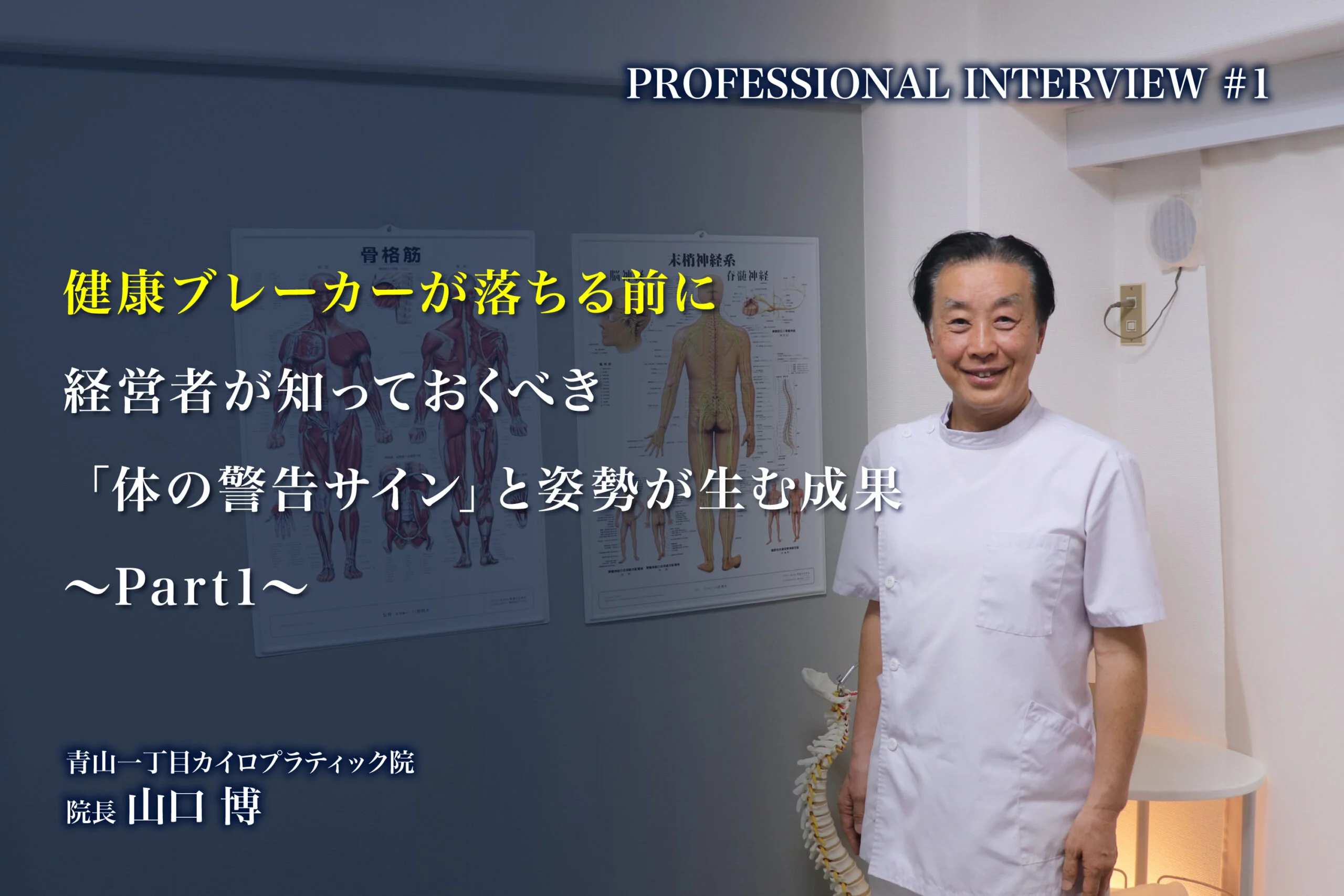
Before Your “Health Circuit Breaker” Trips: What Executives Need to Know About the Body’s Warning Signs and the Power of Posture
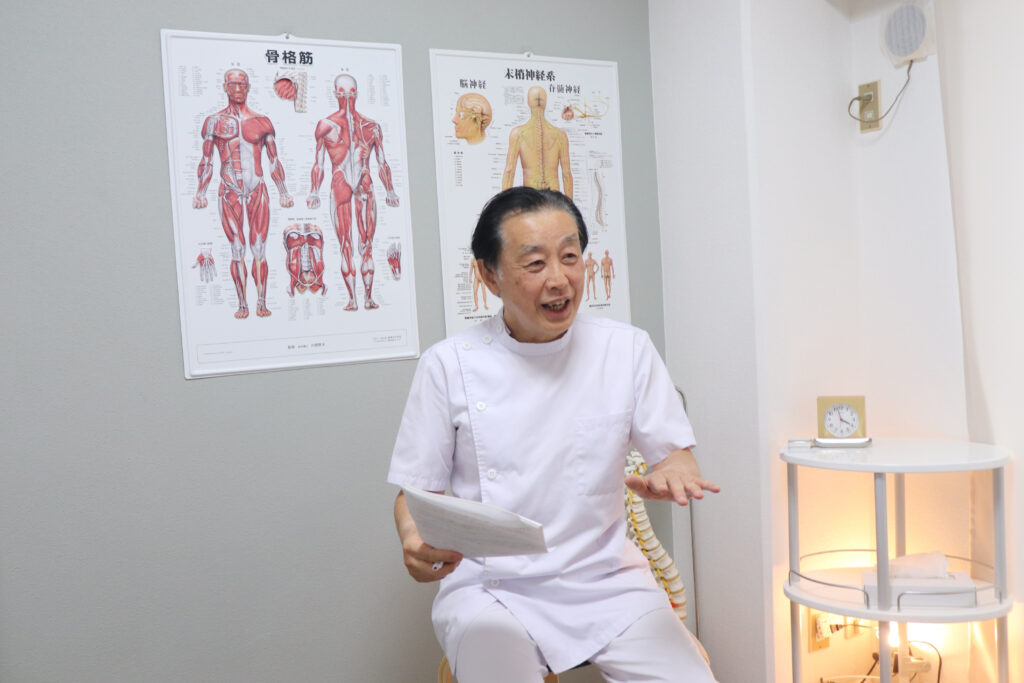
For this installment, we interviewed Director Hiroshi Yamaguchi, a chiropractic professional with a career spanning nearly 40 years.
After encountering one single book, Dr. Yamaguchi quit his job to pursue chiropractic medicine, studying while working part-time jobs in the evenings, and began working at a chiropractic clinic in 1987. Driven by a desire to practice a treatment philosophy aligned with his own values, he went independent and opened the Aoyama-Itchome Chiropractic Clinic, which has been operating to this day. He has treated a cumulative total of over 90,000 patients. As a director of the Japan Posture Education Association, he has taught courses at the Open University of Japan and appeared across various media platforms, serving as a prominent figure in the field for many years.
We sat down with Director Yamaguchi to learn a professional’s perspective on why leaders ought to consider their bodies as an asset, which provided critical insights for building a Venture Ecosystem.
(This interview was conducted in April 2026.)
◆What is a “Health Circuit Breaker”? — The Moment the Body Hits Its Limit
Sugihara:
One passage from the pre-interview report you shared with me left a deep impression on me.
“For people who work incredibly hard, even if they aren’t sick, sometimes their physical health will very suddenly fail. I think of this as a “health circuit breaker” tripping. To use an electrical analogy, it’s like running your appliances right at maximum capacity, and the moment you turn on the microwave, the breaker trips.”
I think a lot of people have seen this happen to themselves or their coworkers. Could you elaborate on the intent behind these words?
Yamaguchi:
When you are throwing yourself entirely into your work, you are usually aware that your body is tired. But if you aren’t experiencing actual pain, how do you react to that? Most people think, “If it doesn’t hurt, I must be fine. I can keep going.”
This sort of “no pain means I’m fine” mindset is exactly what makes it easy for your health circuit breaker to trip all of a sudden. Even when the body is fatigued, even when joints are stiffening and muscles are swimming in lactic acid, it can still maintain high performance. This is because the body secretes “hustle hormones” like adrenaline to override the fatigue. Furthermore, the brain has a built-in filter that blocks out minor discomfort signals so they don’t disrupt our focus. In fact, if our brains didn’t do this, we wouldn’t be able to get any work done.
To return to the electrical analogy, if an average person operates on a 30-amp capacity, an adrenaline-fueled executive’s capacity gets up to nearly 60 amps. Even while using a massive amount of electricity, the breaker doesn’t trip. However, because a person like that is running so close to the limit, the smallest, most trivial thing could suddenly blow the entire circuit. What I hope is that leaders will intervene before their bodies reach that point.
◆The Body Speaks in Tension and Stiffness, Not Words
Yamaguchi:
At the stage where you start thinking, “Am I using too much power?” like in the electrical example, tension and stiffness are the body’s signals. I want people to catch themselves at that exact stage and do something about it.
Your body cannot communicate in words. Instead, it uses stiffness and tightness to tell you, “I’m exhausted”. For example, it can’t say, “If you stay seated for another 30 minutes, your lower back is going to seize up when you stand.” Instead, it gives you a heavy, dull ache while you sit. Your body gives you these kinds of signs.
The thing that’s dangerous to do is to mask that discomfort with painkillers and keep pushing. There was a case where a patient repeatedly took medication to numb back pain and be able to keep playing golf, only for it to escalate into excruciating agony. The person finally went to the hospital, and learned it was a compression fracture.
This is the equivalent of a small fire breaking out in your house, the smoke detector going off, and you disabling the alarm because it’s too noisy. If you ignore the warning, the entire house burns down. I am by no means anti-medication; it is absolutely necessary. However, using medicine solely to silence pain so you can continue working past your limits will result in damaging your body.
Sugihara:
I am sure this hits home with many of the executives and hard workers reading this right now. There must be a lot of people who experience a dull, lingering ache in their backs that they don’t think they could convey to a doctor even if they went to a clinic, but then the moment their stress levels drop, it vanishes naturally. At least, I know I myself experienced that during times when I had a lot of stress, ha ha.
◆What Diverse Leaders from Office Workers to Cruise Ship Captains Have in Common
Sugihara:
For our second question, from what professional backgrounds do Aoyama-Itchome Chiropractic Clinic’s patients come?
Yamaguchi:
The majority of my clients are everyday office workers and homemakers. However, I also treat a significant number of business executives and high-profile leaders.
For instance, the captain of one of Japan’s largest luxury cruise ships is a regular patient. While a cruise ship’s route is predetermined, it is the captain’s responsibility to assess the waves and wind conditions in real time, deciding whether to steer slightly ahead or take a wide detour, and ensuring the passengers enjoy the safest, most comfortable voyage possible.
In short, they are the ultimate decision-makers responsible for thousands of lives. Because of that heavy burden, they realize their own bodies must remain healthy. That is the mindset that brings them to my clinic.
Sugihara:
That’s a great point. To use a corporate analogy, the ship’s crew members are the employees, and the passengers are the customers receiving the service. The captain is the President or CEO. If the person at the top isn’t healthy, you simply cannot provide a safe, high-quality service.
Yamaguchi:
Precisely. Businesses are the same way. I also treat a woman who served as a top executive for a world-renowned theme park. She oversaw multiple massive divisions, including the theme parks, retail shops, music, and films, and she achieved incredible results. Even though she is highly dedicated to her own personal fitness training, she visits us regularly in order to keep up her physical condition.
She once told a friend of hers, who was the CEO of a TV network, “The only reason I can perform this job properly is because I have a chiropractor looking after my body.” The role of chiropractors is to act as the behind-the-scenes supporters who help leaders to be able to succeed and smile, so hearing that was incredibly rewarding.
Another long-time regular is a legendary broadcasting executive who led Japan’s massive transition from analog to digital television. The switch required replacing every single piece of broadcasting equipment and receiver in the country. He had to negotiate extensively with major electronics manufacturers, saying, “The networks are switching to these specifications, so you need to build products that match them.” For the manufacturers, making massive financial investments to build new factories in an uncertain climate was an immense risk. One of his subordinate directors later visited my clinic and admitted, “I could never have pulled off a negotiation that intense.”
So, the fact that we enjoy seamless digital broadcasting today as a matter of course is entirely due to the grueling efforts of leaders like him. He came to us during a time when his body was under severe physical strain, and I am profoundly grateful I could be of some help. I urge everyone in your Venture Ecosystem, please take care of your bodies.
Despite their demanding schedules, many of the executives who visit us make time for sports and hobbies—golf, tennis, mountain climbing, playing musical instruments, and so on. I like to ask them, “What do you do with your sports gear or instruments after you finish using them?” Almost all of them reply, “Of course, I clean and maintain them thoroughly before putting them away.”
It certainly feels good to see your beloved tools looking nice and clean. Now, all I’m asking is for you to take just a fraction of the care and respect you show your gear, and direct it toward your own body. Strangely, many leaders meticulously maintain their equipment but leave their own bodies pushed to the absolute limit. If you keep stacking task after task onto an exhausted body and falling asleep without first winding down, fatigue will build up until it manifests as severe, debilitating symptoms. Even if it’s only for a brief moment in between tasks or after getting home, slowly stretching your joints and muscles will improve blood circulation and be beneficial to your health.
◆The Terrible Experience and Perception of Posture Both Shared by Executive Regulars
Sugihara:
You’ve shared several fascinating case studies of high-level leaders. Assuming their initial visit to your clinic was triggered by acute physical discomfort, do they typically continue to visit you on a regular basis? How do they end up there?
Yamaguchi:
Of course, I get many patients who only walk through my door after their circuit breaker has already been tripped. However, there are plenty of corporate executives who establish a routine of regular visits explicitly to prevent that breakdown from happening in the first place.
The reason is simple: almost all veteran leaders have suffered some sort of terrible experience at least once in their past. They know from firsthand experience that if you wait until the system crashes to seek help, the pain is severe, it takes time, and it costs money as well. They have learned for themselves that regular maintenance ensures that symptoms remain mild or are prevented entirely.
The more seasoned the executive, the better they understand the strategic value of regular checks and corrections. Unfortunately, they almost always have to go through a painful experience to learn that lesson initially.
It is easy for people to respect conditions like bone fractures because the pathology is visible on an X-ray. Conversely, it’s much harder to keep in mind the compounding value of maintaining proper posture and proactively conditioning the body.
People frequently interpret good posture as simply one type of hygiene, but actually, I want to tell people that keeping proper posture is an investment that leads to the success of what they’re doing now. Companies have a leader at the top, the directors, the employees, their families, clients, and shareholders. The physical vitality of that leader directly dictates the performance of the entire organization. Therefore, health is an investment towards realizing your corporate vision.
◆The Mechanics of Poor Posture: What Happens When We Stop Moving?
Sugihara:
Depending on the industry, leaders face vastly different physical environments. Some stand all day, while others are entirely sedentary. For executives, sitting in a boardroom for a five-hour marathon meeting is part of the job. What kind of negative mechanical impact does prolonged poor posture have on one’s physical health? Could you walk us through that specific mechanism?
Yamaguchi:
To put it basically, humans are animals. As the word suggests, we’re supposed to move.
*Note: ‘animal’ in Japanese is dobutsu (動物), which literally translates to ‘moving thing’.
When you sit for hours without moving, freezing your joints and leaving your muscles unengaged, your blood circulation stagnates. Blood is the transit system responsible for delivering oxygen and vital nutrients throughout the body while carrying away metabolic waste. What happens when that infrastructure stalls? Imagine forcing an employee to work from dawn until dusk while denying them meals and locking the restrooms. Anyone would collapse under those conditions. When you sit continuously and restrict your blood flow, that exact same systemic deprivation is occurring inside your tissues.
Specifically, habits like crossing your legs or staring down at a low monitor compound this structural stress. The point I emphasize most heavily to patients is the layout of the environment where they spend the vast majority of their lives: the height of the chair, the height of the desk, the position of the monitor, and the ergonomics of the keyboard. This setup is critically important. Not just for five or ten minutes, you are locking your body into these positions for hours on end, so how it’s set up has an immeasurable impact on your body.
Sugihara:
I try to be mindful of it, but maintaining perfect posture over a long period feels incredibly difficult. Before I know it, my alignment slumps. Furthermore, modern business professionals can accomplish work via a smartphone, so is it definitely bad to have a posture that’s looking down?
Yamaguchi:
When you use a smartphone and tilt your head forward by 15, 20, or 30 degrees, the burden on your neck increases dramatically. It’s said that the posture typical of smartphone usage can be equivalent to placing roughly one-third of your entire body weight directly onto your neck and shoulders. The human head alone accounts for approximately 10% of your total body weight. Think of it like holding two 2-liter plastic water bottles. If you hold them tightly against your chest, it requires very little effort. But if you extend your arms straight out in front of you and try to hold those same bottles, the physical leverage multiplies the strain. Your muscles will give out in less than five minutes. That exact compounding fatigue is what accumulates in your upper back and shoulders every time you look down at a screen, triggering chronic shoulder stiffness, tension headaches, and an inevitable drop in mental concentration.
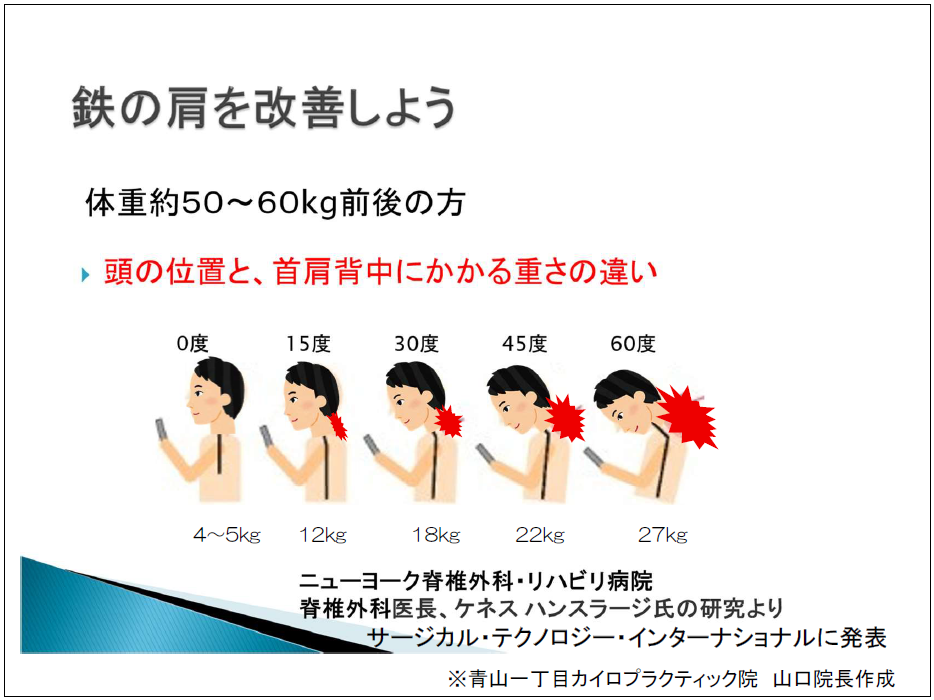
The above illustration shows how much the tilt of one’s head impacts the strain on one’s neck.
~To be continued in Part 2~
Interview conducted by D-POPS GROUP’s advisor Genta Sugihara.
Aoyama-Itchome Chiropractic Clinic
Director: Hiroshi Yamaguchi
Address: 740 Win Aoyama, 2-2-15 Minamiaoyama, Minato, Tokyo
Website: https://aoyama1.jp/
Next, in the second part of the interview, we discuss:
・An entrepreneur’s body is like an “OS”, and posture is an investment towards maximizing productivity
・Stress stiffens the body – the mechanism of mental fatigue
・The path from young train enthusiast to chiropractor
・And other topics
Be sure to check it out here:
https://d-pops-group.co.jp/en/column/startupecosystem-part2/