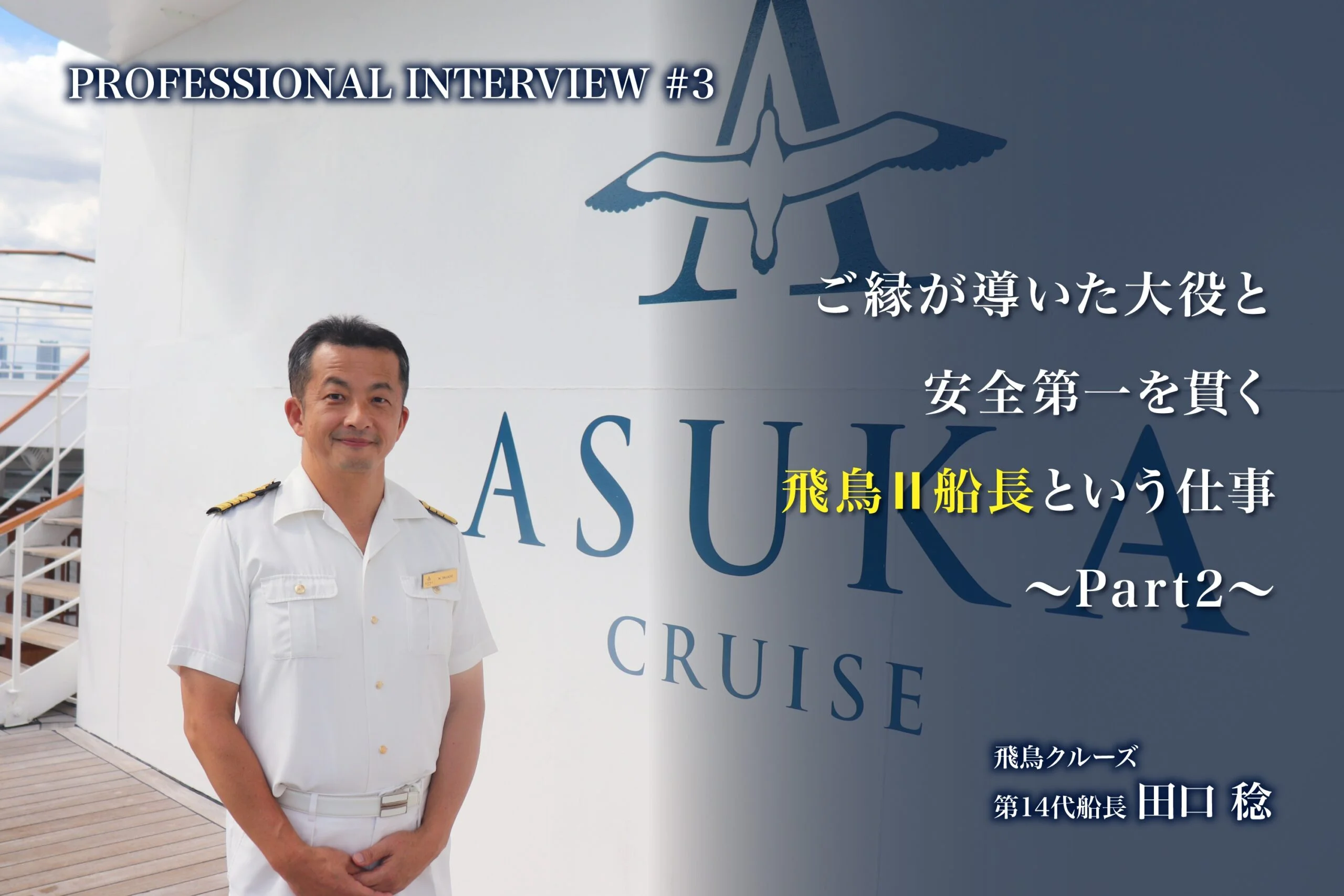
The Job of the Asuka II Captain: An Unwavering Commitment to Safety
【About This Part】
In the second of our three-part interview, we asked about the brand recognition of Asuka II, the reality of a captain’s duties, the career path from cargo ships to passenger ship captain, and dealing with crises like sudden illness and approaching typhoons. (This interview was conducted in August 2026.)
Please check out Part 1 of this interview if you have not already!
◆The Brand Recognition of “Asuka Cruise”: The Difference Between Japan and the World
Sugihara:
Even as someone who has never been on a cruise, I have the impression that when someone thinks of luxury cruises, Asuka Cruise comes to mind. It’s a brand that has been built over many years, but just how much power does this brand hold?
Taguchi:
Domestically speaking, with Asuka III also having debuted in 2025, many customers and the general public associate passenger ships with Asuka Cruise, so I believe our brand recognition is quite high. The background fact that foreign cruise ships rarely visited Japan in the past has also had an influence.
On the other hand, when it comes to overseas presence, there are many operators specializing in passenger ships that run fleets of 10 or 20 vessels. Our company, NYK Cruises Co., Ltd., primarily operates cruises along the Japanese coast, so we might not be as well-recognized globally.
Sugihara:
In that case, it seems Asuka Cruise exists for the people living in Japan. There are many foreign cruise ships that call at Japanese ports, but yours connects Japan with the world.
Taguchi:
That’s right. For example, if someone just wants to go on an Alaska cruise, they could fly to Vancouver, Canada, and board a foreign cruise ship from there. However, in that case, the onboard environment is geared toward Westerners, and I doubt much Japanese food would be served. With our Alaska-Hawaii cruise, guests can enjoy the scenery of Alaska and Hawaii while maintaining a lifestyle similar to what they experience in Japan. It’s truly a cruise designed for Japanese people.
Sugihara:
A cruise for Japanese people, indeed.
Now, I’d like to ask a question geared more toward business management. In a sense, this massive ship could be compared to a company, where the passengers are customers receiving the services provided by the employees—in your case, the crew members. Thinking of it that way, the captain must be like the CEO, the person with the highest level of responsibility. What do you think?
Taguchi:
If you zoom in, I do have the highest level of responsibility on the ship. However, as with the example of food procurement I gave earlier, not everything is handled exclusively onboard. Our operating company, NYK Cruises, has an office on land that plans and designs the types of cruises and services we offer, and conducts various types of research.
Since we have an office and on-site relationship, I may be the top executive on-site, but we’re just one entity within the company, so to say I’m like the CEO isn’t quite accurate. I would say my position is more like a “site manager”, like the manager of one factory in a corporation.
Sugihara:
I think that’s the same in business management. Even if a factory is manufacturing products, it doesn’t operate in a vacuum. Without the headquarters staff doing advance preparation, providing support during manufacturing, and handling sudden accidents, the factory wouldn’t run. The operation isn’t completely contained within a single ship; many people at headquarters are involved as well.
Taguchi:
Yes, that’s correct. We have about 100 to 150 people working in the office.
◆Is the Captain a President or a Factory Manager?
Sugihara:
So it’s not run solely by the 490 crew members. Could you tell us about the specific daily duties of a ship captain?
Taguchi:
Actually, once you become the highest authority, you are rarely involved in detailed, hands-on tasks. In principle, I only need to take direct control during highly sensitive situations like entering or leaving a port, so during those times, I operate the ship from the bridge (the control room). For example, once we leave Tokyo Bay and enter relatively open waters, I entrust the navigation to capable subordinates, while I take time to rest, do administrative work, or interact with guests.
If a true emergency occurs, I stay on the bridge and handle the situation until it is resolved, without any concept of working hours. I can’t really have the mindset of clocking into work and then leaving after exactly eight hours.
Once I board the ship, I may not disembark until the end of September, depending on the cruise schedule, but on the other hand, I don’t work non-stop that entire time. We don’t get full days off like people working on land do during the weekends, but looking at it on a daily basis, I generally work during the day and have time to rest and do as I please at night.
Sugihara:
So, is it possible to catch a glimpse of Captain Taguchi casually drinking alone at the bar in plain clothes, ha ha?
Taguchi:
We have rules about that. If we go into guest areas, we are considered to be on duty and must wear our uniforms. Below the 9th floor where we are now, on Deck 7, there is a promenade that wraps about 400 meters around the ship’s perimeter. If I’m just going for a walk there, I don’t need to be in uniform and can relax in exercise clothes.
Sugihara:
That also seems similar to business executives. For example, our company’s president works 24/7, 365 days a year, taking time off only for two days during New Year’s. He is constantly in a state of complete readiness to respond immediately if anything happens.
Taguchi:
Yes, we have to continuously live with tension. For example, Yokohama is our home port, so we often have a schedule where we dock at 9:00 AM for guests to disembark. To dock by 9:00, we need to reach the entrance to Tokyo Bay around 5:30 AM. I monitor the situation from the bridge while checking port schedules, the congestion of the waters, and the presence of fishing boats, so I sometimes have to work in the middle of the night to make sure we dock on time.
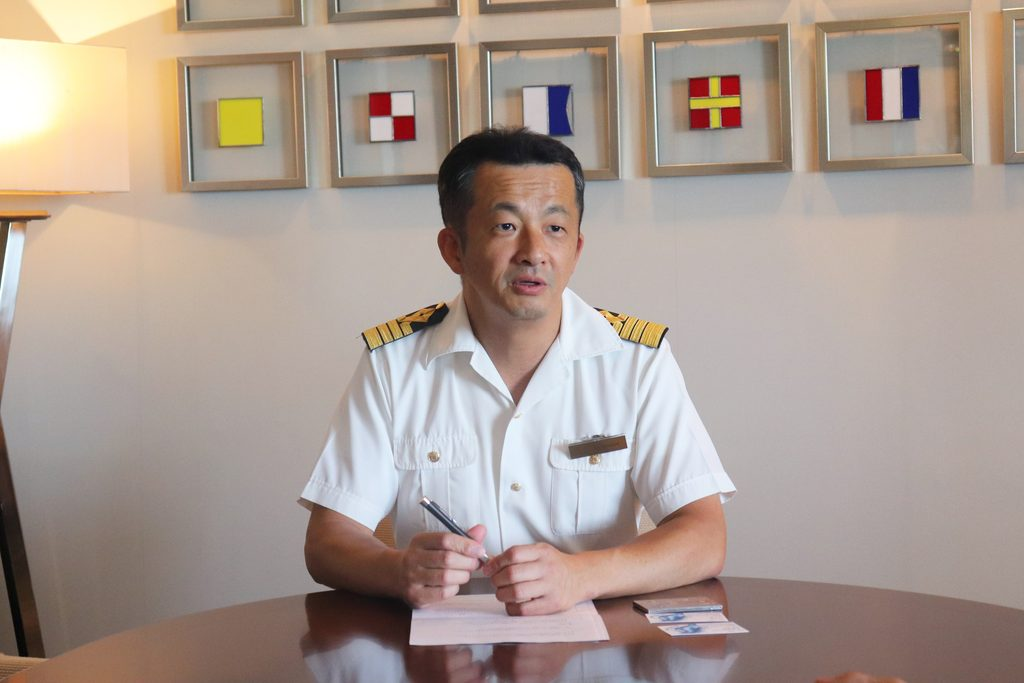
◆From Cargo Ships to Cruise Liner Captain: A Career Guided by Fate
Sugihara:
Next, I would like to ask a question related to career development. Becoming the captain of a luxury cruise ship seems like an ultimate destination, but were you aiming to be a captain from the very beginning?
Taguchi:
I didn’t necessarily have the goal of becoming a passenger ship captain, but ever since I was in elementary school, I was interested in ships and foreign countries, and I knew I wanted to sail on one. I never thought I could be a passenger ship captain, so even though it’s a major role for me to hold, I have been trying to do my best to make it work.
While it wasn’t necessarily a role I actively set out to achieve, I wouldn’t call it pure coincidence either; rather, I have the privilege of serving in this position thanks to a fortunate alignment of timing and connections.
My career path involved stepping up to become a cargo ship captain first. In the field of cargo shipping, people can become Third Officer, Second Officer, and First Officer. When I joined the company, I started as a Third Officer, gained experience to become a Second Officer, then a Chief Officer, and eventually moved up to Captain. Of course, this career progression happens while acquiring national maritime officer licenses.
Sugihara:
Even so, not everyone can get those, and out of the many who do, the ones who can actually become a captain must be less than a few hundred.
Taguchi:
That’s right, there aren’t many. Now, about 10 to 15 years ago, I worked on passenger ships for about three years, but after that, I returned to cargo ships, served as a cargo ship captain for several years, and even lived like a regular office worker on land for a time.
It just so happened that right when I was going to transition back to the water after my land assignment, the captain of Asuka II retired, leaving an opening. HR approached me and asked if I would take the position. Frankly, it was all about timing and connections.
Sugihara:
Connections are important. In the startup world, it’s very common to hear that someone secured investment or got on track because of meeting a specific person. Among the many employees, there must be some who joined with a strong desire to become one of Asuka Cruise’s captains, and it is clear that not everyone can achieve that. If you had to list a few reasons why you were able to become the captain, what would they be?
Taguchi:
I truly believe it was fate and timing. I think doing my job solidly during my cargo ship days played a part, but while HR never gave me the specifics, it seems that when the upper management was choosing from several candidates, they went with me.
Regardless of the competition ratio, there is the fact that I was chosen, and I suspect a big factor was their evaluation that I could grow into the role because I had previous experience on passenger ships. I think the fact that the timing just happened to align perfectly is a huge part of it.
Sugihara:
What I think is that your character played a role, as well. You are a captain with a cheerful personality that puts everyone around you at ease.
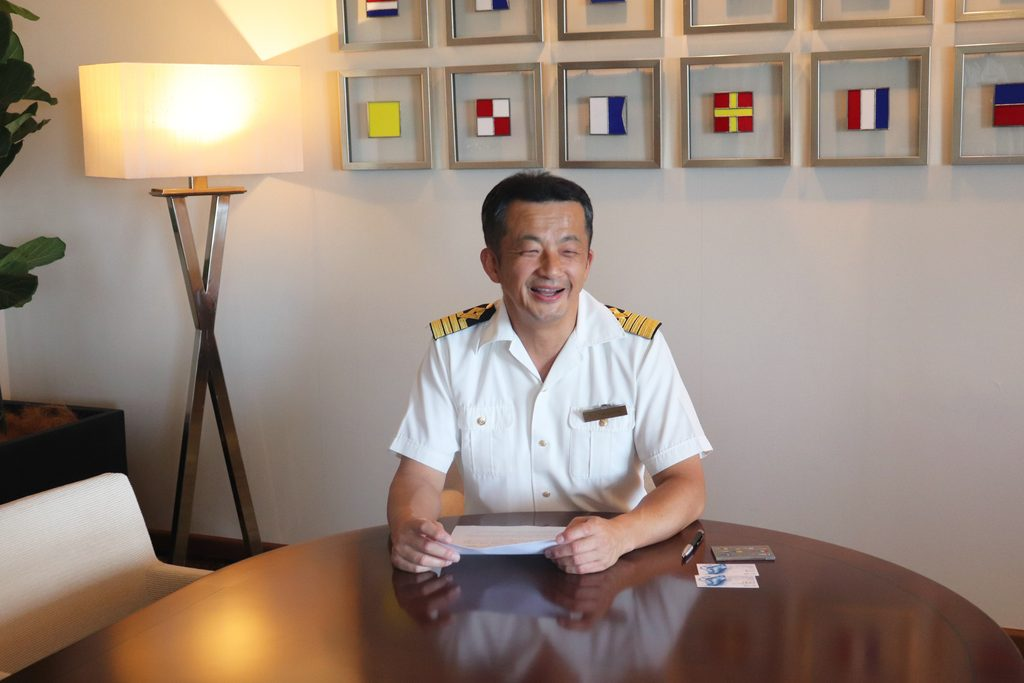
◆Crisis Management: Handling Sudden Illnesses and Deciding to Evade Typhoons
Sugihara:
Now for my next question. Let’s talk about crisis management. As the captain of a vessel that travels right through the middle of the ocean and thus has to deal with nature, have you experienced situations like sudden illnesses, guests with mental health emergencies, collisions, or other incidents on or off the ship? How did you handle them?
Taguchi:
I have captained long cruises, but fortunately, most of our guests have been quite healthy, so I haven’t had to handle any life-or-death emergencies while at sea. There have been cases where someone suddenly fell ill while we were docked at a port and was transported to the hospital by ambulance. In terms of crisis management while on the ship and out at sea, we haven’t faced any overly serious situations.
Now, if something were to occur, we do have a clinic onboard where limited medical procedures can be performed, but it is not a hospital, so the equipment is limited. If needed, we would transport the patient to a medical facility on land as quickly as possible. In some cases, we would push hard to arrive ashore in four days instead of the originally scheduled five.
If it were a truly urgent situation, we would request medical transport assistance via helicopter from organizations like the Coast Guard of whatever country we’re closest to, hoisting the patient up and airlifting them to a hospital. During those times, our land-based staff are also tapped to coordinate the response.
Sugihara:
I know you also have to deal with major environmental changes like swells, storms, and typhoons. Are there cases where you have to change your route because a typhoon is approaching?
Taguchi:
Yes, there are. Above all, it’s about evading danger before putting the ship in a risky situation. Rather than trying to navigate through a typhoon, it’s far better to avoid the typhoon altogether.
I closely monitor the weather forecasts, and if I determine that following a certain route will definitely result in encountering the typhoon, I give up on going that way and take a wide detour.
Sugihara:
So it’s not a matter of skillfully navigating straight through the storm, it’s about avoiding it altogether, and putting the safety of the guests first.
Taguchi:
Exactly. If a typhoon approaches and we can’t execute the planned cruise, we might cancel the original itinerary and prepare an alternative cruise with a different route. In principle, we will never get even close to anything dangerous.
Sugihara:
I see, so you absolutely do not put your ship, with all the passengers on it, into a tense situation like we see in the movies.
~To be concluded in Part 3~
Interview conducted by D-POPS GROUP’s advisor Genta Sugihara.
【NYK Cruises Co., Ltd.】
President and CEO: Yuji Nishijima
Address: The Landmark Tower Yokohama, 2-2-1 Minatomirai, Nishi-ku, Yokohama, 220-8147 Japan
Established: January 1989
Website: https://voyage.asukacruise.co.jp/en/
Next, in the final part of the interview, we discuss:
・The internationalization of the crew and passing down a sense of hospitality
・The differences between large corporations and startups as seen from a captain’s perspective
・The power of greetings in building communication and trust
・The future of Asuka II and the next career steps Captain Taguchi envisions
・Alignment with D-POPS GROUP’s aim of realizing a Venture Ecosystem
・And other topics.
Stay tuned for Part 3!