



This is the first installment in a series on how to increase gross profit, which indicates a company’s fundamental earning power. Here, we will explore the concept of cross-selling.
Cross-selling is a technique used to increase average transaction value and overall sales by introducing additional related products or services to a customer who is purchasing something. The most common examples of cross-selling include being prompted to add an egg or salad at a beef bowl restaurant, or fries and a drink at a hamburger shop. In this article, we will explain cross-selling using examples from the retail industry.
1. Achieve Immense Results Without Costing Extra Money or Time
In previous articles, we covered “Inventory Turnover”, “Sales per Employee”, and “Sales per Tsubo” as methods for increasing profit when managing a company. We intentionally focused on cash flow (CF) and expenses (labor costs, rent) rather than gross profit because, in a competitive environment where companies handle similar products at a similar scale, it is essential to look at CF and expenses to achieve significant differentiation from competitors. We also looked in depth at specific cases of this. Now that the importance of CF and expenses can be understood, we will turn our attention to the heart of corporate management: gross profit.
Gross profit is an extremely simple indicator. Also referred to as gross profit margin, it is calculated as the profit remaining after subtracting the cost of goods sold (COGS) from total sales. If the products or services themselves are unique and differentiated, a high gross profit can be achieved. However, instead of focusing on how to create unique products to raise profit, in this article we will set our goal on increasing gross profit while handling similar products.
The concept of cross-selling we are discussing today is a method that can greatly affect gross profit without requiring additional expenses or time, so let’s take a closer look.
2. What is Cross-selling?
Cross-selling is a method of increasing sales by raising the average transaction value or encouraging repeat purchases. This is achieved by suggesting additional related products and services or recommending a lineup that would complement what a customer already purchased.
Representative examples include:
・Recommending a matching necktie to a customer buying a suit
・Offering a screen protector, AC adapter, insurance, or antivirus software to a customer purchasing a smartphone
・Suggesting lenses, filters, or memory cards to a customer buying a camera
・Proposing additional tires, seat covers, a dash cam, a navigation system, or insurance to a customer purchasing a car
The examples of cross-selling are truly too numerous to list.
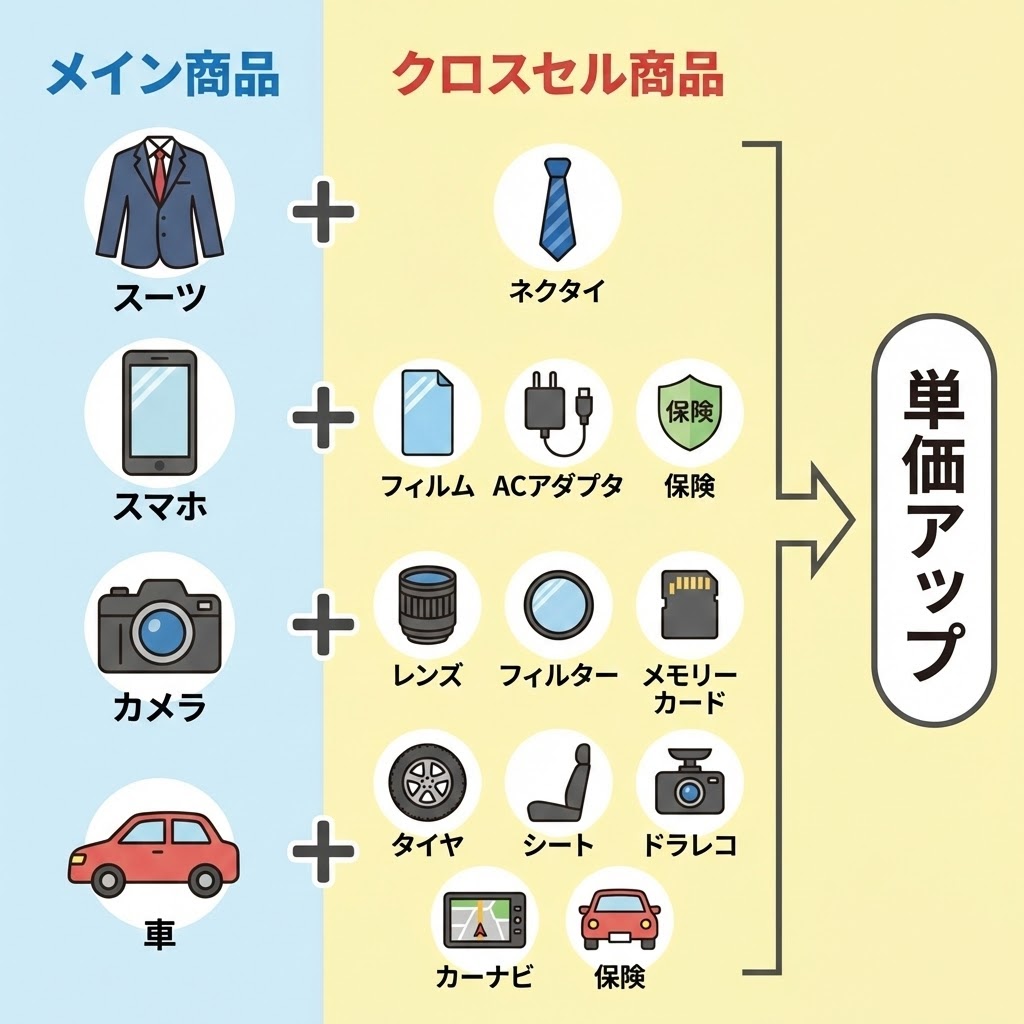
This graphic is a visual representation of the assorted examples of cross-selling offered in the previous paragraph.
Even without making such suggestions verbally, creating an environment where customers can purchase items later (e.g., carrying a wide assortment of peripherals for PCs or cameras) could be considered cross-selling in a broad sense. Whether recommending products through a sales clerk’s dialogue in a physical store or on a website, cross-selling is practiced to some degree by essentially every company involved in selling products or services.
While cross-selling may seem simple at first glance, it has a massive impact on gross profit. In the next section, we will look at just how effective it can be.
3. Why is Cross-selling Important? Understanding Its Effectiveness
I would like to show the efficacy of cross-selling using several examples. First, let’s look at the profits of a company selling PCs during a specific period. (This model company is fictional but based on the numbers from an actual business.)
Model Case: PCs
・The PC units themselves generate a gross profit of ¥2.8 billion, a profit margin of 20%, and total sales of ¥140 billion.
・PC peripherals, accessories, and related products* earn a gross profit of ¥4.4 billion, a profit margin of 40%, and total sales of ¥110 billion.
(*Includes printers, routers, and storage devices; accessories such as mice, keyboards, and bags; consumables like ink and paper; broadband sign-up fees; and related software or books.)
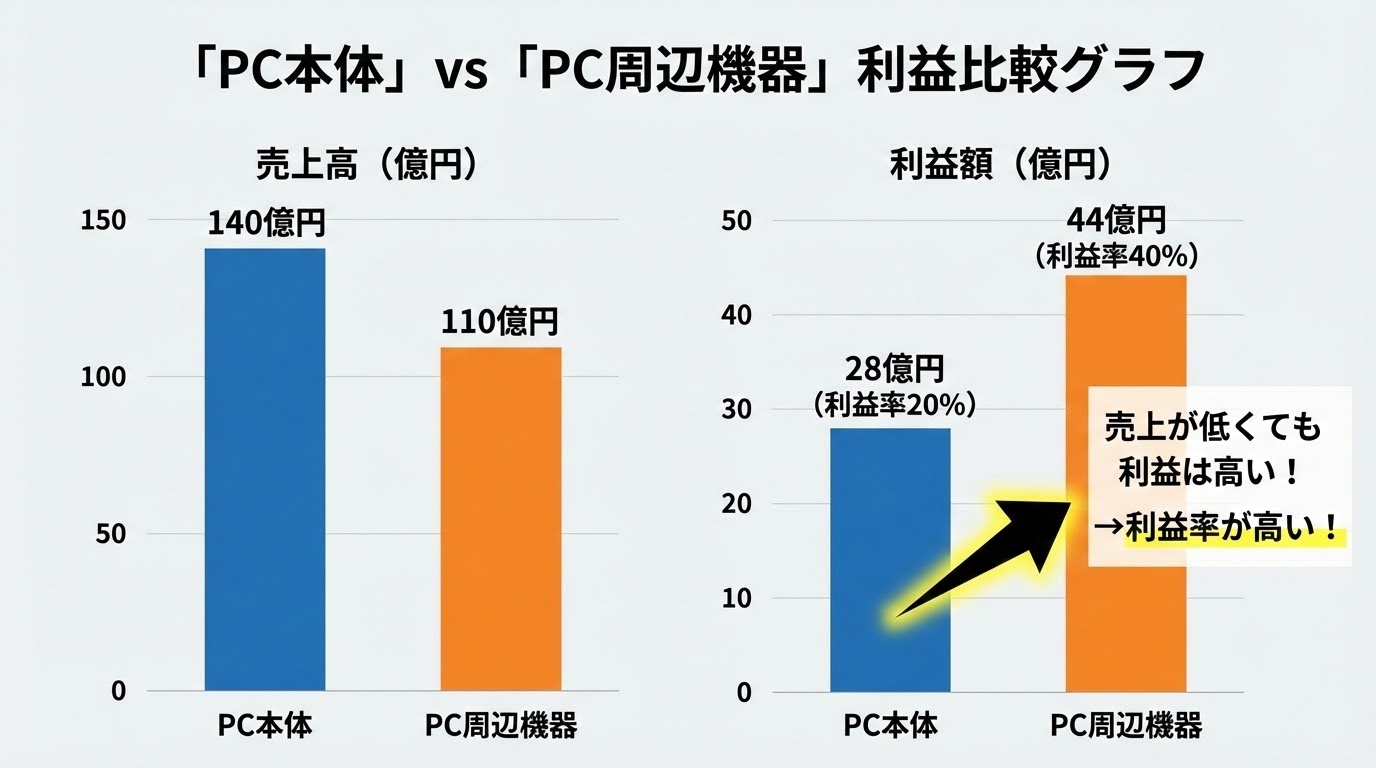
These charts show the comparison between the total sales and gross profits of PC units (blue bars) versus the peripherals, accessories, and related products (orange bars).
The key points to observe in this example are the profit amounts and total sales. The profit from the PC units—which the customers originally intended to buy—is ¥2.8 billion. Meanwhile, the profit from all of the PC-related products (the cross-sell items needed at the time of purchase or afterward) is ¥4.4 billion. There is a difference in profit of ¥1.6 billion, or 157% in relative terms. This is true despite the fact that the total sales for PC-related products (¥110 billion) are ¥30 billion lower than the sales for the units themselves (¥140 billion).
This is not unique to PCs; for many products that customers intend to buy, competition between products and stores is fierce, meaning they are not very profitable. While not true for every item, many cross-sell products have high profit margins. You can see that working hard to pitch these cross-sell items, either at the time of the initial sale or through subsequent repeat business, has a tremendous effect on increasing gross profit, both in terms of total profit amount and efficient profit margins.
Next, let’s look at an example involving smartphones. The following example shows the breakdown of one month of profit from smartphone sales for a certain company. (Again, these numbers are based on actual business results.)
Model Case: Smartphones
・Total gross profit from smartphone sales: ¥90 million
・Profit from the smartphone devices themselves: ¥50 million
・Profit from related products other than smartphones: ¥40 million
In the case of smartphones, the profit from selling the devices themselves is higher than the profit from selling PC units, and as a result, it’s also higher than the profit from smartphone-related products. However, related products still account for nearly 45% of the total profit. This example also demonstrates that diligently selling cross-sell items at the time a customer purchases their intended product has a significant effect on raising gross profit.
As these two examples show, cross-selling is highly effective for increasing gross profit, but more than that, its greatest merit is that it incurs almost no additional expenses. This means that the increase in gross profit leads directly to an increase in operating profit.
For example, if a store wants to increase sales, it might open a new location, but this requires additional expenses such as rent and labor. In B2B sales, increasing revenue usually involves hiring more salespeople, adding advertising costs, or opening new branch office space; all of these incur extra expenses. While these actions will likely increase sales and gross profit to some extent, there is no guarantee the increase will make up for the added costs. There are likely many cases where those expenses are not covered, leading to a deficit on an operating profit basis.
On the other hand, the added cost of cross-selling is relatively little. When sales and gross profit rise through cross-selling, that gross profit essentially has a direct effect on operating profit because there are no new overhead costs. For this reason, cross-selling contributes to net income quite effectively.
This is not only true for the examples mentioned earlier. Making full use of cross-selling enables earning profits equal to or greater than those earned from the customer’s intended purchase no matter the industry, from restaurant to apparel. Boosting the overall gross profit margin by roughly 10% becomes a realistic goal, and as mentioned previously, because cross-selling adds almost no additional expenses, that also boosts operating profit. For this reason, if you wish to increase your profits, start by raising the average transaction value through cross-selling rather than searching for new customers through opening additional stores, hiring more workers, or increasing advertising.
In a competitive environment where companies handle similar products, achieving cross-selling that significantly outperforms your rivals gives you a major advantage not just in gross profit, but in operating profit as well. I believe you can now see just how big an effect cross-selling has on business management.
4. Key Points for Increasing Sales Through Cross-selling
Now that you recognize the importance of cross-selling, I would like to introduce several key methods for successfully implementing it to increase sales.
① Selection of products and accessories
The starting place is to carry products conducive to cross-selling and ensure a solid assortment of related items.
For instance, appliances like refrigerators or washing machines offer limited cross-selling opportunities beyond extended warranties. However, the examples we discussed (suits, smartphones, cameras, cars, and PCs) are gold mines for cross-selling. With suits, beyond the obvious shirts and ties, you can facilitate cross-selling by carrying an assortment of matching bags, belts, and shoes. Even items like tie pins or shirt garters can contribute to cross-selling. By selecting products that naturally invite add-ons and maintaining a robust inventory of related items, your cross-selling revenue will grow.
② Human education and ingenuity
This involves ensuring that employees are educated on the importance of cross-selling. Both the company and its staff must constantly brush up on their product knowledge, sales scripts, and customer service techniques, while figuring out creative ways to look after customers, display products, and procure goods.
Companies that can innovate in this way—learning how to explain why a suggested product is necessary from the customer’s perspective, determining the optimal order and timing for multiple suggestions, and identifying the most effective placement for displays—will see an overwhelming difference compared to companies that cannot.
Furthermore, a cross-sell item shouldn’t be chosen simply because it is profitable. If it has no relevance or benefit to the customer, it simply becomes forced, which lowers customer satisfaction and leads to negative long-term results for the business. You must put yourself in the customer’s perspective and devise a narrative that explains the relevance and benefits of each specific item. It goes without saying that deep product knowledge and constant ingenuity are essential to achieving this.
③ Utilization of technology
When shopping online, recommendations appear based on past purchase history. In the telecommunications industry, systems have begun suggesting recommended products to staff in real-time while they are interacting with customers. Naturally, enlisting technology to visualize data is also vital, such as which salespeople are achieving what levels of cross-selling. While these are just a few examples, it is clear that mastering technology is an indispensable element for boosting sales through cross-selling.
While there are other aspects involved in increasing sales through cross-selling, the key factor is employees who are educated in the importance of cross-selling and in the full use of technology. Ultimately, driving up sales through cross-selling and achieving a dramatic leap in management efficiency rests upon the intersection of People × Technology.
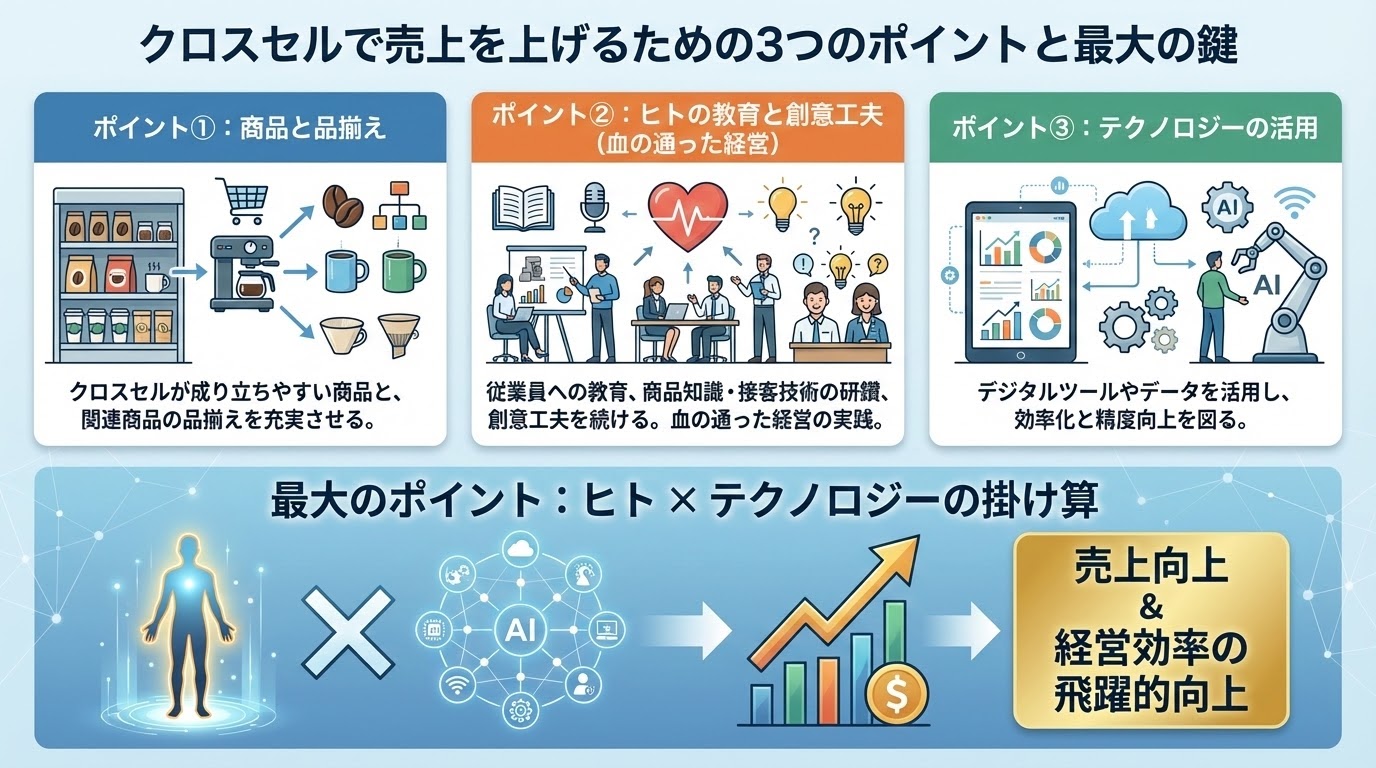
This graphic contains a broad summary of the three sub-points and the key factor of section 4.
5. Summary
In this article, we discussed the concept of cross-selling. We explained that cross-selling is a method that yields immense results not only for gross profit but also for operating profit, without requiring additional expenses or time. By maximizing the sales of products and services related to the customer’s intended purchase, a company can maximize both gross and operating profit, creating a significant competitive advantage over rivals.
I have intentionally addressed cross-selling following our previous discussions on “Inventory Turnover”, “Sales per Employee”, and “Sales per Tsubo”, which focused on cash flow and expenses related to inventory, labor, and rent. If you read these in order, starting with the first article on “Inventory Turnover”, the essential points of business management will become much clearer. For those who have not yet read them, I highly encourage you to do so.
What we at D-POPS GROUP want to convey through this discussion on cross-selling is the same message as before: business is built by people. The customers who purchase products are people, the sales staff who sell the products are people, and those who utilize technology are all people. While I think it is impossible to win in competition and survive in business without commanding technologies like AI, I also think that technology alone is not enough to survive. At D-POPS GROUP, we believe that business success does not happen simply because the technology is good or the management strategy is sound; rather, the intersection of People × Technology × Management Strategies is what truly matters.
In accordance with this line of thinking, D-POPS GROUP’s vision is “realizing a Venture Ecosystem”. Our goal is to support startups through investment to help people shine and solve social issues, providing value that goes beyond mere numbers and efficiency.
We hope that you enjoyed this article and look forward to working with you in the future.
D-POPS GROUP Managing Executive Officer
Tetsuya Watanabe