



To foster a thriving startup ecosystem, we must look back and learn with humility from the legendary leaders who built global enterprises from the ground up.
In this series of “Lessons from Great Business Leaders”, we will share the words of the visionaries and thinkers who have influenced us most, reflecting on how their philosophies have shaped our own experiences in business and life.
This third installment was written by our group’s advisor Sugihara.
1. “Your Mindset Defines Your Life” – Tempu Nakamura
“Whether your mind is positive or negative creates two polar opposite perspectives on life. If your mind is positive, life becomes filled with cheer, adventure, energy, and vigor regardless of the circumstances. Conversely, if your mind is negative, everything in life loses its spirit. If the mind that contemplates life is negative, does not everything end in a pitiful, dark, and miserable state?
Since you only have one chance at life, you must live it in the most perfect mental state possible, starting from this very moment.”
(Excerpt from Tempu Nakamura: One Thought a Day, edited by the Tempu Society. Published in 2005 by PHP Institute.)
2. Reason for Selecting This Passage
On a personal note, I have spent my career since 1990 working consistently within companies that were considered startups in their respective eras. Among these experiences, my time at Daini Denden (the predecessor to what is now KDDI) was particularly formative. It built the foundation of my professional life and forged the entrepreneurial spirit that has served as the emotional bedrock for my continued challenges over the years. I remain deeply grateful for that experience today.
Daini Denden’s co-founder, Kazuo Inamori, is a world-renowned leader respected by executives not only in Japan but also in China and across the globe. One of the thinkers who most profoundly influenced Inamori was Tempu Nakamura. While I was there, my superiors and division heads encouraged me to read books on MBA studies or the then-popular “Lanchester Strategy”, but above all else, the very first thing they told me to read were Tempu’s works.
While Tempu’s most famous longtime bestsellers are Sharpening Your Soul and Open Your Destiny, I have chosen the compilation Tempu Nakamura: One Thought a Day. It distills his essence into short, concise daily entries that are incredibly easy to read. I highly recommend it to anyone who has heard the name “Tempu Nakamura” but doesn’t have any of his works yet, or for those looking for the right book to revisit his teachings.
By the way, it recently became a hot topic that the world-renowned baseball superstar and source of great Japanese pride, Shohei Ohtani, was a devoted reader of Tempu’s books before he moved to the Major Leagues.
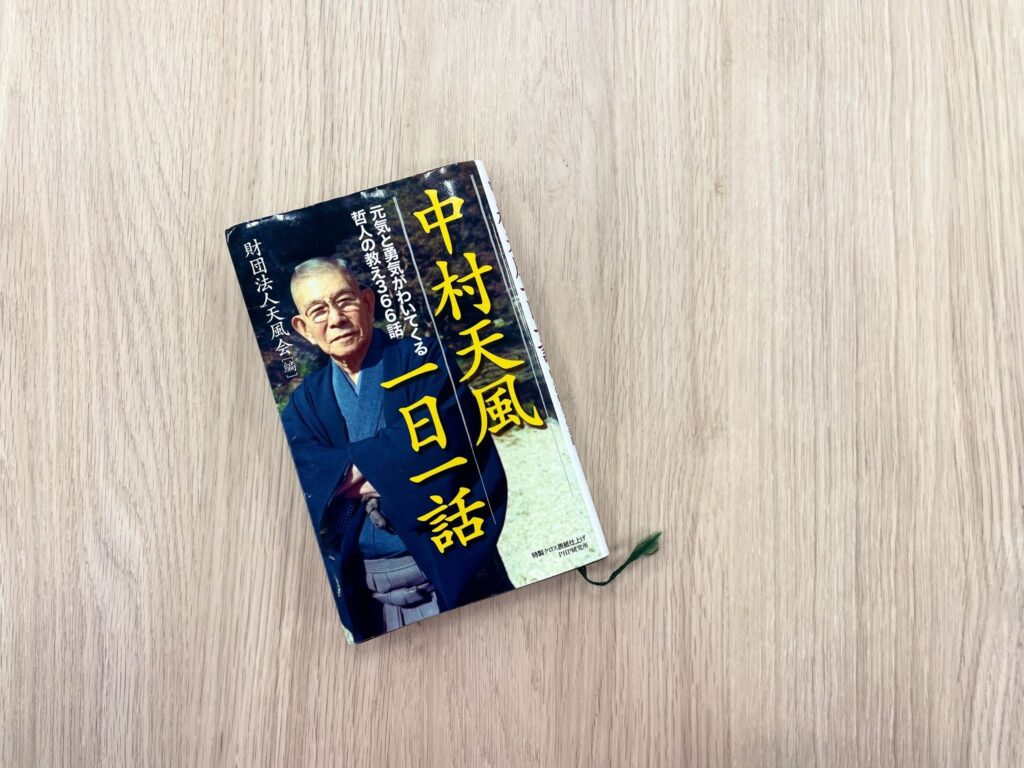
3. My Own Experiences and Thoughts on This Philosophy
Between the 1990s and 2000s, while I was in my 20s and still learning the fundamentals of being a professional, I was suddenly assigned to a new business division, the office preparing to launch DDI Pocket, which would later become their PHS* business. As a member of a launch team with just six people responsible for sales strategy, I worked with such intensity that there was no distinction between day, night, or weekends. Looking back now, I can say it was a workplace that reflected an era when terms like “power harassment” or “work-life balance” did not yet exist. Our supervisor’s orders were absolute, and unreasonable requests were common.
*Note: PHS (Personal Handy-phone System) was a Japanese-developed precursor to modern cellphone technology that was popular in Japan in the 1990s, and expanded to various degrees in Asia, Europe, and Latin America.
Even though I was thrown into an environment where it would have been easy to harbor discontent or want to run away, I made a conscious effort to look at the bright side of things. I did not avoid difficulties, maintained a proactive stance, and continued to put in effort even when no one was watching. It is no exaggeration to say this was entirely because I treated Tempu’s books as my bible, so to speak.
Tempu Nakamura frequently mentioned something in his writings that became representative of his philosophy: “Always keep a positive mindset”, and by making this my habit, I gained a strength that influenced not only that period of my life but my entire subsequent career. It gave me the power to overcome hardships, seize opportunities, and attain numerous priceless experiences.
There are a number of recurring themes within the pages of One Thought a Day, and though they’re expressed differently in different places, they all preach the importance of maintaining positivity in one’s thinking and mental state.
Here are a few passages that reflect those themes.
One’s thoughts create one’s life
“Humans’ health and destiny depend solely on where they put their minds.” The difference between a mind moving in a positive direction and one moving in a negative direction is as vast as that between heaven and earth.
The power of determination
Taken to the extreme, one could even say that having a happy or an unhappy life depends entirely on one’s control over one’s mind. Willpower—in other words, absolute control over one’s mind—could widely be called the driving force that allows one to become a better person.
Noble, strong, righteous, and pure
The first step in conducting oneself according to the laws of nature is to keep a positive mindset at all times, no matter what happens. A positive mindset means to live nobly, strongly, righteously, and purely. There is almost nothing more important to life and existence than this.
Do not voice dissatisfaction or complaints
Under no circumstances should you let yourself vocalize dissatisfaction or complaints. If those feelings exist within your heart, your words will never be truly positive. People who complain are constantly looking only upward and never downward. They think everyone else is happy and that they are the most miserable person in the world.
(Excerpts from Tempu Nakamura: One Thought a Day.)
Encouraged by these words, I was able to spur myself on and approach my work with a forward-looking attitude, which allowed me to deal with situations calmly and read the trends of the times. Subsequently, I was involved in the launch of the mobile internet services of PHS, the launch of broadband at AOL, the music distribution business at Napster, and the creation of mechanisms to improve search engine share at Google. I have walked alongside the history of the internet industry itself.
Modern business professionals are tossed back and forth by a flood of information that changes daily. We must chase not only the knowledge required for our daily tasks but also the world’s latest technical information, such as Generative AI, AI agents, and AI robotics. Furthermore, we find ourselves in an environment where we cannot help but feel anxious that our own job might become another profession replaced by AI.
It is important to fill oneself with knowledge and information and to possess technical skills. However, what humans possess that is fundamentally different from AI is not information or knowledge, but rather, the mind. Technology and knowledge change with the times and can be acquired later. However, I believe that a forward-facing mind and a proactive way of thinking form a foundation and become a personal wealth that accumulates within oneself, regardless of how the era changes.
Right now, I have a small scrap of paper in my wallet that has been there for about 20 years, like a lucky charm. On it, I wrote down my own “Seven Principles for Living”. The first three of these are:
1. Always think about things positively.
2. Always stay hungry to improve and strive for diligence.
3. Do not complain about things out of your control.
These have completely become my own words and convictions. Looking back now, I recall that these were simplified expressions I had quoted from Tempu’s books (and Carl Hilty’s Happiness).
For sharing this method of proactive thinking with the world, I am grateful to the businessman and philosopher Tempu Nakamura.
4. A Message to Our Readers
For this installment, I chose the writings of a figure from a somewhat older era. I also selected him from the perspective of being a thinker who influenced famous business leaders, rather than being a famous leader himself.
At first, I wondered if this might be an unconventional choice for this series. However, when I heard that the world-famous Shohei Ohtani read his work, it made me happy to realize that this philosophy is universal, so I decided to introduce it because I felt his words could resonate with both athletes and business leaders alike.
We live in an era where the future is increasingly difficult to predict (although this could have been said in every era of human history). I hope that by picking up Tempu Nakamura’s works, you can find the driving force to maintain a positive state of mind and approach new businesses or entrepreneurial ventures with vigor and enthusiasm.
May your work, your business, and your life itself be bright and overflowing with happiness!
At D-POPS GROUP, we hold the vision of “realizing a Venture Ecosystem”. We are working on building mechanisms that allow groups of companies within our Ecosystem to grow sustainably, as well as providing hands-on support through our team of advisors.
※For more details, please read: “Venture Ecosystem: A Platform for Growth and Sustainability”
I hope this article will be of some help to startup founders and business managers.
D-POPS GROUP Advisor
Genta Sugihara