



COLUMN

Up-selling: Specific Measures to Dramatically Improve Gross Profit (Part 2)

  • Media
2026.05.20

Up-selling is a technique used to increase sales and average transaction value by proposing a higher-priced product with better features or higher quality than the one the customer is currently intending to purchase. The most common example of up-selling is being recommended a PC with a faster processor at a computer store.

In this installment, focusing again on gross profit (the indicator of a company’s fundamental earning power), we will explore up-selling as the second method for increasing gross profit, using examples from the retail industry.

1. Achieve Immense Results Without Costing Extra Money or Time

In our previous article, we covered cross-selling and focused on gross profit, the heart of corporate management. This time, we will continue to spotlight gross profit, and examine up-selling as the second method for increasing it.

As a quick review, gross profit is an extremely simple indicator. It is the profit remaining after subtracting the cost of goods sold from total sales, often also known as “gross margin”. Companies like Apple or Nintendo, whose products and services possess high levels of uniqueness and differentiation, can achieve high gross profit in a world with very little competition.

Once again, rather than focusing on how to create unique and differentiated products or services to raise profit, we will address how to increase gross profit while handling similar products in a competitive environment. The up-selling we are discussing today, much like cross-selling, is a method that can yield immense effects on gross profit without requiring additional expenses or time.

I will now explain why up-selling is important and how it differs from cross-selling in the following order.

2. What is Up-selling?

First, up-selling is a technique used to increase sales and average transaction value by proposing higher-priced products, such as those with advanced features or superior quality, to a customer who is intending to purchase a particular product or service.

【Examples】

・When intending to buy a suit, being recommended a brand-name suit or one made with premium fabric at a higher price point.
・When intending to buy a smartphone, being recommended a model with more memory or a higher-priced “Pro” model with advanced camera features.
・When intending to buy an air conditioner, being recommended a high-unit-price model with superior energy-saving performance or specialized sensor functions.
・When intending to buy a car, being recommended high-priced vehicles such as SUVs, minivans, or hybrid models.

The examples of up-selling are truly too numerous to list. Even without making a suggestion directly to a customer, selling in bulk—such as large-capacity versions of daily necessities like detergent or sets of multiple items with a lower individual unit price than the standard item alone—can also be considered up-selling.

Products and services that serve as up-selling targets are placed in prime positions in both physical and web-based stores. For manufacturers, these are the main products featured in advertisements. They become the in-store “staff picks” or the recommended items on a website, and are presented as high-performance or high-quality alternatives to entry-level models.

I believe that almost every company involved in the sale of products or services possesses such items and practices up-selling. If successful, up-selling has a profound effect on gross profit.

In the next section, we will examine why up-selling is so effective, including its key differences from cross-selling.

3. Why is Up-selling Important? Analysis Via Sales and Gross Profit

Fundamentally, up-selling is a technique aimed at increasing both sales and gross profit. To understand why up-selling is so vital, we must focus on the individual components of sales and gross profit.

There are two primary elements that make up sales: quantity and unit price. Let’s look at the following examples:

【Examples】
Case 1: If you sell 100 PCs at ¥100,000 each, your total sales are ¥10 million.
Case 2: If you can up-sell these to PCs priced at ¥200,000 each, selling 100 units results in total sales of ¥20 million.
Case 3: Even if the number of units sold drops to 60, successfully up-selling them to ¥200,000 PCs results in total sales of ¥12 million.
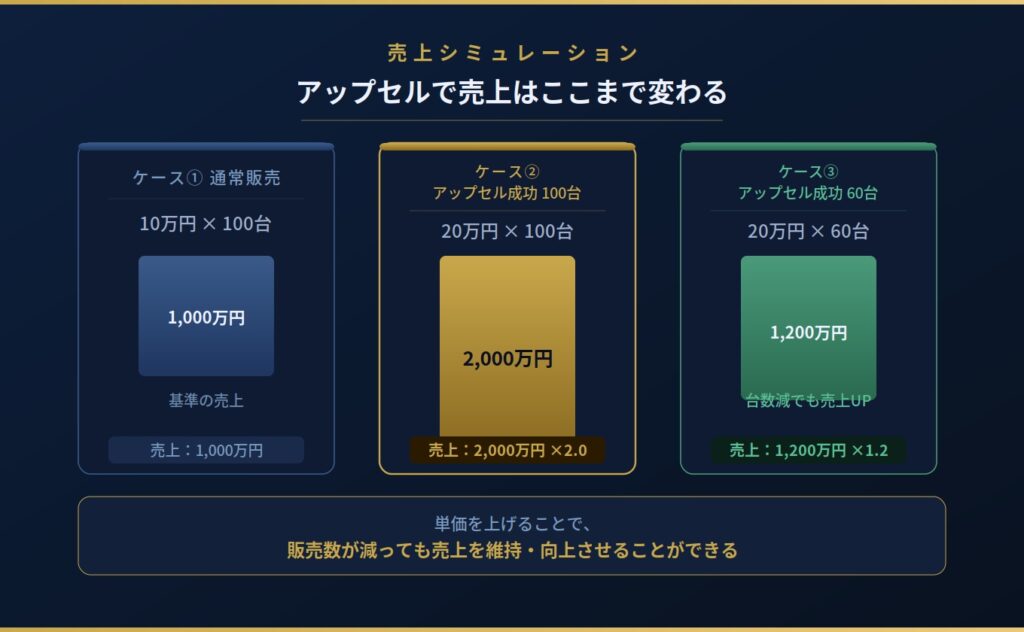
(The above illustration shows the comparison between the total sales of PC units according to the abovementioned examples. Case 1 = blue, Case 2 = yellow, Case 3 = green.)

To generate sales, a customer must purchase a product. However, even if the quantity sold remains the same, revenue increases if the individual sale price is raised through up-selling. As shown in the previous examples, even if the total quantity sold decreases, the higher unit price can result in higher overall revenue. (If the unit price is doubled, revenue will be higher as long as more than 50% of the original volume is sold.)

By understanding that quantity and unit price are the core elements of sales, you can increase revenue more efficiently.

It is common for businesses focusing solely on volume to resort to discounts. However, to match the ¥20 million in revenue generated by 100 up-sold units at ¥200,000 each, you would need to sell 250 units of a ¥100,000 PC if it were discounted by 20% to ¥80,000.

Even more critical is the impact on gross profit (revenue minus cost of goods sold). Let’s examine the previous examples through the lens of profit, assuming a consistent profit margin of 30%.

【Examples】
Standard: 100 PCs sold at ¥100,000 (Cost: ¥70,000) = ¥10M revenue, ¥3M profit.
Up-selling: 100 PCs sold at ¥200,000 (Cost: ¥140,000) = ¥20M revenue, ¥6M profit.
Discounting: 250 PCs sold at ¥80,000 (Cost: ¥70,000) = ¥20M revenue, ¥2.5M profit.

(The above illustration contrasts up-selling with discounting. Compared to the standard case (top), upselling (middle) achieves double the profit margin, while discounting (bottom) results in an extremely low profit margin.)

If you resort to discounting to boost sales, even if you successfully increase the quantity sold and total revenue, your actual profit will decrease compared to what it was before the discount. Understanding that gross profit is composed of the relationship between revenue and the cost of goods sold allows you to increase that profit more efficiently.

If one recognizes that discounting lowers profit and instead tries to increase sales volume through other means, typical measures include increasing advertising spend for e-commerce, opening more physical stores, or expanding the company’s sales force for B2B operations. While these measures may increase gross profit, the corresponding increase in expenses makes it very likely that the resulting operating profit will actually decrease.

As we can see from the examples above, the most effective means of increasing both sales and gross profit is ultimately to focus on up-selling by clearly communicating the value of a product’s features and quality to the customer.

4. The Difference Between Up-selling and Cross-selling

Does this mean you should simply propose the highest-priced items possible to every customer? Not necessarily. For instance, if someone comes in to buy a compact economy car and you immediately suggest a Lexus, you likely won’t make the sale. Unless an up-sell presents specific benefits aligned with the customer’s budget, it becomes forced, which lowers customer satisfaction and negatively impacts business.

When there are limits to up-selling high-performance or high-quality models, the cross-selling we explained in the previous article becomes the driving force for increasing sales.

As a brief reminder, cross-selling is the technique of increasing sales by proposing additional related products or services to go with the customer's purchase, thereby increasing the number of items bought and the average transaction value.

[Using the example from the previous section]
Selling 100 PCs at ¥100,000 each results in ¥10 million in sales. At a 30% profit margin, the profit is ¥3 million.
If you up-sell 60 of these to ¥200,000 PCs while selling the remaining 40 at ¥100,000, your total sales for 100 units become ¥16 million. At a 30% margin, your profit is ¥4.8 million.

If you only use up-selling, the process ends here.
However, if you also sell peripherals such as wireless routers, storage devices, mice, and security software (assuming a combined price of ¥30,000) to 50% of your customers (50 sets) at a 50% profit margin:
50 sets × ¥30,000 = ¥1.5 million in additional sales and ¥750,000 in additional profit.
Adding this to the PC sales results in a total of ¥17.5 million in sales and ¥5.55 million in profit.

Compared to simply selling 100 standard PCs at ¥100,000 each, you can achieve 1.75 times the sales and 1.85 times the profit with a combination of up-selling and cross-selling.
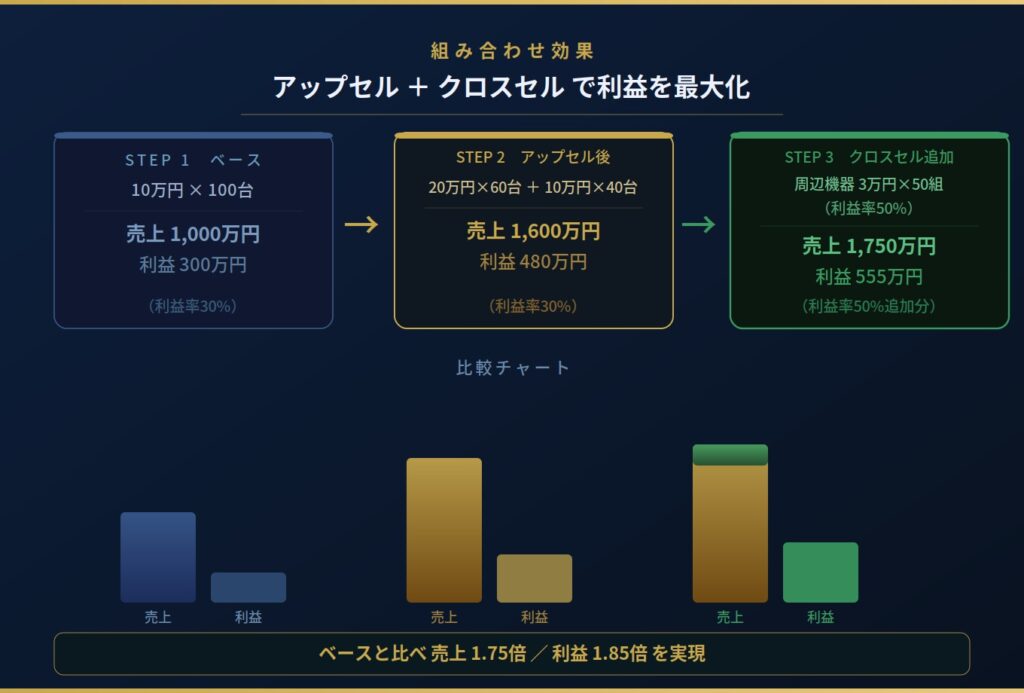
(The above illustration compares the revenue and profit of selling 100 of the standard units (left), 60 of the up-sold units (middle), and 60 of the up-sold units plus 50 sets of cross-sold items (right).)

As we discussed in the previous section, sales are composed of unit price and quantity. Up-selling is effective at increasing the unit price, while cross-selling is effective at increasing the quantity of sales.

By understanding that sales result from the combination of these two elements, and by maximizing and optimizing them through up-selling and cross-selling in a reasonable manner, you can increase sales dramatically and more efficiently than by simply selling more products. Furthermore, because neither method relies on discounting to drive volume, you can reliably increase not just sales but also gross profit.

I trust you now understand that up-selling and cross-selling are methods that yield immense results for both sales and gross profit without requiring extra expenses or time. Below is a summary of the differences between the two:

[Up-selling]
Objective: Increase sales by improving the average transaction value per customer.
Sales method: Propose high-value products or services characterized by high performance, high quality, or large capacity.

[Cross-selling]
Objective: Increase sales by increasing the number of items purchased per customer.
Sales method: Create value by proposing the additional purchase of highly relevant products or services.

As summarized above, up-selling and cross-selling increase revenue by applying different methods to the two components of sales—unit price and quantity. Because these strategies do not involve discounting, they do not negatively impact the components of gross profit. Furthermore, since they do not increase expenses such as advertising, labor, or rent, the resulting revenue growth links directly to an increase in operating profit, making this one of the most effective means of raising profit. While both methods may seem modest, it is no exaggeration to say that their impact on corporate management is profound.

5. Summary

In this installment, we have discussed the effects of up-selling and contrasted it with cross-selling.

While both up-selling and cross-selling are seemingly modest techniques, they are methods that can yield immense effects in maximizing sales and profit. For this reason, it is crucial to educate a company’s employees on their importance, on how to present benefits for customers to avoid forced selling, and on how to utilize various technologies for those purposes, as well.

Maximizing sales and profit through up-selling and cross-selling before taking actions that involve significant expenses (such as running advertisements, opening new stores, or increasing sales personnel) is key for business managers to facilitate efficient profit generation.

I have intentionally addressed cross-selling following our previous discussions on “Inventory Turnover”, “Sales per Employee”, and “Sales per Tsubo”, which focused on cash flow and expenses related to inventory, labor, and rent. If you read these in order, starting with the first article on inventory turnover, the essential points of business management will become much clearer. For those who have not yet read them, I highly encourage you to do so.

What we at D-POPS GROUP want to convey through this discussion on up-selling is the same message as before: business is built by people. The customers who purchase products are people, the sales staff who sell the products are people, and those who utilize technology are all people.

While I think it is impossible to win in competition and survive in business without commanding technologies like AI, I also think that technology alone is not enough to survive. At D-POPS GROUP, we believe that business success does not happen simply because the technology is good or the management strategy is sound; rather, the intersection of People × Technology × Management Strategies is what truly matters.

In accordance with this line of thinking, D-POPS GROUP’s vision is “realizing a Venture Ecosystem”. Our goal is to support startups through investment to help people shine and solve social issues, providing value that goes beyond mere numbers and efficiency.

We hope that you enjoyed this article and look forward to working with you in the future.

D-POPS GROUP Managing Executive Officer

Tetsuya Watanabe

Related Articles

Lessons from Great Business Leaders: “Your Mindset Defines Your Life” (Tempu Nakamura)
To foster a thriving startup ecosystem, we must look back and learn with humility from the legendary leaders who built global enterprises from the ground up. In this series of “Lessons from Great Business Leaders”, we will share the words of the visionaries and thinkers who have influenced us most, reflecting on how their philosophies have shaped our own experiences in business and life. This third installment was written by our group’s advisor Sugihara. 1. “Your Mindset Defines Your Life” – Tempu Nakamura “Whether your mind is positive or negative creates two polar opposite perspectives on life. If your mind is positive, life becomes filled with cheer, adventure, energy, and vigor regardless of the circumstances. Conversely, if your mind is negative, everything in life loses its spirit. If the mind that contemplates life is negative, does not everything end in a pitiful, dark, and miserable state? Since you only have one chance at life, you must live it in the most perfect mental state possible, starting from this very moment.” (Excerpt from Tempu Nakamura: One Thought a Day, edited by the Tempu Society. Published in 2005 by PHP Institute.) 2. Reason for Selecting This Passage On a personal note, I have spent my career since 1990 working consistently within companies that were considered startups in their respective eras. Among these experiences, my time at Daini Denden (the predecessor to what is now KDDI) was particularly formative. It built the foundation of my professional life and forged the entrepreneurial spirit that has served as the emotional bedrock for my continued challenges over the years. I remain deeply grateful for that experience today. Daini Denden’s co-founder, Kazuo Inamori, is a world-renowned leader respected by executives not only in Japan but also in China and across the globe. One of the thinkers who most profoundly influenced Inamori was Tempu Nakamura. While I was there, my superiors and division heads encouraged me to read books on MBA studies or the then-popular “Lanchester Strategy”, but above all else, the very first thing they told me to read were Tempu’s works. While Tempu’s most famous longtime bestsellers are Sharpening Your Soul and Open Your Destiny, I have chosen the compilation Tempu Nakamura: One Thought a Day. It distills his essence into short, concise daily entries that are incredibly easy to read. I highly recommend it to anyone who has heard the name “Tempu Nakamura” but doesn’t have any of his works yet, or for those looking for the right book to revisit his teachings. By the way, it recently became a hot topic that the world-renowned baseball superstar and source of great Japanese pride, Shohei Ohtani, was a devoted reader of Tempu’s books before he moved to the Major Leagues. 3. My Own Experiences and Thoughts on This Philosophy Between the 1990s and 2000s, while I was in my 20s and still learning the fundamentals of being a professional, I was suddenly assigned to a new business division, the office preparing to launch DDI Pocket, which would later become their PHS* business. As a member of a launch team with just six people responsible for sales strategy, I worked with such intensity that there was no distinction between day, night, or weekends. Looking back now, I can say it was a workplace that reflected an era when terms like “power harassment” or “work-life balance” did not yet exist. Our supervisor’s orders were absolute, and unreasonable requests were common. *Note: PHS (Personal Handy-phone System) was a Japanese-developed precursor to modern cellphone technology that was popular in Japan in the 1990s, and expanded to various degrees in Asia, Europe, and Latin America. Even though I was thrown into an environment where it would have been easy to harbor discontent or want to run away, I made a conscious effort to look at the bright side of things. I did not avoid difficulties, maintained a proactive stance, and continued to put in effort even when no one was watching. It is no exaggeration to say this was entirely because I treated Tempu’s books as my bible, so to speak. Tempu Nakamura frequently mentioned something in his writings that became representative of his philosophy: “Always keep a positive mindset”, and by making this my habit, I gained a strength that influenced not only that period of my life but my entire subsequent career. It gave me the power to overcome hardships, seize opportunities, and attain numerous priceless experiences. There are a number of recurring themes within the pages of One Thought a Day, and though they’re expressed differently in different places, they all preach the importance of maintaining positivity in one’s thinking and mental state. Here are a few passages that reflect those themes. One’s thoughts create one’s life “Humans’ health and destiny depend solely on where they put their minds.” The difference between a mind moving in a positive direction and one moving in a negative direction is as vast as that between heaven and earth. The power of determination Taken to the extreme, one could even say that having a happy or an unhappy life depends entirely on one’s control over one’s mind. Willpower—in other words, absolute control over one’s mind—could widely be called the driving force that allows one to become a better person. Noble, strong, righteous, and pure The first step in conducting oneself according to the laws of nature is to keep a positive mindset at all times, no matter what happens. A positive mindset means to live nobly, strongly, righteously, and purely. There is almost nothing more important to life and existence than this. Do not voice dissatisfaction or complaints Under no circumstances should you let yourself vocalize dissatisfaction or complaints. If those feelings exist within your heart, your words will never be truly positive. People who complain are constantly looking only upward and never downward. They think everyone else is happy and that they are the most miserable person in the world. (Excerpts from Tempu Nakamura: One Thought a Day.) Encouraged by these words, I was able to spur myself on and approach my work with a forward-looking attitude, which allowed me to deal with situations calmly and read the trends of the times. Subsequently, I was involved in the launch of the mobile internet services of PHS, the launch of broadband at AOL, the music distribution business at Napster, and the creation of mechanisms to improve search engine share at Google. I have walked alongside the history of the internet industry itself. Modern business professionals are tossed back and forth by a flood of information that changes daily. We must chase not only the knowledge required for our daily tasks but also the world’s latest technical information, such as Generative AI, AI agents, and AI robotics. Furthermore, we find ourselves in an environment where we cannot help but feel anxious that our own job might become another profession replaced by AI. It is important to fill oneself with knowledge and information and to possess technical skills. However, what humans possess that is fundamentally different from AI is not information or knowledge, but rather, the mind. Technology and knowledge change with the times and can be acquired later. However, I believe that a forward-facing mind and a proactive way of thinking form a foundation and become a personal wealth that accumulates within oneself, regardless of how the era changes. Right now, I have a small scrap of paper in my wallet that has been there for about 20 years, like a lucky charm. On it, I wrote down my own “Seven Principles for Living”. The first three of these are: 1. Always think about things positively. 2. Always stay hungry to improve and strive for diligence. 3. Do not complain about things out of your control. These have completely become my own words and convictions. Looking back now, I recall that these were simplified expressions I had quoted from Tempu’s books (and Carl Hilty’s Happiness). For sharing this method of proactive thinking with the world, I am grateful to the businessman and philosopher Tempu Nakamura. 4. A Message to Our Readers For this installment, I chose the writings of a figure from a somewhat older era. I also selected him from the perspective of being a thinker who influenced famous business leaders, rather than being a famous leader himself. At first, I wondered if this might be an unconventional choice for this series. However, when I heard that the world-famous Shohei Ohtani read his work, it made me happy to realize that this philosophy is universal, so I decided to introduce it because I felt his words could resonate with both athletes and business leaders alike. We live in an era where the future is increasingly difficult to predict (although this could have been said in every era of human history). I hope that by picking up Tempu Nakamura’s works, you can find the driving force to maintain a positive state of mind and approach new businesses or entrepreneurial ventures with vigor and enthusiasm. May your work, your business, and your life itself be bright and overflowing with happiness! At D-POPS GROUP, we hold the vision of “realizing a Venture Ecosystem”. We are working on building mechanisms that allow groups of companies within our Ecosystem to grow sustainably, as well as providing hands-on support through our team of advisors. ※For more details, please read: “Venture Ecosystem: A Platform for Growth and Sustainability” I hope this article will be of some help to startup founders and business managers. D-POPS GROUP Advisor Genta Sugihara
  • Media
2026.05.13
Lessons from Great Business Leaders: “Cash-Based Management” (Kazuo Inamori)
To foster a thriving startup ecosystem, we must look back and learn with humility from the legendary leaders who built global enterprises from the ground up. In this series of “Lessons from Great Business Leaders”, we will share the words of the visionaries and thinkers who have influenced us most, reflecting on how their philosophies have shaped our own experiences in business and life. This second installment was written by our group’s advisor Yoneya. 1. “Cash-Based Management” – Kazuo Inamori “Cash-based management means focusing on the actual movement of money to keep management simple and rooted in the essence of things. My first fundamental principle of accounting is that it must be a tool for managing on a cash basis.” Excerpt from Practical Study: Management and Accounting, by Kazuo Inamori. Published in 1998 by Nikkei Inc. 2. Reason for Selecting This Passage When the first edition of Practical Study: Management and Accounting was published in 1998, the Japanese economy had been trapped in a long, dark tunnel following the collapse of the Heisei Bubble (known internationally as the Japanese asset price bubble). While there are many theories regarding the nature of this bubble, I believe it was essentially a fiction decoupled from the reality of cash. At the time, Japanese society was entranced by the real estate myth—the unwavering belief that land prices would rise forever. This allowed companies to use inflated property values as collateral to secure bank loans, creating monetary assets out of thin air without needing to prove the ability to actually generate cash flow. This speculative cycle, borrowing money to buy property that couldn’t pay for itself, eventually collapsed. The illusion faded, leaving behind a mountain of non-performing loans and marking the end of the era. Inamori’s chosen title of Practical Study implies a field of study or science backed by hard reality rather than mere academic theory. I believe he chose this name out of a sense of crisis regarding a Japanese economy that had chased theoretical gains from risky business instead of actual enterprise. Inamori expressed the essence of business through a simple maxim: “Measure what comes in, control what goes out.” He argued that the starting point of management is a truth so simple a middle school student could understand it: “Maximize your income, minimize your expenses, and the difference is what stays with you. That’s all there is to it.” However, as society develops, and social systems and transactions reach a high level of complexity, our accounting standards—which mirror those systems and transactions—also become complex. Concepts like accrual basis or mark-to-market accounting can sometimes obscure the actual movement of cash. Having served as an auditor and a financial reporting lead for listed companies, I recognize that while adhering to formal accounting standards when reporting finances is vital for corporate governance, what truly drives business growth is simple management accounting aligned with the actual flow of money. From here on, while in the process of sharing my key takeaways from Inamori’s philosophy, I will also break down the differences between financial accounting and management accounting. 3. Financial Accounting is for Stakeholders; Management Accounting is for the Leader Financial accounting is designed to report a company’s status to an external audience of stakeholders, such as shareholders, banks, and investors. Precisely because it serves many purposes, the rules are strict and necessarily complex. Listed companies have the strictest rules. This is because they answer to a vast number of stakeholders, including international investors, and because comparability is of the utmost importance. This concept of comparability exists to ensure that investors can evaluate different companies using the same yardstick. For example, if Company A and Company B in the same industry calculated their profits using completely different sets of standards, an investor would have no way of determining which is the superior investment. Because of this, companies are required to prepare financial statements based on incredibly detailed and rigid rules, and auditing firms carefully verify that these standards are being followed to the letter. Even for unlisted companies, the need to report their status to their stakeholders based on financial accounting standards does not change. ・To their investors, these reports prove profitability and ROI (Return On Investment) relative to other companies. ・To their shareholders, these reports demonstrate how capital is being used efficiently to grow their companies. ・To banks and creditors, these reports build up trust that loans can be repaid reliably. However, there is one problem with this. The more elaborate these rules become to satisfy external needs, the more complicated that financial accounting becomes. As a result, the simple movement of money that is so essential to business becomes difficult to see. This is the constant dilemma of financial accounting. On the other hand, rather than being bound by rules such as those, management accounting is a system designed freely by the leader to improve profitability and guide the company toward growth. If financial accounting is the infrastructure that supports external trust, management accounting is the instrument panel in a cockpit, allowing the leaders to judge, “Where are the sources of growth and problems for our business? Where should we concentrate our resources to improve profitability?” So, how can a leader ensure these cockpit instruments are functioning correctly to lead the company toward higher profitability? 4. Four Pillars of Management Accounting I Learned from Practical Study Based on my reading of Practical Study, I have identified four essential areas for effective management accounting. ①Making Profitability Visible Enough for Everyone to Participate Inamori famously advocated for “amoeba management”, where an organization is subdivided into small, self-reliant units. The goal is to create a state where everyone—from those generating sales to those incurring expenses—has a sense of ownership regarding profitability. When you break down profit and loss all the way to the level of those in charge of specific areas, the numbers become personal, so employees will naturally seek to understand what’s at the heart of an issue. This clarification is the first step in management accounting, and makes possible the selection and focus required to deploy limited resources where they matter most. ②Managing Available Funds to “Stay in the Center of the Wrestling Ring” Inamori used the sumo metaphor of “staying in the center of the wrestling ring” to describe a management style that maintains a constant margin of safety. Accordingly, this second point of management accounting is about managing your cash flow so that you can fully grasp how much surplus funds you actually have available for use, including the factors that cause it to fluctuate. Simply creating an ordinary cash flow statement is not enough, in my opinion. You must clarify exactly how your business’s profit translates into cash. In addition, you have to constantly follow working capital (fluctuations in accounts receivable, accounts payable, and inventory) and keep visualizing exactly how much funds are available right now for future outflows (bonuses, corporate taxes, and dividends). Think of this as the fuel gauge in your cockpit. Only when this gauge is accurate and predictive can a leader step forward into aggressive investment without being shaken by unforeseen events. ③Thoroughly Recovering Investments to Support a Lean, Muscular Business Management accounting isn’t just about calculating ROI (Return on Investment); it’s about ruthlessly tracking whether the money you’ve sent out is circulating back without getting stuck. Inamori famously shared his “Ceramic Pebble Argument”: if a high-tech ceramic component ever becomes unsellable, it is no longer any different from a pebble on the side of the road. Following this logic, even if something is recorded as an asset in financial accounting, it is not a true asset in management accounting if it fails to generate cash flow. For instance, labor costs spent on unfinished projects or products are accumulated as assets in financial accounting, which acts as a factor that inflates reported profits. However, if that work is never converted into cash through the collection of sales, then in actual business management terms, it is nothing more than excess fat—a condition where cash has simply flowed out of the company. To eliminate this fat and restore a healthy circulation of funds, you must track the movement of invested cash using honest numbers. In other words, you must constantly grasp how long it took for what amount of the invested cash was recovered, and what margin of profit (that is, ROI) it achieved. This consistency is precisely what trims away the excess fat that burdens a company, allowing it to maintain a lean, muscular build, which results in sustainable growth. ④The One-to-One Correspondence Principle The final point is ensuring every figure matches the facts of monetary movement. Inamori called this the One-to-One Correspondence Principle. I believe this is the foundation of trust for not only management accounting, but financial accounting, as well. Modern accounting has become incredibly complex, incorporating estimates like impairment losses and fair-value adjustments. However, no matter how sophisticated the system becomes, the essence of business remains the simple movement of cash. Understanding the reality of cash flow is, in my opinion, the only starting point for a leader seeking the insights needed to grow their company. 5. Message to the Reader On the long-haul flight of business management, in order to know your current position and keep flying until you reach your destination, you don’t need impenetrable financial theories. What you need is management accounting that acts as a reliable cockpit instrument reflecting the true situation of your company’s funds. Even when the weather of the market changes and visibility drops, I believe this accurate instrument will allow you to choose the optimal flight path toward growth without hesitation. At D-POPS GROUP, our vision is to realize a Venture Ecosystem. We focus on creating a platform that enables companies within our Ecosystem to grow sustainably, supported by the hands-on guidance of our advisors. (For more on this, check out “Venture Ecosystem: A Platform for Growth and Sustainability”.) I hope this article provides valuable perspective for founders and business leaders as they navigate their own journeys. D-POPS GROUP Executive Officer, President’s Office Head Yoshihiro Yoneya
  • Media
2026.03.04
Cross-selling: Specific Measures and Success Stories of Dramatically Improving Gross Profit
This is the first installment in a series on how to increase gross profit, which indicates a company’s fundamental earning power. Here, we will explore the concept of cross-selling. Cross-selling is a technique used to increase average transaction value and overall sales by introducing additional related products or services to a customer who is purchasing something. The most common examples of cross-selling include being prompted to add an egg or salad at a beef bowl restaurant, or fries and a drink at a hamburger shop. In this article, we will explain cross-selling using examples from the retail industry. 1. Achieve Immense Results Without Costing Extra Money or Time In previous articles, we covered “Inventory Turnover”, “Sales per Employee”, and “Sales per Tsubo” as methods for increasing profit when managing a company. We intentionally focused on cash flow (CF) and expenses (labor costs, rent) rather than gross profit because, in a competitive environment where companies handle similar products at a similar scale, it is essential to look at CF and expenses to achieve significant differentiation from competitors. We also looked in depth at specific cases of this. Now that the importance of CF and expenses can be understood, we will turn our attention to the heart of corporate management: gross profit. Gross profit is an extremely simple indicator. Also referred to as gross profit margin, it is calculated as the profit remaining after subtracting the cost of goods sold (COGS) from total sales. If the products or services themselves are unique and differentiated, a high gross profit can be achieved. However, instead of focusing on how to create unique products to raise profit, in this article we will set our goal on increasing gross profit while handling similar products. The concept of cross-selling we are discussing today is a method that can greatly affect gross profit without requiring additional expenses or time, so let’s take a closer look. 2. What is Cross-selling? Cross-selling is a method of increasing sales by raising the average transaction value or encouraging repeat purchases. This is achieved by suggesting additional related products and services or recommending a lineup that would complement what a customer already purchased. Representative examples include: ・Recommending a matching necktie to a customer buying a suit ・Offering a screen protector, AC adapter, insurance, or antivirus software to a customer purchasing a smartphone ・Suggesting lenses, filters, or memory cards to a customer buying a camera ・Proposing additional tires, seat covers, a dash cam, a navigation system, or insurance to a customer purchasing a car The examples of cross-selling are truly too numerous to list. This graphic is a visual representation of the assorted examples of cross-selling offered in the previous paragraph. Even without making such suggestions verbally, creating an environment where customers can purchase items later (e.g., carrying a wide assortment of peripherals for PCs or cameras) could be considered cross-selling in a broad sense. Whether recommending products through a sales clerk’s dialogue in a physical store or on a website, cross-selling is practiced to some degree by essentially every company involved in selling products or services. While cross-selling may seem simple at first glance, it has a massive impact on gross profit. In the next section, we will look at just how effective it can be. 3. Why is Cross-selling Important? Understanding Its Effectiveness I would like to show the efficacy of cross-selling using several examples. First, let’s look at the profits of a company selling PCs during a specific period. (This model company is fictional but based on the numbers from an actual business.) Model Case: PCs ・The PC units themselves generate a gross profit of ¥2.8 billion, a profit margin of 20%, and total sales of ¥140 billion. ・PC peripherals, accessories, and related products* earn a gross profit of ¥4.4 billion, a profit margin of 40%, and total sales of ¥110 billion. (*Includes printers, routers, and storage devices; accessories such as mice, keyboards, and bags; consumables like ink and paper; broadband sign-up fees; and related software or books.) These charts show the comparison between the total sales and gross profits of PC units (blue bars) versus the peripherals, accessories, and related products (orange bars). The key points to observe in this example are the profit amounts and total sales. The profit from the PC units—which the customers originally intended to buy—is ¥2.8 billion. Meanwhile, the profit from all of the PC-related products (the cross-sell items needed at the time of purchase or afterward) is ¥4.4 billion. There is a difference in profit of ¥1.6 billion, or 157% in relative terms. This is true despite the fact that the total sales for PC-related products (¥110 billion) are ¥30 billion lower than the sales for the units themselves (¥140 billion). This is not unique to PCs; for many products that customers intend to buy, competition between products and stores is fierce, meaning they are not very profitable. While not true for every item, many cross-sell products have high profit margins. You can see that working hard to pitch these cross-sell items, either at the time of the initial sale or through subsequent repeat business, has a tremendous effect on increasing gross profit, both in terms of total profit amount and efficient profit margins. Next, let’s look at an example involving smartphones. The following example shows the breakdown of one month of profit from smartphone sales for a certain company. (Again, these numbers are based on actual business results.) Model Case: Smartphones ・Total gross profit from smartphone sales: ¥90 million ・Profit from the smartphone devices themselves: ¥50 million ・Profit from related products other than smartphones: ¥40 million In the case of smartphones, the profit from selling the devices themselves is higher than the profit from selling PC units, and as a result, it’s also higher than the profit from smartphone-related products. However, related products still account for nearly 45% of the total profit. This example also demonstrates that diligently selling cross-sell items at the time a customer purchases their intended product has a significant effect on raising gross profit. As these two examples show, cross-selling is highly effective for increasing gross profit, but more than that, its greatest merit is that it incurs almost no additional expenses. This means that the increase in gross profit leads directly to an increase in operating profit. For example, if a store wants to increase sales, it might open a new location, but this requires additional expenses such as rent and labor. In B2B sales, increasing revenue usually involves hiring more salespeople, adding advertising costs, or opening new branch office space; all of these incur extra expenses. While these actions will likely increase sales and gross profit to some extent, there is no guarantee the increase will make up for the added costs. There are likely many cases where those expenses are not covered, leading to a deficit on an operating profit basis. On the other hand, the added cost of cross-selling is relatively little. When sales and gross profit rise through cross-selling, that gross profit essentially has a direct effect on operating profit because there are no new overhead costs. For this reason, cross-selling contributes to net income quite effectively. This is not only true for the examples mentioned earlier. Making full use of cross-selling enables earning profits equal to or greater than those earned from the customer’s intended purchase no matter the industry, from restaurant to apparel. Boosting the overall gross profit margin by roughly 10% becomes a realistic goal, and as mentioned previously, because cross-selling adds almost no additional expenses, that also boosts operating profit. For this reason, if you wish to increase your profits, start by raising the average transaction value through cross-selling rather than searching for new customers through opening additional stores, hiring more workers, or increasing advertising. In a competitive environment where companies handle similar products, achieving cross-selling that significantly outperforms your rivals gives you a major advantage not just in gross profit, but in operating profit as well. I believe you can now see just how big an effect cross-selling has on business management. 4. Key Points for Increasing Sales Through Cross-selling Now that you recognize the importance of cross-selling, I would like to introduce several key methods for successfully implementing it to increase sales. ① Selection of products and accessories The starting place is to carry products conducive to cross-selling and ensure a solid assortment of related items. For instance, appliances like refrigerators or washing machines offer limited cross-selling opportunities beyond extended warranties. However, the examples we discussed (suits, smartphones, cameras, cars, and PCs) are gold mines for cross-selling. With suits, beyond the obvious shirts and ties, you can facilitate cross-selling by carrying an assortment of matching bags, belts, and shoes. Even items like tie pins or shirt garters can contribute to cross-selling. By selecting products that naturally invite add-ons and maintaining a robust inventory of related items, your cross-selling revenue will grow. ② Human education and ingenuity This involves ensuring that employees are educated on the importance of cross-selling. Both the company and its staff must constantly brush up on their product knowledge, sales scripts, and customer service techniques, while figuring out creative ways to look after customers, display products, and procure goods. Companies that can innovate in this way—learning how to explain why a suggested product is necessary from the customer’s perspective, determining the optimal order and timing for multiple suggestions, and identifying the most effective placement for displays—will see an overwhelming difference compared to companies that cannot. Furthermore, a cross-sell item shouldn’t be chosen simply because it is profitable. If it has no relevance or benefit to the customer, it simply becomes forced, which lowers customer satisfaction and leads to negative long-term results for the business. You must put yourself in the customer’s perspective and devise a narrative that explains the relevance and benefits of each specific item. It goes without saying that deep product knowledge and constant ingenuity are essential to achieving this. ③ Utilization of technology When shopping online, recommendations appear based on past purchase history. In the telecommunications industry, systems have begun suggesting recommended products to staff in real-time while they are interacting with customers. Naturally, enlisting technology to visualize data is also vital, such as which salespeople are achieving what levels of cross-selling. While these are just a few examples, it is clear that mastering technology is an indispensable element for boosting sales through cross-selling. While there are other aspects involved in increasing sales through cross-selling, the key factor is employees who are educated in the importance of cross-selling and in the full use of technology. Ultimately, driving up sales through cross-selling and achieving a dramatic leap in management efficiency rests upon the intersection of People × Technology. This graphic contains a broad summary of the three sub-points and the key factor of section 4. 5. Summary In this article, we discussed the concept of cross-selling. We explained that cross-selling is a method that yields immense results not only for gross profit but also for operating profit, without requiring additional expenses or time. By maximizing the sales of products and services related to the customer’s intended purchase, a company can maximize both gross and operating profit, creating a significant competitive advantage over rivals. I have intentionally addressed cross-selling following our previous discussions on “Inventory Turnover”, “Sales per Employee”, and “Sales per Tsubo”, which focused on cash flow and expenses related to inventory, labor, and rent. If you read these in order, starting with the first article on “Inventory Turnover”, the essential points of business management will become much clearer. For those who have not yet read them, I highly encourage you to do so. What we at D-POPS GROUP want to convey through this discussion on cross-selling is the same message as before: business is built by people. The customers who purchase products are people, the sales staff who sell the products are people, and those who utilize technology are all people. While I think it is impossible to win in competition and survive in business without commanding technologies like AI, I also think that technology alone is not enough to survive. At D-POPS GROUP, we believe that business success does not happen simply because the technology is good or the management strategy is sound; rather, the intersection of People × Technology × Management Strategies is what truly matters. In accordance with this line of thinking, D-POPS GROUP’s vision is “realizing a Venture Ecosystem”. Our goal is to support startups through investment to help people shine and solve social issues, providing value that goes beyond mere numbers and efficiency. We hope that you enjoyed this article and look forward to working with you in the future. D-POPS GROUP Managing Executive Officer Tetsuya Watanabe

  • Media
2026.02.12
Back to COLUMN