


COLUMN

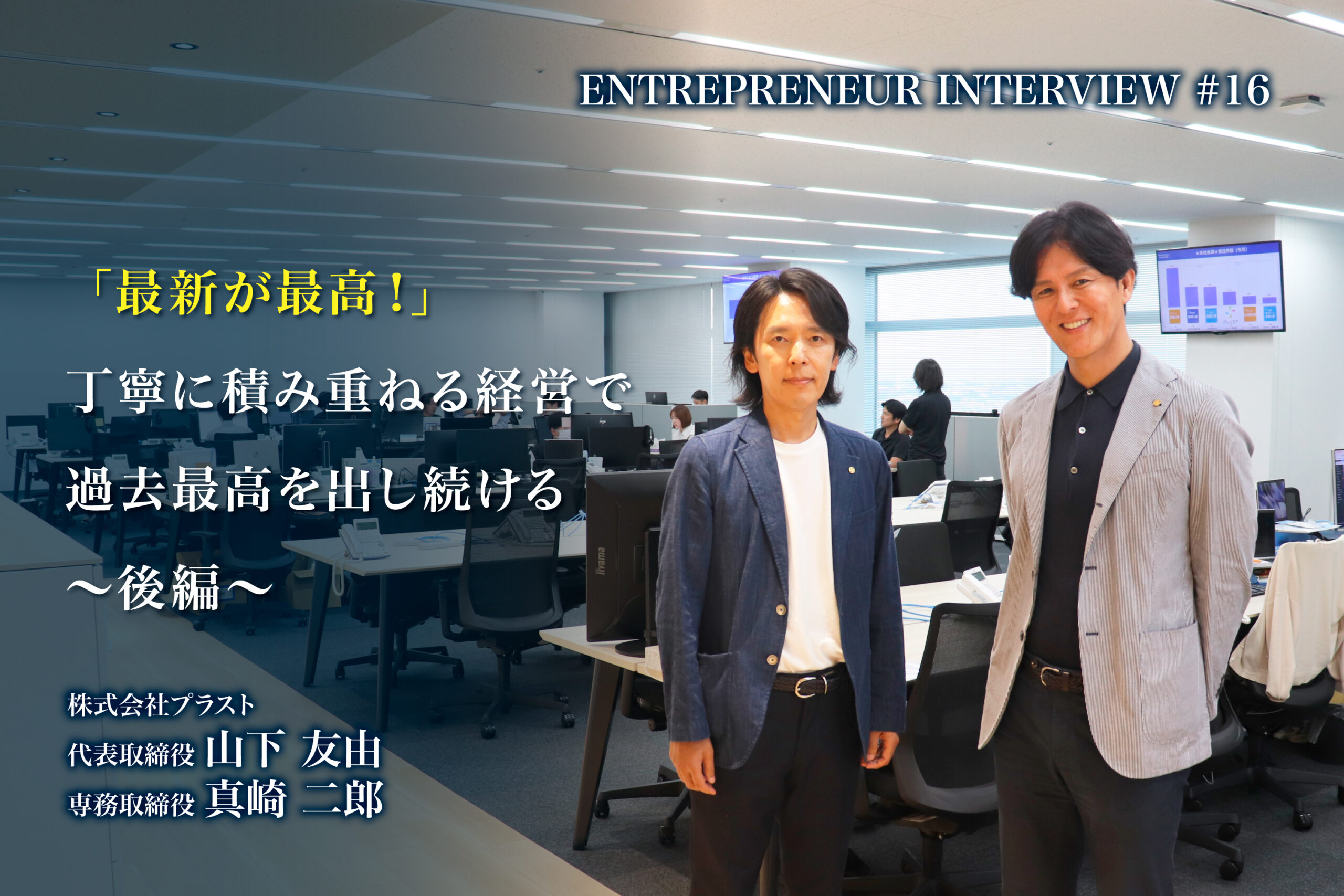
[Entrepreneur Interview #16] Tomoyoshi Yamashita and Jiro Masaki (Plust) – Part 2

  • Group Companies
  • Interview
2025.09.25

“Newest is best!”
Careful, Consistent Management for Continuous Record Growth

D-POPS GROUP has 24 group companies that we call partners (at the time of publication).

For this article, we interviewed Tomoyoshi Yamashita, the President and CEO of PLUST.Co.,Ltd. (Plust from here on)—which joined our group in September 2024—and Jiro Masaki, Plust’s Senior Managing Director. (This interview was conducted in July 2025.)

This is the latter part of the interview. To read the first part, click the link below.
https://d-pops-group.co.jp/en/column/plust-interview-first-part/

◆Case Study Interview Videos

Sugihara:
I watched the interview videos of case studies published on Plust’s website, and I was very impressed by one customer who said, “All their staff, both men and women, have such great personalities that it really underscores their company’s merit, and even the CEO’s merit…” I felt like the sales and marketing teams’ sincere attitudes have become a part of the company’s branding itself.

Yamashita:
Thank you. Before adopting a product or service, it’s not uncommon for customers to worry, “Can I really trust Plust with this?” or “How do other business owners in the same industry actually feel after implementing this?” We believed that customer voices were the solution to alleviate these anxieties even a little. Naturally, we started from zero, asking our customers one by one for their feedback.

As the number of such interviews gradually increased, it allowed us to view our company objectively. For example, understanding why they chose to work with us, or specifically how our support delighted the customers, has become a reference for how to support future customers. We realized things like, “If we respond this way, the customer will say they were helped”, and “If we think together about the store like this, the owner will be pleased.”

Also, through watching these interview videos, our customers basically teach us about our own strengths all over again, and it enables us to think, “Ah, this is definitely our forte. Well, in that case, let’s bring out our team’s strengths even further!”

Sugihara:
The Japan Marketing Research Organization (JMRO) ranked your company as first place for “Number of Public Interviews of Satisfied Customers” in both the “Storefront App Development” and “Web Development” divisions.

It’s remarkable that you conduct so many interviews. How do you go about arranging them?

Yamashita:
Actually, during the contract phase, we ask questions like, “If you implement our services and are satisfied with the results, would you be willing to cooperate in a post-implementation customer interview at a later date?” We also write this request directly into our contracts.

Many of our customers respond by saying things like, “As long as it turns out well, that’s fine” or “If you produce good results, then we’ll be happy, and your sales and marketing teams can certainly use them!” But I can’t say there aren’t some who politely decline our request because they are honestly shy. Almost all of the interview videos are produced by our company’s media production department’s video team.

Sugihara:
That’s wonderful. What kind of reactions do you get from all of the customers and employees who watch those videos?

Yamashita:
First, for our employees, we basically created a “Case Study Interview Video” channel on our internal Slack, so when an interview is released, it’s shared company-wide.

I think they are also displayed on monitors in the office, but when we share the interview with our company Slack, we can let everyone know who the support staff member was, who initially connected with the customer, and who the sales representative was. The customers’ own words let everyone understand in what manner they received their support.

Normally, people in different departments or those in sales roles don’t know in detail how closely the support team works with customers. When a customer speaks highly of the support, sometimes they mention them by name, which shines a spotlight on the support staff and on those who are doing a good job with their sales.

Also, in cases where customers watch the video during a business negotiation, some of them immediately say, “All right, then. We’ll leave it to you!” And others will call us in the following days to say they’ve decided to proceed with the contract. So I think those videos really help customers to envision a good working relationship.

Sugihara:
In that sense, you’ve created a system where the acquisition sales team members share the spotlight with the customer support and customer success team members.

Yamashita:
That’s right. Masaki and I are constantly mindful of creating a system that puts the spotlight not only on sales staff but also on employees who are doing important work that may not be easily quantifiable. Of course, in a sales company, sales often get the most recognition. But I believe that the whole company gets more energized when we make sure that the people who are working hard in their respective, important positions are properly acknowledged, rather than just the sales staff.

Sugihara:
Back-office staff departments like accounting and HR, which don’t have direct customer contact, are also certainly vital. Do you have ways of highlighting them within your company?

Yamashita:
We do have a Monthly MVP program, where the person who shone the brightest that month is selected from each division or department.

About 15 candidates are selected for the Monthly MVP across the entire company. From those, we decide on one person each for the top sales award, the division MVP, and the Plust Monthly MVP. The final award recipients receive a certificate of commendation and a bonus, and the results are also publicized externally on our social media platforms like Instagram. Our public relations team makes sure these social posts are written so that when the employees, their family, or friends see them, they can feel like they are doing good work and being successful.

In June, the information systems team leader, who responds to everyone with system-related questions every day and even worked on weekends to handle our recent head office relocation, was the company-wide MVP. Sometimes the MVP is the top salesperson with an overwhelming lead, and sometimes it’s a support staff member who received high praise from customers. It’s different every time.
◆Origin of the Company Name

Sugihara:
I’m glad to hear about such positive initiatives.

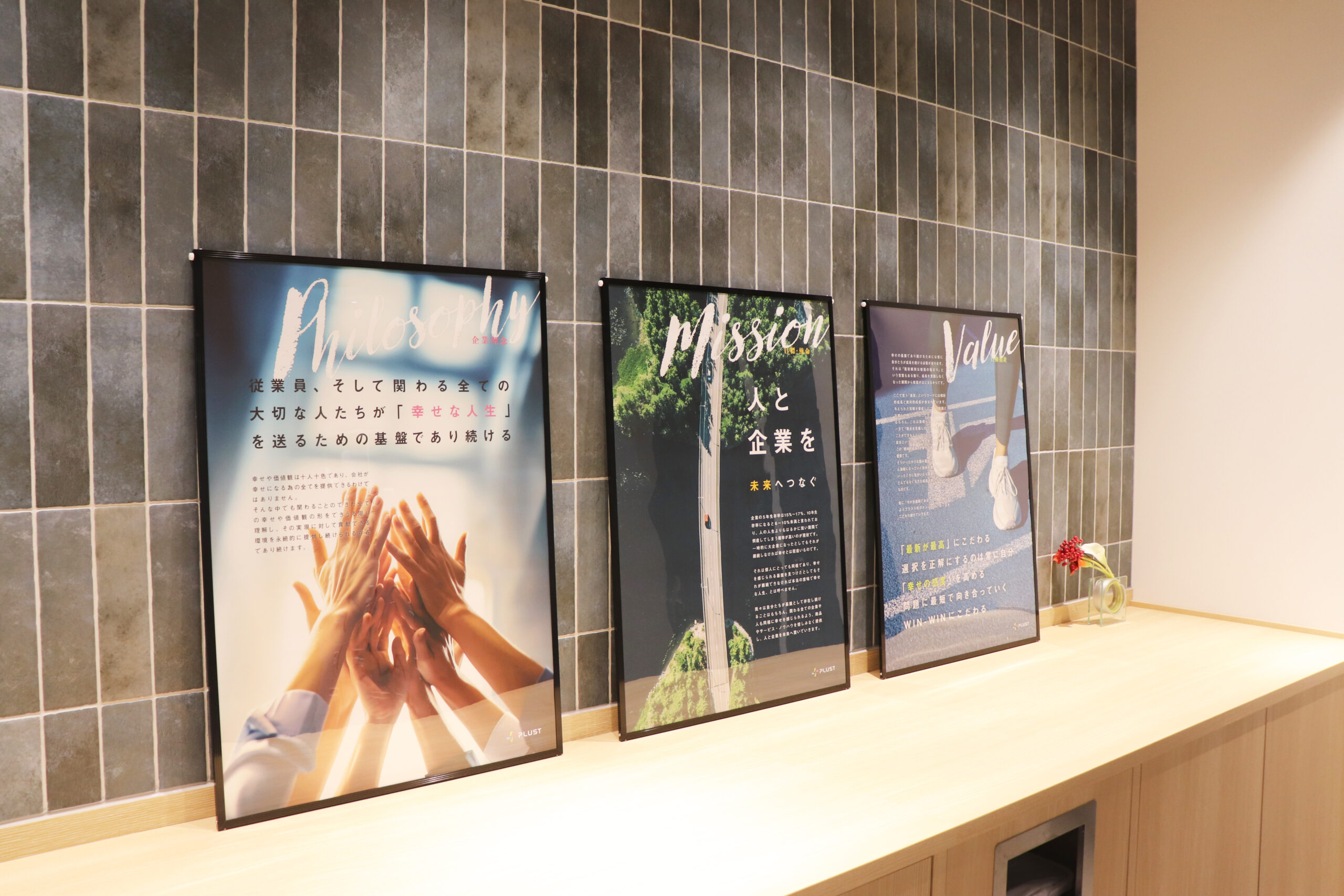
Moving on to the next question. The mission and values page on your website explains the origin of your company name, and it’s quite impressive. The circles of “PLan”, “Unique”, and “Solution” are all encompassed by the foundational circle of “Trust”. As your customer feedback suggests, it seems that all of Plust’s employees work to build a strong relationship of trust with your customers. Could you elaborate on this philosophy?

Yamashita:
“Plan” refers to a total commitment to providing plans aligned with the customer’s perspective. “Unique” means offering proposals to customers out of our own originality. “Solution” means solving the problems that customers face. By fully committing to these three initials—PLUS—we ultimately aim to win the “Trust” of our customers. That’s the full meaning behind our company name.

This has been the case since our establishment. Although I mentioned earlier that we were working every day without deeply internalizing it, our philosophy itself was actually always there. However, when trying to integrate those ideals into our daily operations, there was a large gap between the stated ideal and the reality on the ground at the time. I was a less mature manager then and couldn’t successfully connect the two.

Sugihara:
So the meaning of the company name was decided at the time of its founding. Have the mission and philosophy remained the same since then?

Yamashita:
The core foundation of our ideology hasn’t changed, but our mission, vision, values, and their verbalization were discussed and finalized over about six months, approximately three years ago, with Masaki and the heads of each division working together. To create something that could lead to the realization of our values, leaders from different roles gathered and created it, compiling it into a brand book.

When deciding on the values, we turned ideas like, “Everyone at Plust often uses this kind of language” or “This really feels like us” into written statements.

Masaki:
That’s right. Even if we had a vague doctrine in the beginning, no one was really looking at it or striving for it. But as the number of people grew, we realized that wasn’t sustainable. President Yamashita provided the opportunity, and we undertook a project to create our philosophy and mission.

We established these principles by asking “What are the things that Plust must value?” and “How can we maintain Plust as the foundation for everyone’s happiness?”, and then we made those our permanent motifs by preserving them in the form of a brand book.

Since our brand book was created, it’s become easier to convey our values to new recruits. We can show them the brand book and say, “This is what we aim for”, and communicate that we only want people who resonate with this to work at Plust. In terms of recruitment, we have people who apply because they saw our philosophy, mission, vision, and our five values and felt an affinity for them.

◆Local Area Sustained Support Project

Sugihara:
I can see the history of your extensive social contribution activities on your website, with a cumulative total of about 40 million yen. What was the thinking behind these donations and support activities?

Yamashita:
We call these activities our Local Area Sustained Support Project.

Now, this might not be the best way to say it, but the work that we do from day to day could be described as the “ultimate repetition”. It involves sales activities, carefully setting appointments, enthusiastically negotiating, providing solid support, and satisfying customers with website production.

However, I believe that if there is a greater cause, or if we can feel that the work we do every day is useful to society and contributes to someone’s happiness, we can approach the tasks at hand with a more earnest attitude. Also, emotionally speaking, doesn’t it feel good when someone thanks you for your work? While our contributions may be very small, we hope that through donations and activities, we feel we are helping those in need even a little bit.

That being said, our mindset is a little bit different from those involved in purely voluntary work, in the following sense. We feel good if we can make someone happy, even a little, but it wouldn’t be right if making that person happy meant reducing our business profits and effectiveness.

If we could generate solid profits and also contribute to the world at the same time, that would be pretty cool, since people usually assume you can only achieve one or the other. If you look at it that way, it makes sense for us to commit to doing both. We want to generate solid profits, give back to employees through their salaries, and contribute to society while growing the business. Then no one would be able to complain about our company, so we want to continue these types of activities as long as possible.

Sugihara:
That’s a wonderful plan. Now, onto the next question. You moved your head office in May this year, so what was the concept behind the design of the new office?

Yamashita:
This was a head office expansion and renovation within the same building, the first in 11 years. Since we have sales offices all over Japan, I wanted a space that truly felt like, “Now, this is where the headquarters are!” We discussed the interior design extensively with the contractors and paid close attention to every detail, not just because we wanted it to be stylish or cool, but because we wanted it to reflect our ideology and brand book.

We spoke with various contractors to create it, and because we plan to use it for a long time, we wanted an atmosphere that wasn’t overly flashy—a bright office with good energy that people would want to commute to. One that is calm and somehow exudes trust. We have to perform a lot of stressful tasks every day, so we wanted an environment that would offer our employees a moment of healing when they’re at our headquarters, facilitate brainstorming, and not become tiresome over time.

◆A Decision for the Sake of Growth

Sugihara:
Thank you. By the way, you decided to join D-POPS GROUP last fall. It’s easy to imagine that Plust, being such an excellent company, was receiving numerous M&A offers at the time. What was the main factor in your decision to join D-POPS GROUP from among those?

Yamashita:
I think it was ultimately President Goto. I met many other truly excellent people, including CEOs and executive members of publicly-listed companies, who would talk about how they wanted our group to be or what field they wanted us to be active in…but they rarely asked what I or Plust wanted to do.

I told Masaki this before, but as the founder who started the company, joining any group—even a large corporation—was not an easy decision for me. Furthermore, I felt that if I were to make that decision, it had to be a partnership that would genuinely lead to a brighter future for Plust and all the employees working in the company.

President Goto was the only one who focused on asking, “What do you want to do going forward, President Yamashita?” I was very pleased that he prioritized hearing my intentions first. I told him that I wanted to grow further as a manager, and I wanted the company to develop even more to realize its values. I then shared what I was thinking and what I anticipated our future challenges might be.

As we met several times and had meals together, President Goto told me, “We will continue to entrust the management of Plust to your leadership, President Yamashita. We intend for D-POPS GROUP to essentially be a cheerleading squad, supporting Plust’s development and the flying leap that you and your team are aiming for.” That statement was huge for me, and it gave me a strong vision of working together in the future.

Because of this, I was almost fully decided on moving forward with President Goto and D-POPS GROUP. Then, I went to dinner with Masaki, shared my thoughts on joining the group and my future plans, and he also agreed.

We informed our employees after September’s accounting was closed, so it was around October. We explained it in about seven phases.

Sugihara:
Senior Managing Director Masaki, what did you think when President Yamashita told you about joining the group?

Masaki:
When President Yamashita first told me about it, our company had been growing in size, and we were reaching a point where we had to consider how to continue for many more years on our own. President Yamashita was already contemplating various things. When he suddenly told me the plan, I recognized that joining this group was the optimal solution for resolving the various issues that would inevitably arise. I was convinced after hearing all the details.

Also, even up to now, whenever President Yamashita approves someone, or should I say is impressed by someone, they are generally wonderful people, so I trusted that this was not a mistake. At the time, I hadn’t met President Goto yet, but I wasn’t worried about that aspect at all.

Sugihara:
On the night of the signing day for joining the group, there was a charity party hosted by D-POPS GROUP’s Chairman Semmoto, and both you and President Yamashita attended, right?

Masaki:
That’s right. I was working at the Saitama office when I got a call telling me to come to Nihombashi immediately, ha ha. I left for Nihombashi right away, while wondering to myself whether it was really such an amazing party that I had to drop everything. When I arrived, every single one of the participants were truly remarkable people, and it was great to attend such a fantastic event and hear such valuable stories.
◆“Realizing a Venture Ecosystem”

Sugihara:
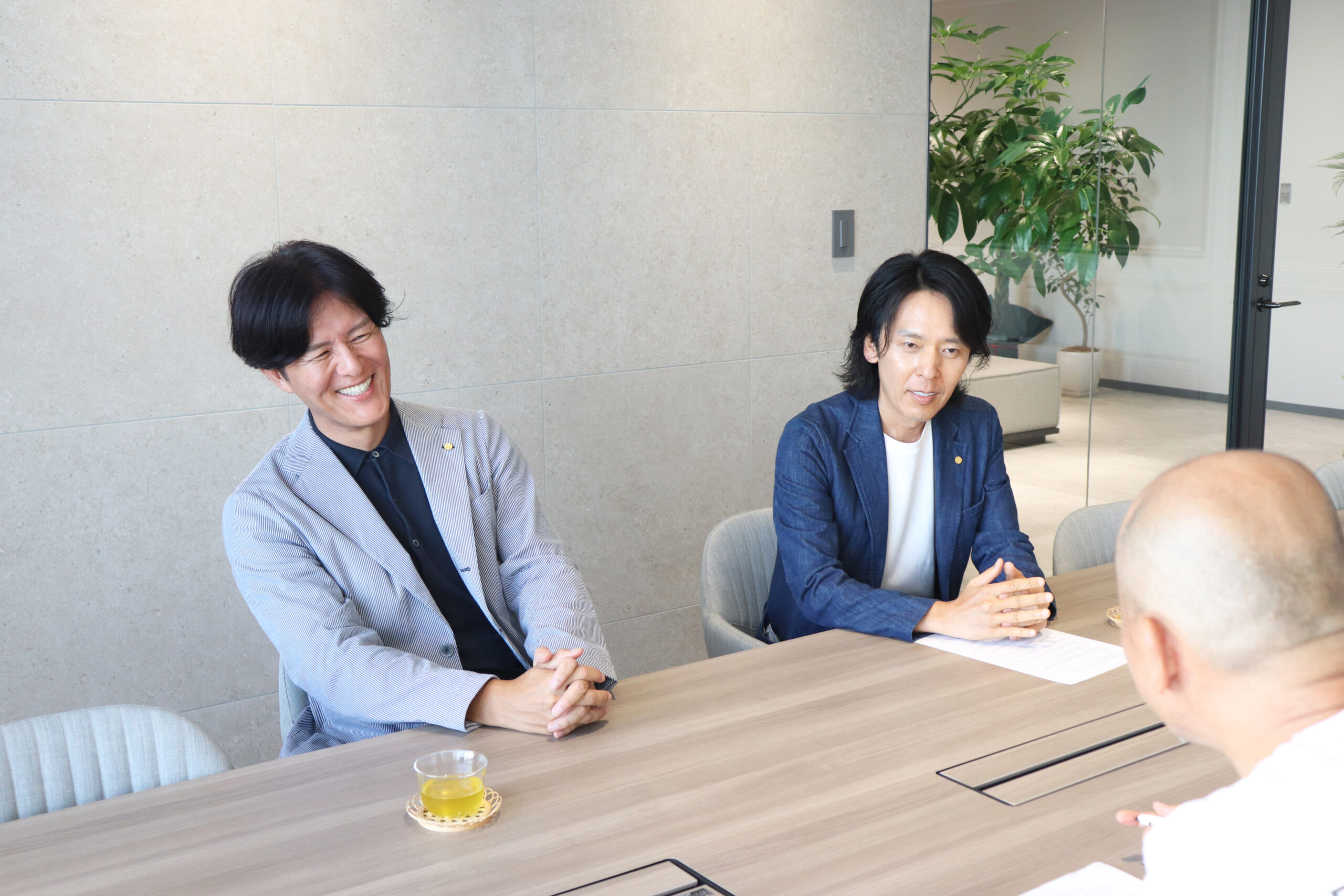
D-POPS GROUP’s aim is “realizing a Venture Ecosystem”. What parts of this goal do you resonate with? Do you have any shared mindsets or activities aimed at creating this Venture Ecosystem together?

Yamashita:
When it comes to Venture Ecosystems, Plust currently has three group companies, so we kind of have our own small-scale Venture Ecosystem. By working together on things, we are experiencing the generation of synergy that transcends the borders between divisions.

For example, our website support members sell security products (OA equipment), or we generate referrals when we encounter a company that wants to build a website. When I consider that such things are happening across divisional boundaries, I deeply resonate with the Venture Ecosystem that D-POPS GROUP is trying to create. Even just by having invoices that previously went externally now circulate within the group, money flows better, and we may even see the creation of new businesses. Even our own management team thinks that this system is a good way for our company to survive without collapsing.

◆5-Year Vision

Sugihara:
Thank you. What is your 5-year vision for Plust?

Yamashita:
In any case, we want to see, even more than today, people who are glad they work at Plust. I view sales as a means, not an end, so I honestly don’t have a strong focus on reaching a specific target for profit or business structures.

However, I’ve always paid special attention to the idea that both myself and everyone I work with must continue to embody our value of “newest is best”. Five years from now, rather than raising a glass over glorious memories from the past, saying “Those were the good old days” or “I was amazing back then”, I want us to have taken on lots of challenges, and piled up more failures as well, and then with more employees than before, say with a smile, “We, right now, are the best Plust has ever been!”

Sugihara:
Then, in order to reach this future where all your employees and stakeholders feel happy, what challenges and efforts do you think you’ll have?

Masaki:
In the same way that we’ve been running this company for the past 20 years, we don’t think too much about the future, and I mean that in a good sense. Our thinking is that we shouldn’t be focused on the past or the future, but on how things are right now, and if things now aren’t the best, that’s not acceptable.

So, I don’t think it’s good to look too far ahead, and we should definitely not dwell on the past. What we see today is the result of building up year by year, while being conscious of whether we are happy right now and whether this is the best we’ve ever been.

Obviously, as managers, we have to think about the next five years, but we don’t have many numerical targets. I can say one thing, though, which is that we want to continuously update our performance record every year as much as possible.

Yamashita:
Actually, there was a period when we created five-year and ten-year plans, but unexpected events like the Lehman Shock, the Great East Japan Earthquake, the COVID-19 pandemic, and the Noto Peninsula Earthquake kept occurring every few years, meaning plans didn’t go as intended. From that experience, I’ve come to feel over these 21 years that, although it’s not glamorous, dedicating ourselves to doing our best and building up day by day is ultimately the shortest path to a bright future.

◆Message to Readers Visiting Our Website

Sugihara:
Finally, could you each offer a closing message to the readers visiting our website?

Yamashita:
I will speak to entrepreneurs who might be considering joining our group. I think many founders like me, who have run their companies for years on their own, might have resistance to joining a group in the middle of leading their own companies. I also struggled internally with that same sense of reluctance, but D-POPS GROUP really allows me to continue leading my company.

In addition, they act like a cheerleading squad, supporting us strongly from behind, and aid in the growth of our company. So, if anyone is considering joining, I think it’s worth having a conversation. Also, when more excellent people join the group, it stimulates us, making things even more interesting. So, if fate brings us together, please don’t hesitate to reach out!

Masaki:
After joining D-POPS GROUP, they have such amazing leaders and advisors, so being able to receive valuable advice from them is an unprecedented benefit for us.


Interview conducted by D-POPS GROUP’s advisor Genta Sugihara.


PLUST.Co.,Ltd.

Company President and CEO: Tomoyoshi Yamashita
Address: 20F and 24F Meiji Yasuda Life Insurance Saitama Shintoshin Bldg., 11-2 Shintoshin, Chuo-ku, Saitama, Saitama-ken
Established: October 22, 2004
Website: https://www.plust.jp/


Related Articles

[Entrepreneur Interview #16] Tomoyoshi Yamashita and Jiro Masaki (Plust) – Part 1
“Newest is best!” Careful, Consistent Management for Continuous Record Growth D-POPS GROUP has 24 group companies that we call partners (at the time of publication). For this article, we interviewed Tomoyoshi Yamashita, the President and CEO of PLUST.Co.,Ltd. (Plust from here on)—which joined our group in September 2024—and Jiro Masaki, Plust’s Senior Managing Director. (This interview was conducted in July 2025.) ◆The Motivation for Founding a Company Sugihara: Thank you for agreeing to this interview, President Yamashita and Senior Managing Director Masaki! First I wanted to say, President Yamashita, I always notice your wonderful smile whenever we meet. I imagine being a business owner involves a lot of hardship. What I want to know is, are you constantly cheerful by nature, or have you already overcome so much difficulty that now you can be this sunny? Yamashita: Oh, you’re too kind! I have experienced countless difficulties, ha ha. Experiencing various difficulties is just my normal mode. When I founded my company, there were times when I looked quite stern. I think I unconsciously wore an unhappy look when our sales weren’t growing or when there were issues with management. However, I feel like I was consciously trying to smile and be cheerful. Sugihara: Senior Managing Director Masaki, you’ve been with President Yamashita since before the company even existed. What is your perspective? Masaki: Recently, as the number of employees—including women—has increased, his way of communicating with the entire organization has changed from the past. However, in meetings attended by our executive members, he is still as strict as ever. He delivers that strictness with love, and that combination is something we executives are completely aware of. Sugihara: I guess since my relationship with President Yamashita is still relatively new, I have no idea what his stern face looks like! Now, let’s move on to the main topic. First, could you tell us what motivated you to found Plust? Yamashita: I had always wanted to be a CEO someday, but at the time, I lacked the courage and the drive, and honestly, I didn’t even know how to become one. So, after graduating high school, I spent four years in the Air Self-Defense Force, and then I worked as an employee at an IT startup company. That’s where I met Senior Managing Director Masaki. While I was entrusted with responsibilities such as the OA equipment business at my previous job, I gained experience as a salesperson, a manager, an office head, and I helped establish a new business office on two separate occasions. This gradually gave me the feeling that I was essentially managing a small company by myself. I started thinking if this was the case, I probably could run my own business, so I decided that the time had come to put my vague dream from the past of becoming a CEO into motion, and I started it alone in my own home. For the first six months, I worked as a sole proprietor with a company that was wholesaling OA equipment, and I was allowed to operate under the name of their business office. After that, I registered my company and created Plust Limited Company. Since I had established business offices twice in Saitama Prefecture (in the cities of Warabi and Omiya) at my previous job, I was familiar with the area, so I decided to found my company in Saitama. ◆How the Two Met Each Other Sugihara: How exactly did you meet Senior Managing Director Masaki? Yamashita: Well, we met at our previous company, when I interviewed him. After he joined the company, Masaki was placed in a slightly different location from mine, but he was consistently at the top of our sales rankings. At some point after his interview, we started working more closely together, and as I got a sense of his personality, we became quite good friends. After that, we became separated again while I established the business offices in Saitama and he continued working in Tokyo, but when I was moved back to Tokyo, we started working together once more. At that time, we were in the positions of office head and manager, and we began to discuss deeper topics than we did when we were just salespeople. At some point, a mutual acquaintance of ours separately invited both of us to start a company together. I was to be a board member, and Masaki was to be a salesperson. However, the person who invited us requested, “Don’t tell anyone else about this”, so neither of us brought it up in conversation with each other. But then I realized that this person must have invited Masaki too, so I finally asked him about it. At that moment, Masaki asked me, “Are you going to do it?” and I replied, “No, I’m not. I’m going to start my own business.” Then he said, “Why don’t we do it together?”, and that’s how the two of us decided to launch a company. To be totally precise, the first person to join me was Ono, who was a subordinate from our previous company and is now a Division Manager and executive officer at Plust, but Masaki did join us a year later. Sugihara: That was a fateful fork in the road. Senior Managing Director Masaki, when President Yamashita invited you to start a company, did you make an immediate decision, even though the future was completely uncertain? Masaki: Actually, since he was my boss and I was working under him, I was the one who said, “You should definitely go for it and start a company!” Our previous company was a really intense sales company that was growing rapidly, but I felt that President Yamashita, with his sense of cleverness that was no different from now, stood out from all the pushy salespeople there. He also had accomplished some considerable achievements as a manager, so I really wanted to work with him. Sugihara: From your perspective, what was your impression of President Yamashita at the time when you first met him? Masaki: As I mentioned, our initial meeting was at my job interview. I think I was in my late 20s when I went for the interview at our previous company. I naturally assumed that my interviewer would be someone of the usual age for conducting a job interview, but then I saw President Yamashita. I believe he was in his early 20s at the time. His hair was longer than it is now, he was tanned, and he gave off a very high-energy vibe, ha ha. ◆The Journey So Far Sugihara: Counting from your company’s founding in 2004, this is your 22nd term (your 21st term was considered a non-standard 5-month period due to a change in the fiscal year end to February) of operations. What have the months and days been like until now? Yamashita: Ahhh, it’s been full of ups and downs. Not even once has there been a period of stability. But the time has certainly flown by. Looking back, I think it’s been pretty interesting overall. Sugihara: But if you look at the management indicators, you seem to have had plenty of stability and growth. Yamashita: It might appear that way at first glance, but the number of failures has been overwhelmingly greater than our successes, and I was fortunate enough to have been helped by various people, which is how we managed to get by. I truly feel that we were lucky. I don’t particularly feel that I’ve worked that hard, either. Aren’t I just doing the minimum that is expected of me? But I guess I’ve always done what was necessary for the company, with an attitude of “That’s something a CEO would do”, or “I’m not just an employee, I’m the founder of this business, so I have to do it”. In the beginning, it might look like sales were increasing, but for several years, even though our sales were increasing, it was only by tens of millions of yen. If we fumbled our sales for even one month, we would fall below the previous year’s numbers. Initially, I didn’t have a clear vision. It was only about earning money, earning more than I did as an employee, or achieving success. If anyone were to ask me if I had a mission to contribute to society at that time, I would have to be honest, I definitely didn’t think about it as deeply as I do now. I was much more concerned about how to generate profit or how to increase the number of contracts. I was diligently working hard on various things every day, but I was living a stoic life with no vision, working from morning until late at night with few days off, until you could say I had hit my limit. So, while the beginning might look like a steady climb, things were actually very tight. You know, I think the catalyst for the company getting on track was actually the Great East Japan Earthquake in 2011. Until then, our main focus had simply been to increase orders and future profit, but suddenly, we couldn’t properly do the work right in front of us. There were times when we had planned power outages, so there was no electricity. Or times when there was no internet, so web designers couldn’t work. Of course, telemarketing was impossible. After desperately thinking about what we should do, we tried cold-calling, we bought generators faster than the government, somehow connected them, and worked in rooms smelling of gasoline. We experienced what it was like to just have to survive. Not only that, but I started wishing we could do something for the people who were struggling because of the earthquake. Initially, we provided condolence money for the families of our employees and donated to the Great East Japan Earthquake relief fund. My desire to contribute to society began to sprout from doing those things. In addition to that, after we started setting clear numerical targets for the year at the beginning of each new year, it became a mission or a target that we had to surpass, and with everyone’s cooperation, we achieved it. I decided to keep setting goals like that, and as a result, we surpassed the previous year every year. It was also significant that we formed a habit of sharing our objectives with the whole company. Sugihara: That’s wonderful. So, by continuously building on each previous year’s results and aiming for even a one-yen increase, you’ve been able to keep going for 20 years. Yamashita: That's right. In the book Good to Great, there’s a reference to some people getting on a bus, others getting off, and still others getting on at the next stop. We kept repeating this, and at first, there was no destination, but gradually it became, “It looks like fun if we go this way”, or “This might work”. During that process, the people on the bus gradually changed, though some people stayed the same, naturally. By accumulating those efforts, we reached our 22nd term, and what we are thinking about and doing now has evolved from that pattern. ◆Company Overview and Business Strengths Sugihara: Now, could you please tell us about Plust’s current business and its differences or unique features compared to other companies in that field, which have allowed it to grow continuously for 21 terms? Yamashita: Sure. We have three main business pillars. The first is the sale and maintenance of OA equipment, which we’ve done since our establishment. The second pillar is website production and operation support for small and medium-sized businesses. The third pillar is the sale and support of a customer relationship management (CRM) system linked to an application. These are our three business areas. Sugihara: What are the strengths of Plust’s business? Yamashita: Though I may be biased, I believe it’s our support capabilities for our customers, which are on par with our ability to make brilliant propositions during business negotiations. We have a support system that focuses on building a long-term relationship, rather than stopping once a sale has been concluded. Since few companies go to that extent, we focus on customers who feel secure in using our services consistently and those who become repeat customers. This connects back to what I mentioned earlier. When we first started, the goal was simply to sell, sell, sell, as much as possible…but we realized that wouldn’t sustain us. We understood that we needed to provide solid support after the sale and maintain longer relationships, or we would be eliminated. Sugihara: Customer support is an often-overlooked area, yet you deliberately focus on it. How do you instill this mindset in your support team staff? Yamashita: It’s true that customer support is a job where performance is not as easily visible as it is for a salesperson. But if support team staff lose motivation just because they aren’t in the spotlight, customer satisfaction won’t increase. So, I thought about how to put the support team in the spotlight, and I figured that if our company’s customer support was solid, our salespeople would find it easier to close more deals with customers. What we came up with and put into action was a means to get raw feedback directly from customers. We feature customer interviews on our website and even create videos of customer testimonials. When our employees see this, they realize things like, “Ah, this was the work of our support team” or “If they are doing this, our company is definitely better than others”. I felt that pointing out the company members who tirelessly support our customers behind the scenes would not be a negative at all, it would be a positive. Sugihara: Ah, so that’s how your website became like that. By the way, you mentioned having three business pillars. What was the catalyst for developing those three pillars? Yamashita: All three of those pillars are, in a sense, things that have helped us in running our company. In the early days after our establishment, we naturally used business phones, multifunction printers, and other OA equipment in our own company, and getting the best OA equipment available made it much easier to do our work. And the website is what we use to let more clients, customers, and job seekers know about the unknown company called Plust. In fact, over 95% of our employees joined the company after seeing our website. If we hadn’t invested in our website, we wouldn’t have been able to meet everyone we have now. The app is slightly different, but in terms of our CRM system, we’ve seen first-hand that if we hadn’t properly used a CRM system, including during the earthquake, our sales would not have grown at that time. It’s something that saved us and allowed our company to survive. We have a strong desire to offer the products and services that saved our business to all the executives out there who are diligently working on their management every day. As a result, instead of general households, we target business operators as much as possible. We want to do business that helps those operators while also increasing our own performance. I believe this is mutually beneficial. Sugihara: You’ve become a large company now, but you originally started from a small home office. You adopted the necessary products yourself as a small-to-medium enterprise, and then in turn, expanded your business into selling those same products to your customers. Yamashita: That’s right. As we primarily sold OA equipment, mainly business phones, our customer base grew steadily. However, there was a very tough period for OA equipment as well. The leasing of business phones became a social issue, making it impossible to sell through TV and newspapers, and leasing companies withdrew. At that time, we received requests from several customers asking, “Do you make websites?” We realized there was a strong need for websites, and we decided to launch a website business for small and medium-sized enterprises. And as the number of customers grew, we recognized the importance of getting our customers to come back again and again, and we started thinking about other methods of customer management besides websites. Back then, in the days before apps, we started with email systems linked to customer management, like newsletters. As times changed, that kind of system turned into apps, and now we also have a business for store-based apps. The products we handle change with the times, but we want to provide services and products that can help our customers’ companies grow or solve the problems they face. Sugihara: So that’s the process by which you’ve developed your businesses. Speaking of which, you have contracts with 6,000 corporate customers nationwide, and you offer a diverse range of services. Could you share some of the innovations you’ve made in your sales, marketing, and customer support systems? Masaki: I think it’s about being attentive, consistent, and meticulously keeping in touch with them. There are still things we need to improve, but the sales, marketing, and customer support teams try to check in on the current situation with customers, even if it’s just a phone call to see what they might need.   ~To be continued in Part 2~   Interview conducted by D-POPS GROUP’s advisor Genta Sugihara.   PLUST.Co.,Ltd. Company President and CEO: Tomoyoshi Yamashita Address: 20F and 24F Meiji Yasuda Life Insurance Saitama Shintoshin Bldg., 11-2 Shintoshin, Chuo-ku, Saitama, Saitama-ken Established: October 22, 2004 Website: https://www.plust.jp/   Next, in the latter part of the interview, we discuss: ・Case study interview videos ・Origin of the company name ・“Realizing a Venture Ecosystem” ・5-year vision ・And other topics Be sure to check it out here: https://d-pops-group.co.jp/en/column/plust-interview-latter-part/
  • Group Companies
  • Interview
2025.09.17
[Venture Ecosystem Case Study] CRM System Development and Customer Engagement
D-POPS Corp. (D-POPS from here on) (page in Japanese only) has utilized our Venture Ecosystem to develop a structure for managing customer relationships as they strive to closely attune their shops to customer needs. Through joint development with two other companies in our group, they were able to solve major challenges that they could not resolve on their own. This article summarizes the challenges D-POPS faced and how they used the Venture Ecosystem to reach a solution. 1. Challenges Faced by Mobile Phone Retail Agencies Mobile phone retail agencies play a crucial role as a point of contact for consumers to sign contracts with mobile carriers and purchase devices, but in recent years, they have faced various challenges. ① Low Profitability and Intense Competition The market penetration for mobile phones in Japan is extraordinarily high, making it difficult to acquire new contracts. As the market is saturated, a significant increase in the number of contracts is unlikely. Furthermore, reductions in communication fees, a decrease in sales incentives, the strengthening of online sales by each carrier, and the spread of MVNOs (low-cost SIMs) have led to a shift toward low-priced plans. All of these are contributing factors to the decline in profitability for retail agencies. ② Product Complexity and Customer Service Difficulty The rate plans of each mobile carrier are extremely diverse, making it difficult to understand all plans and propose the optimal one to the customer. Especially for users with low technological literacy, such as the elderly, procedures for plan changes and carrier transfers can seem complicated and difficult, which makes it necessary to offer thorough guidance. Furthermore, continuous support is required not just for securing new contracts but also for increasing customer satisfaction. ③ Challenges Related to Human Resources Customer service operations in our mobile shops require complex product knowledge and customer service skills, so securing and training personnel is an urgent matter. Moreover, due to regular staff transfers, information relating to contracted customers is also hard to manage accurately, which has occasionally led to disputes arising from multiple personnel telling the same customer different things. ④ Analog Shop Operations While online procedures and support are increasing across mobile carriers, D-POPS has operated its “Smartphone Consultation Desk TOP1” (page in Japanese only) shops using analog methods. For example, the only ways to make a shop reservation were by phone or by walking in, and there was no digital system for recording customer inquiries, which were instead handwritten on paper. ⑤ Customer Information Belonging to Mobile Carriers When a mobile phone retail agency processes a customer contract with a mobile carrier, the customer’s information is handled using dedicated equipment provided by that carrier. Consequently, customer information belongs to the mobile carrier, requiring retail agencies to prepare their own systems, i.e., CRM (customer relationship management), to offer unique services. In response to these challenges, mobile phone retail agencies have had to shift their role from simple sales outlets to local service hubs and specialized inquiry counters.   A wall of devices offered through contracts with various mobile carriers, inside a Smartphone Consultation Desk TOP1 shop. 2. The Need to Utilize CRM to Turn Customers into Supporters Based on the challenges above, we hypothesized that operating physical mobile phone retail shops would require the following: ① Combining CRM and “Empathetic Customer Service” to Turn Customers into Supporters Our motto for customer service is “Empathetic Customer Service”. We recognize how crucial it is to build a genuine connection with our customers beyond just hearing their needs. Through a solid grasp of each customer’s interactions, preferences, and product usage history, we utilize CRM to ensure they become lifelong fans of Smartphone Consultation Desk TOP1. ② Optimization through DX (Digital Transformation) from Analog As DX progresses in the world, it also becomes necessary for our company to adopt digitalization and seamless integration for processes like registering visit appointments and managing customer information in order to better align with our users’ needs. ③ Easy-to-Understand Explanations of Fees and Services Only Possible at a Physical Shop Smartphone Consultation Desk TOP1 is a real location where a customer can receive neutral and fair guidance regarding multiple mobile carriers. Therefore, we need to compare the carriers and propose the plans and services that are perfect for that customer. ④ Differentiation from Specialty Stores through “Smartphone Usage Support” “Smartphone Usage Support”, a unique service provided by D-POPS, offers guidance for smartphone operations, settings, etc., regardless of the mobile carrier, device, or type of service. Although each mobile carrier offers similar services, they usually only offer them to their own customers. Since we handle multiple carriers, it is essential to utilize our unique service to differentiate ourselves from those carriers’ individual specialty stores. Despite forming these hypotheses and having an IT department established in August 2020 with members who had system development experience in other industries, at first D-POPS members did not have very high technological literacy, and we lacked real know-how regarding system development and CRM. 3. CRM System Development and Utilization of Customer Information To move forward with the above hypotheses, we developed a strategy that utilized our Venture Ecosystem. To develop a CRM system and allow us to utilize our customer information in-house, we sought cooperation from other companies within our group and formulated the following tactics: ① Effectively Manage Customer Information through CRM System Development Develop a CRM system that supports all carriers that can be contracted at Smartphone Consultation Desk TOP1. This system would not only manage customer information but also centralize appointment booking data, instructions, documentation, and paper trails, providing an environment that enables smooth customer service. ② Systematize Mobile Carrier Comparison through Sales Manual Setup Introduce a digital sales manual that allows comparison of rate plans and services of each mobile carrier. This is essential to flexibly respond to changes, such as rate plan revisions and service additions by carriers, and to help customers arrive at the optimal plan for them. ③ Improve Customer Engagement through CRM Data Utilization Identify customers whose fees may increase after a certain period due to the discounted rate plans they received upon contract, or those who should review their plans soon because of expected fee revisions. Furthermore, continuous support must be provided to ensure customers always have the optimal plan—not just at the time of contract—creating an environment where they always want to visit our shops to enjoy those services. Based on the above strategies, we proceeded with the development of a CRM system in cooperation with our fellow group companies Techbeans inc. and @SOLUTION (pages in Japanese only). 4. From Appointment Booking Development to CRM Development and Sales Manual Operation Based on the challenges, hypotheses, and strategies outlined above, we advanced the following development and operations over the course of four years or so. ① Development of the Appointment Booking System (Released August 2021) First, we began the development of our appointment booking system in cooperation with Techbeans, and in August 2021, we released the CRM system “DAMO” and the “Appointment Booking Management” feature. Until then, reservations were only possible in-store or by phone, but by posting on our corporate website and GBP (Google Business Profile), we created an environment that encourages online reservations. ② Sales Manual Implementation and Operation (Released March 2023) Next, we introduced our digital sales manual, which serves as an explanatory tool for guiding customers to the optimal mobile carrier and rate plan. First, through discussions with shop members and managers, we identified the flow of customer guidance and created a base flow that is easy for customers to understand. Then, we created a comparison-based explanation tool by including price lists and images within each section, allowing customers to compare and choose. We continue to refine this sales manual daily to make it more intuitive and easier for even new staff to use. ③ CRM System Development (Released October 2023) Following the appointment booking system, we released the “Interview Sheet (Usage Status)”, “Customer Record (Carrier Contract Status)”, “Negotiation Notes (Correspondence History)”, and “Outbound Call Record” functions in October 2023, in cooperation with Techbeans. Furthermore, we released the “Negotiation Result (Contract Information)” function in March 2024, in cooperation with @SOLUTION. These products have consolidated information about what services that customers have used, their contract status with each mobile carrier, and the content of their contracts and correspondence with our shops. ④ Systematization of CRM Data Entry and Data Utilization The above releases enabled the centralization of customer usage status, contract status with each mobile carrier, and the contracts and correspondence with our shops. However, it became a challenge for our employees to adopt these new operational methods and input procedures. So, we created an operations manual summarizing this new flow, and we continue to aggregate and distribute data every week to find the optimal solution for customer guidance and communicate it to our employees.   A page from the digital sales manual developed for D-POPS customer service personnel 5. Over 50,000 Customers Served: Seamless Integration from Appointment Booking to In-Shop Service Since the release of our appointment booking function in August 2021, the number of our customers officially surpassed 50,000 as of the end of May 2025. Furthermore, we seamlessly integrated the entire experience from appointment booking to in-store guidance, allowing us to form a document trail automatically, by means of accurately recording customer requests and usage status. Now, within the utilization of the CRM system, new challenges have emerged. ① Adoption of CRM Objectives and Operations While a convenient system has been released, there have been some difficulties in breaking away from old methods. Also, variations in operational flow among different staff members mean that educating on the purpose of CRM management and standardizing operational procedures has become our next important issue to address. ② Application of Customer Information Another significant future assignment for us is how to take full advantage of the customer information that we have gathered in order to guide customers to the best solutions for them. 6. Summary: Possibilities through Utilizing the Venture Ecosystem This article summarized how we tackled CRM development and creating shops that are more attuned to customer needs through leveraging the Venture Ecosystem. This initiative led to a path for solving problems that D-POPS had long recognized but found difficult to solve due to a lack of internal resources. The members of D-POPS GROUP’s Venture Ecosystem enabled some of these developments to progress in only a few months, reaffirming the innate strength of the Venture Ecosystem. Furthermore, we realized the benefit of an environment that emphasizes collaboration with group companies and the need for continuous improvement both at the start of cooperation and during day-to-day operations. D-POPS Corp. will continue to utilize the infinite possibilities of the Venture Ecosystem to create shops that embody empathetic customer service and an environment where customers become enthusiastic fans of Smartphone Consultation Desk TOP1. D-POPS Corp. Sales Division, Sales Planning Dept./Media Sales Dept. Manager Kana Ishii D-POPS Corp. Company President and CEO: Shoto Masuda Address: Shibuya Hikarie Bldg. 32F, 2-21-1 Shibuya, Shibuya-ku, Tokyo Established: February 1998 Website: https://d-pops.co.jp/
  • Group Companies
2025.08.13
[Entrepreneur Interview #15] Hirai (PlusPass) – Part 2
A New Challenge After 10 Years! Making an Enterprise That Can Help Improve Digital Literacy D-POPS GROUP has 24 group companies that we call partners (at the time of publication). For this article, we interviewed Yuta Hirai, the president and CEO of PlusPass, which was established as a part of D-POPS GROUP in March 2024. This is the latter part of the interview. To read the first part, click the link below. https://d-pops-group.co.jp/en/column/pluspass-interview-first-part/ ◆Initiatives Since the Establishment of PlusPass Sugihara: About one year has passed since you took over Smappy (page in Japanese only). Could you tell us about any unique ideas you came up with or changes you implemented after the business was transferred to you? Have you collaborated with other group companies? Hirai: D-POPS seems to be focused more on real-world business, where we interact face-to-face with our customers who come to our shops in person and, in a sense, support the improvement of their IT literacy while they are consulting with us. However, on the inside, I believe D-POPS is a human resource development company. I’ve also been thinking about the future of Smappy recently, and what I currently believe is that we want to become a company that can provide support by uniting people and digital technology. Since Smappy is close to the digital domain, I want us to properly execute this idea within the telecommunications industry. To consider societal issues, there is the problem of labor shortages, but I believe the reality is that there are plenty of people, but—to be quite frank—most of them just aren’t the kind of person that companies are looking to employ or recruit, so many of those people are failing to get jobs. The important thing to recognize is that when skills or knowledge are lacking or whatever, this can be solved through education. So, I ultimately want PlusPass to become a company that can support people in becoming more digitally literate. As far as collaboration with group companies, PlusPass owes a lot to President Nishikawa of @Solution. He has helped us, not only with the business itself but also with infrastructure migration, so much that I feel like I need to find a way to repay him. We are starting collaborations with various other group companies as well, and we have various projects planned that will be launched soon. Sugihara: Earlier, you mentioned that the “ultimate goal of Smappy is to enable users to choose the mobile plan that is perfect for them.” It’s great that your goal is for people to be able to learn about new areas themselves so they can become the kind of digital talent that society needs. To achieve this, I imagine you will need more content and mechanisms for people to be able to learn and gain knowledge. What sort of initiatives do you have for that? Hirai: Actually, we are gradually scouting out the territory of AI. The range for implementing AI in the Smappy business is wide, and if people become capable of using it, their individual productivity will increase significantly, so I want us to be able to provide education in the AI field as well. We have also started increasing our article content. We are filling out our content by both creating new articles and progressing with the rewriting of existing ones. ◆Growth Strategy Sugihara: Can you share PlusPass’s long-term growth strategy? Hirai: It is similar to what I mentioned before, but I consider Smappy to be merely the catalyst for launching the company. That is not to say that the business we acquired is flawed; rather, I believe it is a business that can be further refined, so I want to build it up properly and create a structure that is suitable for the current era. Essentially, I want to create a high-productivity company. As for future developments, as I also stated, I want to realize a company that contributes to the improvement of Japanese digital literacy by connecting people with digital technology. I have lived more in the real-world side of business, so I want to create an organizational structure that can effectively contribute to clients while maintaining a real-world business strategy. Sugihara: What kind of organization do you want to build, and with what kind of people? Hirai: It’s still a bit abstract, but one thing I want to have is a place for people to venture into new territories and grow, and I want to support that growth. So, first of all, I want to recruit people who have an eagerness to grow. Also, I want people who have been helped out by our services and products to be able to give back to the next generation and beyond, so I want to hire people who believe their personal growth contributes to society and others. In terms of skills, I prefer people who have an open mind toward new things. I want to actively work with people who can approach things with a positive attitude and simply say, “We’re going to use AI now” or “We’re going to try using a new tool”. Ultimately, I want to create an environment similar to D-POPS. Even if complete amateurs with no experience join PlusPass, they will quickly acquire skills and become capable of admirable performance. ◆Adventures and Mountain Climbing Sugihara: Thank you for those answers. Changing the subject, I heard that you climb mountains as a hobby. In fact, I also enjoy mountain climbing! Now, can you tell us more about your hobbies? Hirai: I’m so glad you asked, because I also wanted to talk about mountain climbing with you, ha ha! I got really into climbing as a university student. Since I was in the Kansai region at the time, I climbed mountains like Mt. Ibuki in Shiga Prefecture and Odaigahara on the border of Nara and Mie Prefectures. Then, looking up to Mt. Fuji, I started looking for and climbing mountains that were also around 3,000 meters high. My memory of mountain climbing is connected to the story that I mentioned earlier, about cycling the length of Japan with a close friend of mine. In the middle of that journey, I got scheduled for a training session for new hires, so I suddenly had to get from Wakkanai in Hokkaido to Tokyo in two weeks. So, I started at Cape Soya, took a boat from Hakodate to Oma, and since the Great East Japan Earthquake had occurred one year prior, I detoured around Minamisanriku and went from Sendai to Tokyo. I somehow managed to arrive in time for the new hire training, which turned out to be a climb of Mt. Fuji! I was really looking forward to the climb, but it was suddenly canceled that day due to a typhoon. I was incredibly disappointed. I had been cycling across Japan with the firm intention of climbing the country’s highest mountain, so after the new hire training, I rode my bicycle straight to Yamanashi. People usually take a bus or car to the 5th station of Mt. Fuji and climb from there, but since we weren’t supposed to get into any vehicles during our cross-Japan bike ride, we had to park our bicycles at the bottom of the mountain and climb up. We climbed the mountain, stayed at the 8th station, and then reached the summit. That was my first serious climb over 3,000 meters. After that, I got hooked on high mountains. I’ve probably climbed Mt. Fuji about three times, and then I climbed the Japanese Alps in Nagano. After that, I went a little crazy and started going for more thrilling mountains, ha ha. Since joining D-POPS, I’ve taken many of my junior colleagues with me. The first time I decided to go climbing with my junior colleagues in the business division was because I noticed some of them were mentally struggling, and I thought about what I could do to give a push to the ones who had the potential to grow. One thing was to create learning opportunities by visiting new commercial properties together on my days off, which President Goto often did for me. The other was to take a mental break through mountain climbing. After teaching them various things while climbing together, many of them started to gain a clearer perspective. Going back to the trip across Japan, we did manage to complete the journey from Wakkanai to Okinawa. We mostly slept outdoors; the only times we slept indoors were at each other’s parents’ or grandparents’ houses a few times along the way. Sugihara: Both the mountain climbing and the cross-Japan journey sound incredibly active, ha ha. Have you been riding your bike for a while? Hirai: Originally, in high school, I usually rode my bike about 30 minutes between home and school. For soccer practice matches, we went to a lot of places, and the high school gave us the option of taking the bus or meeting at the venue. Since junior high, as part of my training, I had always cycled for up to one and a half hours to reach some match venues, so I also rode my bike to high school practice matches. I would even cycle two to three hours to reach those places. The reason I wanted to cycle the length of Japan was my study abroad experience. When I joined a homestay study abroad program in Canada, I realized I didn’t understand the island of Japan at all. I usually traveled to different regions by train or plane, but I wondered what it would look like if I saw it properly, and that was what got me started. ◆“Realizing a Venture Ecosystem” Sugihara: People who enjoy adventurous travel and climbing hard mountains are definitely well-suited for working at startups. Now, D-POPS GROUP aims to “realize a Venture Ecosystem”. What parts of this goal resonate with you? Do you have any activities that reflect your commitment to building this Venture Ecosystem? Hirai: If you’re asking me whether I’m confident that I can contribute to the Venture Ecosystem right now, I would have to say I still have a long way to go. However, President Goto has had a great influence on me, and as someone who wants to take up his philosophy, I’m always thinking about how to make PlusPass—as well as D-POPS—a company that can truly contribute to the Venture Ecosystem. Also, of course President Goto teaches us about business, but the core of his teaching is about people. So, I feel I must always strive to improve my character and contribute to the people of the world. Therefore, what I can do now is—for example—connect agencies or PlusPass’s clients to the resources available in the Venture Ecosystem, or conversely, introduce the members of the Venture Ecosystem to beneficial projects. In every business negotiation, and whenever I meet a new client, I always keep the following question in mind: “What will benefit this person?” At that time, I build a relationship with the client while having a comprehensive understanding of not only D-POPS and PlusPass but also all the products and services inside of D-POPS GROUP. After I attended an investment company briefing as a member of the Venture Ecosystem, I strongly felt that I needed to learn more about our group companies and investment companies, so that has become a personal challenge to myself. So, I want to proactively study our partners in the Venture Ecosystem and become able to contribute more. ◆5-Year Vision Sugihara: What is your 5-year vision for yourself and for PlusPass? Hirai: I want to fully promote the Smappy business and complete the plans I have for it right now. The other thing I need to increase the resolution on is the policy I mentioned earlier—contributing to society by bringing together people and digital technology—which will mean creating new aspects of our business. To advance this new kind of business, I want to hire people, form the structure, and then drive the business forward. Sugihara: What challenges do you face in achieving that? Hirai: There are two main challenges: solidifying the resolution of our strategy and firmly increasing the investable profit based on the existing business. I believe we cannot move forward without achieving these two points, so I will focus on them first. ◆Message to Readers Visiting Our Website Sugihara: Finally, could you offer a closing message to the readers visiting our website? Hirai: To new graduates and anyone interested in our Venture Ecosystem: D-POPS GROUP, led by President Goto, is truly trying to create a business entity unlike any other, and it is completely different from the parent companies of typical conglomerates. I think the organization is incredibly unique. I think you’ll come to understand this if you join D-POPS GROUP, but there is a significant emphasis on individual discretion here, so I feel there are virtually no disadvantages to coming under our umbrella. If there is anyone who wants to join D-POPS GROUP in the spirit of taking on a challenge, I would like to contribute to the growth of our Venture Ecosystem with you, and in fact, I hope to learn a great deal from you. To new graduates, I truly feel that my 10 years here have been worthwhile. Many people might judge a company over a short period, like three years, but the experience of receiving strict guidance for an entire decade has truly become a part of me. I believe you will definitely experience first-hand how worthwhile it is to be part of a company for more than the typical three to five years, so I hope people who are willing to put in that amount of effort will join us.   Interview conducted by D-POPS GROUP’s advisor Genta Sugihara.   PlusPass President & CEO: Yuta Hirai Address: 32F Shibuya Hikarie, 2-21-1 Shibuya, Shibuya-ku, Tokyo Established: March 1, 2024 Website: https://plus-pass.com/
  • Group Companies
  • Interview
2025.07.08
Back to COLUMN