

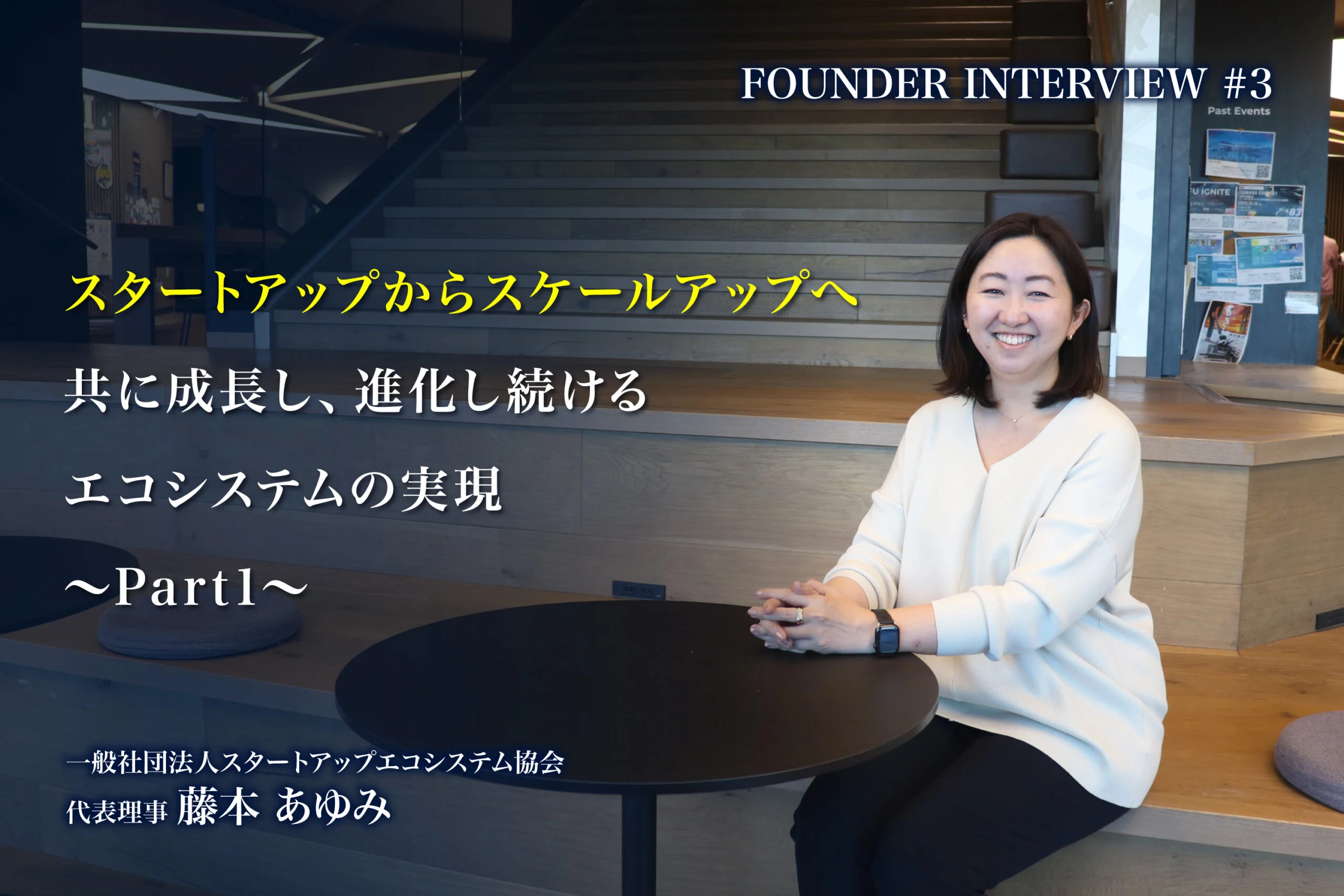
From Startup to Scale-up:
Mutual Growth and Realization of an Advancing Ecosystem
D-POPS GROUP is engaged in a wide range of initiatives to support the evolution of Japan’s Venture Ecosystem.
For this article, we interviewed the Startup Ecosystem Association’s President Ayumi Fujimoto, a leader who shares our vision for Japan’s entrepreneurial future. (This interview was conducted in January 2026.)
In Part 1 of this three-part series, we jump into the story behind the association’s founding and the urgent challenges facing startups revealed by their field research. In fact, these issues often prove more crucial than raising funds.
◆The Origin Story: A Three-Year Vision and a Public "Declaration"
Sugihara:
Thank you for agreeing to this interview, Ms. Fujimoto. In March 2022, you founded the Startup Ecosystem Association, an organization whose mission closely aligns with D-POPS GROUP’s goal of realizing a thriving Venture Ecosystem.
Ms. Fujimoto, could you start by telling us how the Association came to be? You established it while serving as Plug and Play Japan’s CMO, correct?
Fujimoto:
That’s right. While we officially launched in 2022, the concept actually dates back to 2019, shortly after I joined Plug and Play Japan.
At that time, the category of “Accelerator” was just starting to gain recognition in Japan, and various players were emerging. I felt that while one company can only do so much, if we could foster horizontal connections and broader collaboration, we could create a true platform where startups can grow (in other words, an ecosystem). I was actually writing a proposal for a networking entity back then, though I didn’t call it an association yet.
However, the internal feedback at the time was, “We see the value in it, but it’s not really feasible at this point.” So, I put the idea on the shelf for a while.
What got me moving again on this idea was an invitation to the one-year anniversary event for CIC Tokyo. I was part of a panel discussion with Manabu Miyasaka, the vice governor of the Tokyo Metropolitan Area, and Masaru Nagura from CIC Tokyo.
During the panel, somehow the discussion turned to, “We need better horizontal connections to cultivate the right soil for startups to grow, for sure.” At that point, I mentioned my old concept for an organization, and Vice Governor Miyasaka immediately commented, “Someone should totally do that!” By the end of the session, caught up in the momentum, I declared half-jokingly and half-seriously: “Well, in that case, I guess I’m going to do it, ha ha!”
That evening, I immediately dug up and revised my old proposal and sent it to the session participants before midnight. Mr. Nagura, in particular, gave me a strong push. He said “Let’s do this together,” which helped me decide to proceed.
That was late 2021. It was a time of great uncertainty due to the pandemic, but that only strengthened our resolve: we needed to connect with supporters to fortify Japan’s ecosystem.
◆Forming a Network of Supporters
Sugihara:
When you talk about horizontal connections, are you referring to a network of startup supporters rather than the startups themselves?
Fujimoto:
Yes, we focus on the former. We saw a problem where the government, local municipalities, corporations, and individuals were all trying to make progress, but for whatever reason, they were doing so separately, creating an environment where it’s hard to collaborate. Our role is to bridge the gaps between all of those entities.
Around the same time, I reached out to Mr. Sunagawa (President of the Startup Kyokai Association), and he told me, “Actually, we’ve been thinking about exactly the same thing.” In the end, about four different support organizations were born around the same time. While our specific objectives differ, we all share the common goal of creating an environment where startups can grow and contribute to the Japanese economy, and we continue to collaborate closely today.
Sugihara:
Regarding Plug and Play, did they eventually agree to let you operate as a separate entity?
Fujimoto:
Yes. When I spoke to the management team again, they understood that it was necessary for the industry as a whole. However, we reached a consensus that it should not be the proprietary project of one company, but rather a General Incorporated Association with a neutral standpoint.
Sugihara:
Were you already well-acquainted with Mr. Nagura and Vice Governor Miyasaka before that panel?
Fujimoto:
We had only met a few times. However, I had previously appeared on a TV program with Mr. Nagura, which led to him inviting me to the CIC Tokyo event. If it weren’t for that invitation, this association wouldn’t exist today. I’m truly grateful for that connection.
◆Building a Collaborative System
Sugihara:
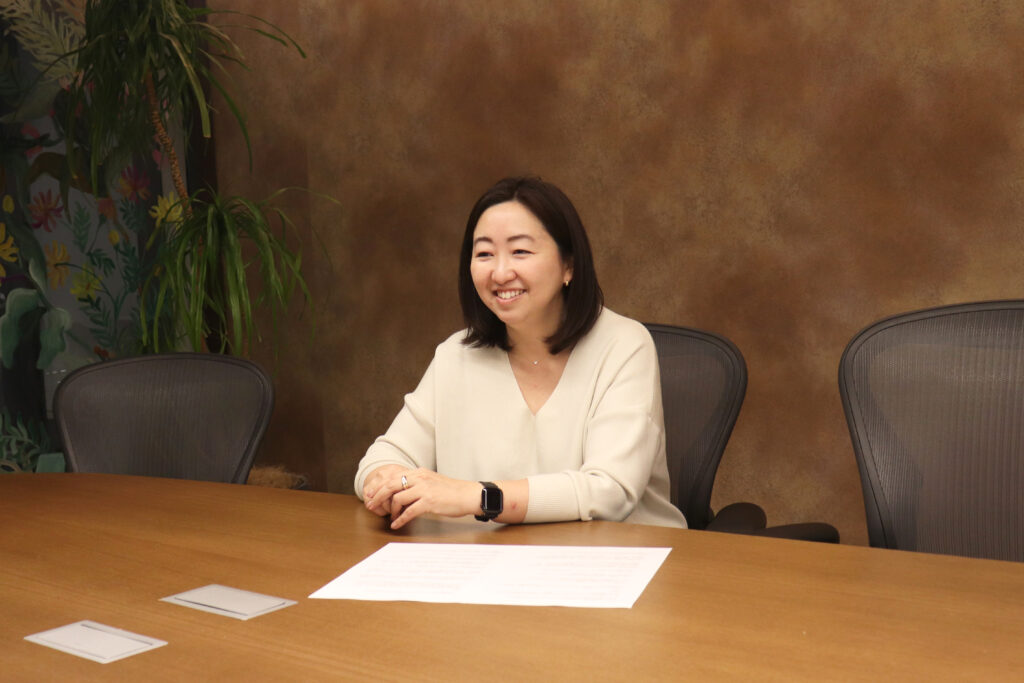
Looking at your association’s official website, you have an incredible lineup of individuals, ranging from the Tokyo Metropolitan Government and prominent serial entrepreneurs to investors and even high-level politicians. How did you manage to build such a powerful network?
Fujimoto:
To be honest, I don’t think I could have rallied these people back in 2019. It was the timing of 2022 that made it possible.
In the middle of our continuing operations, many players within the ecosystem were beginning to feel a genuine need for better collaboration and idea exchange. Mr. Nagura and I sat down and literally wrote out a list of every single person we knew who we felt was essential to this ecosystem.
From there, we approached them one by one, saying, “We want to build this framework, and we would really appreciate your backing on this.” At that stage, our specific activities hadn’t even been fully decided yet, but everyone gave us an immediate “Yes, this needs to happen,” and agreed to join as supporters.
All of these politicians, economic organizations, and corporations support startups from a variety of different angles. I believe that simply gathering their collective wisdom and networks in one place provides immense value to the entire ecosystem.
Sugihara:
What specific roles do you expect from these supporters? Beyond just having their names on the roster, do they give speeches at general meetings, provide advice on specific issues, or anything like that?
Fujimoto:
While we have certainly benefited from these esteemed individuals speaking at our events, we are very intentional about not making their commitments feel like a burden.
Instead of giving our supporters a sense of duty, our goal has been to have a flat, transparent relationship where we can exchange information and seek advice whenever necessary.
Even without demanding a deep commitment, everyone is extremely positive about the development of the ecosystem. Because they believe this is a necessary space, we’ve been able to build a collaborative structure that is flexible yet incredibly strong.
◆The Three Pillars: Information, Equality, and Global Reach
Sugihara:
Could you tell us exactly what the Startup Ecosystem Association’s job is?
Fujimoto:
Certainly. There are three primary pillars of our work.
The first is gathering and sharing information from within Japan. You could say we’re the ecosystem’s version of Google, with the goal of collecting information, organizing it, and making it easily accessible. (Note: This is a reference to Google’s mission, “to organize the world’s information and make it universally accessible and useful”.)
One specific example of this is the Startup Ecosystem Summit, which we hold annually. Usually, these types of startup events feature startup companies on stage. Our summit is unique because rather than featuring startups, we feature the supporters, instead. Representatives from corporations, the national government, and local municipalities present on the specific support programs they are currently offering for startups.
While this is also aimed at startup companies, our real aim is to strengthen information sharing within the community of supporters. It’s surprisingly common for one organization to have no idea what the one next door is doing. By creating this annual forum, we create opportunities for people to notice how others have evolved and find interesting new ways to collaborate.
The second pillar is eliminating information inequality for startups specifically. Startups face countless hurdles as they grow, and I feel the biggest gap is often just information. There are so many obstacles that could be avoided if the founders simply knew enough. To solve this, we are building a comprehensive database that includes support information from a wide range of providers, beyond just those who speak at our summit.
We also launched support for recruitment—a major pain point. Career fairs are expensive, for sure. So it’s hard for a startup to justify spending 400,000 to 500,000 yen when they aren’t even sure they’ll find the right fit. We partnered with the Tokyo Metropolitan Government to host career fairs and recruitment events.
One insight we gained was how students who want to intern at a company feel intimidated to cut into a booth full of conversing adults to ask them about it. This led to the creation of an event exclusively for students we call “Internship Fest”. Facilitating these connections and information flows for startups is our second pillar.
The third is global collaboration. The ecosystem doesn’t end at Japan’s borders. We want to connect with ecosystems worldwide. There is a demand to bring overseas startups to Japan, and a reciprocal need to help Japanese startups expand abroad. We act as a bridge for these global needs.
Everything we do revolves around these three axes.
◆Solving Real-World Challenges: Recruitment and Sales Over Funding
Sugihara: That’s true! When people think of startup events, they usually imagine startups pitching while investors act as judges. That’s the standard format for events hosted by VC funds and financial institutions. An initiative that allows everyone to see how to help startups and puts the supporters center-stage is something you rarely find anywhere else.
Fujimoto: Exactly. I don’t think anyone else is doing it. I feel it’s the kind of activity that is only possible for a non-profit like a General Incorporated Association. It’s hard to turn into a business, but it was one of those things that everyone knew was missing.
Furthermore, we recommend policies to the government. There is currently a gap where government officials can’t easily hear from people who are actually in the thick of things. We take the lead on conducting research to capture exactly what startups are struggling with right now and deliver those insights directly to the government.
Sugihara: That ties back to what you mentioned earlier regarding information inequality and recruitment challenges. Hiring is arguably one of the hardest hurdles for any startup to clear.
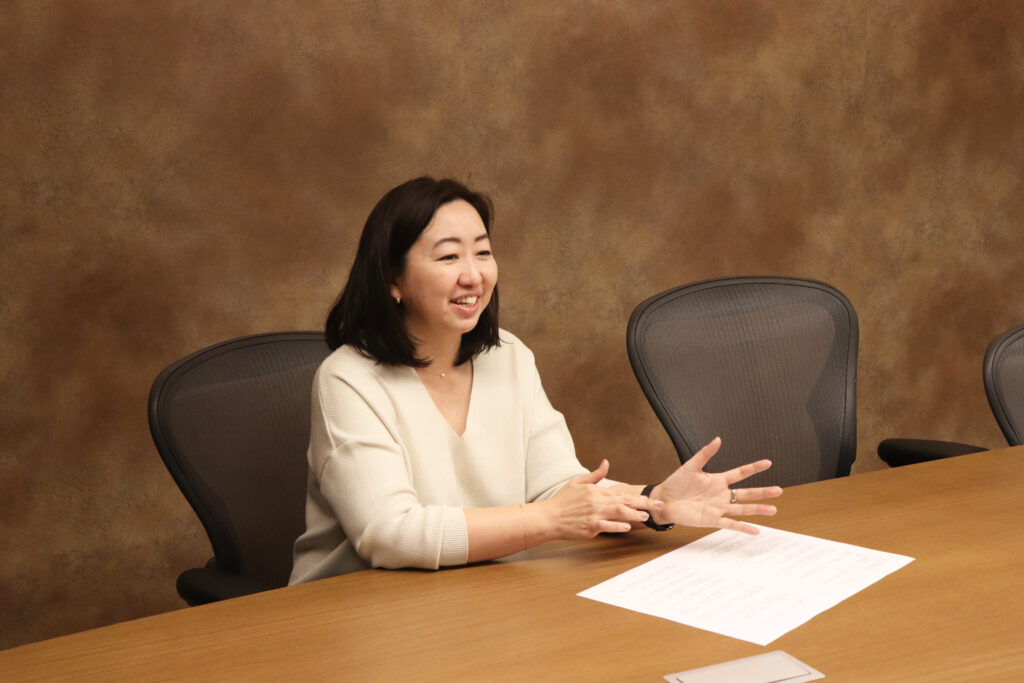
Fujimoto: It really is. And that insight actually came straight from our research. While the world is full of support programs for fundraising, our data showed that only about 30% of startups cited funding as their primary struggle. The vast majority were actually struggling with two other things: hiring and sales.
Despite this, there were almost no support programs available for these areas. There weren’t many places providing clear and specific guidance, which is why we worked with the Tokyo Metropolitan Government to build career fairs from the ground up.
As of this year, we’ve actually transitioned those career fairs to run independently as official Tokyo Metropolitan Government projects. We see our role as having created the initial spark and the framework to get it moving.
~To be continued in Part 2~
Interview conducted by D-POPS GROUP’s advisor Genta Sugihara.
Startup Ecosystem Association
President: Ayumi Fujimoto
Address: 15F Toranomon Hills Business Tower, 1-17-1 Toranomon, Minato, Tokyo
Established: March 30, 2022
Website: https://startupecosystem.org/home-en
Next, in the second part of the interview, we discuss:
・Startup Ecosystem Summit
・Overseas Collaboration
・Global Trend: From Startup to Scale-up
・How a New Company Was Established
・And other topics
Be sure to check it out here:
https://d-pops-group.co.jp/en/column/startupecosystem-part2/