COLUMN

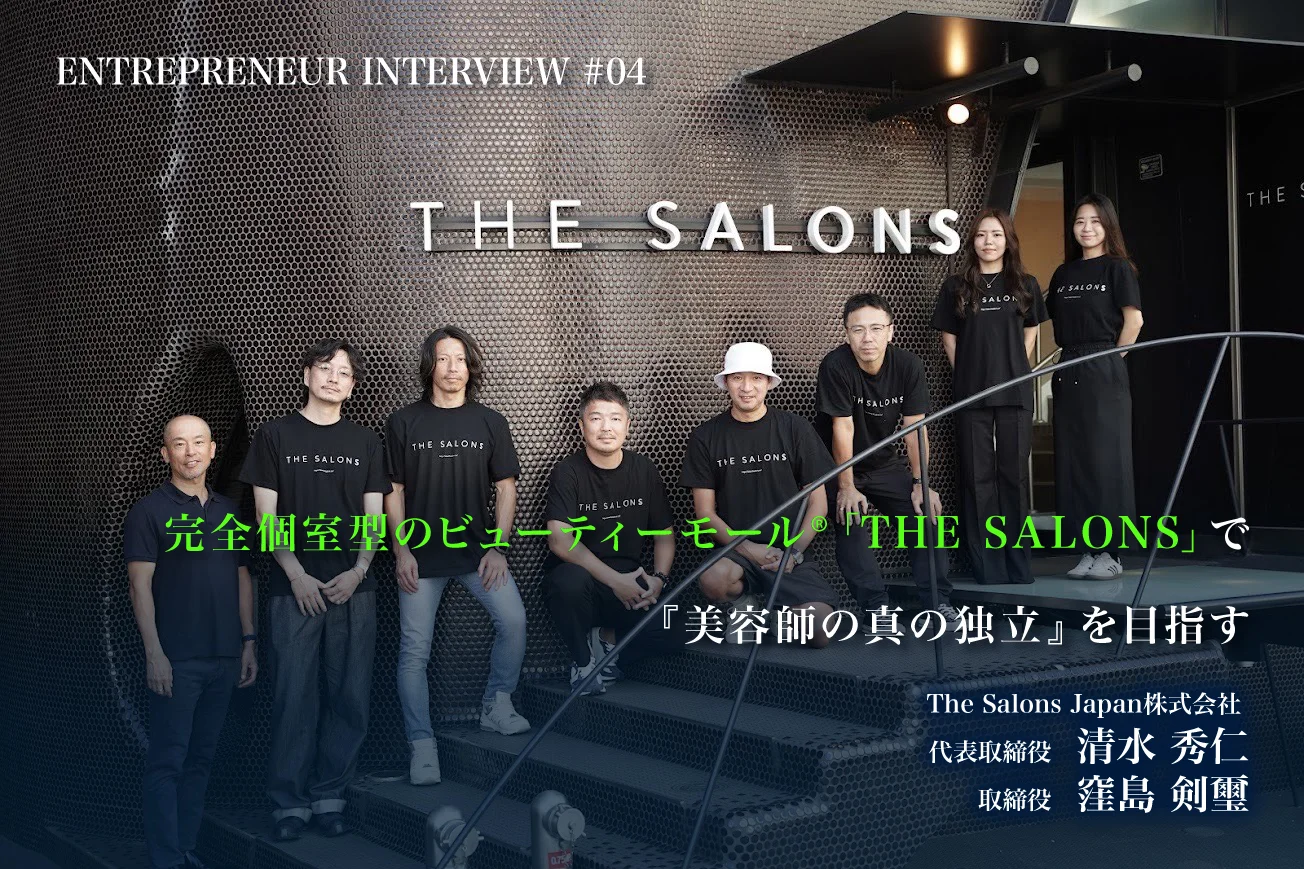
[Entrepreneur Interview #04] Hidetoshi Shimizu & Kenji Kuboshima (The Salons Japan Inc.)

  • Group Companies
  • Interview
2024.10.08

Interview with the CEO & Founder and the Director of The Salons Japan Inc., the company striving for "True independence for beauty professionals"

In June 2024, our company entered into a strategic capital and business alliance with The Salons Japan Inc., which leases private salon studios for beauty professionals, and we have begun our journey together as partners in the Venture Ecosystem.
☆You can see the press release regarding this strategic capital and business alliance with The Salons Japan Inc. on the following page:
https://d-pops-group.co.jp/en/column/the-salons-japan/

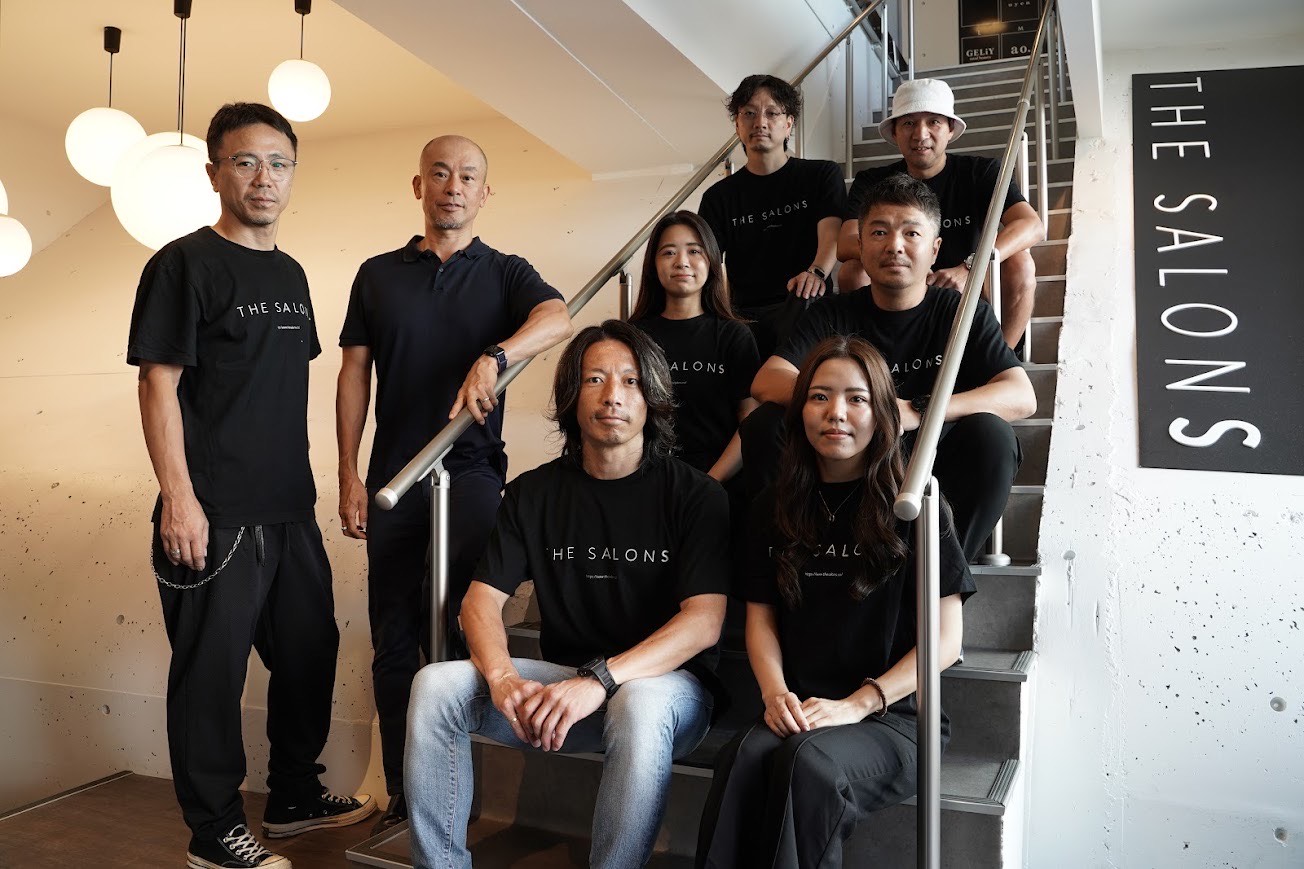
For this article, we interviewed The Salons Japan Inc.’s CEO and founder Hidetoshi Shimizu and director Kenji Kuboshima about their founding story and hopes for “THE SALONS”, their company’s private salon studios for beauty professionals.


1. What inspired you to start the company?

It all began when founding member Takahara told Shimizu, who was a salon owner at the time, about SOLA SALONS’ business model that had transformed the beauty industry across the United States. Shimizu, an exemplary beautician, had been friends with Takahara for a long time. When he heard about such a fascinating business model that didn’t exist in Japan, he immediately traveled with Takahara to Los Angeles to see it for himself, and upon returning to Japan, the two of them founded The Salons Japan.
 

2. Please briefly describe your company’s services.

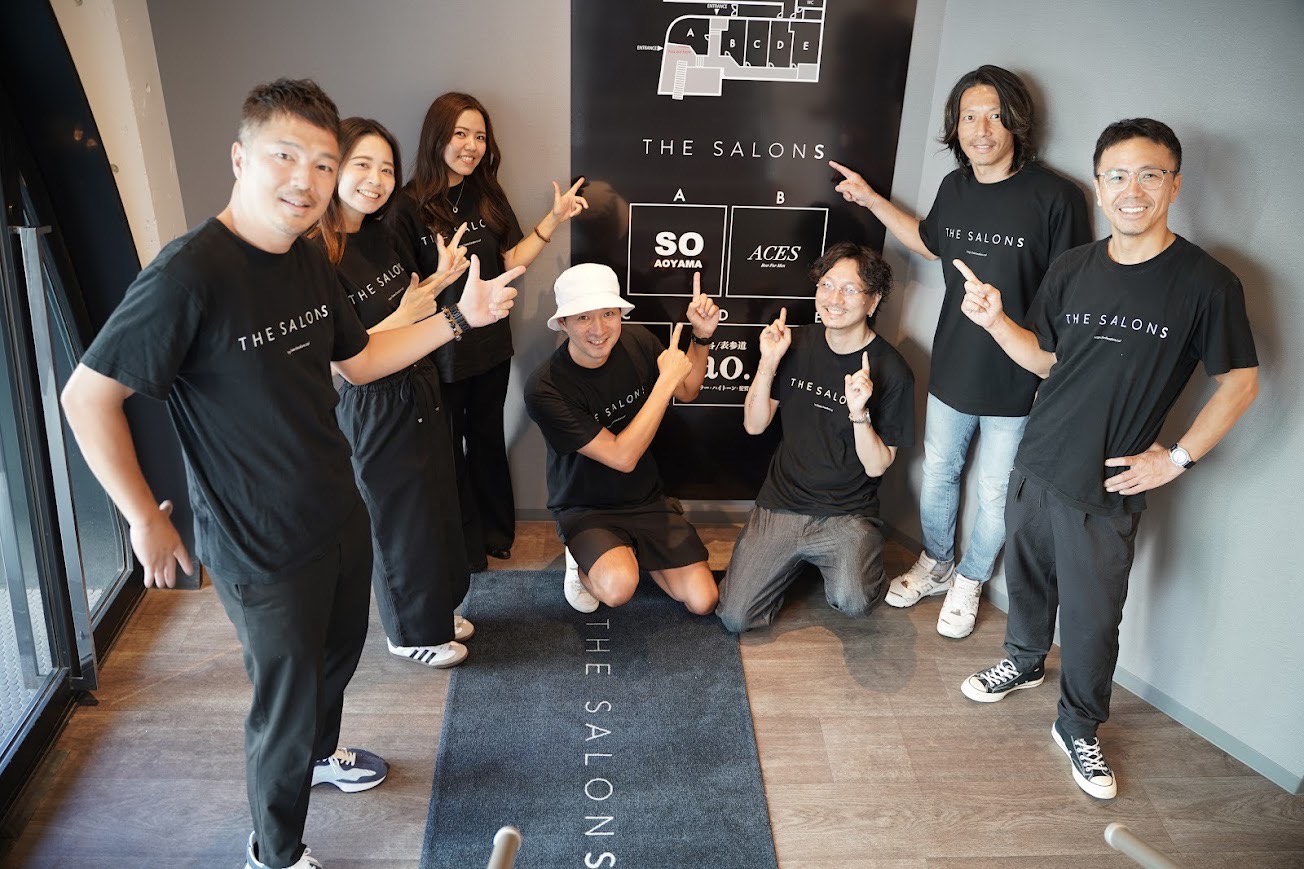
We lease fully private studio spaces, each equipped with a shampoo station, chair, and mirror. Beauty professionals can open their own salon in prime locations without large initial investments. We charge a monthly fee but no commission on sales, so professionals who work hard will see a direct increase in profits according to their efforts. Unlike shared salons or commission-based salons, THE SALONS supports beauty professionals in achieving true independence with minimal risk.
 

3. What sets you apart from similar companies?

We were the first in Japan to launch the leasing of private salon studio spaces—our company’s specialized business—and we have never operated any other services such as shared salons, etc. In other words, we dedicate all our company resources to the concept of “true independence for beauty professionals”. We fully support professionals who aim to graduate from THE SALONS and open their own street-front locations, and we believe this unwavering commitment is what distinguishes us from our competitors and represents our strength.

4. What was the biggest challenge since starting the business?

Since the leasing of private salon studio spaces was unprecedented in Japan, we struggled to get the property owners of our first location in Omotesando to understand our business model.
 

5. What do you most expect from your shareholders?

Utilizing the assets and expertise of a company with such diverse business portfolios as D-POPS GROUP, we want to partner together as colleagues in the same boat to transform the beauty industry.
 

6. What is the best part about receiving investment from D-POPS GROUP?

This investment was realized through the connection between Mr. Sugihara, who has now joined as a director, and our founding member Kuboshima. D-POPS GROUP, led by President Goto, has many group companies and members with various business experiences. We are grateful that they generously share their expertise with us, and we're truly glad to have found genuine partners who think together with us about what's necessary for corporate growth.
 

7. What aspects of realizing a Venture Ecosystem resonate with you?

We founded The Salons Japan with the desire to transform the beauty industry, which faces many challenges, to become more worker-friendly. You could also say that our vision is to create an ecosystem for the industry. Since we’re running a business, money is obviously important; however, we strongly resonated with D-POPS GROUP's powerful commitment to “creating a better society for startups”, which aligns with our founding philosophy.


8. How did you two founding members meet each other?

We met at a nightclub in Roppongi when we were still in our 20s. Since then, we spent our youth together as friends. While we never imagined we would end up running a company together, the trust we built over many years has proven very valuable in managing the company.
 

9. What strengths do you see in each other?

For Shimizu (who is still an active beauty professional), salon management, store operations, and other matters related to the practice itself. For Kuboshima, IT and finances. Each of us has our own area of expertise, and by trusting each other, we can focus on our respective strengths.
 

10. What is your ideal vision for the company 10 years from now?

In a beauty industry where professionals work more actively and energetically, we want to become the most trusted and reliable company among beauty professionals.
 

11. What are some issues you will have to face before seeing that future?

The beauty industry still has too many challenges to list them all here. However, we believe that we will overcome these challenges by keeping our founding conviction—to put hairstylists first—etched clearly in the hearts of our company management.

12. Any closing comments you’d like to briefly share?

Once again, we are proud to have become part of the D-POPS GROUP family and are very much looking forward to growing together in the future!
We are also currently looking for new team members who want to join The Salons Japan and create the future with us!!


The Salons Japan Inc.

Company President and CEO: Hidetoshi Shimizu
Address: 2F Kid Ailack Building, 2-43-11 Matsubara, Setagaya-ku, Tokyo
Established: November 30, 2018
Website: https://www.thesalons.co/

Related Articles

[Entrepreneur Interview #14] Nishikawa and Matsutani (@Solution) – Part 2
Tackling the Development of the Next Generation to Further Invigorate Japan’s IT Sector D-POPS GROUP has 23 group companies that we call partners (at the time of publication). For this article, we interviewed Co-president & COO Akio Nishikawa and Co-president & CFO Yorito Matsutani of @Solution, which joined D-POPS GROUP in 2021. (This interview was conducted in April 2025.) This is the latter part of the interview. To read the first part, click the link below. https://d-pops-group.co.jp/en/column/atmarksol-interview-first-part/ ◆Greatest Strengths and Features Sugihara: The role of the engineer is becoming increasingly sophisticated. Coding itself may no longer be necessary, but what is important is the ability to determine the required program structure, the ideal interface, and the specifications of the final product, and finally coordinate all of those together. In that regard, what is @Solution’s greatest strength or distinguishing feature? Nishikawa: This goes back to our two businesses we described at the start of this interview, but our strength lies in our ability to build and propose solutions not just for surface-level applications, but also for their underlying infrastructure. Ultimately, all systems and services rest on an infrastructural foundation, so our capability to offer total solutions starting from the base infrastructure is our key advantage. Furthermore, we have members who specialize in direction and project management. This ensures we can fully engage with what the client wants and effectively communicate that to our engineers. @Solution is broadly seen as a System Integrator (SIer), and people often have the impression that it’s difficult to communicate with SIers, since they are mostly staffed by engineering-type people. However, in our case, people say “It’s easy to consult with @Solution because they have project managers.” So, this is definitely another of our strengths. Sugihara: That kind of service is definitely high in demand. No matter how widespread AI becomes, it will always be essential to display warmth and kindness, be able to read the room, and other things that only humans can do. The realm of communicating from person to person is where AI should be differentiated from humans. Nishikawa: I agree. In foreign companies, especially those overseas, engineers are considered almost god-like professionals who only need to write code well. They never attend project briefings, but that’s acceptable as long as their productivity is high. However, we prioritize communication and want our clients to know that we value it. That is why some of our members are dedicated to direction and project management. Sugihara: What scale are your typical client companies? Matsutani: We don’t have a size limit either way, so we handle projects for both large corporations and start-ups that have recently launched their own services. By industry, most of our contract development supports BtoC-oriented services. Our SES business has usually seen larger-scale projects since the beginning. Sugihara: What are the main reasons companies come to @Solution with projects? For example, is it because they’re looking to outsource coding, or because they have a lack of manpower? Nishikawa: It’s typically the latter. Clients often seek us out due to a lack of manpower, and they also find us through networking. We are increasingly involved in projects where we partner with companies that simply do not have engineers in-house. For instance, many clients who operate their own services have internal teams for promotion and marketing but not a single development engineer on payroll. They might have had a specific app running for about ten years, and because they lack engineers, they were relying on various vendors. We are now seeing an increase in cases where we are taking over and managing these projects. ◆Recruitment Sugihara: Speaking of which, the general consensus is that Japan is facing an engineer shortage. How is @Solution approaching recruitment in light of this? Matsutani: In engineer recruitment, the biggest salary bubble was around two years ago, when engineers were jumping into the companies that offered the highest salaries. Then, with the emergence of AI and the conversation about whether engineers will be needed in the future, things calmed down somewhat. However, there is still a persistent shortage of engineers, so salaries remain relatively high compared to other industries. After 20 years of trying various methods at @Solution, we’ve found that new graduates are the best fit for our hiring patterns. The cycle of bringing in new grads and providing proper training works well for us, so we are focused on this area. Last year, we ran an internship program. These were not short-term, but year-round long-term internships, totaling about 20 people. They would work on projects, sometimes for a few hours a week and sometimes full-time. We would love for these excellent students to join us, but recently, so many of them are talented enough that they go on to work for companies like CyberAgent, DMM, and IBM. Sugihara: How did such talented students come to apply for an internship at @Solution? Matsutani: After receiving their feedback, we found that last year, there was an overall trend among engineers toward using the more “packaged” technologies like Flutter for mobile. However, students with some experience wanted to work on in-house projects through a lab-based or contract development model like ours, where they could really get their hands dirty writing native code. The more ambitious students had a strong desire to personally experience writing code from scratch, which is why they applied for our internship. During the initial orientation, we tell them this: “Since our management philosophy is ‘Developing the Next Generation’, we want you to gain extensive experience here and become a successful professional.” We believe that Japan’s IT sector still has plenty of room to grow compared to other countries, so an increase in highly skilled IT talent benefits the whole country. We look forward to connecting with them as future partners. Sugihara: Ah, so this is where your management philosophy truly comes to life. It would be fantastic to see cases where students who interned at @Solution thrive as skilled IT professionals and later rejoin the company a few years down the line. What are your future recruitment strategies? Nishikawa: We currently have about 35 engineers, but we plan to increase that number. Our maximum goal is to reach around 200 members within the next 10 years. Sugihara: That’s a great target! Will you be hiring mid-career professionals as well as new graduates? Matsutani: Yes. More specifically, we intend to focus on hiring inexperienced individuals. We are looking for young people, especially in their 20s, who are studying at coding schools or even those who are self-taught. Since becoming an engineer requires interest, curiosity, and passion, we want to hire those who are motivated and studying on their own initiative. ◆“Realizing a Venture Ecosystem” Sugihara: D-POPS GROUP’s vision is to increase the number of growing startup companies that bring about societal transformation. In short, we aim to “realize a Venture Ecosystem”. What are your thoughts on this Venture Ecosystem? Nishikawa: First and foremost, I feel incredibly fortunate to be part of this community every day. Particularly on the financial side of things, D-POPS GROUP provides us with an extremely encouraging and reassuring environment. While managing finances is originally a huge part of running a company, the assistance we receive as a part of the group allows us to concentrate entirely on our core business, so we are truly grateful. Without this environment, we wouldn’t even be able to discuss recruitment plans or consider strategic investments. We feel incredibly supported. Matsutani: I have essentially the same impression as Co-president Nishikawa. I believe this is a truly unique and interesting environment and structure. The individual members of the Venture Ecosystem are relentless challengers, yet they are incredibly kind, gentle, and cooperative. It feels like we are comrades, but at the same time we also have a healthy competition, and it’s rare to find both of those deeply rooted in a single culture. Here, we can pursue many challenges, and the structure for taking on those challenges is already in place. For example, having advisors readily available for consultation is a huge benefit. I am deeply thankful to be in this environment. Sugihara: That’s very true. D-POPS GROUP emphasizes two things regarding challenges. First, to increase the probability of success for those who take them on. We strive to create mechanisms and environments that—even if they aren’t perfect—are just what people need. Second, if an endeavor doesn’t succeed, they can try again within the Ecosystem. We have many examples of successful re-attempts. Matsutani: Exactly. There is internal competition, mutual assistance, and abundant opportunities to generate group synergy, which is a great benefit. When most people hear M&A, they picture strict supervision from the head office, but there is virtually none of that in D-POPS GROUP. We have meaningful support systems without suffering from someone breathing down our necks. ◆Group Synergy (Collaboration among the 3 IT Companies) Sugihara: I believe President Goto prioritizes respecting the will of each company’s managers, working with them to build up those companies, because he can understand those business leaders’ feelings better than anyone. Speaking of the Venture Ecosystem, I heard that @Solution recently started a business collaboration with Techbeans and Idealump. How did this three-way partnership come about, and what is its current status? Matsutani: Originally, the companies in our group who had IT engineers were only @Solution and Techbeans, and we were already collaborating, with us joining projects accepted by Techbeans, and vice-versa. When Idealump joined the group last year, there was one more IT engineering company, allowing us to formalize the collaboration further. So, we currently have various forms of partnership: all three companies are involved in certain projects; we hold joint proposals; sometimes two out of the three collaborate between each other. We are also planning to create opportunities for members to get to know each other and host joint study sessions for all three companies. We plan to accelerate these efforts going forward. Sugihara: Speaking of study sessions, there was a business presentation and Q&A session recently held by BLUEISH, one of D-POPS GROUP’s investment companies. I remember BLUEISH’s President Tameto having a very engaging discussion with Co-president Nishikawa at the social gathering afterward. Are there any insights you’ve gained from members of the Venture Ecosystem like that? Nishikawa: It was a very lively discussion! President Tameto had quite a big impact on me. His presentation style was memorable, but the actual business content was a shock: he explained how they originally did contract work but pivoted to AI based on industry trends, specifically focusing on AI Agents. AI utilization, or AI-driven development as it’s often called now, was an area where I honestly felt my knowledge was lacking. While I could understand some of what President Tameto was saying, I had a strong realization that I needed to do more research. From that point on, I began to change the focus of my own input. I feel that the BLUEISH study session directly led to my idea of wanting to offer consultation services that utilize AI. It was an extremely valuable learning experience. ◆5-Year Goals and How to Get There Sugihara: I’m glad the session was beneficial. We will continue to create opportunities for collaboration within the Venture Ecosystem. Could each of you share where you think @Solution will ideally be in five years and the challenges you face in reaching it? Nishikawa: First of all, from a financial standpoint, I believe sales are important. @Solution is currently a ¥300 million company, and I want that number to become ¥3 billion. To achieve that, all members, including myself, must level up our skills. We will focus on applying AI and lab-based development, and continue to work on improving our skills while acting as project partners for our clients. The most important thing, and I feel this strongly, is for the two of us to grow as leaders. The reason I feel this way stems from attending the all-hands meeting for Findstar GROUP about two years ago, after being invited by President Goto. At that meeting, Findstar GROUP’s President Naito—who is also the Non-Executive Director of D-POPS GROUP—said, “The growth of a company, or how far it can take a leap, is truly limited by its top leader.” That message really stuck with me. We tend to focus on employee growth, but I feel that unless we, the leaders, raise our own ceiling first, the company’s ceiling will not rise. Therefore, our initial focus is on our own growth. Matsutani: I want us to become the hub for digital talent within D-POPS GROUP. I strongly want our company, as well as Idealump and Techbeans, to become the go-to place that everyone consults when they want to pursue anything digital. The prerequisite to achieving this is to continuously learn and absorb knowledge, as this ecosystem offers many learning opportunities—especially for business leaders—and then to produce more output as a result. For me personally, I want to create a greater sense of community, so I will need to act on that premise as much as possible. ◆Message to Readers Visiting Our Website Sugihara: Finally, could you each offer a closing message to the readers visiting our website? Nishikawa: Thank you for reading our interview. We are a team of system and IT experts, so if you need anything IT-related, please think of us first. And let’s go out for a drink sometime, ha ha! Matsutani: D-POPS GROUP is a truly fascinating group of people, so if you are interested, please feel free to visit us in Shibuya Hikarie!   Interview conducted by D-POPS GROUP’s advisor Genta Sugihara.   @SOLUTION Co-president & CEO: Katsuto Masuda Co-president & COO: Akio Nishikawa Co-president & CFO: Yorito Matsutani Address: 32F Shibuya Hikarie, 2-21-1 Shibuya, Shibuya-ku, Tokyo Established: July 2005 Website: https://atmarksol.jp/
  • Group Companies
  • Interview
2025.06.09
[Entrepreneur Interview #14] Nishikawa and Matsutani (@Solution) – Part 1
Tackling the Development of the Next Generation to Further Invigorate Japan’s IT Sector D-POPS GROUP has 23 group companies that we call partners (at the time of publication). For this article, we interviewed Co-president & COO Akio Nishikawa and Co-president & CFO Yorito Matsutani of @Solution, which joined D-POPS GROUP in 2021. (This interview was conducted in April 2025.) ◆Business Overview Sugihara: Today, we have the pleasure of interviewing @Solution’s Co-president and COO Akio Nishikawa, and Co-president and CFO Yorito Matsutani. Thank you for your time. To start, could you please give us an overview of @Solution’s business? Nishikawa: We are a system development company. Our two main businesses are arranging development contracts and running a System Engineering Service (SES). To explain in more detail, we offer services such as mobile application development, web system development, and infrastructure platform construction. Sugihara: Next, could you each describe your respective roles? Nishikawa: My primary focus is on overall sales. I mainly concentrate on smoothly running both of our core existing businesses: contract development and SES. Sugihara: And what is your role, Co-president Matsutani? Matsutani: I am fundamentally in charge of overall back-office operations. My main areas are management, administration, and recruitment. I also handle new business development, strategy, and the management of key business metrics. Sugihara: Ahh, I see! A perfect balance of offense and defense. Could you tell us about the circumstances behind each of you joining the company? Nishikawa: Certainly. I joined the company in 2006. Since joining, I have always been involved in writing code. @Solution was established in July 2005, so I joined shortly after its founding. Matsutani: I joined in February 2022, so this is my fourth year here. Sugihara: Incidentally, when did @Solution join D-POPS GROUP? Matsutani: In June 2021. Sugihara: So, Co-president Matsutani, you joined quite soon after the company became part of D-POPS GROUP. You and Co-president Nishikawa assumed the roles of COO and CFO in September 2023. Could you describe how things have changed since @Solution joined D-POPS GROUP and since the two of you assumed your current positions? Nishikawa: First, I honestly feel surprised that it’s already been four years since we joined the D-POPS GROUP. In these four years, we’ve faced various issues from outside and inside of our company, including project-related problems. It feels as if a full decade has passed because of all the experiences we’ve gained—it’s been incredibly eventful. Matsutani: For me, it went by in a flash. I can’t believe four years have already passed. I was a cram school teacher for three years at the company I joined out of university, then I moved to Recruit before joining @Solution. This is the longest I have ever stayed at a company, but these four years have truly flown by. ◆The Company’s Early Days Sugihara: Co-president Nishikawa, you’ve been with @Solution for nearly 20 years. What was the company like originally? Nishikawa: I don’t believe it’s changed much from what it was before. The company was originally founded by just three people: President Masuda, Director Taniguchi, and an employee named Kusunoki. Because there was such a small number of people, they started out by focusing on SES and recruited workers on a project-by-project basis. Sugihara: So, it seems the founding members are still with the company and continue to provide strong support. Currently, you both serve as co-president alongside President Masuda, the founder and CEO. Beyond the trust you have clearly built with President Masuda, there seems to be a strong mutual trust between the two of you, Co-president Nishikawa and Co-president Matsutani. What philosophy guides you in managing the company under this system of multiple representative directors? Do you have specific role divisions? Nishikawa: I think our role division comes down to our strengths and weaknesses. I strongly feel that each of us possesses what the other lacks. In addition to that, even without putting things into words, our ideas are usually very close, which I feel is a significant advantage. Especially for me, despite being an engineer, I am terrible with numbers, ha ha. Co-president Matsutani is quite good with numbers, so I put a lot of faith in him. Matsutani: Since I joined later, I have a strong commitment to strengthening the existing structure, knowing that it was built by President Masuda and the members who joined him. Given that Co-president Nishikawa has supported the company since joining right out of university, I believe the company will naturally evolve under his leadership. Mine is more of a supportive role, to ensure that direction is successfully implemented and scaled up. So, while I do contribute ideas, I have made it a personal rule that any major strategic change in company direction must be decided by Co-president Nishikawa. I also do things like controlling our sales, general, and administrative (SG&A) expenses. Sugihara: Then your roles are very well-defined. By the way, Co-president Nishikawa, are you naturally a strong type of leader? Nishikawa: Ha, I wouldn’t say so. I am more of a people person, the kind who enjoys communicating over drinks. I’ve been fortunate to forge many connections in that sort of setting, and those connections often seem to become business opportunities, which makes me feel truly grateful to those around me. One such connection that has continued since those early days, particularly with agencies, resulted in the long-term contracts we’ve received from Hakuhodo Group. Matsutani: But that’s just one example. In fact, the majority of our in-house project contracts are the result of an introduction from Co-president Nishikawa. To put it in pure sales terms, approximately 40% of our sales come from his connections and referrals. ◆“Developing the Next Generation” Sugihara: No matter how advanced the technology, in the end, it’s essential to have people on your side. Now, I’d like to ask a little about your business. Could you explain your management philosophy, “Developing the Next Generation”? Nishikawa: This concept was originally devised by President Masuda. When the company was founded in July 2005, the IT industry had just finished weathering the bubble of the early 2000s. It was the dawn of what was called Web 2.0, a time when services and people were beginning to connect around the world. As much as the job of a programmer can be seen as cool or popular now, the prevailing image back then was much more “geeky”. At the time, President Masuda felt strongly that the age of IT was coming soon, and that it would be necessary to learn technical skills. The ultimate goal was to foster talent so that even if they moved on from @Solution to another company, they would be globally employable because they had a solid foundation in basic IT skills. This desire to educate and nurture talent is the core idea behind our management philosophy, “Developing the Next Generation”. ◆Current Business Focus Sugihara: So, your management philosophy is about fostering the next generation of professionals. Which business area are you currently focusing on the most? Nishikawa: We are currently in a period of transition. We are strongly committed to leading the way in AI utilization, creating new AI-related businesses, and providing support services. Our focus is shifting from simply accepting contracts or outsourcing personnel through SES to concentrating on how we can utilize AI to create new systems and structures. Matsutani: I’d say the same thing, but I’d add that our current main focus is on finding contracts for dedicated development teams (DDT). We concentrate on providing smooth operation, maintenance, and development by having customers who already have an app or service switch to us from their original development provider. We’ve been focusing on this since last year. Moving forward from there, with the growing trend of AI utilization, our goal is to first use AI internally to boost efficiency and understand the underlying mechanisms. Then, we can proactively propose to our clients how to best implement AI within their applications or even how AI can be used to optimize the overall efficiency of their entire company, not just the users of their apps. We want to continuously increase the value we provide in this way. Sugihara: As generative AI becomes increasingly sophisticated, some people are saying that the engineering profession will become obsolete. What are your thoughts on this? Nishikawa: When ChatGPT was released, it was about two and a half years ago, right? Honestly, at that time, I was pretty depressed. Thinking that the industry—and my own job—might eventually disappear made me feel extremely pessimistic. However, my perspective has recently shifted. Now, I’m focused on figuring out how to use such tools effectively from an engineering standpoint, since they already exist. No matter which generative AI you use, you have to get used to such technology in order to utilize it well. We believe that we are the ones who can come alongside and support those who are unfamiliar with it, so we are going to continue devising methods of doing that. (To be continued) Interview conducted by D-POPS GROUP’s advisor Genta Sugihara. @SOLUTION Co-president & CEO: Katsuto Masuda Co-president & COO: Akio Nishikawa Co-president & CFO: Yorito Matsutani Address: 32F Shibuya Hikarie, 2-21-1 Shibuya, Shibuya-ku, Tokyo Established: July 2005 Website: https://atmarksol.jp/ Next, in the latter part of the interview, we discuss: ・Greatest strengths and features ・Recruitment ・“Realizing a Venture Ecosystem” ・5-year vision and challenges associated with that ・And other topics Be sure to check it out here: https://d-pops-group.co.jp/en/column/atmarksol-interview-latter-part/
  • Group Companies
  • Interview
2025.05.28
[Entrepreneur Interview #13] Shoto Masuda (D-POPS Corp.) – Part 2
“Serve people and cultivate talent” Aim for further growth through developing human resources and systematization! D-POPS GROUP has 23 group companies that we call partners (at the time of publication). For this article, we interviewed Shoto Masuda, the current CEO of D-POPS Corp., the founding business of D-POPS GROUP. (This interview was conducted in March 2025.) This is the latter part of the interview. To read the first part, click here. ◆The Market Environment Sugihara: It seems that the business model of selling smartphones in physical stores is facing headwinds, given the increase in direct sales by carriers and manufacturers via e-commerce, as well as the growing market in different industries for buying and selling used devices. Could you share some aspects of your strategy in this market situation? Masuda: For about the past year, we’ve been heavily discussing our future strategy. We have many excellent existing businesses. Because they are directly connected to people’s daily lives, the products and services we handle are very attractive, I believe. However, on the other hand, when you’re in the position of an agency, control and management become incredibly difficult, so I really feel that balancing these aspects is extremely challenging. Regarding our strategy moving forward, it’s still fundamentally about telecommunications. While it’s quite broad to say telecommunications as a whole, there are many more products that we should really be selling. We will expand our product lineup to include items developed in-house and procured externally. Selling core products and cross-sellable products will be one of our first courses of action. Another plan is user life design. In essence, we are focusing our discussions on what people need for their daily lives and what problems need solving. This applies to our stores, and we’re also currently exploring if there's anything we can get involved in even without a physical store presence. Sugihara: Speaking of which, how is the “Smartphone Consultation Counter” business doing? Masuda: It’s growing steadily. It took a long time for feature phones and smartphones to penetrate into the Japanese market, but they have been fully received now. However, going forward, the products that come out, such as 5G and certainly 6G, and now even AI-equipped smartphones, are becoming so complex that many people don't know how to use them. For instance, people might not know how to use LINE, or how to link their My Number card, or how to connect IoT products to their home appliances. While devices have become widespread, many people don’t know how to use them, so we really want to address these customer needs, both in person and online. Sugihara: More and more people who are not tech-savvy, especially seniors, are finding themselves with no one to consult. Such individuals can run to a TOP1 store to address their concerns. So it seems there really are people who want to receive advice, even if they have to pay a fee. Masuda: That’s right. We used to do it on a volunteer basis, but we need to distinguish our business, and as we improve the skills of our staff, their wages also need to increase. So, we believe it’s better to charge a fee so that we can serve customers as professionals. We are also developing that service and are focused on continuously improving its quality. The third and final point is education. When I think back to what we most wanted to do since our founding, and what our strength still is today, it’s educating our human resources. The original vision of President Goto, the founder of D-POPS, was to create opportunities for young people. Although I’ve taken over as CEO, we’re still holding onto that vision, so at our core, we’re ultimately about educating people. In the end, we've committed to “cultivating talent”, so I believe that embedded in our company’s DNA is the idea of raising up “leaders equipped with both integrity and skill”, which also continues to be our human resource development policy as our business grows and evolves. In 2024, I had the opportunity to go abroad with Dr. Semmoto, the Chairman of D-POPS GROUP’s Board of Directors, and I realized that while some other countries have growing populations, the quality of Japan as a nation in various aspects is remarkably high. For example, I believe we can convey the high value of Japanese education, culture, and customer-focused service. Recently, as we’ve been brainstorming various ideas, we’ve gone back to our roots, asking: “What kind of company is D-POPS?” The answer is, “We are a company that develops human resources.” To make people genuinely excited and want to join D-POPS or work for us, I felt it was necessary to grow our business domains and to help individuals grow, making them believe that joining will lead to their personal development. ◆TOP1’s Policies for Sales and Proactivity Sugihara: Personally, when I picture mobile phone agencies in the past, I think, “Purely commission-based meritocracy!” What kind of sales and customer service policies does D-POPS’s own brand shop, TOP1, have? Masuda: Whether to compete purely on meritocracy or to prioritize meticulous sales and customer service—this is indeed the most challenging aspect. The truth is, when you chase sheer numbers, quality inevitably declines. That's why the industry as a whole has seen many compliance violations. However, no matter how good your intentions, if you don’t achieve results, you won’t get support, will you? Therefore, I believe it’s crucial to combine building a strong sales organization with education of the mind, which necessitates instilling our philosophy and vision. We believe that we are a company that properly educates its people and contributes meaningfully to those important individuals with whom we have connections, so we must continuously improve our quality. Essentially, it’s about whether we can establish a foundation of trust in human relationships and then build specialized skills and a favorable business environment upon that. There were many companies in the past that lacked this foundation. Those companies sold enormous volumes. They had high transient revenues and contributed more in terms of numbers than we did, but they no longer exist today. However, we need to increase both customer numbers and sales while simultaneously improving quality. So, we are working to strengthen this across the entire organization and aim for growth. ◆New Product “OTHEBES” Sugihara: So that’s why your philosophy-driven management and training truly come to life. It’s not just about the sales method; it’s because the staff, having gone through that philosophy training, are providing a service which enables them to support customers’ lives, lifestyle, and life design. I heard that as a future strategy, you’re launching a brand called “OTHEBES” to strengthen your customer base. Could you tell us more specifically about OTHEBES? Masuda: “OTHEBES” was launched in March. Led by Mr. Sakamaki, our Executive Officer and General Manager of Sales who is also in charge of product and business development, the first phase involves Wi-Fi rental and sales. OTHEBES is a portmanteau of “others” and “best”. While we have existing stores and products, there are still gaps where current products don't quite resonate with or contribute to end-users, and OTHEBES is designed to fill those gaps. Currently, for the first phase, we’re handling Wi-Fi. In the future, for example, some people only use their phone for calls, so we want to create our own brand of call-only mobile phones, plus develop combinations that pick the best aspects of different services. Recently, a slogan has emerged among us: “Create something new out of what already exists!” So, we are now analyzing the demands from both the field and customers, considering combinations that we believe will work. Sugihara: Both in terms of planning and on the ground, with the increasing number of products, carriers, hardware, and brands you handle, and your company’s own services appearing, there’s a risk that sales staff who lack initiative might not know what to propose to customers. Are you concerned about that? Masuda: That’s why we prioritize foundational education. In fact, D-POPS didn't have many established systems until now. So, from here on, our theme for this year is to create proper systems, and based on the premise that people forget, we aim to create systems that can convey information more simply, rather than just forcing memorization. It’s all about human resource development and systematization. If a company can just put the right people in the right places and clearly divide roles, there’s no way they can fail, ha ha. ◆Soccer Activities Sugihara: Nice! I love that kind of attitude! Changing the subject completely, I hear you are quite skilled at soccer! And that you’re active in the company’s futsal club. Could you tell us about these activities? Masuda: I’ve played soccer continuously since my school days, and I’ve kept it up as a hobby even after entering the working world. Initially, it was just an in-house club activity at D-POPS. We play about once a month internally, and since I have various connections, I also play with external members. I probably belong to about three or four main groups. When we focused only on in-house members, we were always just barely scraping by with enough players. We wanted to play but couldn’t. At that time, it suddenly occurred to me: what if we brought in people from both inside and outside the company? So, we started doing that. We organize the games, inviting our employees and other members of D-POPS GROUP to join, plus my acquaintances, some of whom are former professional players. We also forged a connection with BLUEISH Inc. through soccer, a company in which D-POPS GROUP later made a corporate investment. This made me realize that sports can create such networking opportunities. *See the full press release here: D-POPS GROUP Invests in BLUEISH Inc., Operator of Industry-Specific AI Workflow “Omni Workspace” Until now, my life has been pretty much full of those kinds of connections. I attended the Semmoto Management School run by Dr. Semmoto, and there I met another company’s board director who also played soccer. That director turned out to be a high school classmate of a former manager of mine from Germany, who had really helped me out during my time living in Beijing. I really hit it off with that director, started attending the soccer practices he participated in, and that's where I met the people from BLUEISH. But I also think this involves luck and timing. If this had happened five years earlier, I don’t think the discussion about investment would have occurred. I myself have had various experiences up to now, and being in a management position allows me to engage in various conversations, which enabled me to bring this opportunity to D-POPS GROUP. I mentioned playing with external people earlier; there are also skilled individuals among my acquaintances who are business owners, or even executives and younger employees within their companies. And typically, those people also excel at work. It’s like things just connect. That’s incredibly valuable, isn’t it? When people have good character, shared interests that foster friendship, and different expertise, skills, and networks, it leads to a wide range of connections. ◆Recruiting Students Sugihara: It’s the time of year when job hunting for students graduating next year has begun. What type of student would you like to see join D-POPS? And what aspects of D-POPS do you think are attractive points for new graduates? Masuda: Our company, first and foremost, has genuinely good people. They have high self-esteem and are very proactive. They also tend to reach out to others and have a strong sense of contribution. Furthermore, in D-POPS and D-POPS GROUP currently, we offer an environment where you can leverage support and coaching for experience, skills, and networking. I truly believe there’s no better environment than this. So, for those who want to challenge themselves quickly, gain not just knowledge but also practical skills, and refine their human qualities, ultimately, we’d like them to take on management roles. We don’t really prioritize academic background. However, it’s absolutely crucial to have high self-esteem. I think it would be difficult for both of us if an employee is consistently negative. If you think to yourself, “I can’t do this”, then you won’t be able to achieve anything. ◆“Realizing a Venture Ecosystem” Sugihara: D-POPS GROUP has the motto of “Realizing a Venture Ecosystem”. What aspects of this goal do you resonate with? Are there any activities you’re undertaking with the creation of a Venture Ecosystem in mind? Masuda: I believe this ecosystem is essential for living. The truth is, people cannot live alone, and their lives definitely change depending on who they spend time with and the differences in insights they gain. Moreover, the sooner this happens, the better. I think things can change even if it’s late, but realizing things as early as possible leads to making the right choices. Therefore, I personally feel that a Venture Ecosystem is indispensable. Within the D-POPS GROUP community, there are many people whom I’d want to meet even if it meant spending my own time and money. So, I think getting to join a Venture Ecosystem like this—and even getting paid to do it through working for the group—is quite an extraordinary opportunity. I want people to clearly recognize that it isn’t enough to simply show up. How you choose to act is up to you. It would be great if a group could form where people don’t just exist within the community, but actively initiate things themselves—whether it’s asking for guidance or contributing their own expertise. ◆Ideal Vision for D-POPS in 5 Years Sugihara: That’s wonderful! Now, could you tell us your ideal vision for D-POPS as a company and for yourself five years from now? Masuda: First and foremost, the company will have grown significantly. And I believe we will certainly have established a stage where we can better support customers’ life designs and employees’ self-realization within five years. We aim to expand this both domestically and internationally. I view this as a personal mission or message for myself: I want to ask myself, from a larger, global perspective, what do I need to do? I’m currently having various discussions while considering that. I believe the execution phase for that will be this year and next, so the company will likely undergo a significant transformation. Sugihara: That sounds promising. Now, are there any challenges you face in moving toward that future? Masuda: For Japan, it’ll definitely be the severe labor shortage. I have three children now, but when they grow up, in 20 or 30 years, the population will have decreased considerably, won’t it? When the population potentially drops to around 80 million, the question will become to what extent Japan’s culture and values, cultivated until now, can be transmitted and passed down. So, I think it’s about whether we can continue to impart education, not just to Japanese citizens, but also to foreigners. Another challenge, though it’s currently unclear, is nature itself. Among the challenges I’m currently taking on, I see existing businesses, information, and telecommunications as one aspect, then personal development for individuals as another, and finally, environmental conservation. What exactly we can do is not yet clear, but I am gathering information on it. ◆Message to Readers Visiting Our Website Sugihara: Finally, in closing, could you share a message for our online readers? Masuda: I believe our Venture Ecosystem is not just an ecosystem of startup companies, but an ecosystem containing groups of professionals driven by an intense spirit of altruism. I think there’s already something you can see and feel by simply looking at it. If you find something appealing or interesting after checking it out, I sincerely hope you’ll take the next step. We look forward to meeting you directly, and we would be delighted if you could contact us.   Interview conducted by D-POPS GROUP’s advisor Genta Sugihara.   D-POPS Corp. Company President and CEO: Shoto Masuda Address: Shibuya Hikarie Bldg. 32F, 2-21-1 Shibuya, Shibuya-ku, Tokyo Established: February 1998 Website: https://d-pops.co.jp/
  • Group Companies
  • Interview
2025.05.07
Back to COLUMN