

COLUMN

[Founder Interview #7] Naoto Tomita (Adora Inc.) – Part 1

  • Interview
2026.07.17

Partnering with All 3 Major Carriers within 3 Years of Founding:
The Trajectory of the Parental Control App Kodomamo

In Part 1 of this three-part interview series, we hear from Naoto Tomita, President and CEO of Adora Inc. (which develops and operates the child-focused SNS monitoring app “Kodomamo”) about the company’s path from founding to the present day. He also shares what has changed over the approximately two years since receiving investment from D-POPS GROUP Co., Ltd., in July 2024, and how Adora achieved the unprecedented feat of being integrated into au’s new mobile rate plan, the “U12 Value Plan”. This is the authentic journey of a startup that has pushed forward with relentless determination. (Note: This interview was conducted in June 2026.)

◆Reflecting on 2 Years Since Investment and 3 Years Since Founding

Sugihara:
Today, I am speaking with Naoto Tomita, President and CEO of Adora Inc., who became a member of our Venture Ecosystem following our investment in July 2024. President Tomita already gave us the pleasure of an interview in September 2024, but today we want to hear more about the continued rapid growth of Kodomamo and Adora.
(Read the previous interview here.)

President Tomita, we first met in May 2024, and two years have passed since then. It has also been about three years since your founding in July 2023. Looking back over the past two years since our investment and collaboration began, as well as the three years since founding, how do you feel? Please share your thoughts.

Tomita:
Well, receiving your investment reaffirmed and strengthened our mindset that this business and company belong not only to our employees, but to everyone, including stakeholders outside our team. It inspired a stronger sense of responsibility to do our best. Although there were tough times, I feel we worked tirelessly and stayed grounded. Looking back, it all went by in the blink of an eye.

Sugihara:
Does three years feel long or short to you?

Tomita:
Short. It just makes me feel like I need to work even harder.

Of course, I take pride in knowing we consistently did our best in everything we could. But looking back, of course there are also a lot of things I feel we could have done better. Still, the fact remains that we gave our absolute best at every moment, so my candid reaction is that these few years really flew by.

Sugihara:
Let’s look back at how your business has progressed over the past two years. Around the time we invested, you had just started fundraising from Keisuke Honda’s fund, right? Does it seem like things accelerated from that point?

Tomita:
It really does. Around that time, our projects with Docomo Shops were also just getting underway, and we had almost no revenue. We were pitching our vision, but traction hadn’t really kicked in yet, leaving us wondering if we could truly pull it off. We were so grateful to have you believe in us and commit at that stage.

From there, the sales from our partnership with Docomo Shops and our paid subscriptions started coming in, and traction gradually picked up. At the time of your investment, our revenue was nearly zero, so during the first year, we focused heavily on refining the service and building partner relationships with mobile phone shops. Thanks to that foundational year, our revenue surged dramatically from summer to autumn of 2025, growing by far more than tenfold all of a sudden.

Looking back over the three years, there was a clear flow between the preparation, fundraising, and acceleration phases, and I feel our efforts truly paid off with solid results between 2025 and 2026.
◆The Remarkable Feat of Integration into au’s New “U12 Value Plan”

Sugihara:
The biggest milestone during this period must be the integration of your flagship service, Kodomamo, into KDDI’s new monthly plan for au* smartphones in the summer of 2025, called the “U12 Value Plan.”
Note: au is the main consumer mobile network brand operated by KDDI Corporation, one of Japan’s major telecommunications carriers.

Tomita:
Indeed. We already had some distribution through D-POPS Corp.’s retail stores, but having our app officially built into a mobile carrier’s monthly plan was a first for us and an exceptionally major event.

Sugihara:
For au to incorporate a service from a company only about two and a half years old into a monthly plan was quite unprecedented. For a major corporation, adopting a brand that isn’t yet widely recognized carries risks. How did you manage to secure this major partnership?

Tomita:
It started when KDDI was searching for services to protect children’s safety and discovered ours. Within KDDI, there was an internal discussion that went beyond conventional filtering, recognizing the need to approach the subject from the basis of protecting children while still letting them use smartphones, rather than outright banning them. That was when our service caught their attention.

KDDI article: https://mugenlabo-magazine.kddi.com/list/adora/ (available only in Japanese)

Sugihara:
What do you think was the deciding factor for KDDI to choose Adora after researching other services?

Tomita:
While there are other services for managing usage time, I believe we are still the only company in the market dedicated to comprehensive monitoring of SNS chat platforms like LINE. The ability to provide security measures for Japan’s most popular social network was a major selling point.

I also think our collaboration with the Aichi Prefectural Police and our track record with domestic partners added to our high evaluation. Naturally, because KDDI’s brand image was on the line, they carefully considered whether we were truly worthy of their trust before finalizing the partnership.

Sugihara:
Along with introducing your service to au customers, there was also some development required, right?

Tomita:
That’s right. We implemented features to integrate our services, such as a system allowing KDDI users to log in seamlessly with their au IDs.
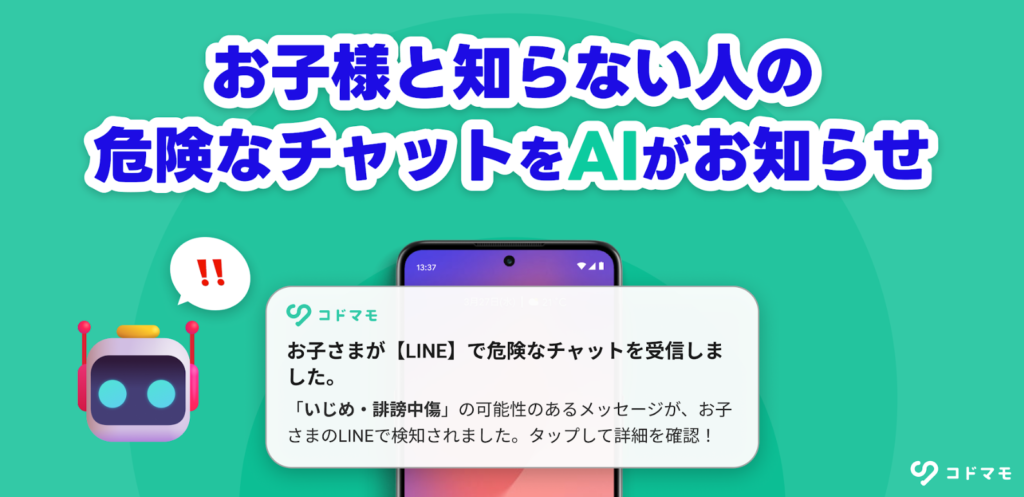
The above graphic illustrates how the Kodomamo app’s AI detects a child’s dangerous chats with a stranger and informs the guardian via an app notification.

◆Technical Superiority Competitors Can’t Replicate

Sugihara:
“Kodomamo” deeply intertwines AI and security technologies, and I would guess that high level of technical capability was another key factor in their evaluation. What specific technical advantages do you believe make you stand out? Where did you focus or struggle with during development?

Tomita:
Monitoring chats sounds simple, but executing it in practice requires various complex underlying technologies. Our core innovation lies in making it possible to analyze social media chat content, which was previously difficult to analyze.

We’ve been developing natural language processing models to determine potential dangers, image recognition models to detect inappropriate content, and ways to make those models lighter so they run smoothly on mobile devices. Being the first to accomplish what no one else had done—making chat analysis possible—is our greatest technical advantage.

At the same time, an intuitive UI/UX is equally crucial. I personally committed to working within the development team, and through everyone’s efforts, we were able to finalize and polish our product. No matter how superior a technology is, if it isn’t easy to use, it won’t achieve widespread adoption. Therefore, we have always been conscious of making the app clear and user-friendly.

Sugihara:
So, reading, analyzing, and detecting hazardous chats across platforms like LINE…are you confident that other startups will not be able to easily replicate this system?

Tomita:
Yes. Nowadays, AI allows people to quickly replicate existing apps, but this is different from creating something that doesn’t yet exist. It’s still quite difficult to simply ask AI to deliver something entirely new. We are proud to have an engineering team with a strong ability to do just that.

Furthermore, by meticulously building up and analyzing user feedback and data, our retention rate is continuing to improve month after month.

Sugihara:
That rate has recently started to stabilize for you, hasn’t it?

Tomita:
Typically, B2C services suffer from continuously declining retention rates, but in our case, the decline firmly stops after about six months. Proving that we are reaching the right target audience indicates that we are approaching product-market fit. But beyond the technical standpoint, I believe we’ve created an app that parents find genuinely useful through high-quality UX and overall branding.

Sugihara:
I can see how balancing serious technological skill with a user-centric design reflects your role as an overall producer, President Tomita.

~To be continued in Part 2~

Interview conducted by D-POPS GROUP’s advisor Genta Sugihara.

Adora Inc.

Company President and CEO: Naoto Tomita
Address: Setagaya Ward, Tokyo
Established: July 2023
Corporate Website: https://corporate.kodomamo.com/en

Next, in the second part of the interview, we discuss:
・Users’ reactions and feedback after installing Kodomamo
・Expanding collaborations with all three major mobile carriers
・“Kodomamo for School”: working with municipalities and schools
・And other topics

Be sure to check it out here:
https://d-pops-group.co.jp/en/column/adora-part2/
Related Articles

[Founder Interview #7] Naoto Tomita (Adora Inc.) – Part 3
The Three Values of Sunny, System, Solid: Building a Company to Solve Societal Issues with a Global Team In Part 3, the final installment of this three-part interview series, we take a close look at the people and culture of Adora Inc. Why did the development team, led by the CTO, Mr. Saurabh—whom President Tomita met in India—choose to join an unknown startup? We also cover the bonds President Tomita formed with the friends he met during his study abroad in Estonia, and their three corporate values of “Sunny, System, and Solid.” (Note: This interview was conducted in June 2026.) ◆Office in Kinshicho: A Choice Driven by Human Connection Sugihara: We are conducting this interview in a room in an apartment building in Kinshicho. It feels very cozy, complete with flowers. I understand you moved here this spring, but why did you choose this location? Tomita: There are a few reasons. Naturally, accessibility for all team members played a role. But on a personal level, I felt Kinshicho was a better fit than a high-profile area. Kinshicho is thriving enough to have five Starbucks locations, yet it maintains a remarkably down-to-earth atmosphere. Personally, I enjoy drinking alcohol together with the team—in moderation, of course—to deepen our bonds and boost our collective drive to push forward. So Kinshicho’s nearby izakaya pubs and convenient access made it the ideal spot. ◆Building a Team in Their Mid-Twenties Who Will Change the Future Sugihara: Your team has gradually expanded over the past six months. Could you share your current team structure, to the extent that you can disclose? Tomita: We remain a small company with around ten regular employees, and our core members are rather engineering-centered, but we’ve also welcomed new employees to handle HR, business development, UX, and public policy. Back-office members have also joined, and our functional roles are taking shape. It’s a young team, with an average age of around 26 to 27. We also have a lot of university student interns, so including them makes the overall average even younger. Sugihara: It’s really a team built to change the future. Starting with co-founder and CTO Saurabh, with whom I’ve had the chance to get a drink together, your development team consists of Indian engineers. Is their technical capability seriously on another level? And why did they choose to join a Japanese startup? Tomita: Individual capabilities matter far more than nationality, of course, but all our team members from India possess outstanding technical skills, paired with exceptional commitment and passion. They have a strong sense of ownership and a drive to build great products. Sugihara: They must be wonderful individuals to be not only highly skilled, but also diligent and passionate as well. Tomita: Indeed. I believe Saurabh’s character is the reason for that. Because he is a great person, great people naturally gather around him. Sugihara: Why did Saurabh and the Indian engineering team join Adora back when it was an unknown startup, long before your partnership with au? Tomita: Saurabh and I met at a cafe in India. Back in my student days, I worked a part-time job serving coffee and tea at that shop, and he was a regular customer. Our relationship started purely as friends. Through that connection, Saurabh brought together his colleagues and younger students from his university. Sugihara: So, it all started after you met at a cafe in India! Was it easy for Saurabh to join the company? Tomita: Initially, he kept his other job, but he was committed full-time to our company in the very early stages. Because he trusted me enough to bet on us, I constantly feel the responsibility to work hard and live up to that trust. He is someone who deeply values believing in people. ◆Making Udon Together in a College Dorm in Estonia Sugihara: Among your team members across various roles, some are friends you met during your time studying abroad in Estonia. What are they like? Tomita: Indeed, I met both our current UI/UX head and our HR head back in Estonia! At our dorm, we even made udon together while talking about how much we missed Japan, ha ha. Not only with them, but with all of the people in our company, there are countless moments when I genuinely enjoy working together and that I want to do my best for them, and I personally treasure that feeling. There are many things I cannot do alone, so I am deeply grateful that we complement each other as a team. I want to continue building on the foundation of what can only be accomplished together as a collective unit. ◆Formulating Three Core Values: “Sunny, System, and Solid” Sugihara: I understand that together with those teammates, you recently formulated your mission and values. Could you introduce them to us today? Tomita: Not too long ago, we began trying out three values as our guiding slogans, and then officially put them into practice starting this fiscal year. All three begin with the letter “S” to keep them memorable: “Sunny, System, and Solid”. “Sunny” means acting in a way that makes others feel that working with us is enjoyable and makes them want to support our journey. “System” is inspired by Toyota’s philosophy: “Don’t blame people; improve the system, instead”. When an issue arises, if the people involved start to blame each other, the individuals who are accused of fault will feel rejected. But when you make the mechanism—rather than the person—the target of discussion, it opens the door to constructive dialogue on how to improve. Because our business carries societal responsibility, we need an environment where mistakes can be identified openly while maintaining psychological safety. “Solid” means doing things right and executing steadily to completion. Being a startup is no excuse for shortcuts. Partnering with established corporations and local governments means that delivering on our promises is the most vital source of our reputation. Sugihara: That is excellent. For a security service partnering with established corporations, adopting “Solid” as a core value makes complete sense. ◆Intentionally Postponing the Corporate Website Sugihara: By the way, while Adora has a dedicated service website for Kodomamo, you don’t have a standard corporate website yet. Given the importance of having a place to show off your philosophy and company culture, was postponing it an intentional choice? Tomita: Since our early days, our mindset was that if we had the time to do something like build a corporate website, we should use that time to better please our app users instead. We operated with the mindset of fixing bugs before bothering to make a website. However, moving forward, we recognize the need for a corporate site that serves as a welcoming front door to recruit new teammates and scale our operations. While we might have seemed like a mysterious entity until now, ha ha, we plan to publish a website soon. (Note: Adora’s corporate website is now live at https://corporate.kodomamo.com/en) Sugihara: So, you were prioritizing product development above all else. There are definitely some startups with flashy corporate sites that lack underlying substance, ha ha, so I agree that focusing on delivering real value was entirely the right decision. ◆Goals for 2026–2027 Sugihara: What are your primary goals and major milestones for this year heading into next year? Tomita: Domestically, we want to further strengthen our sales through mobile carrier retail shops. Having reached approximately 300,000 users, we aim to grow that number to 500,000 and beyond. Internationally, we plan to determine our product-market fit in Taiwan to establish a repeatable success playbook, and then use it to drive expansion into countries such as Indonesia and the UK. We want the numbers for our domestic and international results to raise expectations both inside and outside the company. Furthermore, we aim to engage a broader network of stakeholders. Including collaborations with government ministries, our goal for this year is to demonstrate expansion that creates large-scale social implementation and impact. At the same time, establishing our culture and executing our values in a “Solid” manner remains crucial. We plan to expand our workforce thoughtfully while building a strong, healthy organization. ◆Realizing a Venture Ecosystem Sugihara: Finally, D-POPS GROUP’s aim is to realize a “Venture Ecosystem”. What aspects of that vision resonate with you? Tomita: I resonate with it strongly in all areas. No single individual or company can solve complex social issues or generate massive social impact alone. Just as a company cannot be built by one person, addressing societal challenges requires collaboration from various stakeholders beyond individual corporate boundaries. It takes more than just the startup itself—they need investors to back their vision, major corporations to partner with them to bring that vision to society, governments to support causes that benefit the public, and universities to collaborate with them on joint research. I believe we can only solve significant societal challenges by involving all of these stakeholders together. From our founding, Adora Inc. initiated joint development with the Aichi Prefectural Police and partnered with universities, making sure that our company was working not only for ourselves but for our surroundings, as well. Moving forward, we aim to build the ecosystem necessary for safe communication environments for children and families, protecting people from crime. I think our efforts will serve as a good example within the broader Venture Ecosystem. Sugihara: D-POPS GROUP aims to build a platform where diverse partners build an ecosystem together that generates shared value. Tomita: Exactly. It’s the principle that creating value for the ecosystem ultimately returns benefits to everyone involved. I wholeheartedly agree with that idea. ◆A Message to Readers Sugihara: Finally, do you have a message for our readers? Tomita: We’re strongly committed to deeply impacting society. We would be delighted to work together with anyone who shares that vision, whether they be a team member, a shareholder, or whatever relationship we have. D-POPS GROUP is a wonderful shareholder, and I highly recommend them, ha ha! And Kinshicho is a fantastic town, so please come visit us! Interview conducted by D-POPS GROUP’s advisor Genta Sugihara. Adora Inc. Company President and CEO: Naoto Tomita Address: Setagaya Ward, Tokyo Established: July 2023 Kodomamo App Website: https://www.adora-app.com/ Please check out Part 1 and Part 2 of this interview if you have not already!
  • Interview
2026.07.27
[Founder Interview #7] Naoto Tomita (Adora Inc.) – Part 2
Educational Settings, Global Expansion, and New Services: The Full Picture of Social Implementation Envisioned by Kodomamo In Part 2, the second installment of our three-part interview series, we explore how Kodomamo expanded beyond au into partnerships with the other two major Japanese mobile carriers, NTT Docomo and SoftBank. We also cover the current status of its global expansion into South Korea and Taiwan, initiatives for schools via “Kodomamo for School,” and its entry into a new area: fraud prevention for adults. (Note: This interview was conducted in June 2026.) ◆Post-Integration Performance and Reception Sugihara: How has the reception for Kodomamo been since its integration into au’s service plan? Could you share with us any details regarding signup rates and feedback from the field, to the extent that you can disclose? Tomita: Thanks to the in-store guidance provided at retail locations, the percentage of users actively starting to use Kodomamo has been steadily rising. Our metrics also show that users who try it are continuing to stick with it. We genuinely feel it is being received as a high-quality, valuable service. There is still plenty of room for improvement. We are continuously developing new features and refinements to make it even easier for sales staff at various locations to offer it, and in the future, we also plan to ask for further feedback from those on-site personnel. While more comprehensive feedback from end users and sales personnel will come in over time, the numbers are already showing very positive trends. Specifically, among subscribers to the U12 Value Plan, the proportion of users who register for Kodomamo has been gradually increasing when compared to immediately after the app was released. Sugihara: Do you think it’s because on-site sales staff have become more accustomed to explaining it, and some are now using it personally, making it easier for them to recommend? Tomita: I believe that plays a part. On our end, we’ve also made ongoing improvements, however modest. Early on, when users signed up at mobile phone stores, some mistakenly registered for a standard paid subscription through the app store, even though it was already built into their mobile plan, so they should have been able to use it for free. Accordingly, we updated our onboarding process to ask where users came from, creating a dedicated setup flow specifically for au customers to keep things clear and streamlined. As a result of these improvements, those issues have decreased significantly. We’ve really been improving iteratively as we run. Sugihara: Indeed, operational refinements are just as crucial as the level of completion when it comes to expanding an app’s user base. ◆Expanding Collaborations with All Three Major Mobile Carriers Sugihara: It’s already impressive enough that your app is getting featured at au shops, but we understand that referrals and distribution are now expanding across retail shop networks for NTT Docomo and SoftBank as well. How is the collaboration going with those two companies? Tomita: Because we operate with the mindset of solving a major social issue, partnering with multiple telecom carriers was something we aimed for from the very beginning. Our retail distribution first started in Docomo Shops, followed by official integration into au’s rate plan, and now SoftBank offers it at all of their stores as well. Of course, getting that all set into place required extensive operational adjustments, and the on-site sales teams worked exceptionally hard. Now, our user numbers are growing steadily, for which we are truly grateful. Sugihara: The referral numbers from SoftBank distributors have been surging rapidly, haven’t they? Tomita: They’re growing so much. Thanks to the hard work of everyone at SoftBank C&S and the dedication of the agency partners, momentum has really picked up since the start of this year. Sugihara: Besides the operational issues you experienced with au, did you encounter any challenges unique to NTT Docomo or SoftBank? Tomita: We were particularly mindful of ensuring our app wouldn’t conflict with services each carrier already offered. For example, SoftBank has its own proprietary security services, so we ran tests to ensure our app’s functions wouldn’t directly compete with or negatively impact their features. Rather than demanding for them to sell our product, we approach partnerships through fine-tuned adjustments that benefit both sides. If bugs or issues pop up on the ground, busy store staff lose the motivation to recommend the app. To prevent that, we always maintain a support system ready to respond immediately whenever anything arises. ◆Current Status of Global Expansion into South Korea and Taiwan Sugihara: Last year, you also launched the international expansion of Kodomamo. Which countries have you entered and how are things progressing? Tomita: We’ve expanded into South Korea and Taiwan. While this brought its share of challenges, the great thing about mobile apps is that you can translate the product, run ads, and conduct small-scale testing with a budget of around 500,000 to 1 million yen. In South Korea, testing revealed a clear, strong demand. The dangerous chat detection feature resonated even more than expected. Initially, we assumed location tracking would be the main selling point, but it turned out that right from the start, detecting dangerous chats was the top motivation for customers. During user interviews, Korean parents worried about things like whether their children were getting involved with illegal drugs. We rarely hear concerns like that in Japan, so that’s definitely one difference between regions. However, KakaoTalk is the dominant messaging app in South Korea rather than LINE, and we haven’t fully implemented complete compatibility for KakaoTalk yet. Since we have a strong feeling that doing so will drive growth, we plan to upgrade that before we start to really advertise our services there. In Taiwan, where LINE is widely used, we are currently acquiring users at a very low cost. Market demand is high, with some parents relying on the app even more actively than in Japan. We intend to put even more effort there going forward. Following Taiwan, we want to expand into other Asian nations like Thailand. Once we support WhatsApp, expansion into various other countries—including Indonesia and the UK—will also be within reach. Sugihara: That’s quite aggressive. You’ve really had a global perspective right from the founding of the company. Tomita: I believe this business addresses a universal need felt worldwide. That has been our target from day one. Naturally, a lot of people here want to support Japanese businesses working hard on the global stage, so we aim to become one of those companies. ◆“Kodomamo for School”: Working with Municipalities and Schools Sugihara: “Kodomamo for School” is your intriguing initiative to partner with local governments nationwide for school environments. I guess it must take a lot more time to see results from this, but could you briefly explain it to us? Tomita: Kodomamo for School is a service designed to be installed on educational tablets used in schools. While the standard Kodomamo is installed on smartphones used by parents and children, the “for School” version promotes the safe and effective utilization of students’ tablets. Its features include issuing alerts upon detecting explicit selfies or grooming behavior (such as exchanging nude photos), as well as website monitoring capabilities. While core functionality remains largely similar to the consumer version, the key difference is that the primary stakeholders are local municipalities and boards of education. Sugihara: Between this and your successful negotiation and partnership with the three major mobile carriers, your corporate credibility has grown significantly. Tomita: We are deeply grateful for that. ◆The Next Challenge: Developing Fraud Prevention Services for Adults Sugihara: Moving on, could you share any details about new services or features currently in development following Kodomamo? Tomita: Right now, we are developing a fraud prevention service for the general public aimed at combating scams on social media. Across Japan and globally, social media and chat-based scams—especially investment and romance scams—have become a severe social problem, with hundreds of millions of yen lost daily. While phone scams are well known, chat-based fraud is equally critical. Our core advantage lies in our ability to detect fraudulent activity within social media environments. While Kodomamo targets children, we are currently hard at work developing a service designed to detect fraud and protect adults. We are pushing to release it as quickly as possible. On the other hand, people who fall victim to scams rarely think to install protection apps on their own, making stakeholder collaboration even more crucial here than with children’s services. We are currently moving forward while gathering insights and feedback from various partners. Sugihara: Considering a service like this, being capable of partnering and collaborating with established companies becomes increasingly essential. Tomita: Absolutely. Although our engineering team is small, bringing unique features to market through social implementation alongside large corporations and local governments is indispensable for solving major societal challenges. ~To be concluded in Part 3~ Interview conducted by D-POPS GROUP’s advisor Genta Sugihara. Adora Inc. Company President and CEO: Naoto Tomita Address: Setagaya Ward, Tokyo Established: July 2023 Corporate Website: https://corporate.kodomamo.com/en Finally, in the third part of the interview, we discuss: ・Building a team in their mid-twenties who will change the future ・Forming their three values of “Sunny”, “System”, and “Solid” ・Realizing a Venture Ecosystem ・And other topics Be sure to check it out here: https://d-pops-group.co.jp/en/column/adora-part3/ In case you missed it, you can catch up on Part 1 of this interview here: https://d-pops-group.co.jp/en/column/adora-part1/
  • Interview
2026.07.23
[Founder Interview #6] Masaru Sunagawa (Startup Association of Japan) – Part 3
Creating a Society that Wants to Start Businesses: Opportunities for Japanese Startups and Challenges in Going Global In Part 3, the final installment of this three-part interview series, Masaru Sunagawa speaks candidly about the current state of Japan’s startup landscape. He reflects on how times have changed: in the past, leaving Mitsubishi Corporation to join a startup would’ve invited criticism, but today, it’s common for students at the University of Tokyo to launch their own companies. Yet, he also addresses the structural reasons why Japan has not caught up with the United States. Furthermore, as generative AI reshapes every profession, what human element will remain? Finally, Sunagawa shares his resonance with D-POPS GROUP’s vision of realizing a Venture Ecosystem. (This interview was conducted in May 2026.) ◆“Having Lunch with People I’d Added on Facebook but Hardly Ever Speak to”: How to Build a Wide Network Sugihara: Looking at your Facebook posts, you clearly have a broad network of influential leaders across various fields. How did you come to meet those individuals, and how have you come to grow the number of people you associate with? Sunagawa: I wasn’t posting on Facebook at first. By the way, these are all lunch meetings. Dinners usually involve alcohol, tend to drag on, and start feeling inefficient to me. But with lunches, both parties stick strictly to a one-hour window. It keeps conversations focused, concise, and highly efficient. I realized that lunch is actually far better. Sugihara: These people you’re getting lunch with…are they people you already knew? Sunagawa: They were existing contacts. But at some point, I started a personal project: having lunch with people I’d added on Facebook but hardly ever speak to. It felt like a waste to be connected without actually engaging. Since I only accept friend requests from people I’ve met in person, I have definitely met all of my Facebook friends at some point in the past. But for some contacts, I can’t quite remember who they are or where we met. So, I’ll message them that I honestly don’t quite remember who they are, but ask if they want to go for lunch, ha ha. After getting together with these contacts, I end up having fascinating conversations with people from mountaineers to fortune tellers. Once I started posting about these lunches on Facebook, other connections began reaching out asking, “Would you like to have lunch sometime?” My network expanded organically from there. I didn’t start this to boost my personal branding, by the way. Sugihara: Has this project impacted your company or your association positively? Sunagawa: Even though I didn’t plan it that way, of course it does have a positive effect. I don’t believe society operates only on a direct, transactional basis. If you help someone, they might mention your name elsewhere, another person may become interested in you, and an opportunity will come back to you serendipitously. That happens spontaneously, but I never count on it deliberately. ◆From an Era Skeptical of Entrepreneurship to UTokyo Students Launching Startups as the Norm: Japan’s Rapidly Evolving Environment Sugihara: In recent years, the Japanese government has significantly raised its commitment to supporting startups. An increasing number of top-tier students are choosing to found their own companies or join startups full-time after interning there, rather than taking traditional corporate jobs. As someone who has built multiple companies and achieved successful exits, how do you view today’s environment? Sunagawa: It is buzzing with incredible momentum. Back when I was running LocationValue, people reacted with total disbelief: “You’re seriously leaving Mitsubishi Corporation to start a business?” or “Did you do something to get kicked out?” I was treated almost like I had committed a crime, ha ha! I don’t want to speak ill of my associates of that time, but starting out was truly difficult—it felt like the business world was a total zoo. Today, graduates from the University of Tokyo naturally come to work at our company, and many found their own startups even before graduating. I expect that trend to accelerate even further. Starting a business has become vastly more accessible. Sugihara: The talent landscape is shifting, and entrepreneurship is becoming a natural choice. How many more years do you think it will take Japan to catch up to other countries? Sunagawa: Unfortunately, we’re not catching up yet. I believe it is a structural issue. First, talent mobility in Japan remains abnormally low. Second, regarding rulemaking: the U.S. operates under a federal system where corporate law is determined at the state level. States actively compete against one another to attract startups. This built-in competition naturally drives continuous improvements to startup-friendly regulations. Elon Musk relocating his companies to Texas, or businesses leaving California due to tax hikes—these are direct outcomes of state-level market dynamics. Japan operates under a centralized system, so competitive principles don’t apply as easily. As a result, while the U.S. advances through constant trial and error, Japan remains anchored to traditional corporate law without changing. Right now, we are debating issues like the global minimum tax: under certain conditions, exiting a company in the U.S. might incur zero exit taxes, whereas in Japan, an entrepreneur could face hundreds of millions of yen in taxes. Given that choice, where to incorporate is obvious. Our association argues that this friction directly contradicts the core vision of the government’s Startup Development Five-year Plan. ◆Opportunities and Challenges: How Do We Step Up from Competing at the Micro Level to Expanding Globally? Sugihara: In simple terms, what do you see as the key opportunities and challenges facing Japanese startups today? Sunagawa: The opportunities are nearly countless. On a micro level, the competitive environment within Japan isn’t overly fierce. For instance, our service has around 20 competitors in the U.S., but in Japan, Smartround stands alone as the dominant player. Operating costs in Japan are also lower when exchanged from key foreign currencies, and even if you do the same thing as in other countries, there’s plenty of potential to succeed in Japan. Additionally, the quality of human resources and the level of dependability here are excellent. Having lived in countries like the Philippines, Mexico, and the U.S. during my childhood, I can confidently say that Japan has an abundance of highly skilled, diligent, and trustworthy people. There is ample opportunity to build businesses that scale reliably. On the flip side, the biggest hurdle is expanding into the global market. In Japan, startups can achieve moderate success domestically even without a high level of competition. If founders settle for that level of growth, they rarely develop globally competitive services. That said, I expect at least the language barrier to largely disappear within the next two to three years, since AI can perform simultaneous interpretation. A lot of people talk about the importance of going global, but much of it is just shouting from the sidelines. It’s one thing if it comes from someone who has actually expanded internationally, but yelling advice without ever stepping up to the batter’s box changes nothing. Real change won’t happen unless we bring in truly successful U.S. entrepreneurs to serve as active advisors for Japanese startups. At Smartround, we asked the founder of a U.S. gaming company with a great track record to be an angel investor, and we value his counsel because the perspective he brings is entirely different from ours. ◆“Sell Pickaxes in a Gold Rush”: The Growth Markets Japan Should Target in the Era of AI Sugihara: What sectors could be considered promising growth markets for Japanese startups in the future? Sunagawa: I believe a growth market isn’t something that already exists, but rather, something we must proactively pioneer. Today, the whole world is being laid out according to AI. For example, I think Gemini is so strong because Google operates its own power plants and engineers its own custom TPUs. In contrast, players like Anthropic and OpenAI must purchase power from external providers and buy GPUs from NVIDIA, so they have not achieved full vertical integration. Only Google has been able to achieve that. As the saying goes, “During a gold rush, don’t dig for gold—sell pickaxes.” We need to ask ourselves what the “pickaxes” of the AI era are. The answer is energy and chipsets. Nuclear fusion will be absolutely critical. To establish a competitive edge, Japan shouldn’t spread its capital thin across a bunch of areas, but rather, we must double down and concentrate our resources boldly. ◆Which Jobs Will Vanish and Which Will Endure in the AI Era: The Honest Dilemma of Career Advice for My Son Sugihara: The rise and integration of generative AI are drastically transforming the corporate landscape. Which professions do you see disappearing, and which will survive? Sunagawa: That is an exceptionally tough question. Honestly, I sometimes wonder if any traditional role will remain entirely untouched. When Anthropic released financial capabilities for Claude, it instantly evaporated the primary job of entry-level investment banking analysts building financial models, and their agent Claude Legal will certainly put pressure on lawyers. What’s striking is that AI tools seem to specifically target lucrative, high-paying white-collar professions. If those all get automated, it feels like no jobs will be left. I struggled deeply with this when giving career advice to my son. I’ve built a career through Mitsubishi Corporation and a subsequent MBA from Harvard, interning at VC firms, and exposure to top investment banks like McKinsey and UBS. But when looking at a future where many of those roles could be automated, giving career advice is no longer so straightforward, ha ha! In the end, he decided to join a Japanese general trading company (sogo shosha). I think that was a great choice, because at its core, the work of connecting human beings is something AI cannot replicate. Moving people’s hearts, creating genuine emotional resonance, and building a deep level of trust with someone—AI cannot understand eye contact, physical presence, or interpersonal chemistry. That uniquely human domain is what will endure. ◆“Change Is Impossible Unless We Work Together”: On Realizing a Venture Ecosystem Sugihara: Finally, D-POPS GROUP’s aim is “realizing a Venture Ecosystem”. What aspects of that vision resonate with you, and where do you see opportunities for collaboration? Sunagawa: At the Startup Association of Japan , we have zero intention of trying to beat out anyone. On the contrary, we firmly believe that real systemic change is impossible unless we work together. As I mentioned earlier, our approach is all about open collaboration across every organization. We remain free to partner with anyone. Anyone who shares this desire and wants to elevate Japan’s startup ecosystem—even by a single millimeter—is a kindred spirit of ours, so please join us! Interview conducted by D-POPS GROUP’s advisor Genta Sugihara. Professional Background: Masaru Sunagawa, Representative Director of the Startup Association of Japan, President and CEO of Smartround Inc. After working at Mitsubishi Corporation and obtaining a MBA from Harvard, he worked as a director at a US venture capital firm. After returning to Japan, he founded LocationValue Co., Ltd., and sold it to NTT DOCOMO. After serving as the managing director for Android at Google, he founded Smartround Inc. in 2018. In 2022, he established the Startup Association of Japan and became its Representative Director. He works on developing Japan’s startup ecosystem, and was even involved in the compilation of the “Startup Development Five-year Plan”. Startup Association of Japan: https://www.startup-kyokai.org/ Smartround Inc.: https://jp.smartround.com/corporate Please check out Part 1 and Part 2 of this interview if you have not already!
  • Interview
2026.07.09
Back to COLUMN