

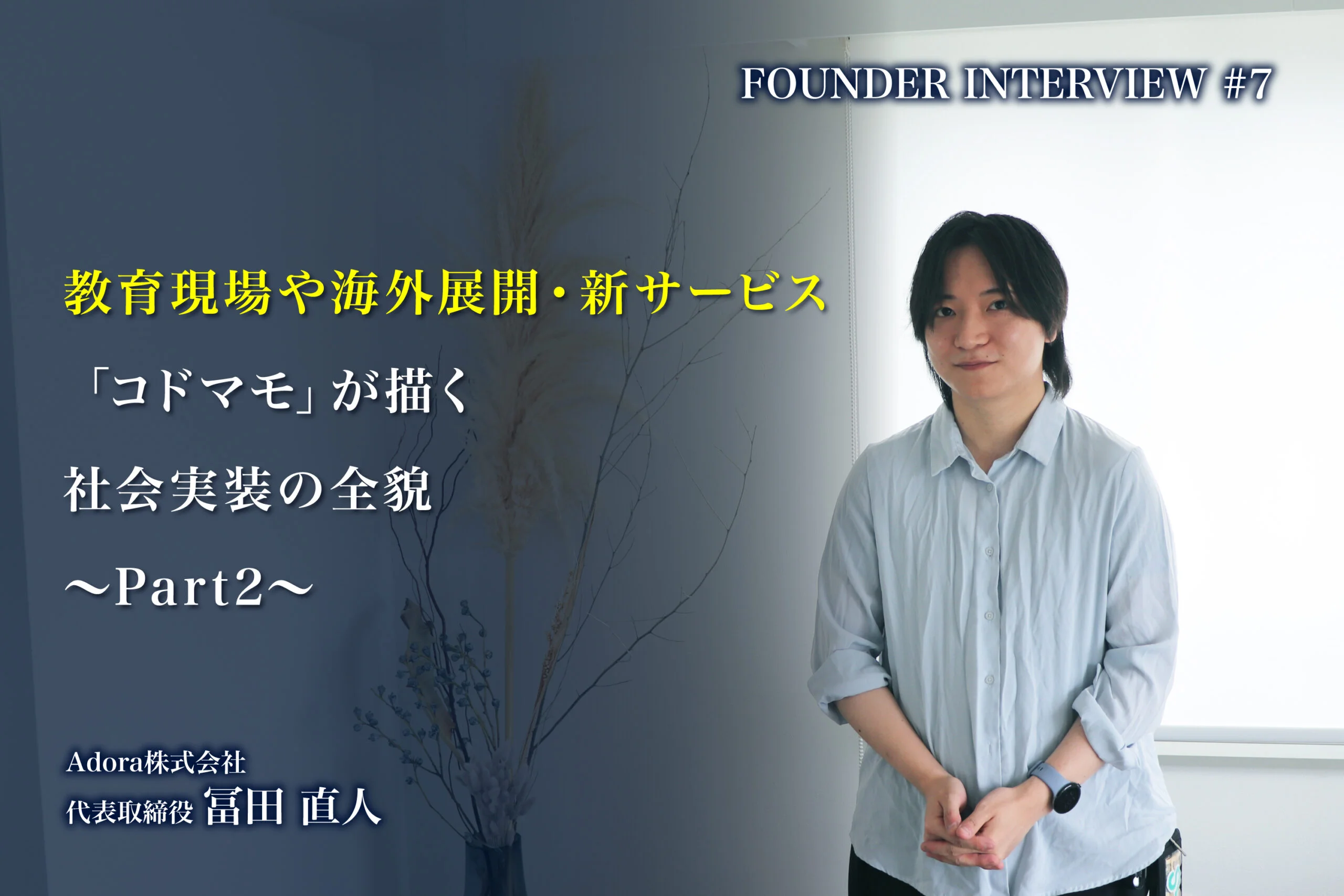
Educational Settings, Global Expansion, and New Services:
The Full Picture of Social Implementation Envisioned by Kodomamo
In Part 2, the second installment of our three-part interview series, we explore how Kodomamo expanded beyond au into partnerships with the other two major Japanese mobile carriers, NTT Docomo and SoftBank. We also cover the current status of its global expansion into South Korea and Taiwan, initiatives for schools via “Kodomamo for School,” and its entry into a new area: fraud prevention for adults. (Note: This interview was conducted in June 2026.)
◆Post-Integration Performance and Reception
Sugihara:
How has the reception for Kodomamo been since its integration into au’s service plan? Could you share with us any details regarding signup rates and feedback from the field, to the extent that you can disclose?
Tomita:
Thanks to the in-store guidance provided at retail locations, the percentage of users actively starting to use Kodomamo has been steadily rising. Our metrics also show that users who try it are continuing to stick with it. We genuinely feel it is being received as a high-quality, valuable service.
There is still plenty of room for improvement. We are continuously developing new features and refinements to make it even easier for sales staff at various locations to offer it, and in the future, we also plan to ask for further feedback from those on-site personnel. While more comprehensive feedback from end users and sales personnel will come in over time, the numbers are already showing very positive trends.
Specifically, among subscribers to the U12 Value Plan, the proportion of users who register for Kodomamo has been gradually increasing when compared to immediately after the app was released.
Sugihara:
Do you think it’s because on-site sales staff have become more accustomed to explaining it, and some are now using it personally, making it easier for them to recommend?
Tomita:
I believe that plays a part. On our end, we’ve also made ongoing improvements, however modest. Early on, when users signed up at mobile phone stores, some mistakenly registered for a standard paid subscription through the app store, even though it was already built into their mobile plan, so they should have been able to use it for free.
Accordingly, we updated our onboarding process to ask where users came from, creating a dedicated setup flow specifically for au customers to keep things clear and streamlined. As a result of these improvements, those issues have decreased significantly. We’ve really been improving iteratively as we run.
Sugihara:
Indeed, operational refinements are just as crucial as the level of completion when it comes to expanding an app’s user base.
◆Expanding Collaborations with All Three Major Mobile Carriers
Sugihara:
It’s already impressive enough that your app is getting featured at au shops, but we understand that referrals and distribution are now expanding across retail shop networks for NTT Docomo and SoftBank as well. How is the collaboration going with those two companies?
Tomita:
Because we operate with the mindset of solving a major social issue, partnering with multiple telecom carriers was something we aimed for from the very beginning. Our retail distribution first started in Docomo Shops, followed by official integration into au’s rate plan, and now SoftBank offers it at all of their stores as well.
Of course, getting that all set into place required extensive operational adjustments, and the on-site sales teams worked exceptionally hard. Now, our user numbers are growing steadily, for which we are truly grateful.
Sugihara:
The referral numbers from SoftBank distributors have been surging rapidly, haven’t they?
Tomita:
They’re growing so much. Thanks to the hard work of everyone at SoftBank C&S and the dedication of the agency partners, momentum has really picked up since the start of this year.
Sugihara:
Besides the operational issues you experienced with au, did you encounter any challenges unique to NTT Docomo or SoftBank?
Tomita:
We were particularly mindful of ensuring our app wouldn’t conflict with services each carrier already offered. For example, SoftBank has its own proprietary security services, so we ran tests to ensure our app’s functions wouldn’t directly compete with or negatively impact their features. Rather than demanding for them to sell our product, we approach partnerships through fine-tuned adjustments that benefit both sides.
If bugs or issues pop up on the ground, busy store staff lose the motivation to recommend the app. To prevent that, we always maintain a support system ready to respond immediately whenever anything arises.
◆Current Status of Global Expansion into South Korea and Taiwan
Sugihara:
Last year, you also launched the international expansion of Kodomamo. Which countries have you entered and how are things progressing?
Tomita:
We’ve expanded into South Korea and Taiwan. While this brought its share of challenges, the great thing about mobile apps is that you can translate the product, run ads, and conduct small-scale testing with a budget of around 500,000 to 1 million yen.
In South Korea, testing revealed a clear, strong demand. The dangerous chat detection feature resonated even more than expected. Initially, we assumed location tracking would be the main selling point, but it turned out that right from the start, detecting dangerous chats was the top motivation for customers. During user interviews, Korean parents worried about things like whether their children were getting involved with illegal drugs. We rarely hear concerns like that in Japan, so that’s definitely one difference between regions.
However, KakaoTalk is the dominant messaging app in South Korea rather than LINE, and we haven’t fully implemented complete compatibility for KakaoTalk yet. Since we have a strong feeling that doing so will drive growth, we plan to upgrade that before we start to really advertise our services there.
In Taiwan, where LINE is widely used, we are currently acquiring users at a very low cost. Market demand is high, with some parents relying on the app even more actively than in Japan. We intend to put even more effort there going forward. Following Taiwan, we want to expand into other Asian nations like Thailand. Once we support WhatsApp, expansion into various other countries—including Indonesia and the UK—will also be within reach.
Sugihara:
That’s quite aggressive. You’ve really had a global perspective right from the founding of the company.
Tomita:
I believe this business addresses a universal need felt worldwide. That has been our target from day one. Naturally, a lot of people here want to support Japanese businesses working hard on the global stage, so we aim to become one of those companies.

◆“Kodomamo for School”: Working with Municipalities and Schools
Sugihara:
“Kodomamo for School” is your intriguing initiative to partner with local governments nationwide for school environments. I guess it must take a lot more time to see results from this, but could you briefly explain it to us?
Tomita:
Kodomamo for School is a service designed to be installed on educational tablets used in schools. While the standard Kodomamo is installed on smartphones used by parents and children, the “for School” version promotes the safe and effective utilization of students’ tablets.
Its features include issuing alerts upon detecting explicit selfies or grooming behavior (such as exchanging nude photos), as well as website monitoring capabilities. While core functionality remains largely similar to the consumer version, the key difference is that the primary stakeholders are local municipalities and boards of education.
Sugihara:
Between this and your successful negotiation and partnership with the three major mobile carriers, your corporate credibility has grown significantly.
Tomita:
We are deeply grateful for that.
◆The Next Challenge: Developing Fraud Prevention Services for Adults
Sugihara:
Moving on, could you share any details about new services or features currently in development following Kodomamo?
Tomita:
Right now, we are developing a fraud prevention service for the general public aimed at combating scams on social media. Across Japan and globally, social media and chat-based scams—especially investment and romance scams—have become a severe social problem, with hundreds of millions of yen lost daily.
While phone scams are well known, chat-based fraud is equally critical. Our core advantage lies in our ability to detect fraudulent activity within social media environments. While Kodomamo targets children, we are currently hard at work developing a service designed to detect fraud and protect adults. We are pushing to release it as quickly as possible.
On the other hand, people who fall victim to scams rarely think to install protection apps on their own, making stakeholder collaboration even more crucial here than with children’s services. We are currently moving forward while gathering insights and feedback from various partners.
Sugihara:
Considering a service like this, being capable of partnering and collaborating with established companies becomes increasingly essential.
Tomita:
Absolutely. Although our engineering team is small, bringing unique features to market through social implementation alongside large corporations and local governments is indispensable for solving major societal challenges.
~To be concluded in Part 3~
Interview conducted by D-POPS GROUP’s advisor Genta Sugihara.
Adora Inc.
Company President and CEO: Naoto Tomita
Address: Setagaya Ward, Tokyo
Established: July 2023
Corporate Website: https://corporate.kodomamo.com/en
Finally, in the third part of the interview, we discuss:
・Building a team in their mid-twenties who will change the future
・Forming their three values of “Sunny”, “System”, and “Solid”
・Realizing a Venture Ecosystem
・And other topics
Be sure to check it out here:
https://d-pops-group.co.jp/en/column/adora-part3/
In case you missed it, you can catch up on Part 1 of this interview here:
https://d-pops-group.co.jp/en/column/adora-part1/