

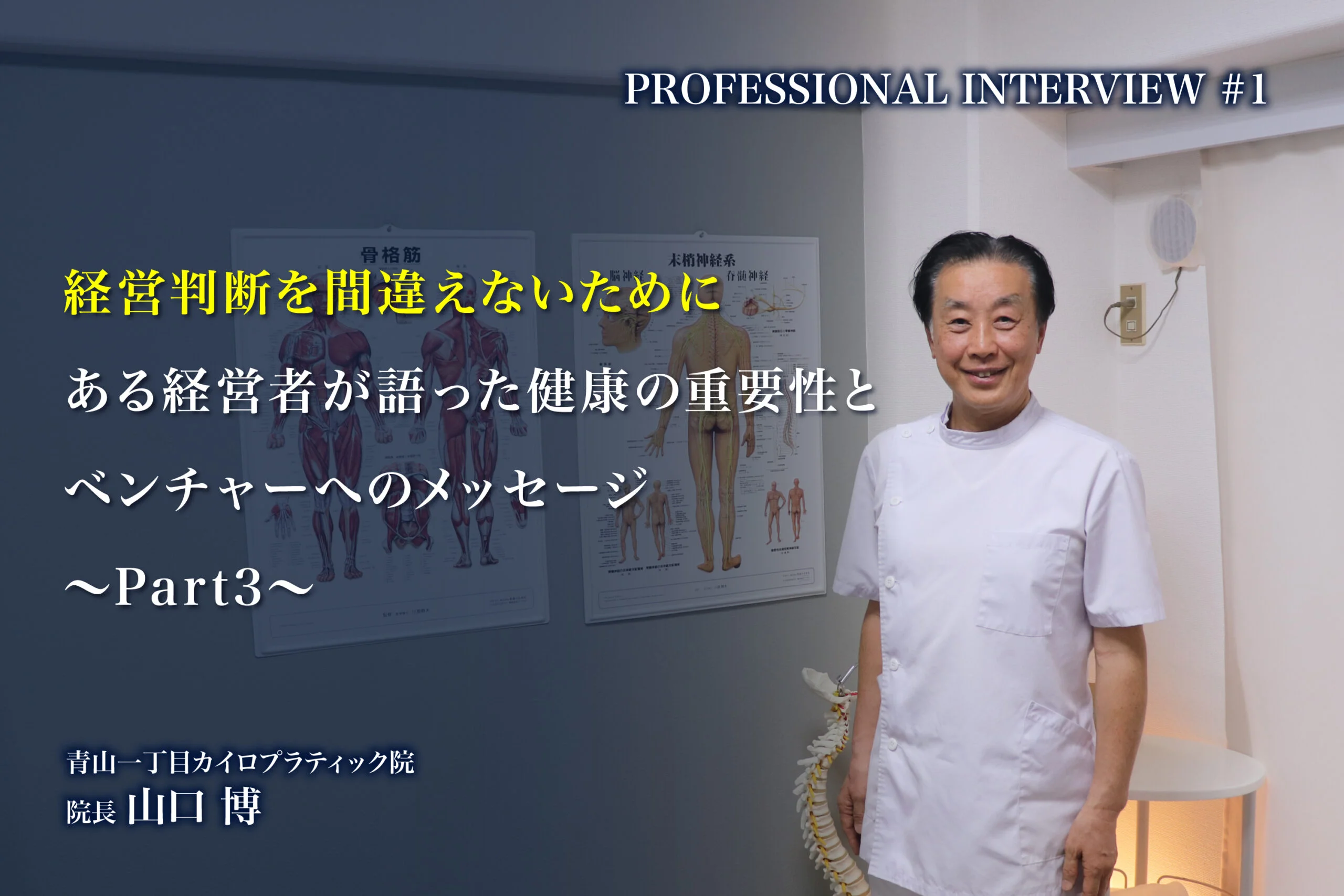
An Executive’s View on the Importance of Health in Avoiding Mistakes in Management, and a Message to Startups
In this final installment of our three-part interview, we hear about Director Yamaguchi’s altruistic habits that paved the way for his numerous television appearances. He also shares priceless quotes from Soichiro Honda (the legendary founder of Honda Motor Co., Ltd., who frequented the high-level clinic where Director Yamaguchi was training) regarding the fundamental reason executives must remain healthy and the speed of executive decision-making. Finally, we discuss the parallels between a thriving Venture Ecosystem and Director Yamaguchi’s philosophy of looking at how a system connects overall. (This interview was conducted in March 2026.)
See Part 1 and Part 2 of the interview here.
◆The Move to Aoyama-Itchome and the Spirit of Altruism that Led to Appearing on TV
Sugihara:
You have been running your chiropractic clinic in the Aoyama district for a quarter of a century now. Could you share the story of how you relocated to your current spot?
Yamaguchi:
Actually, I originally opened my practice in Shibuya. However, back in those days, the area around Tower Records in Shibuya had aggressive street hawkers who would even grab women by the arm to try and sell something to them. My patients would frequently give me feedback such as, “Today as well, I got intercepted twice on my way here,” or “The streets are so crowded, it’s not easy to walk down them.”
I decided it was time to find a new location, and at the time, I noticed that areas like Omotesando and Gaienmae already had chiropractic clinics with active websites, but Aoyama-Itchome had none. I figured that if my existing Shibuya clientele used the Hanzomon subway line, switching to Aoyama-Itchome wouldn’t be too much of an inconvenience. When I visited the neighborhood myself, I saw that the streets were wide enough, and in the year 2000, I officially relocated to Aoyama-Itchome.
Shortly after, the Oedo Subway Line opened, making our accessibility even better. Around the same time, a number of major television networks besides NHK began setting up their offices in Minato Ward. Consequently, assistant directors from various TV programs started calling my clinic requesting research on chronic stiff shoulders and lower back pain.
Instead of just giving them quick answers over the phone, I took the time to meticulously summarize my responses into Word documents, email them over, and even send out documents by post. Then suddenly, one of them asked, “Would you be willing to appear on TV?” That single moment became the catalyst for my appearances on a wide variety of television programs.
Later on, he was promoted to a full director, and I asked him, “Why did you choose me out of all the practitioners in Tokyo?” He replied, “More than anyone else, you responded to me politely, putting together and mailing professional documents. I promised myself back then that the moment I was given my own show, you would be the very first person I called.”
In the words of business philosopher Kazuo Inamori, this is the “spirit of altruism”. I didn’t do all that expecting something in return; simply treating that director with sincerity in my heart eventually came back to me in a much more impactful way. If I had approached the person while specifically looking to get something, it probably wouldn’t have turned out that way.
When I share this story with the executives who visit my clinic, many of them say, “It’s the same with business management.” Many of them have experienced that rather than demanding to get something, doing something sincerely for another person is what ultimately results in receiving something in return.
◆Essential Reasons Why Business Leaders Must be Healthy, According to Soichiro Honda
Yamaguchi:
At the clinic where I trained, a lot of our regular clients were business executives. One particular story from that time is still being passed down to this day. It involves Soichiro Honda, the founder of Honda Motor Co., Ltd. I never met Mr. Honda face-to-face myself, but one of my senior colleagues was responsible for treating him.
One day, my colleague asked him, “Mr. Honda, as the head of a massive corporation, you carry an immense workload. Yet you don’t seem to suffer from any specific pain or physical ailments. So, why do you make it a point to come here so regularly?”
I was told Mr. Honda replied like this: “As the leader of a company, there’s no feeling like when business is going well and you’re blowing the trumpet to command everyone to advance. However, there are times when you must stop that advance, and you sound the trumpet to signal a retreat. If you don’t time that retreat well, you will severely damage the company. But unless you are in good health, you will not be able to sound the retreat accurately, and that is why I keep coming here.”
This quote was passed down among my senior colleagues. It reminds us that for a business leader, staying healthy is not simply a matter of managing one’s physical condition, but rather, it is the very core of being able to correctly make important decisions.
I heard another fascinating story about Mr. Honda. While the clinic’s director was treating him, the director mentioned that the car seats of that era (which were so soft that drivers would sink deeply into the cushion) were not good for the body. Mr. Honda said, “I see,” and left, and then the next day, a whole team of Honda engineers arrived at our clinic. Apparently, they sat down with the director and drafted a seat schematic. That prototype seat was immediately used in the next vehicle models they released.
What amazed me most was how fast his decision-making ability was, and that when he realized “This would be a benefit for our drivers,” he put it into action by the next morning. I deeply felt the significance of having a leader who can move like that.
◆The Japan Posture Education Association – Spreading the Value of Alignment Globally
Sugihara:
While running your clinic in Aoyama for a quarter of a century, you have also been busy with various other activities. Could you tell us about your work with the Japan Posture Education Association?
Yamaguchi:
The goal of this association is to train people to understand the fundamental importance of posture and communicate it clearly to others. Our ultimate mission is to support both mind and body through proper posture, contributing to a long-lived, healthy society.
While almost everyone knows that posture is important, it’s actually difficult to explain in an accessible way why it matters, what’s wrong with having bad posture, and how to correct it. To address this, we established the formal qualifications of “Posture Education Advisor” and “Posture Education Instructor”, and we train people in attaining them. We also host seminars tailored to interested parties as well as to those aiming to become educators.
◆Lectures at the Open University of Japan: The Secret Behind a Course So Popular, It’s Lottery-Based
Sugihara:
Something else you’ve been doing for many years is teaching at the Open University of Japan. What kind of audience are your courses geared toward, and what are they about?
Yamaguchi:
Initially, I taught a course titled “Posture and Health”. Later on, I handed that class over to a younger instructor from our association, and now I teach a course titled “Building an Undefeatable Body with the Study of Posture”.
Not many students of the Open University of Japan are pursuing a college degree; most of them are after personal and social enrichment. A lot of them are in their 40s, 50s, and 60s, you know. My course doesn’t include any aspect of chiropractic medicine at all.
Sugihara:
So it’s designed for those from the general public who seek enrichment. It must be very popular.
Yamaguchi:
Somehow, enrollment has to be determined by a lottery system every single time. It has become one of the most highly attended courses at the Open University of Japan. Before the pandemic, there were even students who would fly in from places like Hokkaido and Kyushu just to attend. Because it’s structured as an intensive course with eight modules on Saturdays and Sundays, out-of-town students can attend on weekends while staying one night in a hotel. Simply hearing stories of such dedication is enough to make us instructors even more motivated to give the lectures our absolute best.
◆Venture Ecosystem and Chiropractic Philosophy: Resonating With Making Big-Picture Connections
Sugihara:
At D-POPS GROUP, our aim is to realize a Venture Ecosystem through integrating “Real World × Technology × Synergy”. We are building a platform where companies both within and outside our group are supported not just through funding, but through sales cross-promotion, talent recruitment, etc. Do you feel like any of these have something in common with your initiatives, or are there any points you particularly resonate with?
Yamaguchi:
Where I deeply resonate with your vision is looking at the overall flow and connections, rather than focusing on a single, isolated part.
For us chiropractors, too, if a patient bumps their elbow and experiences numbness in their pinky finger, for example, we don’t just treat the pinky; we analyze their posture overall to figure out why that happened. Similarly, for stiff shoulders, we look beyond the shoulders themselves, checking the height of their computer monitor, their chair’s position, and their environment in general to help their shoulders get better. I feel like where your perspective aligns with mine is the way we look at something through its connections.
Sugihara:
The part you said about improving the overall flow is really true. During our company’s regular board meetings, the executives from all of our group companies give their progress reports, and then afterwards, they have a second meeting where they share their concerns and dilemmas, and discuss their ideas and experiences with each other.
We also maintain the same kind of relationship with companies outside our immediate group, which are members of our Venture Ecosystem through our corporate investments. It’s never just about the money; we co-pitch to clients, introduce human resources, and connect them with key customers. That is exactly what it means to improve the flow within an ecosystem. And while we’ve been talking, I think that’s really similar to healthy blood circulation.
Yamaguchi:
Blood circulation gets hindered by the physical fatigue of supporting the body’s own weight, but it’s also affected by mental, neurological exhaustion. While you can reduce physical fatigue simply by exercising, in the case of mental fatigue, you can stimulate serotonin production, boost creativity, and stabilize your feelings by being emotionally moved or laughing deeply, or even by taking a slow morning walk in the sunlight, synchronizing your breath with your stride. You can see why so many business leaders go on walks in the morning.
I suggest not wearing sunglasses for your morning walks, unless your eyes have some medical condition that won’t allow it. When direct sunlight enters your eyes, it dramatically increases serotonin secretion. This fact is thoroughly verified by scientific researchers.
◆A Message to Our Readers: The Greatest Doctor Is Inside Your Own Body
Sugihara:
To bring our interview to a close, do you have a final message for our readers?
Yamaguchi:
I urge everyone to invest in their bodies and their health. After all, your health is directly linked to your business performance.
Where do you think the world’s greatest doctor resides? At a famous university hospital? The truth is, the best doctor in the world lives inside your own body. The moment something goes wrong, your body alerts the brain, and the brain immediately sends corrective measures back to the body. Your autonomic nervous system is responsible for this.
Most of the autonomic nerves travel through your spine to your organs and limbs. In other words, your spine’s health is extremely important to your whole body’s health. Furthermore, your spine and your posture are equal. If your posture gets out of shape, your spine will also get out of shape. Therefore, keeping good posture is connected to maintaining your autonomic nervous system.
Once again, if you don’t keep moving your joints, you won’t be able to. If your body remains continuously slouched, it will gradually lose the ability to straighten out entirely. That is exactly why you must make a conscious, daily effort to move. Your investment in your health is an investment in the success of your business. I sincerely hope these insights offer some support to you all. Thank you very much.
Interview conducted by D-POPS GROUP’s advisor Genta Sugihara.
Aoyama-Itchome Chiropractic Clinic
Director: Hiroshi Yamaguchi
Address: 740 Win Aoyama, 2-2-15 Minamiaoyama, Minato, Tokyo
Website: https://aoyama1.jp/