

COLUMN

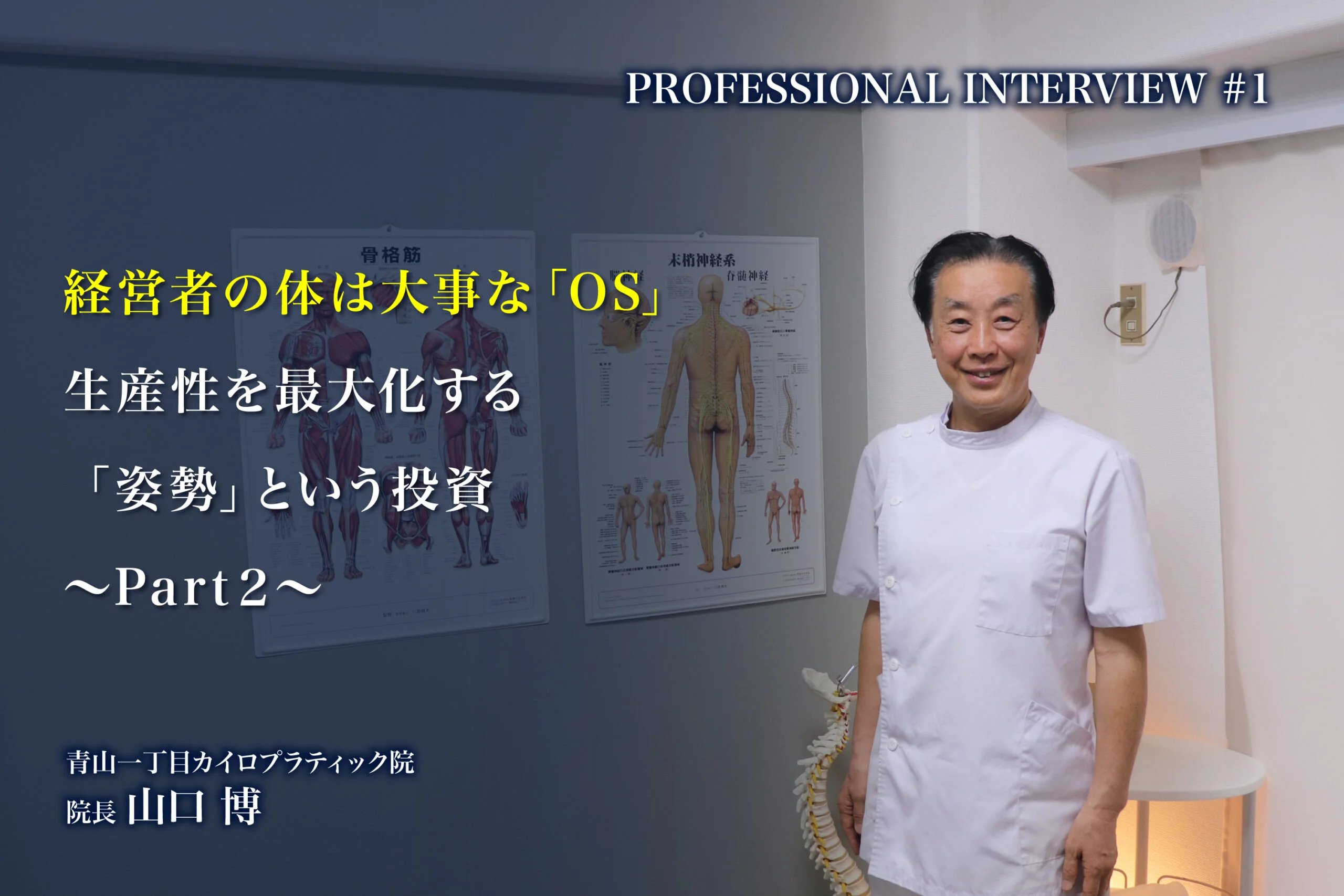
[Founder Interview #6] Hiroshi Yamaguchi (Aoyama-Itchome Chiropractic Clinic) – Part 2

  • Interview
2026.05.29

The Body is an Executive’s Precious “OS”:
Maximizing Productivity by the Investment of One’s Posture

In this second part of our three-part interview, we dive deep into the profound impact that loneliness and mental stress can have on executives’ physical bodies. We reveal the striking parallels between a professional’s perspective—analyzing patients’ walking style, facial expression, and tone of voice before they even sit in the chair—and an investor’s evaluation of an entrepreneur’s “human OS”. Director Yamaguchi also shares the fundamental, biological truth that posture and facial expression mutually reinforce each other, and he opens up about the exact moment that set him on his lifelong path to chiropractic medicine.
(This interview was conducted in March 2026.)

If you haven’t read Part 1 yet, you can do so here.

◆An Entrepreneur’s Body is Like an “OS”, and Posture is an Investment towards Maximizing Productivity

Sugihara:
I believe this topic is incredibly vital for young entrepreneurs in the IT and tech sectors. Many of these founders belong to a generation that has had a smartphone in their hands for as long as they can remember. Could you break down what happens when you have poor posture in a way that speaks directly to them?

Yamaguchi:
As I emphasized earlier, I want leaders to view correcting their posture not simply as a health routine, but as a direct investment to ensure the success of their current business—an investment to maximize their productivity.

For corporate executives and others who work in startups, your physical body is like your OS (Operating System). No matter if you have amazing software (i.e., your skills and strategies), they’re meaningless if the underlying OS isn’t running smoothly. That OS is your own body.

Sugihara:
Right, if the OS is full of bugs, you won’t be able to realize the framework you’ve envisioned in your head, even if you have great apps.

Yamaguchi:
Precisely. While your health is not all about posture, posture is still a deeply important part. That is the exact message I want to convey.
◆Stress Stiffens the Body: the Mechanism of Mental Fatigue

Sugihara:
Within D-POPS GROUP, we have 25 group companies and have invested in about 30 other portfolios. Their leaders are all working incredibly hard across various fields to solve pressing social issues.

However, various forms of pressure—such as cash flow issues or HR problems—start to hit once people step into an executive role, yet many find themselves in a position where they can’t talk about it with anyone. Call it the loneliness of leadership if you will, but they have to persevere while carrying burdens they can’t share. Does this kind of condition easily contribute to physical ailments?

Yamaguchi:
There is physical fatigue, which comes from holding up or carrying something. But there is also mental and emotional fatigue; the exhaustion caused by constantly having to be overly mindful of others, the pressure of endless problem-solving, or being caught in the middle of conflicting parties. This also can cause muscles to stiffen.

In fact, while physical fatigue can be relieved to some extent by moving and stretching, mental fatigue often causes a greater effect on the physical body.

Take the old Japanese idiom, “Drowning in debt so deeply your neck won’t turn”. Continuously worrying about something or experiencing hardships one after another causes your neck and shoulders to become incredibly stiff, leading to insomnia, migraines, etc. People in ancient times were purposely verbalizing those exact physical symptoms. That phrase describes one of the classic physical symptoms triggered by extreme stress.

When the idiom was coined, the word “stress” didn't even exist, but to put it in modern terms, “stress physically prevents your neck from turning”.

I once treated a CEO from a foreign company who didn’t know much Japanese. Suspecting that his chronic headaches and neck pain were purely stress-induced, I asked him in English, “How do you like your new boss?”, to which he replied, “He’s a pain in the neck.” In Japanese, the equivalent phrase would directly translate to ‘He hurts my head’, but it’s clear that in both Japanese and English, people express the biological truth that stress targets the neck.

◆Cranial Nerves Directly Affect the Neck and Shoulders: the Biological Mechanism of Stress

Sugihara:
So, continuing to internalize all that pressure will impact the body.

Yamaguchi:
Exactly. People who spend an entire day working alongside someone they have to tiptoe around or completely clash with, they’ll often have stiff necks and headaches by evening, even if they weren’t sitting down. That isn’t physical exhaustion; it comes entirely from emotional fatigue.

The reason for this is that most movements below the shoulders are controlled by nerves originating from the spinal cord—a body part with no emotions—so no matter how mentally exhausted or stressed you are, your arms or legs won’t suddenly refuse to move. However, motions in the head, neck, and shoulders are connected to the cranial nerves, which emerge directly from the brain itself, which processes your emotions. Mental stress, anxiety, frustration, and worry travel directly along those nerves, causing the muscles in the neck and shoulders to immediately tense up.

There are 12 pairs of cranial nerves. Among them, the 11th pair—known as the accessory nerves—directly stimulates the major muscles responsible for moving the neck and shoulders, such as the sternocleidomastoid muscle. When this specific nerve is compromised by emotional stress, your neck won’t turn and your shoulders become as hard as rocks.

Also, nerves come out of either the left or the right sides of the body. If a right-handed person experiences tension exclusively on their left neck and shoulder, there’s a chance that it’s not being caused by a behavioral habit like how they hold their smartphone, but rather, it might be resulting from a cranial nerve.
◆The Path from Young Train Enthusiast to Chiropractor

Sugihara:
Spoken by a true professional, ha ha.
By the way, had you been aiming for this specific career path since your student days?

Yamaguchi:
No, not at all, ha ha! Back in my student days, I was completely obsessed with steam locomotives. I spent all my time traveling across Japan, from the wilderness of Hokkaido down to the southern tips of Kyushu, just to take photos of trains. I was a total fan of train photography.

But since I had absolutely no money, I traveled on an incredibly grueling budget and schedule. I’d catch a train at midnight, scramble to make a transfer around 3:00 AM, and finally arrive at my destination around 6:00 AM. Combined with the return trip home, it was quite rough on my body. My family home was in Shinjuku, so I would frequently drop by the Kinokuniya bookstore to stand in the aisles, using books about stretching as references.

Even after graduating from university, that habit of visiting Kinokuniya stuck with me. One day, while wandering through the orthopedics section, I found a book written by a chiropractor titled Improper Backbone Shape Triggers These Illnesses. When I picked up that book, I had no idea what was inside, but it became the very reason why I entered the chiropractic world.

The book’s contents were absolutely fascinating to me. Until that moment, I had always assumed physical pain was exclusively caused by overdoing things or bumping into something. But this book claimed that poor posture alone could cause problems for all sorts of body parts. I found it so intriguing that I immediately called the phone number printed in the book, and they pointed me toward an institution where I could actually study chiropractic medicine.

◆Quitting a Job, Working Part-Time Every Night, and Studying until Morning

Yamaguchi:
I agonized over the decision for a few months, but I finally made up my mind, quit my corporate job, and worked part-time while studying. At the time, I worked at Potomac, a traditional-style coffee shop inside the Akasaka Prince Hotel. My shifts ran from 4:00 PM until 12:30 AM. Afterward, I’d get a ride back to my home in Waseda and keep studying until daybreak.

However, that study schedule didn’t bother me in the slightest. Perhaps because my sympathetic nerves were stimulated from my part-time job, I was able to stay very focused deep into the night. Just like when I was studying for university entrance exams, my brain was operating at full power. Every single day, I would completely lose myself in anatomy textbooks until dawn. Just as it was becoming light outside and people were starting to walk around, I’d fall asleep. Then, I’d wake up in the afternoon, and head back to work again.

Looking back, I sometimes wonder if my father’s experience as a combat medic treating wounded soldiers in the war got passed down to me through DNA or something. He wasn’t a military surgeon, but as a combat medic, he still treated countless individuals under extreme pressure. I am not a medical doctor either, but the fact that I have dedicated my life to preserving people’s health makes me feel connected to him somehow.

Sugihara:
How many years ago did you first become independent?

Yamaguchi:
My first time trying to go independent was about 40 years ago. I was naive, so I simply registered my home address as a chiropractic research institute and mailed advertisements to dozens of companies listed in the quarterly business journal. I remember pouring a drink and eagerly waiting by the phone to see how many responses I’d get…but of course, there weren’t any, ha ha. There were no personal computers back then, so I had simply typed a plain text document on a word processor. No diagrams, and no one whom I could use as a reference. It was just a letter stating, “I wish to help meet the health needs of your company’s employees.”

However, when I shared what I was doing with my mentors and close friends from university, three of them actually went out of their way to negotiate with their respective employers. They managed to get permission for me to utilize their companies’ medical rooms and employee lounges once a week or twice a month. Instead of having to force my way in, I was able to build up my practice through those companies officially.

Later on, I was contacted by a famous practitioner in Shibuya who recruited me into one of Japan’s top-tier chiropractic clinics. Their clients were prominent figures from various fields, including three former Prime Ministers, professional athletes, executive members of major businesses, major real estate companies, and the aviation industry, well-known celebrities, etc.

Sugihara:
And you call that your ‘training period’? Ha ha…

Yamaguchi:
Yes, that really was my training period before I went independent.

At that clinic, some of the patients wouldn’t pay any attention to me, but when the director entered, they would smile happily and start a conversation. When I saw that, it ignited a fighting spirit inside me. After all, it was perfectly natural that none of them would be particularly interested in talking with a young kid, since they were coming to see the director, who they felt would keep their bodies in good health. At some point, I had the thought that I would become like him someday.

◆A Professional’s Perspective: Analyzing a Person through Walking Style, Facial Expression, and Tone of Voice

Sugihara:
In your line of work, dialogue must be a critical component of administering an effective treatment, right?

Yamaguchi:
It is absolutely necessary. Observing the way a patient walks through the door, their responsiveness when speaking, or any subtle deviations from their usual baseline is part of the treatment, not just the physical adjustment.

Keep in mind that patients who are bordering on clinical depression, for example, present themselves with a rounded spine and a downward gaze the moment they enter. Even the person’s response to a greeting can signal that something is not right. I approach every treatment by holistically evaluating a person’s walk, sitting posture, facial expression, and voice.

Sugihara:
I resonate with that deeply. Back when I worked in business development, and even now when I interview entrepreneurs as an investor, it is exactly the same.

Naturally, I ask structural questions about their business model, market domain, and technical solutions. However, what I am truly analyzing is the expression on their face when they walk into the room, the level of confidence radiating from their answers, and the way their eyes light up when you hit them with a poignant, spot-on question. My primary goal is to thoroughly evaluate the individual’s underlying OS. It’s the same sort of evaluation.

Yamaguchi:
I actually conducted a survey among students at Waseda University regarding their impressions of individuals with rounded backs. The overwhelming responses were descriptions like “lacks confidence”, “frail”, or “looks like life isn’t going well”. Furthermore, a slouched posture is a primary reason people look prematurely aged.

Conversely, an upright, elongated spine not only projects youthfulness but physically lifts the muscles that control facial expression and optimizes blood flow to the brain. When posture collapses, cerebral blood flow stagnates, causing brain activity to decelerate. Correcting your alignment is truly a strategic investment that simultaneously optimizes both your internal state and your external presence.

Sugihara:
Absolutely, a slouch immediately projects a lack of confidence. I pay close attention to facial micro-expressions during interviews as well. Occasionally, someone will give off a distinct negative vibe or energy. No matter how eloquently they speak, it makes me pause and reconsider forming a deep partnership with them.

Alternatively, when reconnecting with an entrepreneur after a while, even if they say, “I’m doing great,” I will cross-reference that statement against their posture, eye strength, and overall expression. If I sense an underlying misalignment, I gently prompt them to tell me if anything is wrong, and adjust how I interact with them if necessary.

Yamaguchi:
Facial expressions dictate your physical state, and your physical state dictates your facial expressions. This goes both ways. For example, when a patient’s stomach lining is inflamed, the distress often manifests as acute tension in the upper back. While I cannot physically massage someone’s internal organs, relieving the tension in the back muscles can indirectly soothe the stomach. The same principle applies to depression. By physically unburdening and loosening the spine, I can often alleviate some of the emotional weight clouding the mind. The body and the mind are profoundly and inextricably linked.

~To be continued in Part 3~

Interview conducted by D-POPS GROUP’s advisor Genta Sugihara.

Aoyama-Itchome Chiropractic Clinic

Director: Hiroshi Yamaguchi
Address: 740 Win Aoyama, 2-2-15 Minamiaoyama, Minato, Tokyo
Website: https://aoyama1.jp/

Next, in the third part of the interview, we discuss:

・The move to Aoyama-Itchome and the spirit of altruism that led to appearing on TV
・Essential reasons why business leaders must be healthy, according to Soichiro Honda
・Similarities with a Venture Ecosystem
・And other topics
Be sure to check it out here:
https://d-pops-group.co.jp/en/column/aoyama1-yamaguchi-part3/
Related Articles

[Founder Interview #5] Masaru Sunagawa (Startup Association of Japan) – Part 1
Why an Entrepreneur Created an Organization Himself: The Startup Association’s Origin Story In this first entry of a three-part interview, we explore the backstory of serial entrepreneur Masaru Sunagawa establishing the Startup Association of Japan in 2022. We hear about how strange he felt the Ministry of Economy, Trade and Industry’s advisory committee was because it had virtually no representative from the entrepreneur side, and how that led to the establishment of an organization. We get a glimpse of their activities aimed at raising the level of the startup ecosystem, the meaning of their mission “policy making by startups, for startups”, and the difficulty of management compared to the example of a PTA. (This interview was conducted in May 2026.) Professional Background: Masaru Sunagawa, Representative Director of the Startup Association of Japan, President and CEO of Smartround Inc. After working at Mitsubishi Corporation and obtaining a MBA from Harvard, he worked as a director at a US venture capital firm. After returning to Japan, he founded LocationValue Co., Ltd., and sold it to NTT DOCOMO. After serving as the managing director for Android at Google, he founded Smartround Inc. in 2018. In 2022, he established the Startup Association of Japan and became its Representative Director. He works on developing Japan’s startup ecosystem, and was even involved in the compilation of the “Startup Development Five-year Plan”. Startup Association of Japan: https://www.startup-kyokai.org/ Smartround Inc.: https://jp.smartround.com/corporate ◆“There Were Almost No Entrepreneurs”: A Strange Advisory Committee Led to the Establishment of an Organization Sugihara: First, could you tell us the background of how you established this Startup Association four years ago in February 2022? Sunagawa: Originally, before joining Google, I was running a startup called “LocationValue”, and before that, I worked at an independent VC (venture capital) firm in the US, so I have been involved with startups in various positions. When I came back to Japan and was managing a startup, there were many times when I thought that entrepreneurship here looked strange. The current Companies Act was enacted in 2006, so when I started my company in 2005, companies at that time had to follow the old commercial code. The law itself was written in katakana and was very hard to read, and moreover, the concept of preferred stock like we have now was not established. Therefore, we had no choice but to receive investment from VC through ordinary shares, and to avoid that associated risks, buyback clauses had to be included. Although the Companies Act was enacted in 2006, it was around 2010 when preferred stock started to be used in earnest. I am one of the rare individuals who have experienced business management both from before and after that transition period. Because of my background, a person named Ishii, who was a director at the Ministry of Economy, Trade and Industry at the time, reached out to me at some point in 2019 or 2020. Director Ishii said, “You seem to know a lot about the contents of investment contracts, so would you join our advisory committee?” However, when I went there, virtually everyone was from academia or VC, and there were almost no entrepreneurs. I thought, “Even though we are discussing startup investment contracts, why are there so few people here who are actually from a startup?” The investing side and the side receiving the investment have conflicting interests. For example, at the time of an M&A, it always becomes a talk about who takes more, so an investment contract is a very delicate thing. I told that to Director Ishii, who said to me, “I just didn’t know who to approach.” That became my inspiration to establish an organization. However, it took time from there. I had to gather partners, and I also had my own job. Even figuring out how to make a general incorporated association was a matter of trial and error, and the preparations took time. Sugihara: At that time, you had already started your own company too, right? Sunagawa: I had started Smartround Inc. in 2018, and we had just launched services in 2019. Sugihara: Even so, when you presented your awareness of the problem at the advisory committee, you were told, “Why don’t you make it?”, and it was pretty much decided for you. Did you have a “Well, somebody’s gotta do it” sort of attitude? Sunagawa: Exactly. Thankfully, since I had successfully exited my first startup, I am not in much trouble financially. And since that’s the case, it’s natural to start thinking about what I can do for the next generation. That’s my philosophy behind Smartround, too. Smartround is a service that helps to optimize operating within the rules, but if the rules themselves are not good, there is nothing we can do. So the idea is to make sure the rules are properly fixed. ◆“Policy Recommendation”: The Only Thing They’re Really Doing Sugihara: On your association’s website, if one looks at the details of what your various working groups are up to, and what external collaborations are going on, it’s clear that in a wide range of areas, you are participating in commissions and events, as well as publishing reports. What area do you focus on the most? Sunagawa: What we are focusing on is policy recommendation, and you should think of that as all we’re really doing. Everything else we do is more like an accompaniment to that. Honestly, I think policy recommendation is everything. Our mission is “to evolve Japan into the ‘world’s best environment for startups’ through providing mutual aid for startups”. And since we are aiming to create the most startup-friendly ecosystem in the world, we definitely have to change the rules. Sugihara: When you make policies that benefit startups, do you get agreement from investors? Sunagawa: Naturally, they agree. The reason is clear. When many startups are born and successful startups appear, VCs can take the upside. If the number of startups in Japan decreases and they cannot get on a growth track, the VC industry cannot hold itself up. So, our interests clearly align there. Sugihara: At the same time, even if it’s unintentional, is there also the angle that you’re trying to reduce Japanese society’s emphasis on large companies? Sunagawa: I think large companies still have a role to play. I was also at Mitsubishi Corporation, and I still love their company. There are things that only large corporations are able to do, like building infrastructure, implementing energy policies, or excavating for rare earth materials. So that is how the roles are shared. However, startups are better when it comes to driving innovation and creating seeds from scratch. For example, if you ask whether a large company can introduce totally new AI technologies in parallel at the same time and throw all their internal information into them, they absolutely cannot do it due to security reasons. On the other hand, startups can. What’s different is their agility. ◆Only Startup Executives Allowed: Strengths and “PTA-like Difficulties” Sugihara: As the founder of Smartround, you yourself are managing a startup, but I believe all of the other board members are also managing startups. What are the strengths of a support organization run by entrepreneurs? And, for that matter, what challenges or difficulties are there? Sunagawa: Both the weaknesses and the strengths come down to the fact that it is operated only by startups. We require that our regular members are also startup executives. No one else is allowed to become a regular member. Sugihara: How do you define a startup? Sunagawa: That is a difficult question. There is no clear definition anywhere in the world, so we have to evaluate each company one by one to see if it’s aiming for and actually attaining rapid growth. For example, a company that has been doing contract development for a long time but newly created its own product and grew rapidly is a startup. And a company that has just been established and does not have a product yet, but aims to go public, is also a startup. Sugihara: The fact that it is an organization led solely by startups is a feature, a strength, and also a challenge. What is that challenge? Sunagawa: You’re totally right. Because everyone has their own main business, there are differences in the time and passion they can dedicate to this activity. I often tell people to imagine it being like a school PTA (Parent-Teacher Association). Since everyone is a business executive, there is no hierarchical relationship, and decision-making is also very difficult. Everyone’s business domains are also scattered, and since they are all executives, they have solid opinions, but their ranges of interest are often different. What I do not want people to misunderstand is that we do not think we are an organization representing 25,000 startups. That is impossible, and in the first place, there is no need to represent people who have no interest at all. I think it’s more about how to adjust opinions among the people who participate because they want to improve rule-making and the overall startup ecosystem. Also, people may wonder what to do if a competitor of your company is in the organization, but even in the Federation of Economic Organizations, everyone is competing, so it is the same story. However, in our case, we concentrate only on raising the level of the overall ecosystem, so it is not about benefiting only one specific company, but we mainly make policy recommendations on things that benefit the whole. Sugihara: If it is an organization within the same industry, it is easy to face the same direction, but the Startup Association is not like that. Sunagawa: That’s right. But even though our industries are different, we can unite in the sense of making policies that allow startups to properly thrive. We do not have discussions specialized to certain industries or business types, so if we want to do that kind of thing, we take the form of doing it jointly with other related organizations, such as the Fintech Association or the Sharing Economy Association, for example. We do not take the lead ourselves; we cooperate with them in the direction they’re going. Otherwise, things just don’t go anywhere. ◆To Prevent Repeating Common Mistakes: A System of Off-the-Record Meetings Sugihara: Your association’s statement of purpose says, “Unless they are serial entrepreneurs, startup executives tend to repeat the same common mistakes as senior executives.” How do you prevent people from repeating those same mistakes? Sunagawa: There are all kinds of common mistakes, but I’m most knowledgeable in the area of financing policies. For example, if you accept a demand like “We will give you 5 million yen, so give us 50% of the company’s stock”, you won’t be able to continue fundraising after that. But if you know nothing, you would think, “They’re giving me 5 million whole yen! So that demand must be reasonable,” even though reality is different. Another mistake is that the knowledge gained by predecessors is not passed down. One difficult trait of the Startup Association is that members eventually “graduate”. When they go public or get acquired, they are no longer startups. Since we gathered together in such a loose framework, not many people intentionally try to do something for another person. Rather, most have the mindset of trying to outsmart other members, so solidarity tends to be weak. What we’re aiming for is to reverse that cycle. With that in mind—and by the way, we don’t usually mention this to outsiders—one thing we do which is very popular among our members is holding meetings off the record. The kinds of things that can never be said from a public stage happen to startups all the time, right? Matters that are practically life and death, too. By sharing those with everyone, we make it possible to avoid the same failures. Also, things like sharing information using real names, such as “You’d better watch out for investor so-and-so”. Sugihara: This is a great thing. It is often said that business managers are lonely. But by joining this organization, they enter a place where they can share information with peers in the same position. By the way, is there a membership fee? Sunagawa: 1,000 yen per month. Sugihara: No way! That is incredibly cheap! Sunagawa: To be honest, we’re in the red, ha ha. We’re practically at the level of a student club. ◆Changing the Ecosystem by Paying it Forward: The Case of New York’s Transformation Sugihara: Really, it is not about beating someone, and it is fine if everyone succeeds. Even if 1,000 people start businesses, there’s no reason all 1,000 can’t succeed. But if most people have no intention to share their knowledge, they end up like single grains of sand. Sunagawa: There’s a very good example of this. New York City, which used to be a barren land for IT, transformed into the world’s second largest startup city after Silicon Valley, due to one entrepreneur named Kevin Ryan, who made the internet advertising company “DoubleClick” successful and launched prominent companies like MongoDB one after another. With this one great entrepreneur as the starting point, a regional system of paying it forward that circulates mentorship, angel investment, and the production of excellent human resources turned New York into a startup city. What I want to say is that as long as there is such a person, there is a possibility for change. In Japan, despite many people saying “Let’s build another Silicon Valley together”, nobody cooperates with each other, so nothing happens. I think it’s definitely important for someone to engage and shift into gear. Sugihara: The leaders of VC funds on the US side are all originally serial entrepreneurs, aren’t they? Sunagawa: That’s right. In Japan’s case, quite a lot of people who become VCs did so straight out of financial companies, and haven’t started their own businesses before. Furthermore, entrepreneurs here often stay on as president for a long time without stepping down, even after going public. I don’t mean to criticize, but that’s the reality here. On the other hand, in the US, they have a worldview like AOL founder Steve Case, for example. They start teaching and investing in others, which creates an ecosystem. ~To be continued in Part 2~ Interview conducted by D-POPS GROUP’s advisor Genta Sugihara. Next, in the second part of the interview, we discuss: ・Building up a trustworthy reputation recognized by the government ・Stock option reform: a policy proposal that turned scraps of paper into returns ・The honest thoughts of a serial entrepreneur who declared “I’ll quit in three years” on his third day at Google ・And other topics
  • Interview
2026.07.02
[Founder Interview #5] Yuki Nakashima (HR Cloud) – Part 3
Creating a Society that Looks Forward to Tomorrow’s Work: The Path to 10,000 Corporate Clients In Part 1 and Part 2, we brought you the story of President Nakashima’s origins as an entrepreneur, the rapid growth of “Mr. All-in-One Recruiting Manager”, and innovating the recruitment process with the use of AI. This third and final part is about how he overcame the trial of organizational management that started in his company’s founding days, his experience with humanoids at CES, the background of HR Cloud’s relationship with D-POPS GROUP, and his five year vision of connecting with a total of 10,000 corporate clients. ◆The “Biggest Crisis” in the First 5 Years Since Founding: Failure of Organizational Management Sugihara: As you enter your 13th year of operations, what was the biggest crisis you encountered in these past 12 years? Nakashima: Organizational management was a big wall. I started the company knowing almost nothing about management. Thankfully, there were many people who said, “I’ll work together with you” and joined the company, but then after they joined, I couldn’t manage them well at all. I was totally focused on external relations and paid no attention to my employees. Because of that, for the first five years, people kept joining and then quitting, which was heart-breaking. It was totally my fault, though. Sugihara: That was a bigger crisis than when you were 200 million yen in the red, wasn’t it? Nakashima: Yes. When it came to finances, we were able to just barely scrape by as long as I did sales and earned money, because we didn’t have so many employees. The people problem was more mentally and emotionally painful because the same thing kept happening again and again. The thing that caused the greatest change was shifting to culture-based hiring and changing our employee evaluation system to visualize how much they can grow if they work hard. These two things. The situation was beginning to settle down from the 2018 hiring season. My failure was not being able to transition from an individual player to a business manager. Sugihara: Culture fit and designing an evaluation system really are important. The 10 core values and credo displayed at the entrance to your office are all very easy to relate to. Were they made around that time? Nakashima: Yes, but a lot of them have changed since then. We set a management theme for the company every year. Last year’s theme was “Think Positively About the Future”, and the year before that was “One Team”. Many of those yearly themes are added to our credo. ◆100+ Employees: Transmitting Corporate Culture and Training the Next Generation of Executives Sugihara: I heard that 18 employees joined you this April, bringing the total number of your employees to over 100. When companies reach this scale, I think problems will start to appear with passing on corporate culture and maintaining a high speed. What are you doing to prevent those? Nakashima: Just as we were approaching 100 employees, we changed our management hierarchy from three levels to four levels. What I’m doing now is to hold training sessions every month to bring up our next generation of executives. I think that if the culture does not permeate well, the company mindset will eventually slow down. Therefore, I am training about 15 prospective managers on my corporate management philosophies. Sugihara: Do all the employees have opportunities to gather together? Nakashima: We have an award ceremony every month. The flow is a small award ceremony once a month, a big award ceremony once a quarter, and an even bigger award ceremony for the whole year. We hold the monthly award ceremony in this office, and then have a social gathering together afterwards. Sugihara: You reward employees with various types of jobs, right? Not just sales results? Nakashima: Yes, everyone has a chance to win an award. ◆Corporate Values of Honesty, Respect, and Challenge Sugihara: Your website lists ‘honesty’, ‘respect’, and ‘challenge’ as your corporate values. This is extremely similar to the D-POPS GROUP’s value of “Grow and learn together through sincerity, humility, and gratitude.” Please let us know your thoughts or impressions regarding this similarity. Nakashima: Since we have the vision of “creating a society that looks forward to tomorrow’s work,” we want to be a company that places our highest priority on achieving that vision. I want our employees to face their work seriously and enjoy it, and the things that are important for that are honesty, respect, and challenge. After all, if people don’t personally grow through their work, they won’t enjoy it. And in order to grow, they need honesty and humility, and they have to challenge themselves. Also, it is important from the company side to provide a place to take on challenges. Also, when it comes to respect, our company spans many areas like engineering, marketing, sales, customer success, and administration, which means horizontal collaboration is very important. So, we place great importance on giving each other proper respect. We decided on these three values with the sense that we are all working as a team. Sugihara: Listening to you speak made me feel that you are full of honesty and sincerity, and I think that value is communicated to your employees as well. Nakashima: Over the past three years, about 30 employees have joined as new graduates, and only one of them has quit. Sugihara: That is wonderful! Is there anything unique about your hiring criteria? Nakashima: I wouldn’t really call it a hiring criterion, but anyway, the biggest thing is to be teachable and open-minded. No matter how high their skills are and how well they can work, being teachable is the most important thing. ◆The Future of Humanoids Experienced at CES Sugihara: By the way, I heard that you visited CES at the beginning of the year as an observer. What global trends impressed you or caught your attention? Nakashima: Definitely the humanoids presented by Chinese companies. I felt firsthand that when AI is combined on top of robots, the world will change. There were also dog-shaped robots, and they could run amazingly fast. Since they are equipped with sensors and AI, it was too easy to picture them holding guns and being used for war. It is scary to imagine, but I figured this really is what the future might look like. In a broader sense, I could also see humanoids coming into play within the human resources industry. Many of our clients hire blue-collar workers, so in the current labor shortage, it seems like a business that proposes “What about using humanoids instead?” is not out of the question, so I plan to look more into that possibility. Sugihara: I heard you were accompanying D-POPS GROUP’s Chairman Semmoto and President Goto on that trip to CES. I also heard that you played golf with Chairman Semmoto after returning to Japan. What kind of impressions did you have through your interactions with these two veteran business managers? Nakashima: Chairman Semmoto’s words, “Anyway, do something unimaginably huge that benefits society,” really resonated inside me. Also, every time we meet, he asks, “How many years since you founded? What are your sales? How many employees?” and when I answer, he says, “No good at all, huh.” Every time that happens, I feel frustrated, but it always energizes me, too. On the other hand, there are times when he compliments me, saying, “That’s great!” and each time, I feel like working hard again. ◆The Reason for Receiving Investment from D-POPS GROUP Sugihara: For HR Cloud, which is looking to go public in the future, I guess there were many companies interested in investing. Why is it you chose to receive D-POPS GROUP’s investment, and is there anything that makes you particularly glad you received it? Nakashima: There are many. First, the reason I asked him was that President Goto had been supporting me since before I started my company. At the time of founding, my first business was a recruitment agency. President Goto asked me, “How much do you charge to find one person?” When I answered, “It is 800,000 yen,” he replied, “Well then, I’ll ask you to find us five people.” Things at that point were difficult, and money wasn’t circulating at all, so receiving 4 million yen really helped me run the business. And even now, I receive business management advice from President Goto one or two times a year. The advice I receive at those times always deeply touches my heart, and I have a huge debt of gratitude for how many times he helped me. I asked President Goto to invest in my company out of a desire to return that favor. Sugihara: So, it was an investment to return a favor, just as I hear from President Goto sometimes. Nakashima: That’s exactly what it was. I asked him because I wanted to pay him back for all he’s given me. We have not been able to go public yet, so I have not returned the favor completely, but I think I can if HR Cloud keeps growing well and goes public someday. ◆Identifying with the Venture Ecosystem: “I Want to Make Japan Stronger” Sugihara: D-POPS GROUP’s aim is “realizing a Venture Ecosystem”. Do you identify with any part of that? Nakashima: At the very basis of who I am is a desire to “make Japan stronger”. The reason is because I often heard stories about the war from my grandfather, and my grandfather’s younger brother was in a special attack unit, and I had the chance to read his diary that he kept from that time. That impression has stayed strong in my memory, so I definitely want to make Japan stronger. Because I want to make Japan stronger—and this is our thinking behind creating people who look forward to their jobs—that probably connects to this. In the end, I think startups will change Japan, so our Venture Ecosystem, which provides foundational support for these efforts, is something I totally believe in as a means of strengthening Japan. Sugihara: Chairman Semmoto often says this, too, but it is startups that have made Japan big up until now, isn’t it? It is really true that making startups strong and supporting them will certainly lead to making Japan stronger. ◆5-Year Vision: “10,000 Companies” and “Utilization of Big Data” Sugihara: Could you tell us about any new features or services you are preparing to accelerate growth further in the future? Where do you aim to be in 5 years? Nakashima: In five years, I want the number of companies using our system to exceed 10,000, and I want to develop a business that utilizes the big data we get from those 10,000 corporate clients. Because our recruitment platform is being used by 1,800 companies, a considerable amount of data is gathering, and I always get excited about developing an AI business which can put that data to even better use. I think we’re still lacking in the area of human resources necessary for us to get there, so I want to train our employees more thoroughly and create a company with an organizational culture and flexibility that are both strong. Sugihara: So then, your move to this office here in Kioicho last October was a step towards that vision, wasn’t it? Nakashima: The deciding factor for that move was our intention to increase loyalty, both inside and outside the company. Loyalty with customers, and loyalty with our own members. We hold social gatherings and user meetings here, and just last Friday, we invited a sushi chef and held a welcome party for our newly-joined employees. ◆A Message to Our Readers Sugihara: Finally, could you give a message to our readers? Nakashima: It is true for my management life as well, but I think I really could not do it by the power of one person alone. I have only been able to continue running this company until now thanks to the support of many people. We are still a small company, but we have been blessed with various close partners, so I think it is important to rely on what they have to offer, and to form more connections like those. And I think the Venture Ecosystem plays a part in that. I think it’ll be easier to grow if we can make good use of the opportunities we have there. Interview conducted by D-POPS GROUP’s advisor Genta Sugihara. HR Cloud Co., Ltd. Representative: President and CEO Yuki Nakashima Address: 7F Kioicho Park Bldg., 3-6 Kioicho, Chiyoda, Tokyo Established: April 2014 Website: https://hr-cloud.co.jp/
  • Interview
2026.06.26
[Founder Interview #5] Yuki Nakashima (HR Cloud) – Part 2
Reducing HR Workload by 80%: Solving the Three Major Recruiting Problems of Small and Medium-Sized Enterprises In Part 1, we heard why President Nakashima decided to become an entrepreneur, and the details of his journey to starting a company at age 27. In Part 2, we bring you the inside story behind the creation and surprising features of our main service, “Mr. All-in-One Recruiting Manager”, which innovates recruitment through DX (digital transformation). We also learn about the growth strategy that turned the COVID-19 pandemic into a tailwind for HR Cloud, and being at the forefront of AI utilization. ◆Creating a Service to Solve the Three Major Recruiting Problems of Small and Medium-Sized Enterprises Sugihara: You have a mission to become a platform provider in the human resources industry. Specifically, what kind of products do you offer, and for what kind of customers? Nakashima: At this point, we’re providing an AI recruiting agent service for small and medium-sized enterprises (SMEs) that want to hire five or more new graduates. SMEs have three main issues when it comes to recruitment: they cannot attract enough applicants, prospective candidates decline their offers, and they do not have enough dedicated staff. When I was working in sales at Rakuten and Gakujo, every time I talked with owners and HR managers of various SMEs, they all shared these same problems. There were almost no services in the world that could solve these problems directly. Therefore, we started with a recruitment agency business first, and that led to where we are today. Sugihara: So, in addition to recruitment agency services, you were also providing a service where robots and AI automate recruiting tasks. ◆Mr. All-in-One Recruiting Manager — A System that Reduces HR Work by 80% Sugihara: Could you tell us again about your main service, Mr. All-in-One Recruiting Manager? Nakashima: In most companies, HR staff manage recruitment using Excel or spreadsheets. They attract applicants using various platforms like Mynavi, Rikunabi, OfferBox, and other recruitment agencies, as I’m sure you know. They copy the gathered applicant information into an Excel spreadsheet, where they manage thousands of people; checking whether an invitation to an information session was sent, whether someone attended it, collecting questionnaires, sending invitations for the first selection phase…it takes a lot of effort and is very complicated. To make matters worse, they have to send emails or make phone calls to each person individually. After an interview evaluation, they have to ask the interviewer how it went, which creates back-and-forth communication. Recently, many interviews are held online, so once the interview schedule is confirmed, they have to issue and send an online URL...they have to do things like this for thousands of people. Sugihara: True, when you list it like that, it seems like a lot. How do you automate it? Nakashima: First, our system can be managed on the cloud, and it has strong automation features. Once applicant information is added to the interface, Mr. All-in-One Recruiting Manager automatically registers each applicant. Once registered, applicants are automatically invited to the information session. Furthermore, applicants receive that invitation on the LINE messaging app, so they can make a reservation by just tapping the LINE message. When they make a reservation, they receive detailed information about the session, and an online URL is also automatically issued. After the information session ends, the participants receive a questionnaire. On that questionnaire, if students press the button that indicates they want to proceed to the next selection phase, then the next selection invitation is also sent to their LINE. Students complete their reservation for the next selection phase on LINE, and the online URL is sent automatically. It is a system where everything runs without the HR staff doing anything. In fact, this service reduces HR work by 80%. For example, we interviewed one of our clients, BOLD INC., and they recruit 300 new graduates a year with only a single HR staff member. ☆Customer Success Story: BOLD INC. https://www.career-cloud.asia/lp/interview/bold (webpage in Japanese only) You could say that if they recruit 300 people, they must have around 1,000 applicants. That kind of scale would normally be impossible for one HR person. We also use this same service for our own mid-career hiring, and we hire 20 people a year with zero dedicated HR staff. However, there are some things that only HR personnel can do. Interviews and casual meetings are tasks that require a human touch. We built Mr. All-in-One Recruiting Manager with the hope that as it manages all of the other aspects through automatic processes, HR staff can focus on the tasks that only people can do. The above image depicts the various processes Mr. All-in-One Recruiting Manager takes care of automatically, from building an applicant pool and managing candidates to tracking the status of selection and follow-ups. ◆Why the Name “Mr. All-in-One Recruiting Manager” Sugihara: Speaking of which, you gave this service a great name! Mr. All-in-One Recruiting Manager emphasizes the “Mr. Manager” part, and your commercials also give off a highly-approachable impression. What kind of intention is behind this? Nakashima: Thanks! Large companies can use a cool name with foreign loan words, spend a lot of money on advertising, and then the general public will eventually catch onto the name…but we can’t possibly spend that much money. Therefore, I thought it was important that people can understand what the service does just by hearing it once, and that way, it can get popular organically. When people hear “Mr. All-in-One Recruiting Manager”, they can grasp that it’s an all-inclusive, recruitment management system. When the HR staff of various companies are talking with each other and they ask, “What system are you using?” Our clients can immediately answer, “We use Mr. Manager.” If our service’s name had a bunch of loan words, they might say, “Ahh, what was it called, again…?” (Translation note: this service’s original Japanese name is 採用一括かんりくん.) Sugihara: That’s a good point, now that you mention it. Was this your idea, President Nakashima? Nakashima: I have a close surfing buddy who is a senior business owner, and he does a lot for me. I often ask him questions about business management. When I was launching this service, I asked him, “What would be a good name for this service?” He responded, “How about something like, ‘Mr. All-in-One Recruiting Manager’?” He also gave me some valuable advice about my company’s name. It was originally “Roots”, but he advised me, “With a name like that, people won’t get what your company does, so why don’t you change it to something like ‘HR Cloud’?” Sugihara: I think you’re surrounded by wonderful senior business owners like that precisely because you have such a teachable personality. The fact that you immediately adopted his naming suggestions proves it beyond a doubt. ◆The COVID-19 Pandemic as a Turning Point — A Crucial Decision that Caught the Tailwind Sugihara: The number of active accounts for Mr. All-in-One Recruiting Manager has surpassed 1,800 companies. Were there any pivotal moments in reaching this point? Nakashima: First of all, the COVID era was a big one. Up until the pandemic, our service had only grown to about 100 companies. We were not putting much strength into sales, and at that time, we were still focusing on our recruitment agency business, so it pretty much stayed at around 100 companies. Then in 2020, when COVID-19 started spreading, companies reduced their hiring at first, but after that, they realized they still needed to hire, so hiring started to move again. The number of companies doing remote hiring began to increase because of the pandemic. When that happened, they realized they needed to manage recruitment on the cloud to do remote hiring. They started looking for a recruitment management system, and suddenly Mr. All-in-One Recruiting Manager started to get more and more inquiries. At that time, we saw our chance, so we hired a well-known actor to do commercials for us. That’s basically how it went, but there is also a background story. Actually, while doing the recruitment agency business, we had also been investing in our Mr. Manager system for a long time, so we were 200 million yen in debt. Then, just as we were in such a critical situation, COVID-19 came, and our sales from the recruitment agency business were cut in half. Things looked pretty bad. At that time, we were able to get a 200 million yen loan through the government’s safety net program. Then, inquiries for Mr. All-in-One Recruiting Manager started to increase, and I thought, “You know what, let’s bet big on this!”, and we put all of the borrowed 200 million yen towards advertising. For me, it was the biggest gamble of my life. In one year, the number of corporate buyers increased by about 300 all at once, and from there, it has now become 1,800 companies. We also placed advertisements on NewsPicks, and we’re running commercials again. In the past few months, companies are adopting this service at double the pace compared to last year. ◆The Forefront of AI Utilization — Recruiting DX Utilizing ChatGPT and Claude Sugihara: Since last year, you’ve been releasing multiple AI features. “AI Scout” for discovering potential candidates and “Attract AI” for following up with candidates. Is this part of a clear strategy? Nakashima: Oh, yes. It’s about eliminating HR tasks and turning them into hiring results. When we thought about what is necessary to solve the three main problems I mentioned earlier, we realized we must automate HR tasks, which are simply too numerous, using AI and robots. Also, regarding the problem of candidates declining offers, in the first place, HR staff should share proper feedback from interviews along with a warm, caring invitation to the next selection phase. However, most HR staff are too busy, so they cannot easily do it. AI replaces that. We developed this service by focusing on reducing HR work and raising applicants’ interest levels. Sugihara: Were you thinking about this before GenAI was really booming? Nakashima: In terms of RPA (Robotic Process Automation), our system was already one step ahead of other companies. We had many robot functions for automation. However, we had not started on AI at all. Technically, Mr. All-in-One Recruiting Manager sends data to Claude (Anthropic) or ChatGPT in prompt form, and displays the results. The core of this service is that we design those prompts ourselves, and we have the know-how to automatically generate warm messages specialized to lower the rate at which candidates reject offers. ~To be continued in Part 3~ Interview conducted by D-POPS GROUP’s advisor Genta Sugihara. HR Cloud Co., Ltd. Representative: President and CEO Yuki Nakashima Address: 7F Kioicho Park Bldg., 3-6 Kioicho, Chiyoda, Tokyo Established: April 2014 Website: https://hr-cloud.co.jp/ Finally, in the third part of the interview, we discuss: ・Crisis and growth opportunities from creating organizational structure ・Experiencing the future at CES ・Relationship with D-POPS GROUP ・Similarities with a Venture Ecosystem ・And other topics Be sure to check it out here: https://d-pops-group.co.jp/en/column/hrcloud-part3/
  • Interview
2026.06.18
Back to COLUMN