

At D-POPS GROUP, we define a Venture Ecosystem as “a platform for growth and sustainability that supports a community of enterprises that are united by a common identity and philosophy and continue to take on the challenge of solving social issues through highly innovative business models.” We strive and challenge ourselves every day to realize this ideal.
※For more details, please read: “Venture Ecosystem: A Platform for Growth and Sustainability”
To achieve this, it is essential to maintain a humble attitude and learn from the legendary leaders of the past who successfully scaled startups into global enterprises.
In this “Lessons from Great Business Leaders” series, we will introduce the words of visionaries and thinkers who have deeply influenced us, reflecting on our own experiences and how these lessons can be applied to business and daily life.
Our very first installment in this series was written by our group’s advisor Sugihara.
1. “Our Path” – Konosuke Matsushita
“Each of us has a path that is ours and ours alone to follow. That path is our own life, precious and heaven-sent. We don’t really know where this path will take us, but we know no one else will ever have one exactly like it. For each of us, it is our own personal path, and one we will never travel down a second time. Our way takes us through wide, open spaces, but also into narrow, tight spots. The path ascends, carrying us high at one time, but at others, it descends, taking us down. The way is sometimes smooth, and we stride forth unencumbered, but at other times we must clear obstacles from our way, struggling with each step.
There are times when we are at our wits’ end, unsure as to whether the path is a good one or bad. There are times when we want to take a detour. But ultimately, there is no other way for us than the path we are on.
It is not a matter of just meekly resigning ourselves; the important thing is we must keep going along the path we are on. Isn’t it the path that we and only we can travel? Isn’t it the life that is uniquely and irreplaceably ours?
We may gaze in envy at the lives of others, and we may be stymied from time to time, unable to see which way to go. For our way to open up, what we have to do is to keep going, to keep moving along. We have to make up our minds and be resolute, to the best of our ability. The journey may seem long, but by striding forth, without pause, our path will open up, and will lead to happiness.”
(Excerpt from The Path, written by Konosuke Matsushita. Published in 1968 by PHP Institute.)
2. Reason for Selecting This Passage
Over the years, I have voraciously read a vast number of business books, management guides, MBA materials, and future trend forecasts. Among them, while some became bestsellers in their year of release, many turned out to be short-lived fads that faded after just a few years. Some future predictions completely missed the mark (though that, too, was a good lesson for me), and there were even cases where leaders once hailed as “legendary executives” later fell from grace or were even arrested.
By contrast, works that continue to be bestsellers long after their authors have passed away teach us universally important principles that withstand the test of time. These books can serve as a bible or a compass for anyone, making them invaluable resources that we should go back and reread periodically.
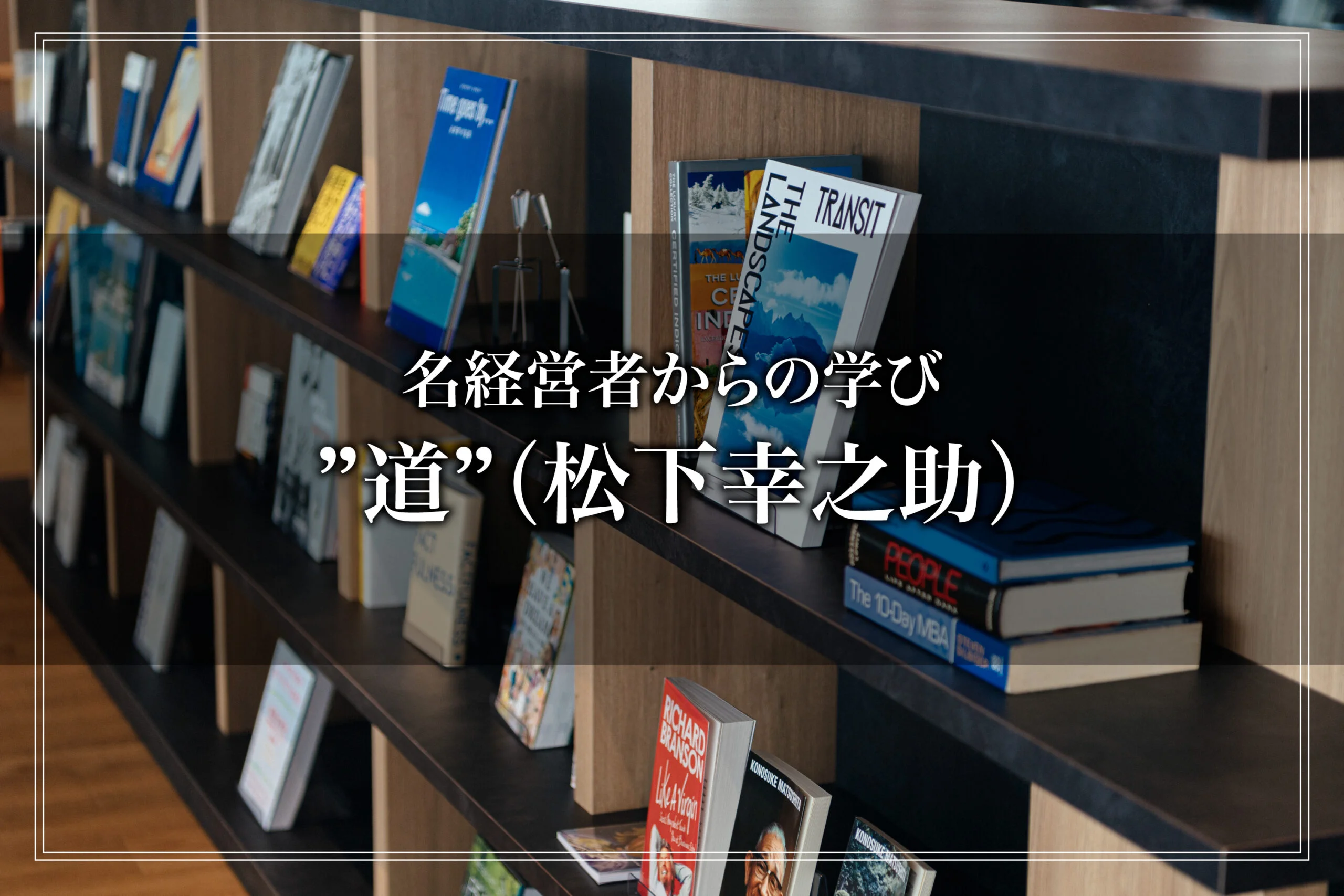
The Path is a long-selling masterpiece by Konosuke Matsushita, who built Panasonic Holdings in a single generation and profoundly influenced countless subsequent business leaders. Personally, I own two copies: a heavily worn, dog-eared version filled with highlighter marks from years of intense reading, and a pristine, brand-new copy I purchased later. Yet, whenever I return to its pages, I find parts with which I deeply resonate anew, which I can only truly appreciate now after gaining more life experience. It remains incredibly fresh and consistently offers new insights.
The very first page of this book is titled “Our Path”.
I would like to take this opportunity to look back on my thoughts from over 30 years ago when I first picked up this book.
3. My Own Experiences and Thoughts on This Philosophy
I believe I was in my early twenties, fresh out of university and just starting my corporate career, when I first bought The Path. At the time, I didn’t have a clear career plan, nor did I possess the fierce passion or burning desire to solve social issues that would drive someone to launch a startup. I was, frankly, a passive young man who had simply drifted into a corporate job.
To make matters worse—or perhaps it was just the reality of the era in Japan—the transition from the Showa to the Heisei era (the late 1980s and early 1990s) was characterized by an incredibly toxic and punishing work culture, at least how we would see it from today’s perspective, ha ha. This was the era when a popular TV commercial for an energy drink featured the slogan, “Can you work 24 hours a day?” My life consisted of squeezing onto packed commuter trains to get to the office by 7:30 AM, and returning home on the last train or by taxi late at night. I was a young man with neither the energy nor the time to carefully design my career or map out a business plan.
When I first opened the book and read the opening lines, I remember being on the verge of tears. In fact, I think I actually cried. I was undoubtedly exhausted, both physically and mentally.
“Our way takes us through wide, open spaces, but also into narrow, tight spots. The path ascends, carrying us high at one time, but at others, it descends, taking us down. The way is sometimes smooth, and we stride forth unencumbered, but at other times we must clear obstacles from our way, struggling with each step.
There are times when we are at our wits’ end, unsure as to whether the path is a good one or bad. There are times when we want to take a detour.”
However, the words that followed really hit me the hardest:
“For our way to open up, what we have to do is to keep going, to keep moving along. We have to make up our minds and be resolute, to the best of our ability.”
I was pushed to take immediate action. Encouraged by the many insights that followed, I made a firm resolution: No matter what, I am going to carve out my own path. I will never run away, I will never give up, and I will never stop walking. Even if the road is steep, I will build a path that belongs uniquely to me.
Against the backdrop of that intense era, I watched many senior colleagues and peers fall by the wayside on what was an unforgiving road. Some simply vanished overnight, others completely abandoned their own opinions and convictions to become unthinking yes-men, and others turned to excessive drinking, smoking, and gambling just to cope with the sheer pressure.
Yet, because I discovered The Path and walked forward believing in its words, I managed to stay on track without losing my footing, and eventually began creating new opportunities.
It took a long time…about thirty years, in fact…but I finally came to understand my true path and my role in society: to serve as a supportive companion to entrepreneurs and their employees, drawing upon my extensive experience navigating the launch phases and the ultimate rises and falls of numerous domestic and international startups.
Just as Matsushita wrote, “The journey may seem long, but by striding forth, without pause, our path will open up.” When I was a low-ranking employee in my twenties, in such a stressful environment, I couldn’t possibly imagine my role in society or envision where my path would lead. However, by refusing to run away, choosing to achieve my goals no matter the circumstances, making suggestions and changing my own behavior, and finding the courage to leap into new domains whenever I sensed the tides of a new era changing, as a result, I accumulated a wealth of experience that proved new paths really do open up.
Looking back now as I write this article, reflecting on a journey that began in my teens and early twenties when I was a bundle of anxiety and insecurities, I find myself thinking about these words once again. For those who keep walking, a path will always open, and cutting through to find your own way will lead to happiness.
I am deeply grateful to Konosuke Matsushita for giving this book to the world. And now that I’ve reached this point in my life, I feel that I can give myself some credit for forging ahead and pushing my way through a road that had plenty of ups and downs.
4. A Message to Our Readers
You should not compare the path that was given to you in your life to anyone else’s path. You should not envy or resent the lives of others, feel sorry for yourself by comparing yourself to famous individuals with brilliant careers, or conversely, brag and take excessive pride in your own achievements. You simply need to keep walking and striving in your own way.
Ideally, we would establish a clear goal before we set out. However, I do not believe a path lacks any value just because its destination is not yet totally defined. Even if you cannot see the goal right now, it can suddenly become crystal clear as you consistently keep putting one foot in front of the other.
It can be said that life is a series of choices. On your own path, you will periodically encounter crossroads where you are forced to decide whether to turn right or left. You will also face massive walls that you must overcome. The shape of your unique path will follow along the resulting series of choices and challenges.
Will you choose to walk along a paved road or atop the rails of a track? Or will you choose a path that is steeper and unpredictable, yet holds immense potential?
Times are constantly changing. In particular, as AI becomes increasingly deeply integrated into our world, the next decade is bound to be a period of intense upheaval. In light of this, the paths for some could suddenly be cut short, while the paths of others could very well pioneer a new era.
I encourage you to seize this age of AI as a massive opportunity and carve out your own path that ultimately “will lead to happiness”.
I sincerely hope this article proves to be of some value to all who read it.
D-POPS GROUP Advisor
Genta Sugihara