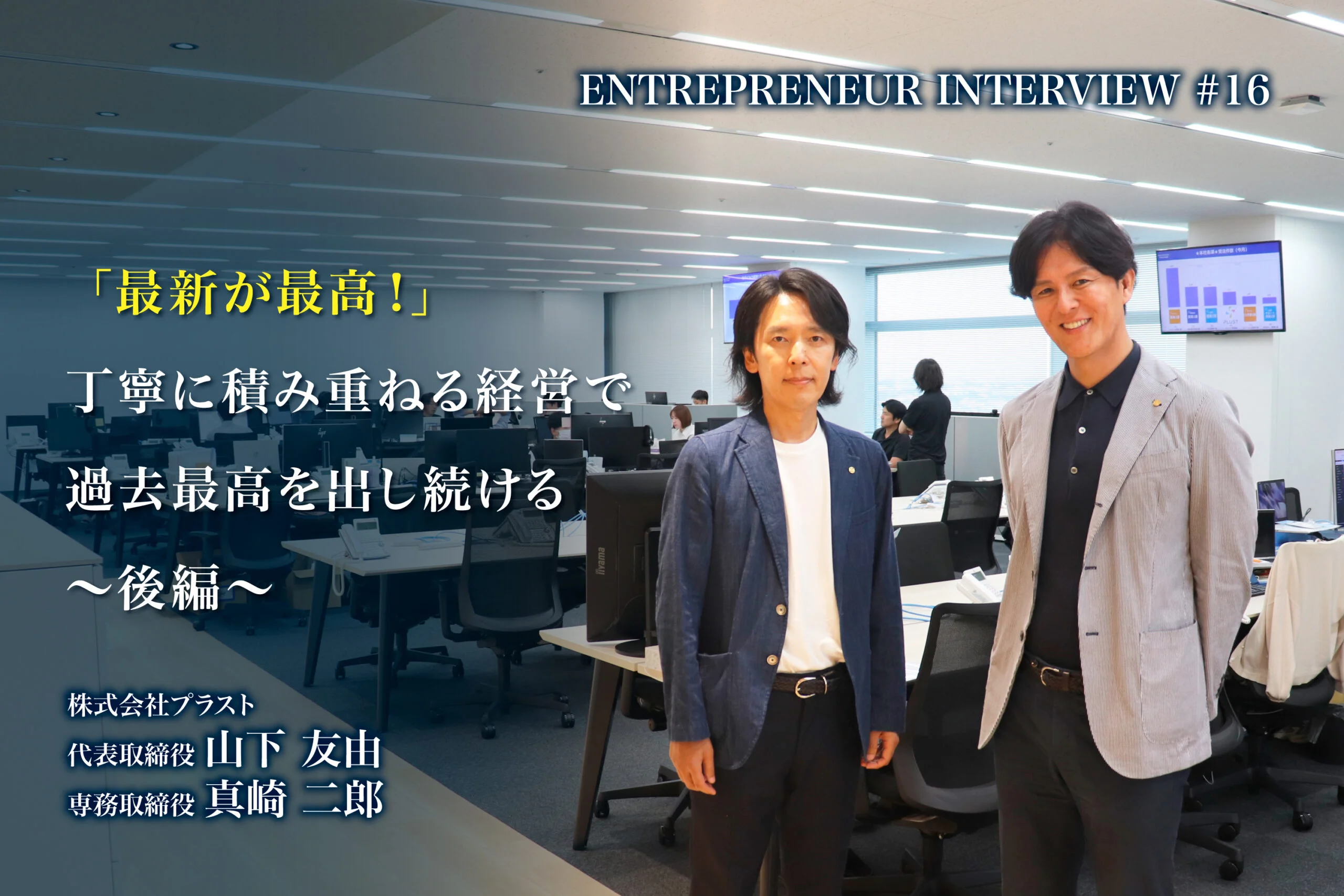


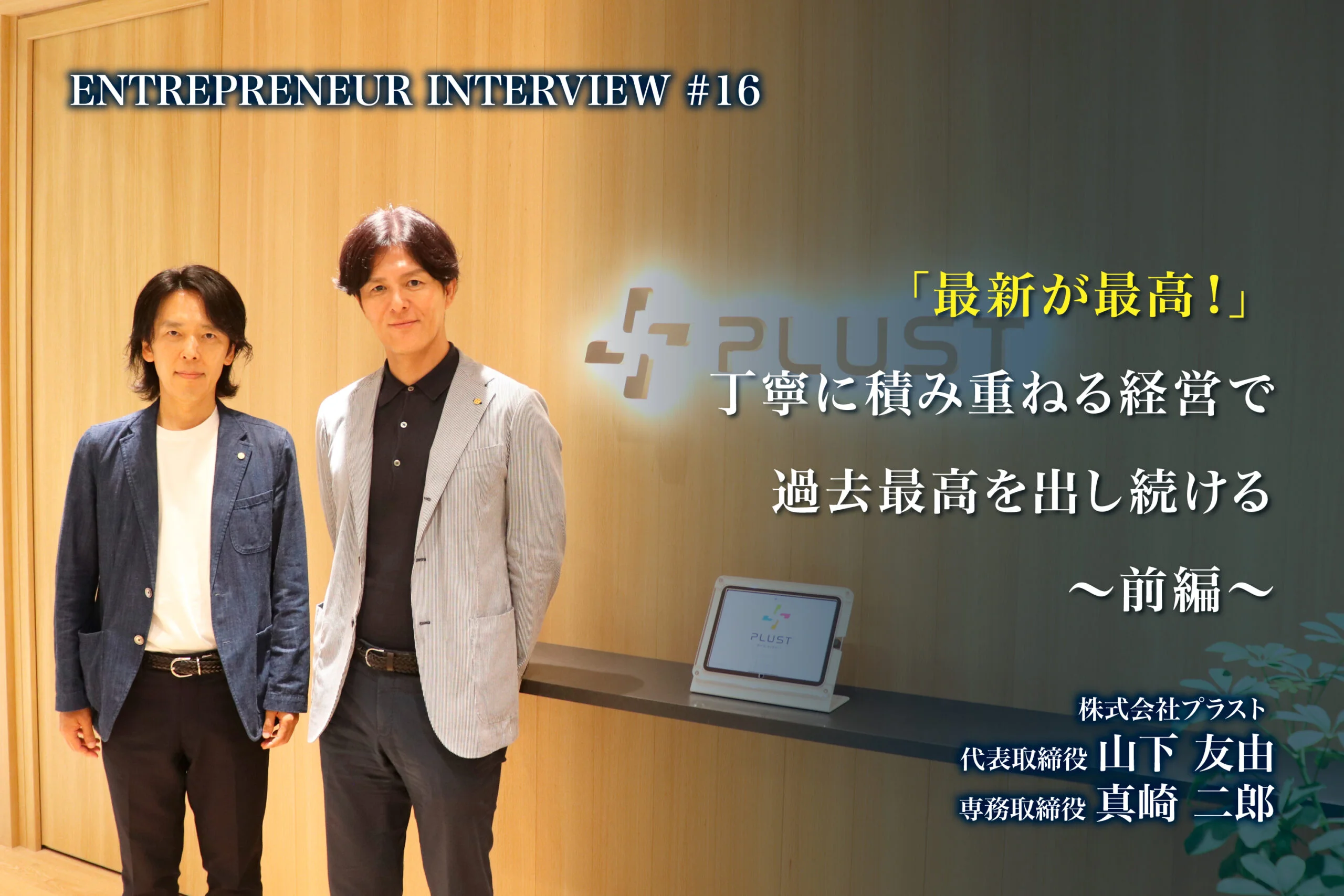
“Newest is best!”
Careful, Consistent Management for Continuous Record Growth
D-POPS GROUP has 24 group companies that we call partners (at the time of publication).
For this article, we interviewed Tomoyoshi Yamashita, the President and CEO of PLUST.Co.,Ltd. (Plust from here on)—which joined our group in September 2024—and Jiro Masaki, Plust’s Senior Managing Director. (This interview was conducted in July 2025.)
◆The Motivation for Founding a Company
Sugihara:
Thank you for agreeing to this interview, President Yamashita and Senior Managing Director Masaki!
First I wanted to say, President Yamashita, I always notice your wonderful smile whenever we meet. I imagine being a business owner involves a lot of hardship. What I want to know is, are you constantly cheerful by nature, or have you already overcome so much difficulty that now you can be this sunny?
Yamashita:
Oh, you’re too kind! I have experienced countless difficulties, ha ha. Experiencing various difficulties is just my normal mode.
When I founded my company, there were times when I looked quite stern. I think I unconsciously wore an unhappy look when our sales weren’t growing or when there were issues with management. However, I feel like I was consciously trying to smile and be cheerful.
Sugihara:
Senior Managing Director Masaki, you’ve been with President Yamashita since before the company even existed. What is your perspective?
Masaki:
Recently, as the number of employees—including women—has increased, his way of communicating with the entire organization has changed from the past. However, in meetings attended by our executive members, he is still as strict as ever. He delivers that strictness with love, and that combination is something we executives are completely aware of.
Sugihara:
I guess since my relationship with President Yamashita is still relatively new, I have no idea what his stern face looks like!
Now, let’s move on to the main topic. First, could you tell us what motivated you to found Plust?
Yamashita:
I had always wanted to be a CEO someday, but at the time, I lacked the courage and the drive, and honestly, I didn’t even know how to become one. So, after graduating high school, I spent four years in the Air Self-Defense Force, and then I worked as an employee at an IT startup company. That’s where I met Senior Managing Director Masaki.
While I was entrusted with responsibilities such as the OA equipment business at my previous job, I gained experience as a salesperson, a manager, an office head, and I helped establish a new business office on two separate occasions. This gradually gave me the feeling that I was essentially managing a small company by myself. I started thinking if this was the case, I probably could run my own business, so I decided that the time had come to put my vague dream from the past of becoming a CEO into motion, and I started it alone in my own home.
For the first six months, I worked as a sole proprietor with a company that was wholesaling OA equipment, and I was allowed to operate under the name of their business office. After that, I registered my company and created Plust Limited Company.
Since I had established business offices twice in Saitama Prefecture (in the cities of Warabi and Omiya) at my previous job, I was familiar with the area, so I decided to found my company in Saitama.
◆How the Two Met Each Other
Sugihara:
How exactly did you meet Senior Managing Director Masaki?
Yamashita:
Well, we met at our previous company, when I interviewed him. After he joined the company, Masaki was placed in a slightly different location from mine, but he was consistently at the top of our sales rankings.
At some point after his interview, we started working more closely together, and as I got a sense of his personality, we became quite good friends. After that, we became separated again while I established the business offices in Saitama and he continued working in Tokyo, but when I was moved back to Tokyo, we started working together once more. At that time, we were in the positions of office head and manager, and we began to discuss deeper topics than we did when we were just salespeople.
At some point, a mutual acquaintance of ours separately invited both of us to start a company together. I was to be a board member, and Masaki was to be a salesperson. However, the person who invited us requested, “Don’t tell anyone else about this”, so neither of us brought it up in conversation with each other.
But then I realized that this person must have invited Masaki too, so I finally asked him about it. At that moment, Masaki asked me, “Are you going to do it?” and I replied, “No, I’m not. I’m going to start my own business.” Then he said, “Why don’t we do it together?”, and that’s how the two of us decided to launch a company.
To be totally precise, the first person to join me was Ono, who was a subordinate from our previous company and is now a Division Manager and executive officer at Plust, but Masaki did join us a year later.
Sugihara:
That was a fateful fork in the road.
Senior Managing Director Masaki, when President Yamashita invited you to start a company, did you make an immediate decision, even though the future was completely uncertain?
Masaki:
Actually, since he was my boss and I was working under him, I was the one who said, “You should definitely go for it and start a company!”
Our previous company was a really intense sales company that was growing rapidly, but I felt that President Yamashita, with his sense of cleverness that was no different from now, stood out from all the pushy salespeople there. He also had accomplished some considerable achievements as a manager, so I really wanted to work with him.
Sugihara:
From your perspective, what was your impression of President Yamashita at the time when you first met him?
Masaki:
As I mentioned, our initial meeting was at my job interview. I think I was in my late 20s when I went for the interview at our previous company. I naturally assumed that my interviewer would be someone of the usual age for conducting a job interview, but then I saw President Yamashita. I believe he was in his early 20s at the time. His hair was longer than it is now, he was tanned, and he gave off a very high-energy vibe, ha ha.
◆The Journey So Far
Sugihara:
Counting from your company’s founding in 2004, this is your 22nd term (your 21st term was considered a non-standard 5-month period due to a change in the fiscal year end to February) of operations. What have the months and days been like until now?
Yamashita:
Ahhh, it’s been full of ups and downs. Not even once has there been a period of stability. But the time has certainly flown by. Looking back, I think it’s been pretty interesting overall.
Sugihara:
But if you look at the management indicators, you seem to have had plenty of stability and growth.
Yamashita:
It might appear that way at first glance, but the number of failures has been overwhelmingly greater than our successes, and I was fortunate enough to have been helped by various people, which is how we managed to get by. I truly feel that we were lucky.
I don’t particularly feel that I’ve worked that hard, either. Aren’t I just doing the minimum that is expected of me? But I guess I’ve always done what was necessary for the company, with an attitude of “That’s something a CEO would do”, or “I’m not just an employee, I’m the founder of this business, so I have to do it”.
In the beginning, it might look like sales were increasing, but for several years, even though our sales were increasing, it was only by tens of millions of yen. If we fumbled our sales for even one month, we would fall below the previous year’s numbers.
Initially, I didn’t have a clear vision. It was only about earning money, earning more than I did as an employee, or achieving success. If anyone were to ask me if I had a mission to contribute to society at that time, I would have to be honest, I definitely didn’t think about it as deeply as I do now.
I was much more concerned about how to generate profit or how to increase the number of contracts. I was diligently working hard on various things every day, but I was living a stoic life with no vision, working from morning until late at night with few days off, until you could say I had hit my limit. So, while the beginning might look like a steady climb, things were actually very tight.
You know, I think the catalyst for the company getting on track was actually the Great East Japan Earthquake in 2011. Until then, our main focus had simply been to increase orders and future profit, but suddenly, we couldn’t properly do the work right in front of us.
There were times when we had planned power outages, so there was no electricity. Or times when there was no internet, so web designers couldn’t work. Of course, telemarketing was impossible.
After desperately thinking about what we should do, we tried cold-calling, we bought generators faster than the government, somehow connected them, and worked in rooms smelling of gasoline. We experienced what it was like to just have to survive. Not only that, but I started wishing we could do something for the people who were struggling because of the earthquake. Initially, we provided condolence money for the families of our employees and donated to the Great East Japan Earthquake relief fund. My desire to contribute to society began to sprout from doing those things.
In addition to that, after we started setting clear numerical targets for the year at the beginning of each new year, it became a mission or a target that we had to surpass, and with everyone’s cooperation, we achieved it. I decided to keep setting goals like that, and as a result, we surpassed the previous year every year. It was also significant that we formed a habit of sharing our objectives with the whole company.
Sugihara:
That’s wonderful. So, by continuously building on each previous year’s results and aiming for even a one-yen increase, you’ve been able to keep going for 20 years.
Yamashita:
That's right. In the book Good to Great, there’s a reference to some people getting on a bus, others getting off, and still others getting on at the next stop. We kept repeating this, and at first, there was no destination, but gradually it became, “It looks like fun if we go this way”, or “This might work”. During that process, the people on the bus gradually changed, though some people stayed the same, naturally. By accumulating those efforts, we reached our 22nd term, and what we are thinking about and doing now has evolved from that pattern.

◆Company Overview and Business Strengths
Sugihara:
Now, could you please tell us about Plust’s current business and its differences or unique features compared to other companies in that field, which have allowed it to grow continuously for 21 terms?
Yamashita:
Sure. We have three main business pillars. The first is the sale and maintenance of OA equipment, which we’ve done since our establishment. The second pillar is website production and operation support for small and medium-sized businesses. The third pillar is the sale and support of a customer relationship management (CRM) system linked to an application. These are our three business areas.
Sugihara:
What are the strengths of Plust’s business?
Yamashita:
Though I may be biased, I believe it’s our support capabilities for our customers, which are on par with our ability to make brilliant propositions during business negotiations. We have a support system that focuses on building a long-term relationship, rather than stopping once a sale has been concluded. Since few companies go to that extent, we focus on customers who feel secure in using our services consistently and those who become repeat customers. This connects back to what I mentioned earlier. When we first started, the goal was simply to sell, sell, sell, as much as possible…but we realized that wouldn’t sustain us. We understood that we needed to provide solid support after the sale and maintain longer relationships, or we would be eliminated.
Sugihara:
Customer support is an often-overlooked area, yet you deliberately focus on it. How do you instill this mindset in your support team staff?
Yamashita:
It’s true that customer support is a job where performance is not as easily visible as it is for a salesperson. But if support team staff lose motivation just because they aren’t in the spotlight, customer satisfaction won’t increase.
So, I thought about how to put the support team in the spotlight, and I figured that if our company’s customer support was solid, our salespeople would find it easier to close more deals with customers. What we came up with and put into action was a means to get raw feedback directly from customers.
We feature customer interviews on our website and even create videos of customer testimonials. When our employees see this, they realize things like, “Ah, this was the work of our support team” or “If they are doing this, our company is definitely better than others”. I felt that pointing out the company members who tirelessly support our customers behind the scenes would not be a negative at all, it would be a positive.
Sugihara:
Ah, so that’s how your website became like that. By the way, you mentioned having three business pillars. What was the catalyst for developing those three pillars?
Yamashita:
All three of those pillars are, in a sense, things that have helped us in running our company.
In the early days after our establishment, we naturally used business phones, multifunction printers, and other OA equipment in our own company, and getting the best OA equipment available made it much easier to do our work. And the website is what we use to let more clients, customers, and job seekers know about the unknown company called Plust. In fact, over 95% of our employees joined the company after seeing our website. If we hadn’t invested in our website, we wouldn’t have been able to meet everyone we have now. The app is slightly different, but in terms of our CRM system, we’ve seen first-hand that if we hadn’t properly used a CRM system, including during the earthquake, our sales would not have grown at that time. It’s something that saved us and allowed our company to survive. We have a strong desire to offer the products and services that saved our business to all the executives out there who are diligently working on their management every day.
As a result, instead of general households, we target business operators as much as possible. We want to do business that helps those operators while also increasing our own performance. I believe this is mutually beneficial.
Sugihara:
You’ve become a large company now, but you originally started from a small home office. You adopted the necessary products yourself as a small-to-medium enterprise, and then in turn, expanded your business into selling those same products to your customers.
Yamashita:
That’s right. As we primarily sold OA equipment, mainly business phones, our customer base grew steadily. However, there was a very tough period for OA equipment as well. The leasing of business phones became a social issue, making it impossible to sell through TV and newspapers, and leasing companies withdrew. At that time, we received requests from several customers asking, “Do you make websites?” We realized there was a strong need for websites, and we decided to launch a website business for small and medium-sized enterprises. And as the number of customers grew, we recognized the importance of getting our customers to come back again and again, and we started thinking about other methods of customer management besides websites. Back then, in the days before apps, we started with email systems linked to customer management, like newsletters. As times changed, that kind of system turned into apps, and now we also have a business for store-based apps.
The products we handle change with the times, but we want to provide services and products that can help our customers’ companies grow or solve the problems they face.
Sugihara:
So that’s the process by which you’ve developed your businesses. Speaking of which, you have contracts with 6,000 corporate customers nationwide, and you offer a diverse range of services. Could you share some of the innovations you’ve made in your sales, marketing, and customer support systems?
Masaki:
I think it’s about being attentive, consistent, and meticulously keeping in touch with them. There are still things we need to improve, but the sales, marketing, and customer support teams try to check in on the current situation with customers, even if it’s just a phone call to see what they might need.
~To be continued in Part 2~
Interview conducted by D-POPS GROUP’s advisor Genta Sugihara.
PLUST.Co.,Ltd.
Company President and CEO: Tomoyoshi Yamashita
Address: 20F and 24F Meiji Yasuda Life Insurance Saitama Shintoshin Bldg., 11-2 Shintoshin, Chuo-ku, Saitama, Saitama-ken
Established: October 22, 2004
Website: https://www.plust.jp/
Next, in the latter part of the interview, we discuss:
・Case study interview videos
・Origin of the company name
・“Realizing a Venture Ecosystem”
・5-year vision
・And other topics
Be sure to check it out here:
https://d-pops-group.co.jp/en/column/plust-interview-latter-part/