

Creating an Ecosystem that Connects Shibuya with the World!
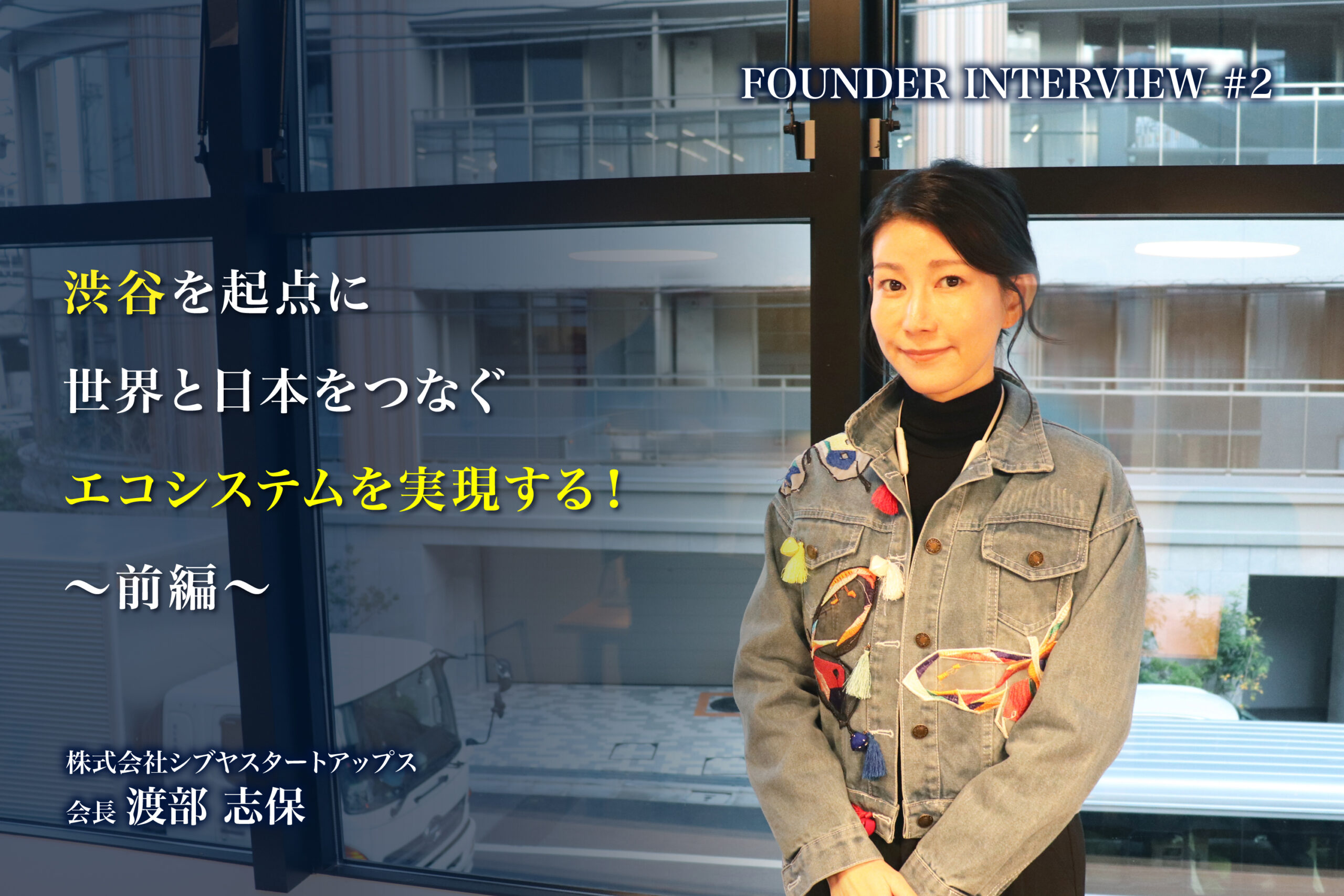
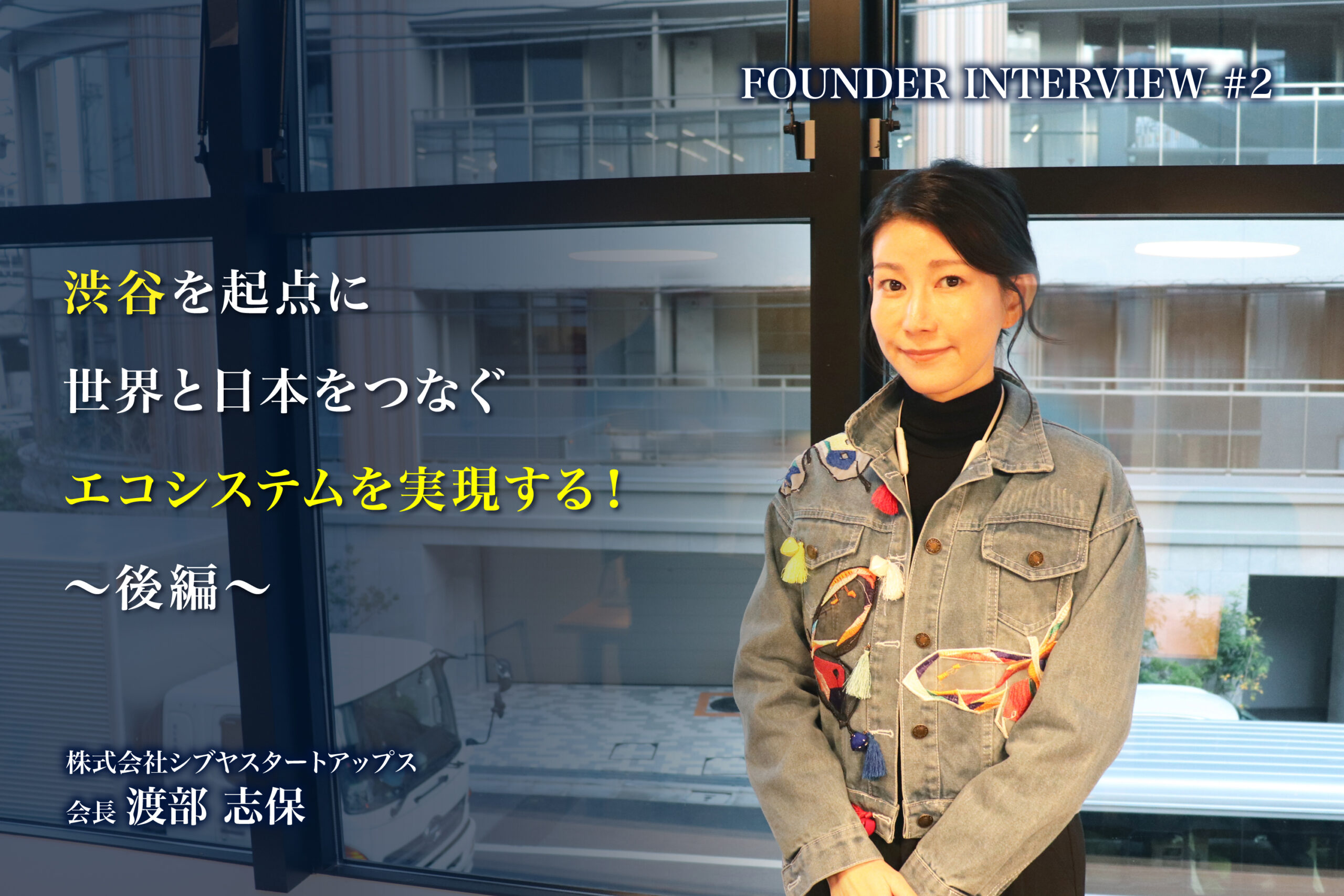
For this article, we interviewed Shiho Watabe, Chairperson of Shibuya Startups KK, who participated in our company’s Venture Ecosystem Summit 2025 as a speaker.
(This interview was conducted in November 2025.)
This is the latter part of the interview. To read the first part, click the link below.
https://d-pops-group.co.jp/en/column/shibuya-startups-interview-first-part/
◆ Why She Chose Startup Support
Sugihara:
Let’s turn back the clock a bit. You started your career as an analyst at Morgan Stanley and built a brilliant career at Google Japan, followed by periods at premier startup corporations like Mercari and ELSA Speak. Why would someone like you choose the path of supporting entrepreneurs?
Watabe:
To be honest, I feel like a big part of it was simply fate, but other than that, I think there were two main reasons.
The first was a desire to somehow return the favor to Shibuya, the city that got me to where I am. I gained so much experience at foreign firms and startups here, and after I reflected on my origins, I had the sense that I’d be coming home, and the urge to give back something to this city naturally welled up inside of me.
The second was a spirit of “non-conformity”, which has been an ever-present keyword in my life. In a mainstream Silicon Valley career, people generally work for a unicorn or start their own companies and later become investors. However, in my lifetime, there are many times when I’ve found myself choosing the road less traveled without intending to, and this case was no exception.
For example, as a recent graduate looking to change jobs in 2008 (before the Lehman shock), I moved from the Investment Banking Division at Morgan Stanley to Google Japan. At that time, the tech industry’s recognition in Japan wasn’t nearly as established as investment banking. In addition, I studied journalism in university and had a dream of getting to use that degree, and I actually received an offer to be an economic reporter for a foreign TV station. Nevertheless, I chose Google. It wasn’t so much a calculated decision, but more like a hunch. Jumping into an unknown industry seems difficult on the surface, but it’s exciting, too. I also remember being impressed by how much the people who interviewed me at Google seemed to enjoy their work.
There is definitely risk in choosing the path that 9 out of 10 people won’t take, but I believe it leads to countless insights and might even lead to an unexpected new stage in one’s career. While it goes without saying that my skills are useful at this workplace, this choice to support startups is also probably an extension of my “non-conformative” lifestyle.
◆ The Appeal Factor of Shibuya
Sugihara:
Thank you for sharing. Speaking of Shibuya, as the leader of Shibuya Startups, what do you feel are this city’s charms?
Watabe:
It might be easier to understand using the Bohemian Index. Proposed by sociologist Richard Florida, it measures the concentration of artists and creators relative to the population. Cities with a high index are said to be rich in diversity and tolerance, making economic development and innovation more likely. Shibuya is exactly that: a city with an extremely high Bohemian Index that is open to change. That is its greatest charm.
◆ Japan’s Strengths and Challenges
Sugihara:
That makes sense, Japan’s highest location on that index must be Shibuya. From your global perspective, what are Japan’s strengths and what do you see as its challenges?
Watabe:
Ironically, as a Japanese person, I don’t see Japan’s strengths very easily. However, once you go abroad, you clearly realize the high level of standards we expect of our food quality, public safety, craftsmanship, and hospitality in this country.
On the other hand, there is something that isn’t a problem as much as a characteristic, where the Japanese business world places extreme importance on consideration for stakeholders. Our unique culture of “reading the room” is a virtue, but in terms of making decisions quickly, it can be a weakness. For example, China works fast under their state leadership; the US pursues freedom and profit through libertarianism; and Europe has many regulations but clear roles for the public and private sectors. Japan is different from all of these, instead relying on peer pressure or unspoken understandings, where the whole team moves things forward flexibly and cautiously while in sync. While this has its merits, such systems and rules easily break down when an outsider enters the organization.
Furthermore, Japanese people will at times resign themselves to a certain status quo because it’s considered the only option, when in reality, there may be massive business opportunities hiding underneath. For example, if there was a method to streamline Japan’s unique multi-layered brokerage structures, excessive bureaucratic processes, or analog-based workflows that cause unfairly high costs and low efficiency, that could become a viable business. An outside perspective can call into question what we Japanese consider normal and discover something new and valuable.
Sugihara:
Japan’s unique consensus-based system takes time to find a decision that satisfies everyone, but it has the merit of incurring fewer reversals later on. However, in the modern era, the downside of slow response to change is becoming prominent. While these “invisible walls” have functioned as a barrier to entry, they may also be a factor making it difficult for Japanese people to succeed globally.
Watabe:
That’s true. However, Japan should be proud of the culture, creativity, and safety nurtured inside those “walls” that are unique in the world.
Another thing I feel poignantly while living in the US is the richness of Japan’s social security. When you aspire to start a business in Japan, you don’t have to worry about arranging health insurance for employees. This is a powerful advantage for taking on challenges fearlessly.
Sugihara:
Exactly! Right after I joined Google and attended training in the US, the first thing all participants asked in the first session was, “Are there insurance benefits?” After seeing our HR promote the quality of our insurance, I realized that what we take for granted in Japan is a privilege elsewhere.
Watabe:
It’s really true. In the US, simply getting a ride in an ambulance can cost hundreds of thousands of yen, and that’s not including the cost of treatment! In Japan, there are safety nets even if you fail. That’s how I can confidently tell people, “You should start your business in Japan.”
◆ Growth Markets in Japan
Sugihara:
I’d like to ask about your outlook for the future. From the perspective of entrepreneurship and new business, which growth markets do you consider particularly promising in Japan?
Watabe:
Without a doubt, the fields related to our nation’s super-aging society and declining birthrate. There is huge potential not just in elderly care itself, but in any of the businesses surrounding that, whether they be SaaS for optimizing operations, robotics, AI, etc. I’m sure the approaches will vary, but solutions in this domain will become increasingly important.
For example, one of the companies we support is a startup developing an app that can detect early-stage dementia in users just by playing AI-powered games. With early detection, memory regression can be dramatically slowed through proper treatment. Such technology will definitely be in demand.
Japan is facing the problem of a population that is aging more rapidly than any other country, but conversely, that means we are at the forefront of a market that can present solutions to the rest of the world. Furthermore, Japan has an accumulation of hardware technology in deep tech, edge AI, and quantum computing. I am convinced that a very strong growth sector will emerge at the intersection of this cutting-edge hardware and software that solves social issues.
Sugihara:
I completely agree. By having Shibuya Startups and D-POPS GROUP collaborate to support such innovation, even greater possibilities will open up.
By the way, the rapid penetration of AI is fundamentally changing the business environment. There are various discussions about disappearing jobs, newly created jobs, and doubts regarding human capability itself. How do you personally view the current situation?
Watabe:
I believe that while technology changes at a dizzying rate, and trends come and go, the civilization at the root of humanity does not change so easily.
Of course, the potential of AI is extremely high, and if used well, efficiency will increase and certain occupations will certainly disappear. However, it is also true that we have no choice but to find a way to coexist with AI. AI has the power to instantaneously perform processing tasks impossible for humans, so the key is how we master it.
In the coming era, the field of education will surely change. Instead of competing on the ability to provide answers as students have done, the ability to ask questions—that is, how to formulate highly precise AI prompts—will become more important.
However, I don’t think the world will suddenly become a completely different place tomorrow. As long as humans continue to have the will to allow and control it, I don’t think technology will leave humans behind and go on a rampage.
Sugihara:
Based on those societal changes you predict for the future, how do you think entrepreneurs and Shibuya Startups itself will be impacted? Will it be a great opportunity or a big obstacle?
Watabe:
I definitely see it as an opportunity. Currently, over 70% of the companies we support are AI-utilizing companies, but this is becoming normal for us. Just as every startup in the previous generation assumed they would utilize the internet, using AI will become commonplace in the next.
What’s important here is that AI is a means, not the end. For example, Uber is a ride-dispatching company at its core, and technology is merely the infrastructure for that. They simply utilize technology thoroughly to run the service at maximum efficiency.
Startups of the future will be the same. Even without calling themselves an “AI company”, they will use AI as a matter of course to achieve their mission with the utmost efficiency. I believe companies with such practical utility will become the mainstream, and infinite business opportunities are opening up there.
◆ What “startup ecosystem” means to Shibuya Startups
Sugihara:
According to Shibuya Startups, what is the definition of a startup ecosystem?
Watabe:
I believe a startup ecosystem is not just about the existence of startups, but a state where mature businesses become the customers and supporters for the next generation of companies, along with investors, and the cycle of growth is completed within that framework.
Currently, while Japan has resources to provide support, I feel we still lack the sheer number of startups and the human resources themselves. That is why we’re trying to invite excellent talent from overseas who are interested in Japan to improve the Japanese startup ecosystem.
We’ve gathered 52 different “superstars” into our community, including startups founded by the co-founder of the Polygon blockchain and the co-founder of Xoogler (a network for Google alumni). They are a truly capable bunch, raising funds from even the top American VCs.
Why invite such talent to Shibuya? Because if your friends are building unicorn companies, that route becomes the obvious choice for you, too. Conversely, if you are in an environment where small-scale IPOs are the norm, then your goals become that much lower.
My role is like a conductor of an orchestra. I don’t play the instruments—in other words, start the companies—myself. Instead, I gather players who can give the best performance and create an environment where they can perform at their peak. That is the kind of ecosystem we aim for.
◆ “Realizing a Venture Ecosystem”
Sugihara:
D-POPS GROUP has a vision of “realizing a Venture Ecosystem”. Where can you relate to this vision or see opportunities for collaboration?
Watabe:
I see the potential for collaboration in the area of diverse talent.
The overseas entrepreneurs we currently support have high technical skills but are not familiar with Japan. I believe the strongest startups in the future will be multinational teams, just like celebrity groups. Having members from various countries allows a team to immediately grasp local sales networks and needs during global expansion. I don’t think there is any benefit to Japanese-only or non-Japanese-only teams.
I find it interesting that foreigners are part of the founding teams developing AI models that bear the national strategy of Japan, such as Sakana AI or Shisa AI. Since Google and OpenAI are US companies, it’s possible that we could suddenly lose access to their AI infrastructure during an emergency, so developing our own AI models is a vital pursuit for Japan. Furthermore, developing our own LLMs will lead to preserving the fine details of Japanese culture—which might not remain on the internet—in the AI era. And in this field of building Japan’s infrastructure, foreigners are participating actively.
There are many Japanese issues and values that can only be brought to our attention by the presence of diversity. I would love to collaborate on building mechanisms that support diverse teams and increase talent mobility by bringing together excellent personnel with an outside perspective and companies with solid foundations within Japan.
Interview conducted by D-POPS GROUP’s advisor Genta Sugihara.
Shibuya Startups KK
Company Representative and Chairperson: Shiho Watabe
Company CEO: Yoshiro Tasaka
Address: Shibuya Bridge Building B, 1-29-3 Higashi, Shibuya-ku, Tokyo
Established: February 2023
Website: https://upshibuya.com/en/