

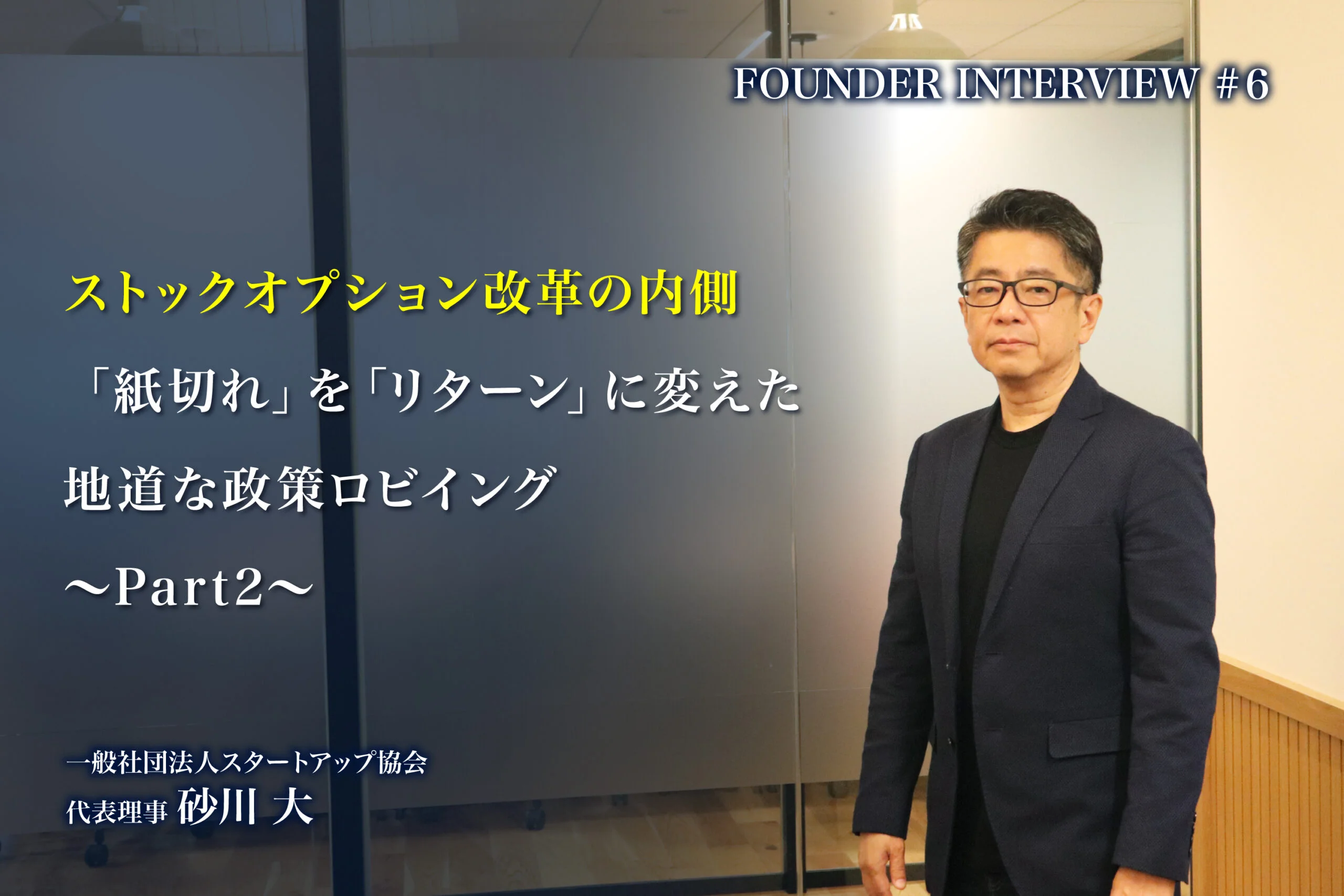
The Inside Story of the Stock Option Reform: Steady Policy Lobbying that Turned Scraps of Paper into Actual Returns
In Part 2 of this three-part interview series (click here for Part 1), we dive deep into the full scope of the “Stock Option Reform”—the most significant policy recommendation that the Startup Association of Japan has poured its energy into.
How did an obscure regulatory hurdle called the “custody entrustment requirement” turn entrepreneurs’ potential returns into worthless scraps of paper? Masaru Sunagawa takes us behind the scenes of policymaking, sharing how he and his team brought this issue directly to the government and successfully had it integrated into national policy. (This interview was conducted in May 2026.)
◆Building a Reputation: Establishing Credibility to Gain “Representative-ness” in the Eyes of the Government
Sugihara:
Even if you do not represent all 25,000 startup companies, you still need to present a certain level of credibility to make policy recommendations as an industry representative. How do you present and explain yourselves to the government?
Sunagawa:
I believe it comes down to reputation. You have to build it step by step. Through our initiatives, people naturally begin to recognize us as a respectable group. We ensure transparency, and when discussing important matters, we maintain strict governance through our board of directors. By operating with a solid organizational structure similar to a formal corporate business, we build trust.
Since I have served in this role for quite some time, starting this year, I plan to pass the baton over to someone who’s taken on the role of co-president.
◆Stock Option Reform — Policy Recommendations That Turned Scraps of Paper into Actual Returns
Sugihara:
Among the association’s initiatives, your policy lobbying work seems particularly unique. Could you share some concrete examples where you significantly influenced Japanese government policies regarding startups or helped design new systems?
Sunagawa:
We worked incredibly hard on reforms related to stock options. The reason is simple: to create a startup-friendly ecosystem, we must first make Japan an environment where highly sought-after, talented entrepreneurs actually want to start businesses. To achieve this, it is crucial to design a system where entrepreneurs are fairly rewarded for the risks they take.
Historically, Japan’s stock option framework was put together extremely cautiously and offered almost no advantages compared to the US system. If you board a high-risk ship, you deserve a corresponding reward. Salaries are low and the risk is high—so where do you get your returns? Naturally, it has to be stock options.
However, there were too many cases where things did not go as planned, and options ended up as mere scraps of paper. For example, though this was not widely known, tax-qualified stock options used to have a “custody entrustment requirement”. This meant startups needed a financial institution to act as a custodian. But in reality, almost no financial institutions were willing to take on this role. There was only one that did, but to deposit shares with them, companies had to issue physical paper stock certificates, which triggered the need to issue paper certificates for all other outstanding shares as well. The operational burden was immense. Naturally, entrepreneurs thought, “This is impossible.”
Only those who have actually handled these operations understand where the bottlenecks are. We had to explain to policymakers, “Actually, under the current laws, this isn’t a viable method.”
Sugihara:
In the US, some people exit before an IPO by selling their shares (such as in Facebook’s early days) to funds. You do not hear much about that in Japan; everyone seems to wait for the IPO.
Sunagawa:
Exactly. Furthermore, in Japan, stock options expire when you leave a company as a matter of principle, but in foreign-affiliated firms, your contribution is respected even after you leave, meaning vested stock options are preserved. Pouring your blood, sweat, and tears into a startup without your time being rewarded means the risk-reward ratio is completely off. The recent stock option reform was all about fixing these issues one by one.
Sugihara:
So, over the past four years, you have successfully reshaped the system so early-stage leaders at startups can actually receive the returns they deserve through stock options. How did startup support change under the Kishida administration?
Sunagawa:
Around the second or third year of the Kishida administration, the “Startup Development Five-year Plan” was formulated. The Startup Association of Japan lobbied hard to ensure that the plan included the actual measures startups desperately need. As a result, we were able to draft 10 out of around 140 measures.
We do this through steady, persistent work. Policymakers are not experts on startups, so they do not know what needs to be done, where the bottlenecks lie, which specific legal clauses are problematic, what startup founders actually think, or how things are done in the US, for example. We researched all of these aspects, brought the data to them, and explained, “This is exactly how we’d like you to change things.”
After that, we took those proposals to the group of startup lawmakers within the Liberal Democratic Party, worked to get them incorporated into the government’s Basic Policies for Economic and Fiscal Management and Structural Reform, and followed through on the process until an official budget was allocated.
Sugihara:
Just hearing about it makes me realize how much energy the association’s work takes. Weren’t you doing all of this while running your own company?
Sunagawa:
Fortunately, Smartround has an exceptionally talented team, which allowed me to temporarily divert a significant portion of my time to the association’s activities. A massive amount of time, actually.
◆The Real Motivations of a Serial Entrepreneur Who Declared “I’m Leaving in 3 Years” on His Third Day at Google
Sugihara:
You are a serial entrepreneur. You sold your location-based service startup, LocationValue, to NTT DOCOMO, and after your lock-up period ended, you joined Google. But you left quite early and started Smartround in May 2018.
Sunagawa:
Actually, on my third day at Google, at their SMB (small and medium-sized businesses) sales department, I was asked to give a speech. In my speech, I declared that I would be leaving in three years. So, why did I join Google? Honestly, it was to scout out their brilliant engineers, ha ha. All the HR team at Google could do was offer wry smiles.
In my first startup, the hardest challenge was finding top-tier engineering talent. After selling the company to DOCOMO, I knew I wanted to build another startup next. Around that time, I remembered Google had scouted me earlier. When I went to talk to them, they offered me a PM (Product Manager) position. I thought, “I’ll try it for three years,” and took the job.
Sugihara:
And in May 2018, you founded Smartround Inc. Could you briefly introduce your services to our readers?
Sunagawa:
Smartround is an information-sharing platform designed for startups and investors. Its purpose shifts depending on whether a startup is pre- or post-funding.
Before the fundraising stage, it functions as a CRM (customer relationship management) tool. It allows startups to search for and manage lists of investors, track negotiation statuses, and monitor data sharing. For investors, it does the same, allowing them to source startups, track negotiation progress, and manage internal investment committee approvals.
Post-fundraising, it becomes a tool for “corporate governance”. When investment agreements or shareholder agreements are in place, startups must obtain prior approval from lead investors before holding board meetings. Our tool helps companies execute this entire process—from securing approval, to presenting to the board, and finally presenting at the shareholders’ meeting—seamlessly and in strict compliance with the Companies Act. The system stores all corporate documents (such as articles of incorporation, registration certificates, and shareholder agreements) as data, and then uses this data to automatically determine what actions must be taken in compliance with the law.
Lastly, there is data sharing. VC (venture capital) firms often invest in 100 to 200 startups from a single fund, making it extremely difficult to track each company’s status and equity structures. To make matters worse, startups do not always submit documents in consistent formats, and often contain errors. Smartround users can control all of this on a single online platform.
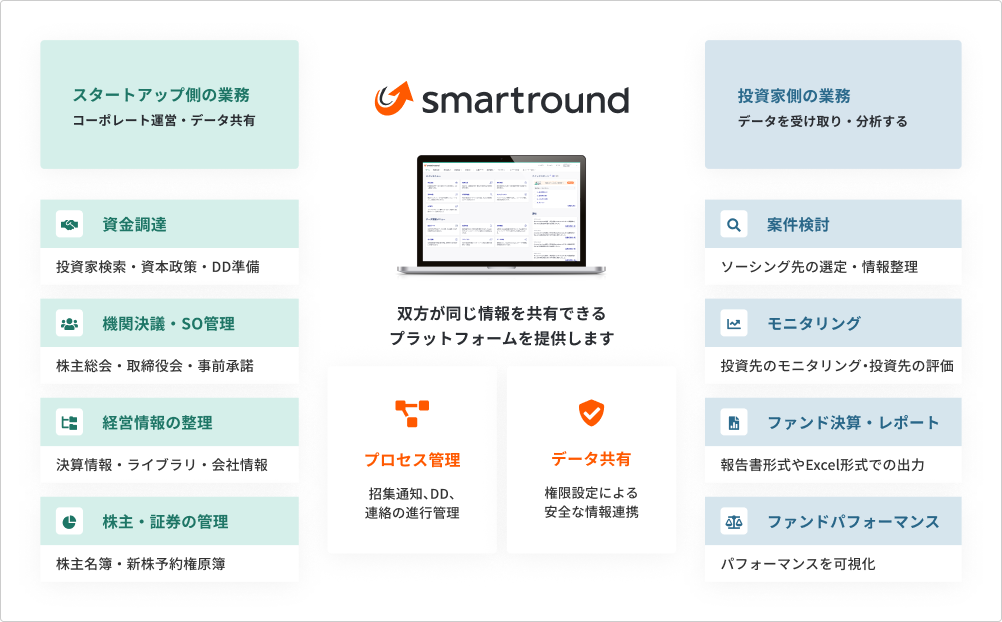
An overview of Smartround’s system, illustrating how it bridges startup corporate operations (left) and investor management workflows (right) on a single, secure platform to enable seamless, real-time information sharing.
◆“Everything Was on Excel Before Smartround”: The Lag in Japan’s VC Ecosystem
Sugihara:
How was all of this done before Smartround existed?
Sunagawa:
Everyone, including the major players, relied on Excel. To anyone who worked in the American VC scene, it probably looked decades out of date. The US has been using much more sophisticated digital solutions for a long time.
The reason Japanese VCs had not adopted such tools comes down to how the market evolved. In the US, institutional investors (like university endowments and pension funds) back VCs as LPs (limited partners). This creates high-pressure environments where VCs are thoroughly grilled and must closely track their data. In Japan, corporate venture capitalists or corporations often act as LPs, resulting in a more laidback, hands-off approach. The difference lies between how American VCs absolutely needed such tools to meet rigorous investor demands while Japanese VCs were under much less pressure.
Sugihara:
So, both startups and investors in Japan have a genuine need for this service. How widely adopted is it now?
Sunagawa:
Almost 300 VC funds and over 7,500 startup companies are currently using our platform.
Sugihara:
Those are incredible numbers. Do you have any competitors?
Sunagawa:
In the US, there are about 20 companies, the largest of which is called Carta. This shows just how mature the US market is. Meanwhile, in Japan, there is only Smartround. Now, we do have competitors that handle investment management for investors specifically, some that only build tools for startups, and others that focus solely on stock option management. However, we are the only company in Japan that offers an all-in-one, comprehensive suite.
Effective networking is absolutely vital in this business; a platform is valuable precisely when both VCs and startups are using it. As with phones, if the other party does not have one, your phone is basically useless, which is why our platform must offer both sides.
~To be concluded in Part 3~
Interview conducted by D-POPS GROUP’s advisor Genta Sugihara.
Professional Background:
Masaru Sunagawa, Representative Director of the Startup Association of Japan, President and CEO of Smartround Inc.
After working at Mitsubishi Corporation and obtaining a MBA from Harvard, he worked as a director at a US venture capital firm. After returning to Japan, he founded LocationValue Co., Ltd., and sold it to NTT DOCOMO. After serving as the managing director for Android at Google, he founded Smartround Inc. in 2018. In 2022, he established the Startup Association of Japan and became its Representative Director. He works on developing Japan’s startup ecosystem, and was even involved in the compilation of the “Startup Development Five-year Plan”.
Startup Association of Japan: https://www.startup-kyokai.org/
Smartround Inc.: https://jp.smartround.com/corporate
Finally, in the third part of the interview, we discuss:
・“Having lunch with people I’d added on Facebook but hardly ever speak to”: how to build a wide network
・From an era skeptical of entrepreneurship to UTokyo students launching startups as the norm: Japan’s rapidly evolving environment
・Realizing a Venture Ecosystem
・And other topics
Be sure to check it out here:
https://d-pops-group.co.jp/en/column/startup-kyokai-part3/