

COLUMN

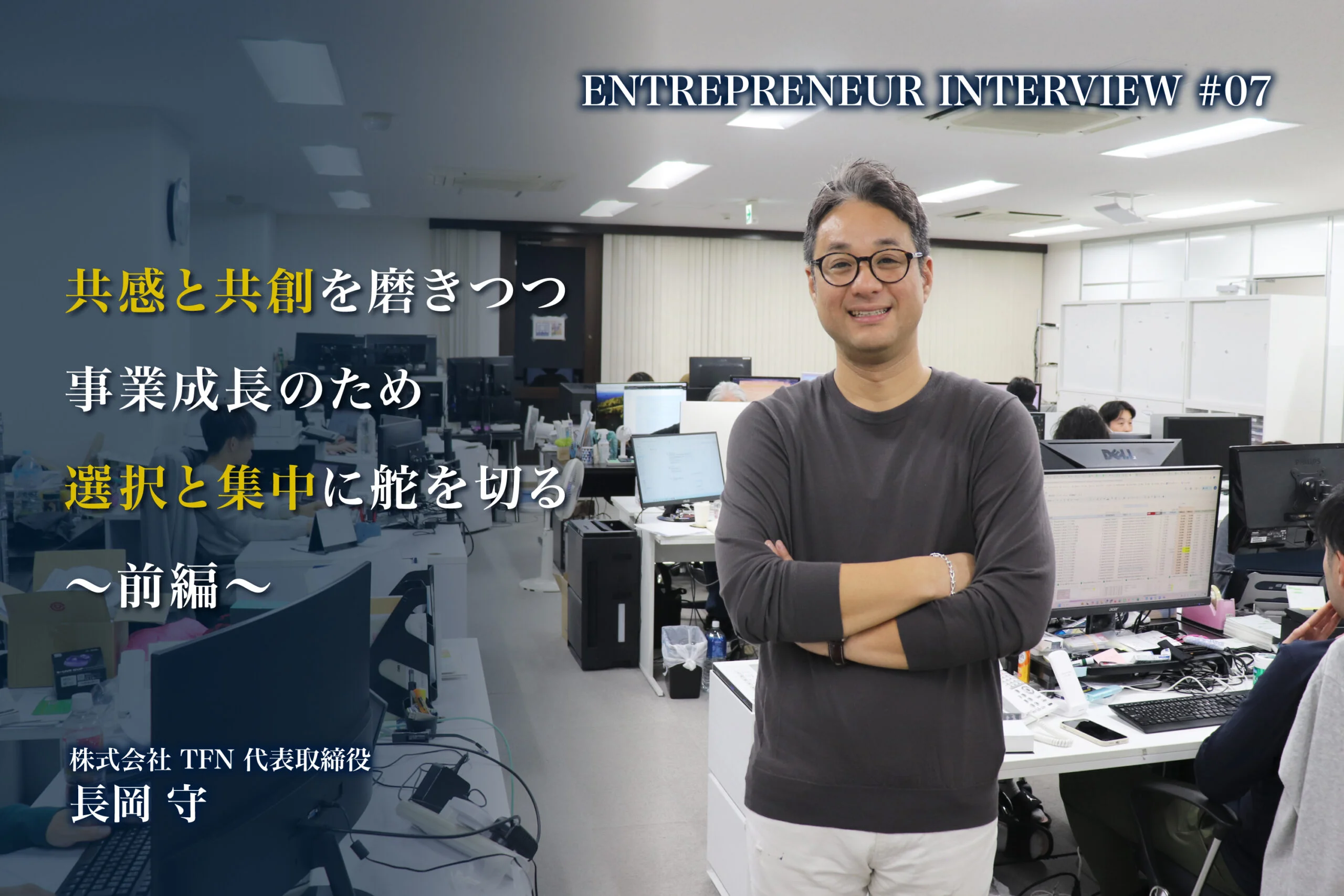
[Entrepreneur Interview #07] Mamoru Nagaoka (TFN) – Part 1

  • Group Companies
  • Interview
2024.12.13

Steering towards selection and focus to grow the company while refining empathy and co-creativity

D-POPS GROUP has 23 group companies that we call partners (at the time of publication).

For this article, we interviewed Mamoru Nagaoka, the CEO of TFN, which joined D-POPS GROUP in 2018.

◆Background of TFN’s Initial Establishment

Sugihara:
Today, we’re interviewing President Nagaoka, CEO of TFN. Thank you for your time. It’s been nine years since TFN was established. Could you start by briefly telling us about the circumstances surrounding TFN’s founding and your career leading up to it?

Nagaoka:
Yes. I founded TFN in 2015. Around 2011, when I was working at SoftBank C&S, I first encountered cloud SIM technology. At that time, I explored various options to launch a business, perhaps as an in-house venture, but I eventually gave up on the idea. Then, around 2013 or 2014, I came across cloud SIM again, and I had a strong desire to pursue it as a business. That, combined with my aspiration to become an entrepreneur, led me to leave my ordinary job and start my own company. So, while e-commerce is our main business now, my primary motivation for leaving my previous job wasn’t to do e-commerce, but to pursue the cloud SIM business.

Sugihara:
I see. When did TFN ask to join D-POPS GROUP?

Nagaoka:
In 2018.

Sugihara:
You mentioned that the company started out working with cloud SIM technology. When did you begin the e-commerce business?

Nagaoka:
The reason I encountered cloud SIM in the first place was that I was in charge of distribution at SoftBank C&S. During my time as a salaryman, which was quite long, I played a trading company-like role in various product sales, so many manufacturers would come to us with proposals. Encountering cloud SIM was part of that. At the same time, I was also dealing with various manufacturers of smartphone cases, PC supplies, and so on. So, while cloud SIM was the main focus, I also had a feeling that e-commerce would become popular. So I thought, “Let’s do this business too!” and launched it alongside cloud SIM.

Sugihara:
That makes sense. So, people you knew from your SoftBank days supported you, then?

Nagaoka:
That’s right. After I became independent, many business partners besides those related to cloud SIM supported me. Among them, there are still companies that I had relationships with even before I started my business nine years ago. Naturally, I could also go to China myself to manufacture products and handle direct negotiations. So while we certainly have many new vendors, whether for domestic procurement or direct purchasing from overseas, there are occasions where I get introductions through connections I made back then.
◆Business Overview

Sugihara:
That’s a huge asset, isn’t it? Next, could you briefly introduce TFN’s business overview?

Nagaoka:
Currently, it’s almost entirely focused on the e-commerce business. As for products, we’re targeting smartphone accessories. The total period we were involved in the cloud SIM business, which I mentioned at the beginning, was six to seven years, but we’ve now pivoted and are concentrating on the e-commerce business.

When we first started, we launched the company with both cloud SIM and e-commerce businesses. Operating a telecommunications business requires enormous capital. However, I was quite inexperienced as an entrepreneur, so my initial capital policy didn’t go well. At that time, I personally reached out to Mr. Watanabe, who is now a Managing Director at D-POPS GROUP, to ask him to join TFN as a director so that we could benefit from his business-related counsel. As a result, we also received an offer to join D-POPS GROUP and further grow our telecommunications business as a partner member. At that time, there were not so many group companies within D-POPS GROUP. There were a few CEOs who had originally belonged to D-POPS GROUP and then started their own group companies, but we were one of the very first companies to join from outside of D-POPS GROUP.

Sugihara:
I see. Perhaps that was one of the catalysts for the idea of a Venture Ecosystem that D-POPS GROUP is now aiming for.

Nagaoka:
That’s right. That’s how we were operating the cloud SIM business as a D-POPS GROUP company, but when we considered how to grow it further, President Goto proposed an M&A of a company that handles rental WiFi. What impressed me at the time was that he gave me three books about PMI and so on, and then I met the CEO of the M&A target company, and after that, it felt like President Goto was expecting me to make the decision myself.

Honestly, at that moment, I thought it was an unreasonable request, but I read all the books; handled the negotiations myself; drafted the contract; then, even though D-POPS GROUP had enough money, my company found our own investors; and finally, the contract was successfully concluded.

About half a year later, we took over ‘any-fi,’ a rental WiFi business that was originally part of D-POPS GROUP, and ran a rental router store on Miyamasu-zaka in Shibuya. From that point on, we gradually leaned into our WiFi business more and more.

On the other hand, the e-commerce side had steadily increased its product lineup since the company’s inception. A characteristic of our company is that we proactively incorporated DX and IT as part of our corporate culture, so we developed our e-commerce system in-house from an early stage. I feel that this has supported our growth.

Sugihara:
And then came COVID-19? I heard that your purchasing business was started during the COVID era.

Nagaoka:
Yes. Before COVID, both telecommunications and e-commerce were growing steadily, and just when we had acquired the telecommunications business through M&A and the numbers were quite steady, we entered the COVID era. It had been less than a year since the M&A, and within a month after the pandemic started, our P&L was in the red by about 40 to 50 million yen. I truly didn’t know what to do.

I still remember it now…I called President Goto and consulted with him, saying that the company was in a big deficit and we were even considering layoffs. At that time, President Goto said something like, “So you’re a president who cuts people, that’s all you can do, eh?”

No way, I was thinking about how to get TFN back into the black, for the sake of the group, and layoffs were only a part of that idea. But President Goto had a slightly different perspective. He told me, “It’s easy to lay off employees, and it would probably be easy to get back into the black immediately that way. But on the other hand, if you do that once, you will only ever be a CEO who does that. That will follow you for life…are you okay with that? And employees will also see you as a CEO who lays people off. So, maybe you should think about how to grow the company instead.”

Fortunately, the e-commerce business sold reasonably well due to the stay-at-home demand during the pandemic. So, although the telecommunications business was almost at zero, we managed to get by somehow. But it was incredibly tough.

Anyway, there was nothing else to do but start something new, and the fastest option was to drastically increase the number of products in e-commerce. At that time, Mr. Watanabe and I were trying to somehow increase our suppliers, and increasing suppliers meant handling home appliances. We focused on how to get products from famous manufacturers, but no matter how many introductions we received, no one would sell to us. I was thinking, “This is bad.”

But there are quite a few people selling home appliances in the world. So I thought there must be something to it. It was then, purely by chance at a drinking party, that someone’s words caught my ear: “I’m into ‘Poi-katsu’.” I asked, “What’s Poi-katsu?” And they replied, “It’s buying things, earning points, and then selling them on Mercari or other platforms.” I said, “That’s amazing. How much do you make a month doing that?” And they casually replied, “About 500,000 yen.” I thought, “If I had ten people like this, my company could recover!” So at that point, I started investigating.

I went directly to our current business partners and various e-commerce companies that handle home appliances, sticking around for hours, constantly observing, trying to figure out where they were getting their supplies. I realized that it wasn’t a usual supplier. From there, digging into various information on social media and elsewhere, I eventually arrived at the conclusion that they were purchasing and reselling goods. From that point, things moved fast. The website was completed in a week, and we said, “Let’s do it!”

So, we started our online purchasing business. At that time, we didn’t even have money to rent a storefront, so we started doing it in our head office. It quickly became popular, but then the owner told us that a regular rented office cannot be used as a storefront, so if we wanted to continue, we had to either move out or rent our own store. So, we immediately rented a store.

After renting the store, the purchasing business grew rapidly, reaching about 1.8 billion yen in one year, and with the support of D-POPS GROUP, we somehow managed to turn a profit. That being said, in the end, we’re actually going to close down the business in February 2025. After all, it was a low-profit business to begin with, but it carried us through the COVID era, so I can only say we were lucky to have it.

Sugihara:
I don’t think you should dismiss it as mere luck. To overcome that adversity, you practically tore apart your brain thinking over and over, observing, and quickly executing a plan to launch a business, and you managed to get through it. That’s wonderful. And then, just when one might think, “Let’s keep going with this purchasing business now that it’s on track!”, you made the bold decision to end it.

Nagaoka:
That’s right. When I look at the other entrepreneurs President Goto introduced me to, I realize that ultimately, it’s about profit more than sales. And when I thought about making TFN a good company that gives back to its employees, I figured this purchasing business definitely doesn’t belong among our services. As an example, if a business partner’s situation changes, our company will naturally be affected by that change. Ultimately, I had a personal desire to return to our own services and our own products. So, I decided our business will gradually pivot that way.
◆Development of In-House Goods

Sugihara:
Was it around that time? You’ve developed and created various things in-house, such as bicycles and suitcases, but when was it you started making your own e-commerce products?

Nagaoka:
Actually, we've been doing it since the company was founded. In the past, we developed products like scales and beauty rollers, so we’ve always been doing product development. I’ve always loved making things, so I’ve continued to do it even now. The impetus for making a bicycle was that someone in the company just happened to want one when we were deciding what to create. We made it, and it turned out to be a hit.

Sugihara:
I see! So, while working on various businesses, TFN has really accumulated a lot of experience and know-how. What would you say is TFN’s strength?

Nagaoka:
I would say it’s the way we construct our operations and flow. We are very thorough about forming a process and then implementing it into our system, so I think that’s our greatest strength.

Sugihara:
You also developed your e-commerce system in-house. Can you tell us about its features?

Nagaoka:
Certainly. We now have about 12 e-commerce stores. While there were systems out there that could instantly aggregate sales and quickly register products for operational purposes, they had both good and bad aspects. For example, with an external system, it was usable, but we could only ever achieve an 80% score. I thought it would be faster to just build everything ourselves.

From the time of our founding, we decided to do our system development in-house. Initially, rather than developing a full-fledged system, I built it myself using Microsoft Access, but it eventually couldn’t keep up, so I decided to develop our own system. I was certain that investing in our own systems and automating our processes would be beneficial in the long run for our company’s growth. And I also thought that in the future, the know-how we accumulated through in-house development could lead to various things, such as selling the software or acting as a consultant for other companies. That’s why we’ve focused on system development.

Sugihara:
So you expanded your business by leveraging your strengths. After many twists and turns, and overcoming the rough seas of the COVID era, the storm finally subsided. At that point, you thought deeply and decided to set your strategy for this year to focus solely on the e-commerce business, isn’t that right?

Nagaoka:
Yes. I personally like coming up with ideas, and when I decide to do something, I’m quick to execute. However, I had been thinking for a long time that our businesses were too dispersed. I’m more of a person who wants to think about how to turn one business into 6 billion yen, rather than creating three 2-billion-yen businesses to get 6 billion yen, or in other words, I want to do things in a Lanchester way*. That idea became stronger, and when I thought about what we are originally best at, it was e-commerce and retail. In order to concentrate on that, we decided to sell the telecommunications business for now.
(*Note: the “Lanchester” method is a well-known business strategy in Japan which focuses on concentrating resources in a single market to achieve dominance.)


Interview conducted by D-POPS GROUP’s advisor Genta Sugihara.


TFN

Company President and CEO: Mamoru Nagaoka
Address: 1F Asano Higashi-nihonbashi Bldg., 2-27-8 Higashi-nihonbashi, Chuo-ku, Tokyo
Established: November 25, 2015
Website: https://tfnmobile.com/


Next, in the latter part of the interview, we discuss:
・Selling off a business
・TFN’s atmosphere and culture
・“Realizing a Venture Ecosystem”
・TFN’s 10-year vision
・And other topics

Be sure to check it out here:
https://d-pops-group.co.jp/en/column/tfn-interview-latter-part/
Related Articles

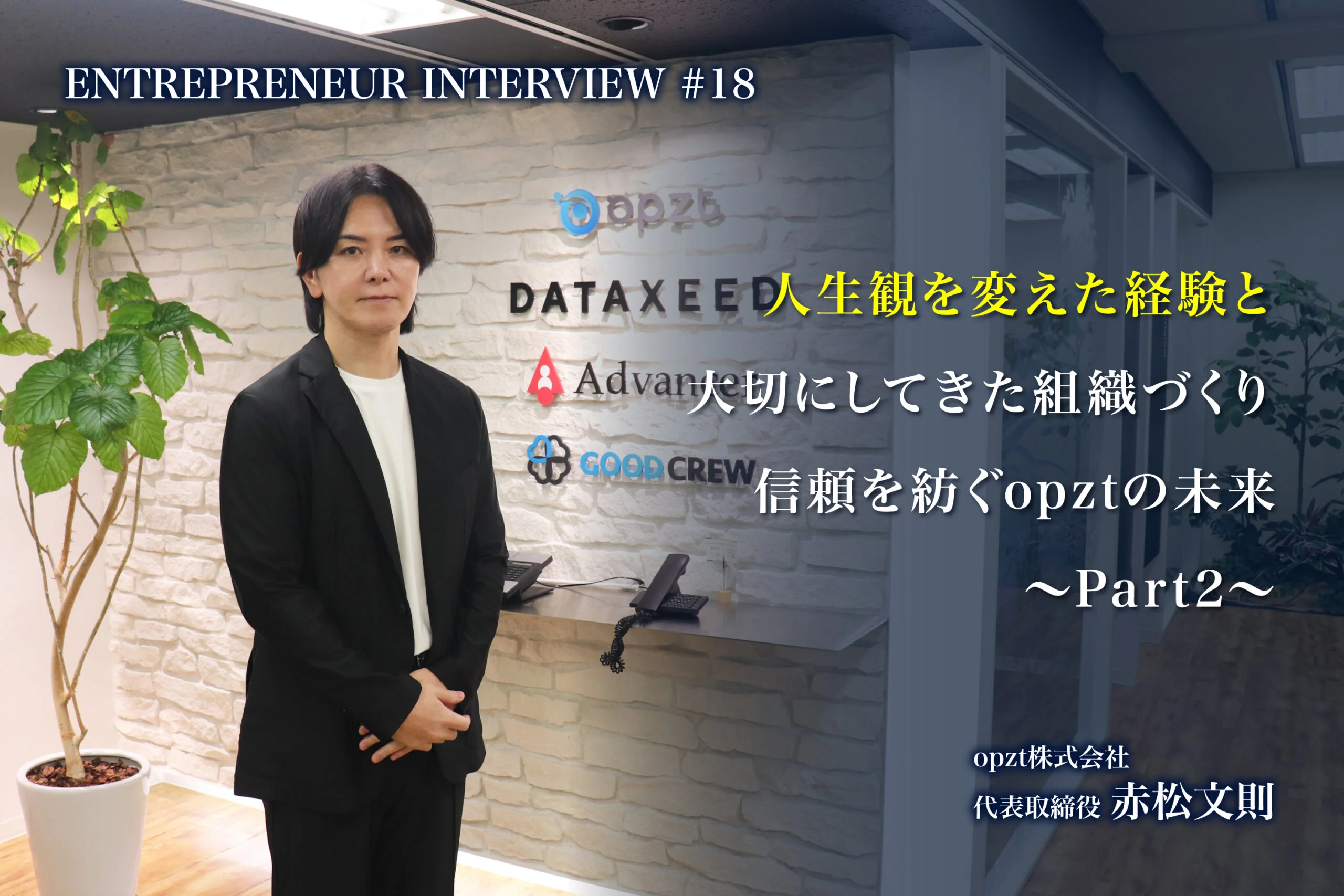
[Entrepreneur Interview #18] Fuminori Akamatsu (opzt) – Part 2
Life-Changing Experiences and a Valued Organizational Structure: opzt’s Future in Developing Trust In this final installment of a two-part interview, we asked President Akamatsu about his experiences as a musician, what made him decide to be an entrepreneur, his dedication to organization building, the entertainment business he launched after a serious illness, the background of the M&A with D-POPS GROUP, his resonance with realizing a Venture Ecosystem, his vision for five years from now, and a message for our readers. (This interview was conducted in August 2026.) This is the latter part of the interview. To read the first part, click the link below.https://d-pops-group.co.jp/en/column/opzt-interview-first-part/ ◆Applying Experiences from His Band Member Days to Business Management Sugihara:Let’s step away from the business topics for a bit and talk more about you. I’ve heard you used to be a musician. Is that true? Akamatsu:Yes, it is true. I played the bass when I was younger and lived in a world completely different from corporate management. However, in a band, if only one person is skilled, the team doesn’t come together. I think there are actually quite a few similarities with managing a company. Everyone has their own personality and abilities. But in the sense of trying to build a single stage on which to perform, I feel corporate management is much the same. Sugihara:So you cultivated a sense of teamwork and balance over a long period in the field of music. Has your experience as a musician back then helped you in your role as CEO? Akamatsu:I suppose so, though it’s hard to say for sure. The sense of reading the audience’s reactions during a live performance and grasping what they want might be something I still utilize today. Sugihara:That makes sense. You definitely can’t do business with major corporations if you can’t read the room. ◆Creating a Company to Be Proud Of: The Background of opzt’s Founding Sugihara:You touched on this briefly earlier, but could you tell us again: what was the catalyst for starting opzt, and how do you feel now looking back on the 13 years since founding it? Akamatsu:My original motivation for starting a business wasn’t a grand plan to build a massive corporation. Rather, it was a somewhat modest ambition to run a business I alone was responsible for, and create a company that my employees and I could truly be proud of and satisfied with. I didn’t have some sort of grand vision. About 20 years ago, the HR industry was full of extremely exploitative, so-called “black companies”. While working in that environment, part of me felt a desire bubbling up to build a company that would value workers more and could respond more quickly and flexibly to clients. That was how I decided to start up opzt in 2013. Looking back over these 13 years, more than the company’s sales or scale, my strongest feeling is that we’ve somehow made it this far thanks to the connections and relationships we’ve built with people. Sugihara:It’s wonderful that your journey began not with a grand corporate scheme—which doesn’t always go well for entrepreneurs without a concrete plan—but from a genuine desire to provide everyone with an ideal workplace due to your personal experience. In my case, I joined my previous systems company intending to be an engineer, but as it turned out, it used to be a dispatch business back then. My boss would only show his face about once every six months, and I was constantly working at a client’s factory. In those days, we were just seen as unit prices. Even if I was highly evaluated on-site, it was never reflected in my salary at all. That was the era, wasn’t it? In the end, I quit three years later, ha ha. Akamatsu:That’s exactly how it was. In those times, dispatch staff weren’t allowed to take paid leave, and if we were short on people, we were told to go recruit strangers on the street. We were judged solely on numbers and told to push for more overtime. It really was an unreasonable era. Sugihara:Speaking of that, I get the impression that employees who joined around the time of your founding have stayed with you for a long time. Is there anything you prioritize or keep in mind regarding your people in terms of organization building and company management? Akamatsu:Honestly, I simply have nothing but gratitude towards them. I am truly thankful that many employees have stayed for so long. What I value is not looking at employees merely from the perspective of job titles or numbers. Everyone has things they are good at and things they struggle with; some excel at sales, while others are great at administration. Rather than forcing everyone into the same mold, I consciously try to create roles where each person can thrive. Also, rather than having only the founding members make decisions, I want to properly provide opportunities to newer employees and nurture the next generation of leaders and managers. While we’re intentionally preserving those values, at the same time we are trying to transition into an organization that operates according to systems rather than relying on specific individuals. ◆A Philosophy of Helping to Raise Up Executives Instead of Micromanaging Individual Branches Sugihara:I often meet with the team members of opzt’s Tokyo branch based in Shibuya Hikarie. Even when you aren’t there, they work incredibly earnestly and harmoniously. They maintain a bright, positive atmosphere, mixing seriousness with jokes as they manage their tasks. With offices scattered across Nagoya, Shikoku, and Kyushu, as you mentioned earlier, how do your staff and employees work so independently and reliably? Akamatsu:Well, the key is actually to not micromanage each branch. The clients and recruitment markets are completely different depending on the region, and we’ve learned in the past that simply forcing them to use the patterns that are successful at our headquarters doesn’t work. And I think a major reason the Tokyo team can operate autonomously is that the local members think for themselves, make decisions, and commit to the results. It feels less like managing a branch and more like helping branch managers to grow. Sugihara:That’s impressive. Everyone truly acts with a mindset like they’re also an executive, and seem driven to boost Tokyo’s performance. ◆Lessons from a Serious Illness: The Background Behind the Birth of the Entertainment Business “SELEBRO” Sugihara:On a different note, I understand you run an entertainment-related business separate from opzt, called “SELEBRO”. You launched this company after opzt, correct? Akamatsu:Yes, that’s right. Currently, through SELEBRO, we operate live music venues and nightclubs, manage artists, and do event planning for music festivals, etc. As for our business model, we are also heavily involved in entertainment tech, a blending of entertainment and technology. It’s separate from opzt, and while its headquarters is also in Osaka, they aren’t here in this building. My love for music and entertainment was one of my original reasons for founding it, but the biggest factor was being hospitalized for a condition called cerebral artery dissection. It happened around June or July of 2019, about six months after we joined D-POPS GROUP in December 2018. It was completely sudden; when I went to the hospital, I was told to be admitted immediately. It was a truly desperate situation, and I spent a month in a state where every day could have been my last. That experience profoundly changed my outlook on life by 180 degrees. Before that, I assumed I still had a long future ahead and I would live until I was 80 or 90. That baseless assumption was turned upside down. I had vaguely thought it would be nice to try my hand at the music business at some point in my long life, but after going through that hospitalization, I realized that rather than thinking I’ll just do it someday, it was better for me to be intentional about doing it so I wouldn’t die with regrets. When I put on that mindset, old connections of mine from the music world started getting back in contact with me, fantastic venues opened up, and opportunities like that kept coming to me. I figured now I had to do it. So I spoke properly with President Goto, telling him, “This is what I want to do.” He told me as long as I continued to run opzt properly, he was fine with it, making it clear he didn’t want me to do either half-heartedly. By the way, I recovered from my medical condition. Eventually, my body was able to heal without surgery, and I’m in good health now. I feel like I’m getting a second chance at life. I no longer postpone what I want to do until “someday”, because you never know when you’re going to die. ◆Respecting Our Company’s Individuality: Why We Chose D-POPS GROUP Sugihara:Thank you for telling us so much about your personal life. You really went through a difficult experience. Now, you joined D-POPS GROUP in 2018 through an M&A. Could you tell us about that process and why you chose D-POPS GROUP out of the many offers you likely received? Akamatsu:At the time, my company was in its fifth year and approaching a scale of about 1 billion yen. As we grew to a certain size, I started to realize that to proceed to the next phase, we needed management resources and expertise that we couldn’t get on our own. That was the starting point. Since we were growing steadily, we were receiving offers from various companies. The reason I chose D-POPS GROUP was that I was drawn to your CEO’s personality and your philosophies. You didn’t want to simply acquire a company; you wanted to grow together while firmly preserving my identity as a manager and my company’s individuality. I have many peers who have gone through M&As, and I’ve seen numerous cases where the management policy changes after joining a group, or the founding manager leaves the business. In contrast, D-POPS GROUP continues to let me run the company, allowing opzt to grow while respecting our culture and strengths. I really appreciate how they gently watch over us. I really decided not based on terms or conditions, but based on who would be managing the company alongside me and whether my employees could continue working positively after joining D-POPS GROUP. Sugihara:Just as you hoped back then, your 1-billion-yen company has kept growing over these past six years. Have you learned a lot from President Goto and D-POPS GROUP’s management study sessions while keeping your own structure intact? Akamatsu:Yes. Every day, I get to learn more about various aspects, I’m still receiving mentorship, and I feel like I am studying on a daily basis. ◆More and More Managers Emerging from the Group: Resonating with the Venture Ecosystem Sugihara:That’s wonderful. Finally, D-POPS GROUP has the slogan of “realizing a Venture Ecosystem”. Please tell us what aspects of this goal resonate with you, and if you’re doing anything to help build this Ecosystem. Akamatsu:I resonate with a lot of aspects, but most of all, with the philosophy that it’s not just about one company succeeding, but about new managers and new businesses emerging one after another from within the group. As a founding manager myself, my goal isn’t solely to make my company bigger. I want to create a cyclical environment where the next business leaders and managers emerge from among our employees, and they in turn create new companies and businesses. Even within opzt, we give each branch authority and discretion, having them run the branches with the mindset of managing a small company. I believe that circulating the talent, funds, and trust generated by those operations into the next business connects directly to realizing a Venture Ecosystem, so I also agree with that idea. Sugihara:It sounds like you are creating an ecosystem within opzt itself, too. Akamatsu:Yes. The scale is still small, but I think they share common elements. ◆Five Years from Now: A Company Supporting Corporate Growth with People and Technology Sugihara:Please tell us what opzt will look like in five years, or any specific goals you have. Akamatsu:In five years, as I mentioned earlier, I want us to be a company that doesn’t just dispatch talent, but supports corporate growth by combining people and technology. Our staffing business remains a major foundation, so while we will firmly maintain that, I want to increase our focus on AI, data, and the data center sectors, transforming into a highly specialized and profitable business structure. Beyond that, I want us to be a company where employees and staff can properly grow, where clients need us for a long time, and where we generate appropriate profits to invest in new businesses. ◆A Message to Our Readers Sugihara:Lastly, could you share a few words with our readers? Anything is fine. Akamatsu:opzt itself is still an immature company, and I believe technology, including AI, will continue to change at an incredible speed. However, as a company, we want to challenge ourselves with new things without being bound by past successes. If anyone looking for a job happens to read this article, I hope you won’t limit your potential based solely on your current experience. Even if you lack experience now, you can build a new career by learning and taking on challenges. To any corporations reading this, we want to be a partner who can think alongside you, not just in introducing talent, but also in organization building, operational improvement, and taking on new business ventures. If you have even the slightest interest, please feel free to reach out to us. Sugihara:Wonderful. Thank you very much! Interview conducted by D-POPS GROUP’s advisor Genta Sugihara. opzt, Inc. Company President and CEO: Fuminori AkamatsuAddress: 5F Nomura Real Estate Building, 4-2-12 Honmachi, Chuo Ward, OsakaEstablished: September 10, 2013Website: https://opzt.net/
  • Group Companies
  • Interview
2026.09.03
[Entrepreneur Interview #18] Fuminori Akamatsu (opzt) – Part 1
Building Trust with Major Corporations and Creating a Staffing Business that Develops Human Resources In this first installment of a two-part interview, we asked Fuminori Akamatsu, opzt, Inc.’s founder and CEO, about their business operations, how they build trust with major corporations, their expansion into the technology sector, human resource development, and their approach to the generative AI era. (This interview was conducted in August 2026.) ◆Introducing a Nationwide Business with 5 Locations, Centered on HR and Technology Sugihara: Currently, 26 group companies belong to D-POPS GROUP. Today, we are interviewing Mr. Fuminori Akamatsu, president of opzt, Inc., which joined the group in 2018. Thank you for your time! First of all, although it is posted on your website (available in Japanese only), could you give us an overview of your business in your own words? Akamatsu: Our core operations are centered around two main pillars: our HR business, which includes staffing, recruitment, and outsourcing; and our tech business, which handles the IT technology sector. Since our founding, we have provided HR services primarily for the telecommunications industry, focusing on administrative roles, call centers, and sales and promotional support. We currently operate out of five locations—Osaka, Tokyo, Nagoya, Shikoku, and Fukuoka—with many team members working throughout Japan. Recently, we have been focusing not only on conventional HR services but also on the IT technology sector, rolling out highly specialized HR services for roles such as AI specialists, data scientists, and infrastructure engineers. Currently, we mainly provide System Engineering Services (SES) and operate on an outsourcing and contracting basis, but in the future, we hope to develop and release our own in-house products. Sugihara: By the way, could you tell us the origin of your company name? Akamatsu: It originally came from the desire for our company to be our clients’ first choice. However, the word “choice” itself implies picking from a variety of options, whereas “opt” carries the nuance of proactively selecting something, so we embedded our desire to become that kind of company into the name. Since there was already a famous company called Opt, we wanted to avoid using the same spelling. We added ‘z’, the last letter of the alphabet, to make a new word which we gave the meaning of “the ultimate, best company”. Sugihara: So you drew inspiration from English and coined a new word to make your company’s name. About how many employees do you have in terms of the scale of your staffing? Akamatsu: Including both our headquarters staff as well as all of our dispatch employees, there are currently about 550 people registered with our company. ◆Building Trust from Year Two: Forging Bonds with NTT Sugihara: You have a very large pool of talent. How do you go about connecting with the clients where you dispatch your employees? I’ve heard before that you have many clients related to NTT. How did you manage to get your company involved with such a massive corporation? Akamatsu: A major factor is that when I was working as a corporate employee, I was given a lot of responsibility within NTT Group. Even though I was really just a young kid at the time, various key figures took me under their wing, allowing me to build not only business relationships but also deep interpersonal trust. Later, when I decided to start my own business, an NTT executive who had been a great mentor to me said, “If you’re going independent, I want to support you,” and offered to help me as an advisor. While that’s not the only reason, when I launched my business, former colleagues and other excellent individuals within NTT helped me out in various capacities. Because many of these individuals had long-standing trust, networks, and lots of personal connections with major companies like NTT, leveraging those connections to establish business deals became our starting point. And then, truly miraculously, we were able to sign a contract with NTT at the very early stage of our second year in business. Given that we didn’t have a Teikoku Databank rating at the time and weren’t yet the kind of company that they would typically even look at, I think our dealing with NTT was quite the exception. Sugihara: I believe your clients include other major corporations besides NTT. Many startups struggle to establish working relationships, so how did you and your management team pave the way for that? Akamatsu: We were truly fortunate to do business with a massive company like NTT in our second year, as it allowed us to learn through trial and error the difficulties of working with large corporations (things like information management, compliance, and talent quality). Because we were able to build a certain level of trust with NTT and establish an organizational framework for engaging with major companies, we were able to apply that to other large corporations, which helped us to get up and running relatively quickly. As has been the case for a while, rather than sales strategies that simply win contracts, we value strategies that focus on how long we can sustain those contracts. I believe our ongoing transactions with major companies like NTT and Docomo are the result of gradually building things up, one step at a time. Sugihara: What do you specifically pay attention to in order to maintain business with major corporations, or what do you think is the reason you enjoy such favor with your mentors? Akamatsu: I truly believe it’s the accumulation of consistently keeping small promises. It’s about trust—ensuring that the quality of our talent, compliance, and information management are solid, as I mentioned earlier. When a problem occurs on-site, we don’t hide it; we report it immediately and communicate how we will improve as a company. The larger the company, the more they scrutinize these aspects. So, we immediately and thoroughly address each issue. Our employees also strictly adhere to this principle, and I think the accumulation of all these efforts is what makes us stand out. We started from nothing, and while our initial entry point may have been personal connections, I don’t believe business relationships last this long purely on personal ties. It’s all about the cumulative effort. ◆From Routine Tasks to Highly Specialized Fields: Differentiating Their Business in the Era of AI Sugihara: I have the impression that your services have pivoted over these past 13 years. In particular, you recently started a tech-related staffing business. How are you differentiating yourselves in that area? Akamatsu: We didn’t originally set out with a conscious decision to pivot. Rather, as we kept our eyes on the HR market, we realized that routine and standardized tasks would inevitably become automated by AI. At the same time, we saw market movement showing an increased demand for talent capable of utilizing AI, such as data scientists and professionals in the AI and data fields. Our company realized about three or four years ago that if we just continued our traditional HR services, we would definitely be weeded out, so we knew we had to focus on high-growth sectors. However, we felt there was no point in doing the same thing as conventional SES companies. Therefore, we are specifically focusing on areas that directly tie into a company’s competitiveness moving forward, such as AI and data engineers, data scientists, and talent within the infrastructure field who can support data centers. Additionally, rather than only hiring individuals who already possess high skills, we are running a parallel initiative where we hire high-potential individuals with no prior experience, educate them, and develop them into specialized professionals while they gain practical experience. I believe combining the know-how we’ve cultivated in the staffing industry with specialized expertise in the technology sector is our unique point of differentiation that other companies don’t have. Sugihara: Your focus on the data center field, as you just mentioned, is definitely the right move. I’ve seen news from the US where, despite an increase in IT engineer layoffs, the demand for electricians is surging, to the point where even certified public accountants are quitting to become electricians or plumbers. I simply thought it was about having a tangible trade, but it turns out these jobs are related to data center construction. I hear there is a severe labor shortage, and while Japanese manufacturers are profiting from semiconductors and servers, there's also an ultimate demand for the people who actually install them. Akamatsu: That’s exactly right. In Osaka, in particular, data centers are rapidly increasing as backups for ones running in Tokyo. They are currently being built at a rapid pace with the idea that even if Tokyo falls, data can be protected in Osaka. Because these facilities require 24-hour monitoring and are often located in remote areas, telecommunications carriers are constantly struggling with labor shortages. We decided we wanted to tackle this head-on and are putting significant effort into it. I may use AI quite a bit myself, but people really are starting to use AI more and more. ◆Hiring Strategies and Educational Programs to Become Clients’ First Choice Sugihara: Now, I’d like to ask about acquiring the talent you actually dispatch to the clients receiving these services. I’ve heard of companies even within our own group that are struggling with recruitment. With costs rising and a shrinking talent pool to begin with, how is opzt tackling this? Akamatsu: Not to say it’s going perfectly well for us either, but we make a point not to rely on just one recruitment method. Our defining characteristic is that we use a mix of multiple recruitment channels—job boards, recruitment agencies, referrals, social media, and hiring events—depending on the job role and region. More important than that is becoming a company that applicants actively choose. Today’s job seekers look closely not only at the salary and job description, but also at what kind of experiences they will gain after joining, how it will lead to their future career, and how the company will treat them. Because of this, we make sure not to just say the good things, but to honestly explain everything: the job content, workplace environment, and expected roles. We place more emphasis on ensuring that the people who join us can thrive and work with us for a long time, rather than just focusing on the sheer number of hires. Sugihara: That’s wonderful. You mentioned that when people join opzt, you don’t necessarily just hire those who already possess high skills, but you also have programs to educate your employees. Could you elaborate on that? Can someone with no background in technology really become the kind of talent dispatched to that sector? Akamatsu: As part of our fundamental training, in addition to basic education on business etiquette, information security, and compliance, we conduct training tailored to each assignment. Especially in the tech sector, we don’t just have them learn online; we prioritize getting them to a point where they can use what they’ve learned in actual practice. We do this by creating assignments for them to present, supporting their acquisition of certifications, and pairing this with follow-up support from senior engineers. Furthermore, we believe that the ability to report, communicate, ask for help, and to understand a client’s intent is just as crucial as technical skill. So, we adjust our programs for each individual to cover these areas as well. Our goal is to develop talent that makes clients say, “I want to request this person for the job again.” ◆The Era of AI Agents: Stormy Seas or Smooth Sailing? Sugihara: Now, for this kind of staffing business—especially within the tech talent sector you’re focusing on—generative AI, and more recently, agentic AI, is a point of concern. Do you view this trend as a tough situation, or an opportunity? What countermeasures or approaches are you taking? Akamatsu: I think it’s definitely a storm and a critical situation, but more than that, I consider it a massive opportunity. As I mentioned earlier, standardized and routine tasks are increasingly being replaced by AI, and I can already feel that replacement happening in reality. However, if we just continue with the same kind of HR services we’ve offered up to now, I believe our company will undoubtedly disappear. On the other hand, I can feel a steady, upward trend in the demand for talent who can utilize data, talent who can implement AI into businesses, and talent with the level of communication and interpersonal skills that AI cannot replace. In that sense, if opzt itself can change and ride this wave, I believe we could be catching a very massive wave indeed. At our company, we are trying to develop talent capable of using AI even in non-engineering roles like administration, management, and recruitment, beyond just AI specialists and data scientists. By educating people to be on the side that uses AI rather than being used by it, I hope to create a differentiation strategy not found elsewhere. ◆Three New Initiatives for Further Growth Sugihara: Thank you. Are there any specific new initiatives you are currently working on for the further growth of your business? Akamatsu: There are three main things. First, as we discussed earlier, we are prioritizing the growth of our AI and data business, as well as the infrastructure sector surrounding data centers. Second, instead of dispatching individuals one by one, we are steadily increasing contracts with higher added value through outsourcing, where we provide support as a team. Third, even within our existing HR services, we are utilizing AI to enhance productivity in tasks such as recruitment, interviews, and staff follow-ups. Sugihara: Are there clients who need an entire team to be dispatched? Akamatsu: There actually are. Right now, engineers with those specific skills are either no longer available, or their rates have become expensive. So, we are seeing an increase in cases where we form and dispatch a team combining experienced professionals with the young talent we are training. As they grow, we add the next wave of new staff to the team, creating a cycle of continuous on-site training. Sugihara: I see, the younger members gain experience working alongside their mentors on the same job and in the same field with the same client, building their skills to eventually become leaders themselves. Akamatsu: Right. Our clients are also unable to train such talent themselves, so there is a strong demand to outsource the whole process to us. While this system can make things difficult sometimes, it allows our company to bring in inexperienced individuals, so we have recently been proposing to send whole teams to client companies quite often. Sugihara: Indeed, while sending someone individually helps that specific person build skills and experience, it raises the question of whether know-how is accumulating within the company itself. Usually, that person would have to come back and act as an instructor for internal training. But that training time doesn’t translate to revenue right away. Instead of making them just play the role of a teacher, they are essentially providing on-the-job training for younger members while both are getting paid by the client, and they themselves learn something through that, as well. Akamatsu: Exactly. So we are rapidly expanding this method right now. Interview conducted by D-POPS GROUP’s advisor Genta Sugihara. opzt, Inc. Company President and CEO: Fuminori Akamatsu Address: 5F Nomura Real Estate Building, 4-2-12 Honmachi, Chuo Ward, Osaka Established: September 10, 2013 Website: https://opzt.net/ In the second part of the interview, we discuss: ・President Akamatsu’s experience as a musician and how he applies it to business management ・The catalyst for founding opzt, its 13-year trajectory, and organization building ・“SELEBRO”, the entertainment business he launched after a serious illness ・The story of joining D-POPS GROUP and his resonance with realizing a Venture Ecosystem ・opzt’s 5-year vision and a message for the readers ・And other topics Be sure to check it out here: https://d-pops-group.co.jp/en/column/opzt-interview-latter-part/
  • Group Companies
  • Interview
2026.08.31
[Venture Ecosystem Case Study] The Power of Three Arrows
“One Tech World”, a Development Alliance Formed by Three IT Companies “We lack engineers.” “One company alone can’t handle enterprise-scale projects.” These are the recurring problems in an IT industry facing severe labor shortages and increasingly complex project requirements. To address these challenges, three IT companies within D-POPS GROUP joined forces in May 2024 to form “One Tech World”, a strategic development alliance designed to leverage their collective strengths. The alliance consists of techbeans inc., an AI-leading company specializing in system development and AI solutions; @SOLUTION, the founding architect of this alliance, and a powerhouse in system development, infrastructure, mobile apps, and consulting; and idealump Co., Ltd, experts in web service development, UI/UX design, and other creative productions. This article explores how these three companies generate group synergy to secure large-scale enterprise contracts that would be unfeasible for any of them to obtain individually. 1. The “Wall” for Small to Mid-Sized IT Firms Certain areas of business are inaccessible for individual IT companies except for larger ones due to three main factors. ①Chronic Talent Shortages Large-scale projects require a massive headcount. Many firms must decline lucrative opportunities simply because they lack the internal resources. ②The Jack-of-All-Trades Trap Modern projects require a diverse elite skill set—PMs, designers, frontend/backend specialists, and infrastructure engineers. High-level mastery of every field within one company is rare. ③Ceiling on Internal Education Relying solely on internal projects limits a junior engineer’s growth. There are not many opportunities to learn from veteran engineers at other companies, so from an educational standpoint, they cannot overcome the limitations of in-house-only training. 2. The “Three Arrows” Concept: Unbreakable When Bundled There is a Japanese parable about “Three Arrows”, where a single arrow is easily broken but three held together are not. ①Exceeding the Limits of One To solve the challenges mentioned above, we arrived at a clear conclusion. By forming an alliance between the three IT companies within our group, we could flexibly handle large-scale projects that would be impossible for a single company to manage alone. Just like the Three Arrows—where a project that might snap a single firm’s resources can be successfully supported when three firms are bundled together—this vision was set into motion by a call to action from our organizer, @SOLUTION. ②The Right Talent, at the Right Time By forming this alliance, we can assign engineers across company lines, making it possible to take on project scales that a single firm simply could not accept. In an era where the shortage of IT talent is a major social issue, our ability to mobilize a large workforce all at once whenever necessary is a significant competitive advantage. ③Bringing Together Our Strong Points We are able to demonstrate our synergistic strength by combining the specific expertises of each company, including project management and direction, design, creative, frontend, backend, AI implementation, etc. Furthermore, skill sets that are difficult to assemble within a single organization can be fully covered when our three companies collaborate, vastly expanding the technical domains we can handle. ④Cultivating Talent Across Company Borders When veterans from one company work together with junior engineers from another on the same project, it creates growth opportunities that cannot be found within a single firm. Exposure to the different corporate cultures and technical approaches of other companies provides engineers with invaluable professional experience that accelerates their development. 3. The Three Coming Together: The Birth of “One Tech World” ①Why We Chose the Alliance Model We chose this system over a simple outsourcing relationship to ensure speed and quality by collaborating on a daily basis, rather than searching for new partners for every individual project. We believed that by teaming up with trusted colleagues who understand each other’s strengths and weaknesses, we could provide significantly higher value to our clients. ②Agility Through a Horizontal Structure By accepting projects as a horizontal alliance of three equals, we are able to keep the commercial flow simple and costs low while maintaining a flexible team structure. We have established a system where the primary contractor serves as the single point of contact while the alliance as a whole manages the project. ③Speed and Simplicity of Communication We utilize tools such as Slack to ensure smooth communication between our three companies. We also place a heavy emphasis on creating systems for information sharing and problem-solving through regular meetings. This commitment to open communication has been the key to increasing our collaborative speed. ④Development Rules as a Common Language We are actively developing standardized development rules for the alliance, clarifying the boundaries of responsibility and standardizing project management protocols. When different companies work together, keeping a set of rules that we have in common is essential for guaranteeing high-quality output. ⑤Keeping Everyone Up-to-date with AI Led by techbeans, we hold AI-related study sessions to create an environment where employees from all three companies can acquire AI utilization skills. As an AI-leading company, techbeans also actively publishes blogs and interviews, helping to drive AI adoption across the entire alliance. 4.The Journey to Launching: Inevitability, Rather than Coincidence Pre-2020 (Laying the Groundwork for Collaboration) The birth of One Tech World was preceded by a history of collaboration within the group. Around 2020, techbeans and @SOLUTION participated in the development of “DAMO”, the proprietary CRM system for D-POPS. This period allowed us to accumulate a track record of successful joint projects, cultivating the fertile ground necessary for a deep-seated partnership. December 2023 (Adding the Power of Creativity) idealump, a firm with significant strengths in design and creative production, joined D-POPS GROUP. This expanded the group’s IT capabilities into a three-company system, completing a lineup that could cover everything from technical development to high-end design. May 2024 (The Alliance Starts Moving) Following a call to action by @SOLUTION, the One Tech World development alliance was formally established between the three companies. Group synergy was demonstrated immediately, with idealump taking charge of renewing D-POPS GROUP’s corporate website during the same period. 2024–2025 (Expanding to Over 20 Collaborative Projects in 18 Months) In the year and a half or so since the alliance’s inception, the number of collaborative projects within the group reached approximately 20. By establishing a solid communication infrastructure, we have realized a higher speed of collaboration than we ever had before. Honestly, the sense of momentum we are experiencing is unlike anything any of us felt in the past. November 2025 (Stepping Outward: DXPO Exhibition) One Tech World made its debut as a unified entity by co-exhibiting at a major IT seminar event series in Japan called DXPO. By highlighting our strengths as an alliance—such as our AI-integrated products and our deep pool of talented engineers—we are working to increase our appeal among external clients. 5. Future Challenges: Racing Through the AI Era as a Unified Trio ①Overcoming the “Turning Point” in Development Since the launch of the alliance, we have successfully driven more than 20 collaborative projects within the group. Through continuous efforts to streamline communication, we have achieved a level of collaborative speed that we’ve never experienced before. This has made it possible for us to handle projects of a scale and scope that would have been impossible for a single company to manage alone. ②Accelerating Development with AI The development landscape is currently at a major crossroads. As the industry shifts toward accelerating development speeds through AI, techbeans—as an AI-leading company—is spearheading this movement by publishing AI-related blogs and interviews and hosting internal study sessions for the alliance. By supporting the employees of all three companies in mastering AI, we are significantly strengthening the collective development power of the entire alliance. ③Becoming the “Preferred Choice” through Creative Excellence Among the three companies, idealump possesses particularly strong design and creative capabilities, serving as a powerful asset when approaching external clients. While it comes a bit later than our initial launch a year and a half ago, we plan to significantly strengthen our inbound marketing strategy in 2026. We aim to capture new markets by fully utilizing the unique strengths of our three-member partnership. ④Opening the Door to Enterprise-Level Projects The alliance was brought together by the vision of the originator, @SOLUTION. Much like the bundling of three arrows, this partnership has turned the dream of approaching major corporations—once impossible for a single firm—into a reality. In an era of chronic IT talent shortages, the ability to mobilize a large, skilled workforce the moment it is needed serves as a massive competitive advantage. ⑤Expanding Collaboration with External Partners Moving forward, we plan to invite partner companies from outside D-POPS GROUP to participate in our projects. However, this will not be open to everyone. We will only admit partners who meet the specific high standards set by One Tech World. Our goal is not simply to become a large IT organization, but to be a collective of highly skilled IT talent and, above all, a group of companies that clients can trust implicitly. We will continue to increase the value of this alliance by balancing the expansion of our scale with strict quality assurance. 6. Summary: Choosing to “Bundle Together” In this article, we have summarized the initiatives of One Tech World, the development alliance formed by three IT companies within D-POPS GROUP. In this era when IT is accelerating faster and faster, issues that a single company cannot solve alone are increasing. Just as in the Three Arrows parable, by leveraging group synergy and mutually complementing each other’s resources, expertise, and talent cultivation, One Tech World represents a new collaborative model that IT companies in the future will be pursuing desperately. D-POPS GROUP will continue to harness the potential of our Venture Ecosystem, striving to make new, valuable contributions to society through the sharing and nurturing of exceptional IT talent. techbeans inc. Kazuhiro Maekawa
  • Group Companies
2025.12.18
Back to COLUMN