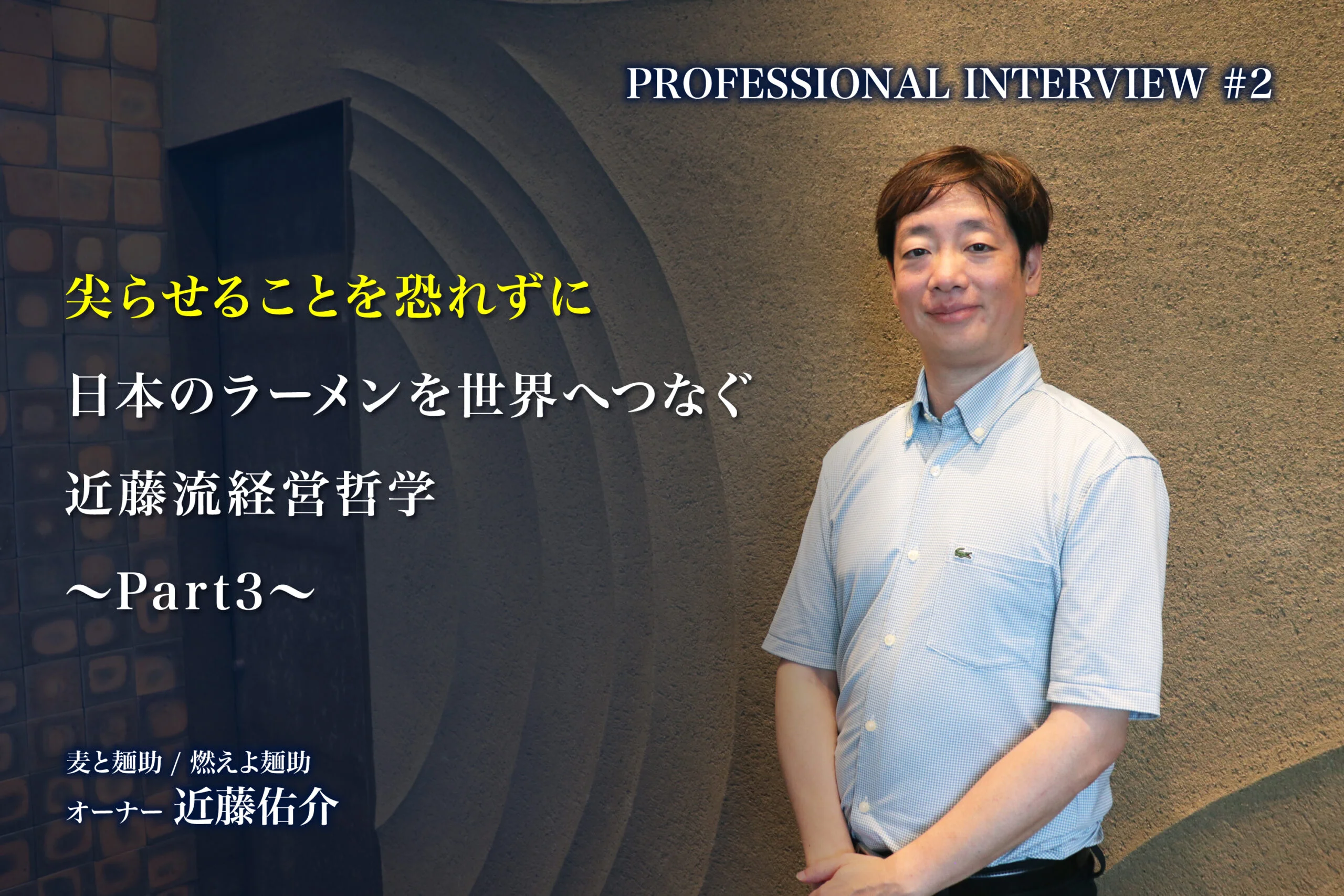
Connecting Japan’s Ramen with the World Without Being Afraid to Specialize
In Part 3, the final installment of this three-part interview series, we asked about the potential for global expansion of ramen as a Japanese cuisine, the breadth of collaborations leveraging his brand, his advice for aspiring restaurant owners, and where his ideas align with D-POPS GROUP’s aim of realizing a Venture Ecosystem. (This interview was conducted in July 2026.)
Be sure to check out Part 1 and Part 2 of this interview, as well!
◆Special Opportunities Guided by Encounters
Sugihara:
Let me change the subject for a moment. I heard you served ramen at the home of ZOZO’s founder Yusaku Maezawa, and that you were scheduled to serve Shohei Ohtani and Johnny Depp in Kyoto. I understand that the event itself was canceled, but could you please share a little about this story?
Kondo:
First of all, we didn’t serve Mr. Maezawa at his home, but actually at our restaurant. As for Kyoto, it was supposed to be a charity event attended by many celebrities, but it overlapped with the timing of the wildfires in Los Angeles. It was canceled because they decided it wasn’t the right time for a charity event. It’s a shame, as I’m sure everyone would have been delighted if we could have made it happen.
Sugihara:
I hear Mr. Maezawa has reached out to you again this year.
Kondo:
Yes. My criterion is always whether or not I feel excited about an opportunity, so I want to keep moving in directions that seem interesting. If you just keep doing uninteresting things, you can’t create good products, nor can you produce good results. I believe that when a leader finds something genuinely interesting, the staff around them will naturally follow.
◆“Authentic” Ramen Can Compete Globally: The Potential for International Expansion and Collaboration
Sugihara:
Thanks for sharing! Now, let’s shift to a global perspective. Sushi has already gained immense popularity worldwide as a representative Japanese cuisine. Recently, ramen is also increasingly recognized globally as a Japanese food. Although it originated in China, how do you feel about the potential for ramen’s international expansion?
Kondo:
Honestly, I think the potential is terrifyingly huge. Recently, I was asked to come and teach how to make ramen in Nairobi, Kenya, and I was seriously considering going. Due to vaccination requirements and my family being against it, I passed on it this time, but I personally really wanted to go.
Sugihara:
I would imagine ramen might be difficult overseas from an ingredient sourcing perspective.
Kondo:
Surprisingly, it’s not that hard at all; as long as you understand the underlying theory, you can do it. I believe it has that much potential, and it is an incredibly delicious food. The number of offers I receive from overseas chefs has been increasing, and I feel that when competing in the same price range, there are very few foods that can beat ramen.
Overseas, it’s not uncommon to spend a similar amount on what is essentially fast food. But there’s no contest between a 3,000-yen fast food meal and something like ramen, which provides a far greater sense of satisfaction. With its approachable price point and its simple composition of wheat noodles and soup that anyone can accept, ramen might actually be the strongest contender globally.
In fact, I’ve heard that Japanese chefs working abroad are increasingly being asked to “make ramen,” which often puts them in a tough spot. Since the preparation method is different from the perspective of traditional Japanese cuisine, it requires a complete reversal of their usual thinking, leaving many bewildered. That’s how unique of a culinary concept ramen really is.
Sugihara:
So, even among Japanese food, it stands out on a totally different level from soul foods like Japanese-style fried chicken or curry.
Kondo:
This ties back to the topic of authenticity versus imitation, but I really think it’s completely different. When you go overseas, you sometimes see non-Japanese people operating restaurants while claiming to be Japanese. Now, some cuisines can still work even if the preparation is slightly unrefined, as long as the ingredients and toppings are good, if ramen doesn’t taste good, then Japanese people won’t eat it in the first place.
That’s exactly why I believe that if we properly export authentic Japanese techniques, people will recognize that our food is unique. There are actually a lot of people overseas who want to learn how to make ramen, and I think the concept of running a ramen school is highly realistic. The possibilities are endless. In extreme terms, I wouldn’t be surprised if there’s a future where a ramen chain as ubiquitous as KFC exists in Africa.
Sugihara:
So there is that much demand. That is fascinating.
Kondo:
I personally want to do it, and I’m currently trying to persuade my family. However, I also feel that it wouldn’t be right to push a purely capitalistic corporate structure too forcefully, so I’m carefully considering how to balance that.
Sugihara:
How do you envision future overseas expansion or collaborations with other industries leveraging the Mugi to Mensuke brand?
Kondo:
If it sounds interesting, I want to try anything. Actually, at the end of this month, we are planning a collaboration with a French-style restaurant, and we also have an upcoming collaboration with a yakitori restaurant called Ishii which is said to be the best yakitori place in the Kansai region. Previously, we collaborated with the top-ranked pork cutlet restaurant Tonkatsu Noguchi. I want to absorb knowledge from those experiences and aim for one step higher—a level that other companies cannot easily catch up to.
Sugihara:
This perfectly aligns with what our President Goto often calls ‘hybridization’ and ‘complexification’. If you operate entirely alone, there’s a risk that your recipes could be copied and imitated. But when you step into collaborations, you forge a relationship based on the premise that “this partnership is only possible because it’s Yusuke Kondo”. That is what builds a network that cannot be easily replicated.
◆“Don’t Start Carelessly”: A Message for Restaurant Owners
Sugihara:
I’d like to hear your thoughts on the food and beverage industry. It seems like an industry where a massive number of restaurants open, but just as many close down. What is the most important thing for people who want to start a restaurant, or for current owners who want to survive in the long run?
Kondo:
I’ll start with the good news first. The level of food in Japan is incredibly high, so if you consider expanding overseas as an option, your survival rate will increase dramatically. Japan’s standard for “delicious” is far above what the rest of the world considers normal.
On the other hand, the bad news is that honestly, I believe the probability of a new restaurant surviving for 10 years is quite low. You should approach this with the understanding that nearly 90% of restaurants disappear within a decade. Many people start with a casual mindset, thinking, “I could probably run a takoyaki stand,” but if you enter the industry with that attitude, surviving will be extremely difficult. If you don’t commit seriously and truly brace yourself, it’ll be pretty tough to make it.
Conversely, if you brace yourself and work incredibly hard, someone will often be watching and offer a helping hand.
However, there’s no denying the harshness of reality. We proceed with a constant sense of urgency, constantly keeping in mind that while scoring 90 points is achievable, scoring a perfect 100 is incredibly difficult. The reality is that within three years, 60 to 70 percent of restaurants end up closing their doors.
◆Alignment with D-POPS GROUP’s Aim of Realizing a Venture Ecosystem
Sugihara:
D-POPS GROUP is a collective of companies that integrates actual businesses and technology together, a concept that we denote as “Real World x Technology x Synergy”. We are working to create a growth platform for startup companies that can provide one-stop solutions to businesses both inside and outside the group. Are there any aspects of this initiative that resonate with you or share commonalities with your own approach?
Kondo:
I see eye to eye with many of those aspects. Above all, I am particularly conscious of the concept of sharpening one’s edge. I strongly feel how detrimental it can be to aim for the so-called average, trying to be like everyone else. If you are going to start a business, I believe you must have the mindset of specializing in something. In extreme terms, you’ll be fine as long as you can break through exceptionally in one specific area, even if you’re somewhat lacking in other elements.
In fact, an acquaintance of mine who opened a restaurant has a brother with a highly unusual special skill. This brother apparently has spent countless hours of his life just sharpening knives. At first, he couldn’t do much besides sharpen knives, but because he had relentlessly honed that one single skill, Michelin-starred chefs started taking notice of his level of knife sharpening, and the restaurant grew at an unbelievable speed. Things like that actually happen quite often. To catch people’s attention, focusing on one specific area is often a faster route than trying to start with a high status everywhere.
The other thing is, of course, human relationships. Though this is somewhat repeating what I said earlier, humans are the ones who sell things; if you forget that, you will face painful consequences. We may be living in an era where goods can be ordered online and delivered without ever seeing a person’s face, but the ones buying the products are neither AI nor computers—they are humans. I believe that is the foundation of all commerce and business.
Sugihara:
We also prioritize the strengths of the members in our group companies above all else, and we value treating our customers with sincerity, humility, and gratitude. Regarding our investments, we focus on businesses that have a tangible, real-world presence, and we place the highest importance on the character of the individual and the management. When you operate that way, you look around and realize that the peers in this ecosystem are all wonderful people. It’s not always smooth sailing, but I feel that it is sustained by a spirit of mutual support.
Finally, could you share a message with our readers? Our audience mainly consists of professionals like executives and entrepreneurs, and many of them read all of these interview articles together at the start of their week.
Kondo:
Something I felt recently when traveling overseas is that one of the reasons Chinese people can form living communities anywhere in the world is their overwhelming sense of cooperation. If one of them is in trouble, they help each other out. On the other hand, I heard a story about some Japanese diners that didn’t get the news about Toyota relocating from Los Angeles to Texas, and they got left behind when the factory moved.
Hearing stories like that makes me feel that we, as Japanese people, should unite a bit more. I’m not in a position to preach, but I want to help if there’s anything I can do, though until now, I’ve overwhelmingly been the one receiving help. So for that reason, I strongly feel that if Japan can face the world with a united front, it will lead to a path of revitalization.
Interview conducted by D-POPS GROUP’s advisor Genta Sugihara.
【Mugi to Mensuke】
Owner: Yusuke Kondo
Location: 3-4-12 Toyosaki, Kita-ku, Osaka-shi, Osaka
Established: May 19, 2018 (sister restaurant “Moeyo Mensuke” established in Fukushima, Osaka, in April 2016)
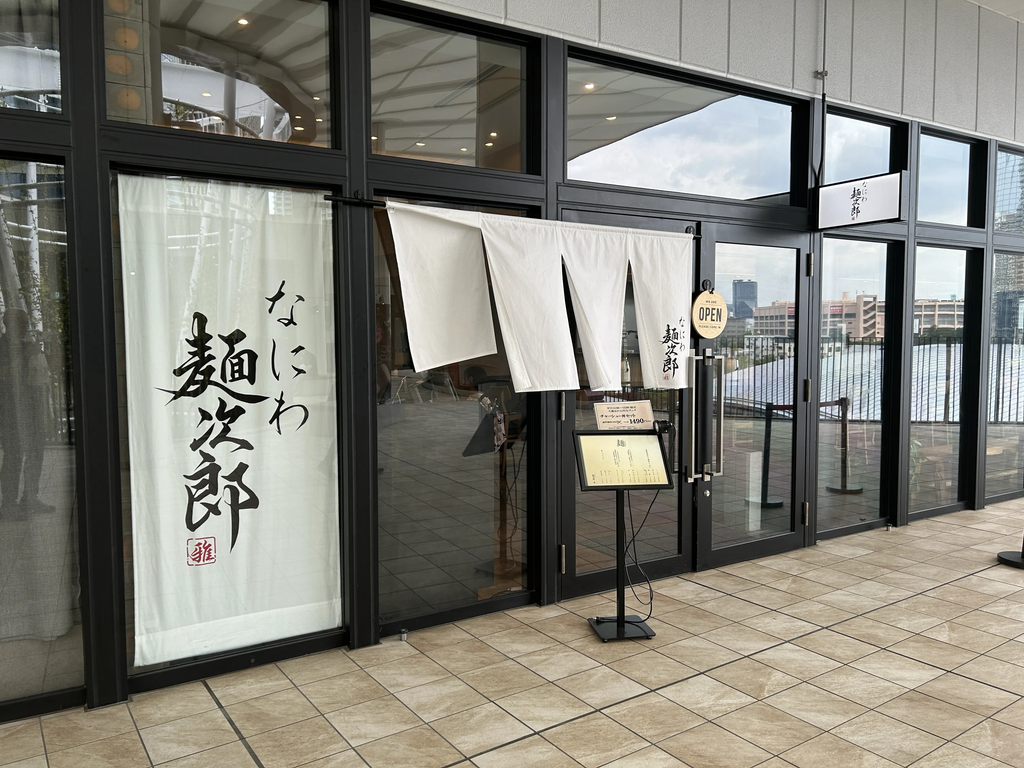
Sister Restaurants: Moeyo Mensuke (Fukushima, Osaka), Naniwa Menjiro locations (Namba, Osaka, and Umeda, Osaka)